
How to Improve your Octaves on the Flute
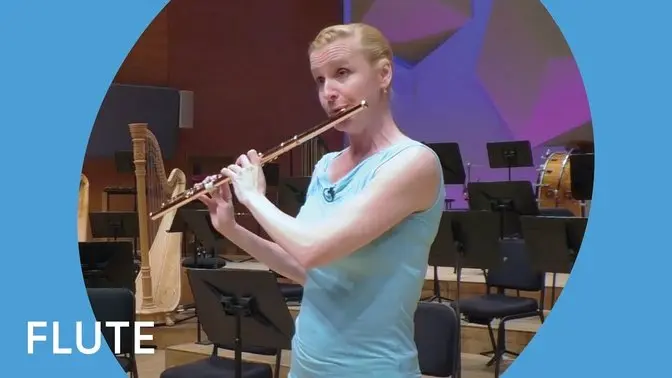
#Education #music # instruments # Flute # Orchestra # instrument demonstration
Hi, it's Amélie.
Today we're going to answer a question about octaves.
An octave is an interval that is eight notes apart from each other.
So let's say you play a G and then you play another G an octave higher, it goes like this.
In order to play an octave, if you're going up, you'll need a little bit more airspeed
and you might want to use your muscles here to push a little bit forward when you go higher.
But really it's so little, really I would put more emphasis on the airspeed and also
be careful not to send the air too high because your flute is under you.
So don't send the air like this.
It's like some people do this, you know, or they, or just keep it down, you know, and
there's not a big movement here.
Don't overdo it like this because then the angle won't be good anymore.
It's really about the air speed.
So you can go, I don't know if you can hear that I'm going a bit faster with the air.
You can put your hand on your belly and do ah, ah, and then ah.
But it's really, you can really feel it when you go higher, that the support is going higher.
So really try to start it from there.
You see, I'm not moving a lot here.
Basically, I don't even feel it, but I know there's a slight, slight movement when I look
in the mirror.
Sometimes people get scared of octaves or playing in the high register and then they
get all nervous and their bodies are tensed.
So it's difficult also to play the flute if you're all tensed.
And just visualizing yourself failing can be enough for you to not have the sound you
want.
So you should try to hear the sound you want in your head first and visualize yourself.
Stay calm, keep the energy low, don't bring everything too high in your body and that
will help you.
So I'll try to give an example of how people stress in their upper body when they, you
know they get all, and then you don't blow air anymore, you're just, you can't really
blow with control and being all, you know, closed here.
You need to stay open and go, you know.
Sometimes some people smile too much or, and it creates tension in the, around the embouchure
and that's also difficult to, to do if you're like this, but then all your sound will be
affected.
Try to keep everything as neutral as possible.
There's not that much movement, it's really from the air speed.
You can practice scales like this, so let's say I practice a G major scale, I can do it
like that.
So that's a way to practice it and you can change the scale every time.
You can also, after a while, when you get more comfortable, do it in a chromaticism.
I practice it like this, so I go all the way down.
I start from a B, and then I go B, B, B, and then B flat, and then A, all the way down,
and then when I hit the low B, let's say I, I go from low B and I go back up.
And I go all the way up to high C, and then I go back down to my first B.
Remember, when you play an octave, to fill it up with air, you really need to blow as
if you were blowing between the notes, you know, you're trying to fill up the gap.
Even any, any big interval, bigger than a fifth, I would say, you really need that air.
Well, when you play the flute, you always need air, but really think about it when you go...
As flutists, we tend to overanalyze our embouchure, but really the big,
big part of playing the flute is the air.
So remember to support, to use airspeed and try that and see how it helps you, if it helps you,
and leave your comments and suggestions in the comment box below.
And if you like the video, please like it.
If you haven't subscribed yet, please subscribe and see you next time.