
Tonguing Techniques 👅 [for FLUTE]
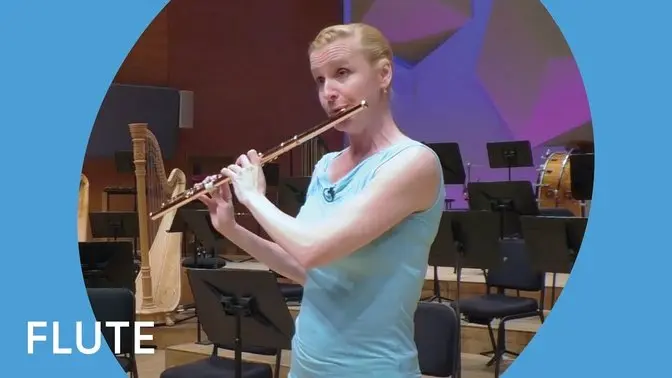
#Education #music # instruments # Flute # Orchestra # instrument demonstration
Comments are disabled for this video.
Hi everyone, this is Jasmine Choi.
I've been performing flute for many years at concert halls all around the world.
And over the years, one of the most asked questions to me was, how do I tongue so fast?
So I wanted to show you guys today all different techniques of tonguing on this instrument.
And hopefully at the end of this video, you'll be able to improve your own tonguing technique
as well.
So let's get started.
So the tonguing techniques on flute is like when we talk, we need our tongue to pronounce
certain things.
Otherwise, our talking would be only vowels.
So we need this articulation to pronounce and express better on this instrument.
Before we get into the single tonguing first, we actually learn without the tonguing when
we first learn the flute.
So we learn...
So only vowels.
Once we can make certain sound and note, we learn this tonguing technique called single tonguing.
How we learned was pronounce like what we taught.
So TA or DA, TA, TA, TA, TA, TA.
My very first piece that I learned when I started the flute was the Andante from Wolfgang
Amadeus Mozart.
And it goes like...
So without the tonguing, TA, TA, TA, TA, TA, it would be all slurred.
So that was the single tonguing, TA, TA, TA, TA.
But then when I moved on to the next piece, which was Handel Sonata, something like that,
I couldn't do it so quickly with single tonguing in that tempo.
My teacher taught me this other technique called double tonguing.
Double tonguing means TA, TA, TA, TA, TA, so you are able to do this articulation quickly.
So instead of me doing TA, TA, TA, TA, TA, now I'll be able to play TA, TA, TA, TA, TA.
Of course, to get to that tempo, you need a lot of practicing.
That was the double tonguing introduction to me.
But then of course, there are other thousands of pieces that requires double tonguing in
all different speeds.
So later on, I was able to play more complicated pieces in faster speed.
And for those of you who is learning the flute or majoring the flute and asking me how to
play the double tonguing faster, it comes in from the slow practicing.
Don't despair when you don't get better right away.
I have spent so many hours every day practicing and learning more about the tonguing and articulation.
It paid off, I would say.
But those of you who are looking for more inspirations, there's this app called Tonic
that I've been using.
You can find your music friends from all over the world.
You can open your own practice studio and people will come in and listen to you, give
feedbacks and advices and you can ask questions and so on.
If this is something that interests you, you can also download for free and join this practice
community using this QR code or from the link in the description below.
Moving on to the other pieces of the double tonguing, I will go by the speed.
There's Midsummer Night's Dream.
So it's ta-ka-ta-ka-ta-ka-ta-ka-ta-ka-ta-ka-ta-ka-ta-ka-ta-ka-ta-ka-ta-ka-ta-ka-ta.
Moving on to the slightly faster tempo.
Faster one, which got me practice so much in my teenage days especially, it's the Volière,
means birds from the Saint-Saëns' Carnival of the Animals.
There's also Tchaudash, something like that.
Now that we covered the single tonguing, double tonguing, and you might think the triple tonguing
is gonna be super fast, even faster than the double tonguing, but actually it's not necessarily
so, because we use the triple tonguing more in the purpose for making the triplets sound
more like a triplet.
Let me explain to you with an example.
Ta-ka-ta-ka-ta-ka-ta-ka-ta-ka-ta-ka-ta-ka-ta-ka-ta-ka-ta-ka-ta-ka-ta-ka-ta-ka-ta-ka-ta-ka-ta-ka-ta-ka.
So that the triplet sounds like ta-ka-ta-ta-ka-ta-ka-ta-ka-ta-ka-ta-ka.
As you can see, ta-ka-ta-ta-ka-ta-ka-ta.
So there is a repetition of the single tonguing in between every triplets.
That could slow down your tempo.
I mean, if you can do it really quickly, it could be but then if you do your double tonguing
quickly, it's going to be so much faster.
Triple tonguing is more for the triplet sounding more like a triplet, not like diggah diggah
diggah diggah diggah, when it should be sounding like diggah diggah diggah diggah diggah diggah
diggah more, 3 and 3, than 2 2 2.
So that was the introduction of single tonguing, double tonguing and triple tonguing.
And you might think, okay, what's left?
And in our modern flute techniques, there has been a lot of more interesting techniques
on the tonguing.
We flutists actually use the actual pronunciations in our talking while playing the flute.
Oh my god, how interesting.
If I put the P pronunciation on the flute, it would be...
And if I put more pressure on it, it could sound like a beatbox.
If you put the pronunciation S or CH, there's a tonguing called slap tonguing.
Instead of da-da-da, you can do...
So you put your tongue on the ceiling of your mouth and put a lot of pressure before you
pronounce da-da-da instead of da-da-da.
And it depends on how strongly you do or lightly you do.
If I play it with a very light touch, it could sound like a string pizzicato.
Something like that.
There is this piece called Zoomtube from Ian Clarke and in the middle of the piece it goes...
And you can do something like...
This I just invented.
I don't know how that's called.
And finally, if all you care is about speed, there's one more tonguing technique that's
left, which gives you the fastest articulation ever.
The flutter tonguing.
So the flutter tonguing has been one of the standard flute techniques over the years and
it's been used very widely.
For me, in the very beginning, learning the flutter tonguing didn't come very easily because
in Korean language, the rolling the tongue doesn't exist.
So this was something completely new.
I was in a school bus trying to get this technique and then I remember this excitement finally
getting it on the flute.
If you're looking at the fastest tonguing, it could be also...
But then it's also about your fingerings.
You have to also follow with your tonguing speed as well.
So that's it for all different kinds of tonguing techniques on the flute.
I know it wasn't so in-depth, some of it, but if you guys want to know more about certain
things that we covered today, please comment below and we'll delve into it in the next
video.
And in the meantime, if you guys are curious about some of the extended flute techniques
that I covered before, please check it out here and here.
And I hope you guys enjoyed this video and I'll see you next time.
Bye!