
Give Me 9 Minutes, I’ll Save You 20 Years Of WASTED PRACTICE
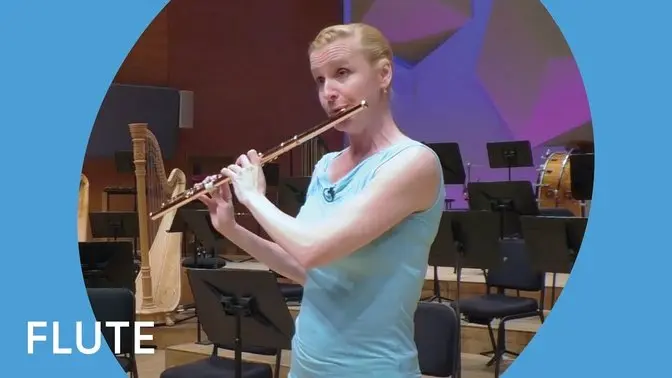
23 Video Views·Jul 15, 2026
Video Summary
AI GeneratedThis video provides five immediate techniques to improve flute tone, focusing on physical relaxation, air direction, posture, air volume, and lip moisture to help players achieve a rich, resonant sound.
It can be frustrating to keep working on your tone for months and months and not seeing results.
There are five things you can do right now to instantly get a strong focus tone,
and the last one is a little weird, but it's my favorite of them all.
Tell me if your tone sounds like one of these examples.
Or...
These are all things that can be fixed, starting with making sure your lips are not too firm.
If your lips are too firm or tight, the air can't escape your mouth,
you need to make sure your lips are nice and relaxed to the point where you have almost no
embouchure at all. Then you're going to start blowing and gradually increase the tension in
your lips until you start to get a sound that you like. Then you're going to take a breath and try
to go right back to that shape of your lips immediately as opposed to gradually getting
there. Then you're going to do that as many times as you need to to get your lips nice and relaxed
to the point you're getting that tone that you like. You may have to do this on several notes,
but it's all about making sure that you're getting the shape relaxed and not too tight
in the corners here. You also want to make sure your air is blowing in the correct direction.
Your airstream should be splitting the embouchure hole, so about 60% of your air goes in and 40%
of your air goes out. So as you're blowing across it like this, some air is going into the flute
and some is going out. You need that 40 to 60% ratio to make sure that the right amount of air
is getting into the flute. If your airstream is aimed too high, the sound will be thin and airy.
If you aim too low, the pitch is going to be flat and it's going to be airy.
In order to aim in the right direction, you're going to do really tiny movements with your
chin going forward and back as well as kind of up and down. So it's going to go in a
diagonal movement, not just forward and back and not just up and down, but kind of forward and up
or down and back. To practice this, you're going to hold your hand out in front of you about six
inches and you're going to blow up and down, changing the direction with your jaw going
forward and back. You need to make sure that your head is not going up and down. Your head should be
still. I can feel my air in my arm moving up and down like this. It's not going to be a single
kind of laser. It's going to feel more like a wide stream of air, but you should feel it going up and
down and notice how my head did not move. Now we're going to try that on the flute to see where
the tone sounds the best. In general, for higher notes, your air needs to be aimed higher and for
lower notes, your air needs to be aimed lower. Almost like if you connected the dots of the note
heads on your piece of music, that's the shape that your airstream would be making as you play
the notes. That's a big generalization because when we start to move fast, we can't move for
every single individual note, so we have to do more of a gesture with our notes like this.
You can really see this very clearly when I change octaves because I'm going to be moving
my chin even more because I'm going a very large leap. So I'm going to play some octaves for you
and you're going to see my chin moving forward and back. You also want to make sure you're sitting up.
Bad posture can really affect everything. When you lean forward, you're compressing your abdomen and
your lungs. You're making your throat tense, so make sure you're standing up straight with your
shoulders back. A lot of times we think about just pushing our shoulders back like this, but instead
if you think about lifting from your heart, that's going to help get you in a much better position.
Make sure your chin is parallel to the floor. You don't want to be down or up. We always bring the
flute. What I mean by that is we bring the flute here, not... Let's practice that a couple times sitting still.
You also want to make sure that your music stand is high enough so you're not having to look down.
Your music stand should be at about eye level and you should be tracking your music with your eyes
as you go down the page, not moving your head. So the stand needs to be up high enough that you can
see the bottom part of the page without having to move your head down and you can just look with
your lips. I like my music stand to be about an arm's length away. That gives me enough space to
be able to see the entire sheet of music without having to move my head. You can move it closer or
further away depending on your needs with vision. Some people like to have it really close, some
people like to have it far. I have a student who used to have really thin glasses and if the music
stand wasn't at the right distance, she would look down at the bottom of the page and actually be
looking under her glasses so she couldn't read the music. So you're gonna have to experiment with
the distance. The distance doesn't matter as much as the fact that you're not moving your head up
and down as you're reading the music. So try standing up tall and look up and down. A big thing
that flutists struggle with is making sure that we're using enough air. We lose 40% of our
airstream across the embouchure hole, so we need to make sure that we're blowing out enough air
that the air is going into the flute in addition to the air that's going out across the flute. When
we don't use enough air, our tone is often weak and flat. A lot of times, when in doubt, use more
air. It fixes a lot of problems. If something doesn't seem to be working right with your fingers
in a fast passage, use more air. Sometimes when we're nervous about a fast passage, we don't
realize that we're letting up on the air and the fingers are actually there, the coordination's
there. We just let up on the air. If our tone isn't like we want it to be, try more air. Tone
sounding airy, use more air. Believe it or not, the solution to an airy tone a lot of times is
more air. I'm going to demonstrate by using a small amount of air. You're going to hear how
the sound is very quiet, it's not carrying, and it's not resonant. Now when I use enough air,
the tone is rich, it's vibrant, it fills the room, whether it's a tiny room or a huge concert hall,
that sound is getting out to the back of the hall.
And the last thing you can do to help your tone is the weirdest and my favorite of them all,
licking your lips. It's my favorite because when I tell my students, like,
this may sound weird, but just try licking your lips. They lick their lips and they play and it's
instantly better. The reason this happens is your air needs a smooth surface to glide across when
you're playing. So if your lips are dry or especially chapped in the winter season,
the air is going to take the path of least resistance. So if you have a crack in your
lip, it's going to go that direction. Or if your lips are dry, it's just going to spread out as it
comes out of your lips. So licking your lips gives a smooth surface for the air to come across,
kind of like the Zamboni in an ice skating rink. They use it when the ice has been skated on
enough that there's dips and divots in it that it becomes unsafe to skate on. So what they do is
they drive it out onto the ice and it puts a very thin layer of water filling in those gaps
and making it smooth as glass again. Similarly, when we lick our lips just before playing,
it creates a smooth surface and makes it easier for the air to glide across your lips. I'm going
to play first without licking my lips and then with licking my lips. I love telling my students
this one because at first they're like, are you serious? And then once they do it, they're amazed
at how much better the sound is instantly. This is a good time to briefly talk about chapstick
as well. Keeping your lips moisturized is really helpful for playing the flute. You can't really
play with chapstick on, but wearing chapstick regularly without the flute is going to help
your lips feel nice and smooth. So it's easier to get a nice tone, especially in the colder months,
using chapstick or something like Vaseline every time you go outside is really going to help keep
your lips in the best shape possible for playing the flute. And now that your tone won't hold you
back anymore, you need to know what to actually practice. Watch this next video where I break down
the perfect practice routine that'll transform your playing in weeks instead of years.