
Double Tonguing For Flute
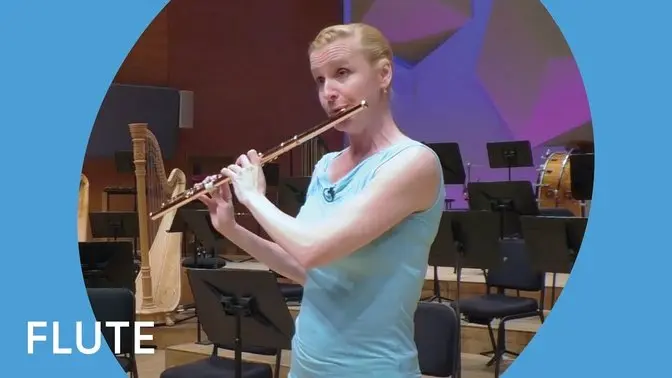
#Education #music # instruments # Flute # Orchestra # instrument demonstration
Comments are disabled for this video.
Hi, it's Amélie.
Today I'm going to talk about double tonguing and triple tonguing.
They're quite the same thing.
So it's pretty simple.
If you already have a good simple tonguing, you add the sound ka.
So you will go ta-ka-ta-ka-ta-ka-ta for double tonguing.
I would start by practicing the ka alone because that's a new sound that you haven't
used when you were doing simple tonguing.
So if I do it like this, it's ka-ka-ka.
The same principles apply as with the simple tonguing.
You keep a good airstream with good pressure and you don't move the lips.
You keep everything as stable as possible.
You can go like this and play a whole scale, ka-ka-ka-ka-ka-ka-ka-ka-ka-ka-ka-ka-ka-ka-ka.
Then when you're comfortable with that, you can go ta-ka-ta-ka-ta-ka-ta-ka-ta-ka.
I'll do a G major scale and I'll do each note twice, ta-ka-ta-ka.
So I do ta-ka on G, ta-ka on A, ta-ka on B, and so on and so on.
And eventually you will want to go a bit faster.
A good way to practice it is to practice it backwards and forwards.
So I would take a high C and go down semitones, playing each note four times, and I will do
ka-ta-ka-ta-ka-ta-ka-ta-ka-ta-ka-ta-ka.
So I start with ka-ka-ta-ka-ta-ka-ta-ka-ta.
I'll do it.
When I'm comfortable, I can go faster.
I go all the way down.
And then I practice with ta-ka-ta-ka.
I'll do it a bit slow first, and then I'll do it faster, and so on.
Once you master this, you can also do da-ga.
You can go a little bit faster and you can make it a more legato type of articulation.
So instead of ta-ka-ta-ka, you go da-ga-da-ga, and in the mouth, it's a little bit closer.
Da-ga-da-ga-da-ga-da-ga-da.
So I'll show you.
I'll do it one more time.
I'll do you the ta-ka-ta-ka, and the da-ga.
So you can use those different ways of articulating if you have different intentions when you're
playing.
And triple tonguing is quite the same thing as double tonguing.
The only thing is it's the same sounds, you just have to assemble them differently.
So you do ta-ka-ta, ta-ka-ta, ta-ka-ta.
So ta-ka-ta, ta-ka-ta, ta-ka-ta, ta-ka-ta, ta-ka-ta, ta-ka-ta, ta-ka-ta, ta-ka-ta, ta-ka-ta,
ta-ka-ta, ta-ka-ta, ta-ka-ta, ta-ka-ta.
I'll give you an example.
You can also practice it backwards, the same way you practice your double tonguing backwards.
So it would do ka-ta-ka, ka-ta-ka, ka-ta-ka, ka-ta-ka, ka-ta-ka, ka-ta-ka.
Instead of repeating the ta, you repeat the ka.
Ka-ta-ka, ka-ta-ka.
It's way more difficult, but when you master this, then the real way is much easier.
That was the ka-ta-ka, ka-ta-ka, ka-ta-ka.
You can practice tonguing even when you don't have your flute.
If you're waiting for the bus, if you're doing something,
and you can do it without people thinking you're too weird,
you can go ka-ta-ka, ka-ta-ka, ka-ta-ka, ka-ta-ka, ka-ta-ka, ta-ka-ta, ta-ka-ta, ta-ka-ta, ta-ka-ta, ta-ka-ta, ta-ka-ta,
and this way you just practice the movement.
You should start slowly and increase your speed gradually.
Use a metronome and write down what's the speed that you can master,
and then go a bit faster every day doing this exercise.
Personally, I practice both slowly and fast.
I have a little book and I write one slow tempo that I practice it at
just so I listen to the quality of the articulation
and then I have another tempo that's just to work on speed and getting faster.
If you found this video helpful, please like it.
If you have any questions or comments, leave them in the box below,
and if you haven't subscribed, please subscribe.
There are other videos for you to watch just right there.
See you next time.