
How to play in TUNE with your Flute
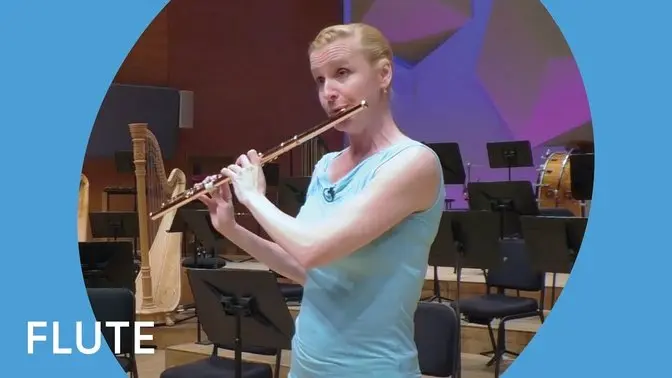
#Education #music # instruments # Flute # Orchestra # instrument demonstration
Hi, it's Emilie.
Today I'm going to talk about intonation and I'm going to give some little tips on how
to play in tune.
So the first thing to know is what are the tendencies of the flute.
So the natural tendency of the flute when we play in the low register is to be too flat,
so too low.
And when we play in the high register, the tendency is to be too sharp or too high.
Also when we play loud, it tends to be sharper.
And when we play softly, it tends to be flat.
Also at end of phrases, it tends to be flat, so we have to be careful with that.
So now that we know what are the tendencies of our flute, we can counterbalance those
tendencies voluntarily.
The first way to counterbalance the tendencies of the flute is to change the angle of the
air.
So to change the angle of the air, first when you send the air more out, your intonation
will go up, and when you bring it back in, your intonation goes down.
So I'll give you an example, I play a C and I go...
So when I turn it out, it becomes sharper.
When I turn it in, it becomes flat.
Then I can also just move my head.
So when I move it up, it goes higher, and when I move it down, it goes lower.
But the best way is to use my lower lip, my jaw, my chin, and when I move it forward,
it goes a bit higher, and when I move it backwards, it goes a bit lower or flat.
That's the best way.
I try not to use those movements too much, but I guess sometimes we kind of combine all
of them without noticing too much, but really I try to use the lower lip and the chin.
I want to specify that I'm not moving my jaw forward, I'm trying to do a natural movement
of just up and down, opening my mouth, because if you push forward, you might strain your
jaw and hurt yourself.
Then you have airspeed.
If you send the air faster, your intonation will go up, and if you send it slower, it
will go down.
So that's interesting to know.
If you stop sustaining the air, then your intonation will go down, and that's what happens
often.
And you can try this too, with just the speed of air, the intonation moves.
Then a good tool to use is a tuner.
I'm old school, I have a real tuner, but you can just put an app on your tablet or phone,
and you try to keep the arrow in the middle as much as possible.
That will help you, because some people don't hear it at first, that they are too low, too
high, but when they have the arrow, the visual aspect, they connect it to what they hear,
and then they're like, oh, that's how it's supposed to sound, and it helps a lot, especially
in end of phrases and some notes that are very out of tune, like the C sharp, the second
C sharp, this one, it tends to be very high, so if you practice with a tuner, you'll learn
how to counterbalance those tendencies of the flute.
So what you can do is play around with your tuner.
You can play some notes, just single notes, and bend the pitch to see, oh, that's what
happens when I bend the pitch, so you go like this.
Then you bring it back in the middle.
Try it with the air, just the air without moving your mouth.
Then you can play a scale, or you can play a whole piece with your tuner, and try to
keep it as much as you can in the middle.
I'll do a G major scale slowly.
I'm not saying that by playing in tune with a tuner, you're going to be perfectly in tune,
or you're going to be in tune with others.
That's not enough, but that's a very good beginning, and it's a good beginning to know
your tendencies, the tendencies of your flute, and how to counterbalance those.
I hope this was helpful.
If you have any questions or comments, just leave them in the box below.
If you liked the video, please like it.
If you haven't subscribed yet, please subscribe, and see you next time.