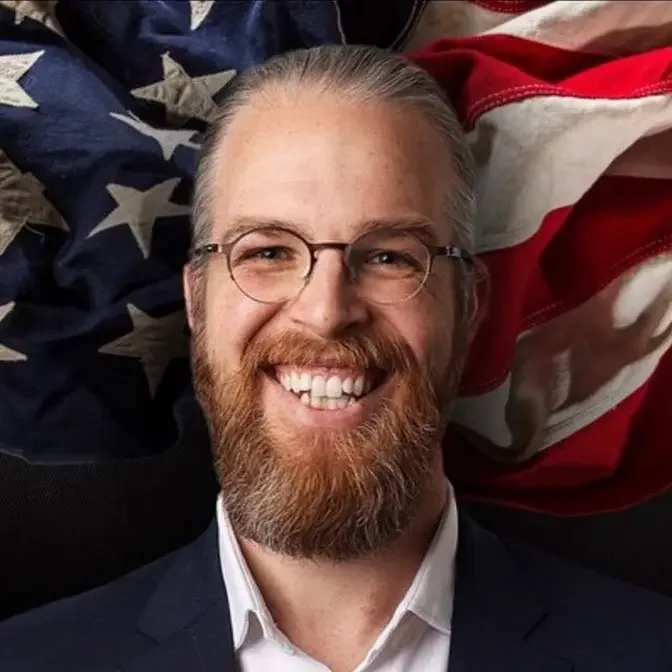
Ladies and gentlemen, welcome to Man in America. I'm your host Seth Wholehouse.
So we've witnessed here in America something I never thought I'd be seeing,
and that is the weaponization of our own agencies against we the people. If you look back in history
at Germany and look at the Gestapo, look at other regimes and their enforcement arms of the
government, you would have thought, gosh, that that would never happen here in America. Thank
goodness. But what we're seeing actually is the weaponization of these agencies against us with
the FBI as being the domestic agency being on the top of the list. And so joining us today to help
us better understand what's happening within the FBI, what their long-term goals are, how we can
resist what's happening, is an actual FBI whistleblower named Steve Friend, who's someone
that was fighting human trafficking and child pornography, but then got reassigned to domestic
terrorism to basically be watching over people like you and I. And that was where he drew the
line and decided to leave the agency and expose what's happening inside the agency. So folks,
enjoy this interview with Steve Friend. Steve, it's great to have you on the show. Thank you
so much for joining us today. Thanks for having me today. So you are what people call an FBI
whistleblower, which sounds like a dangerous title to be attached to. But can you give us
a little bit of background just with your trajectory within the FBI, where you kind of
started in doing child pornography and then being pulled under more domestic terror. And
what led to you then saying, hey, this isn't right?
Yeah, my path all sort of converged on this moment in my life. I spent my first seven years in the
FBI. I joined in 2014. And I was in the Midwest, in Iowa, and I investigated Indian country crimes,
violent crimes that happened on Native American reservations in Nebraska. And as a result of that,
I got very familiar with the FBI's DIOG, the Domestic Investigation Operations Guide. That's
the rule book. I opened about 200 cases. And then after seven years, relocated to Florida,
and to my currently still am in Daytona Beach area, and took the transfer with the understanding I was
going to work on child pornography and human trafficking cases. That was in the summer of 2021.
But as the government fiscal year ends on September 30, they were going to rejigger
manpower. And I was assigned to work on domestic terrorism cases in my office,
starting in the new fiscal year, so in October of 2021. So it was in fiscal year 2022. And that was
the first opportunity that I had to look into anything pertaining to January 6 from an
investigator standpoint. I mean, obviously knew and was familiar with the incident,
but hadn't had a case file in my hand. And when I saw what the FBI is doing with those cases,
it was very apparent to me from my experience that there's a major departure from the way you're
supposed to manage cases. And I also became concerned that the FBI was using some very
aggressive measures to bring people into custody. And I thought that that presented a risk to their
public safety. And then just looking down the pipeline at what's gone on within the District
of Columbia, when these folks do go and face the jurors and judges, I have a due process concern
with that, as well as a cruel and unusual punishment with the fact that the process
has become a punishment for a lot of these people. So those were all my concerns. I never really,
in my mind, thought this is the day I'm going to become a whistleblower. I just went to my boss's
office on a Friday afternoon and was like, hey, Greg, can I talk to you? And that was a protected
disclosure at that point. And that's when I entered this portal that I have been living for
almost a year now. It's interesting looking at the FBI right now. Growing up, we are always shown
the movies of the FBI agents, the CIA agents, and they're the ones that are taking down the bad
guys or finding the kidnapped people. And you have this perception of them. But if you look back in
history at some of the other, say, alphabet agencies that existed within different countries,
like the Gestapo, for instance, or the modern day in China, they have an office called the 610
Office, which is a particular office that basically has power beyond the other offices
or beyond any governance. They almost have free reign and unlimited budget. Their specific
responsibility is the persecution of Falun Gong, this meditation practice that they've been tasked
with infiltrating and destroying at all costs, basically, all torture methods. And that's
modern day communist China. But again, going back in history, looking at the Gestapo, as I mentioned,
you look back on it and think, gosh, that was so evil. And the people must have known what the
Gestapo was and how bad it was. But I imagine there was a lot of propaganda at that time
that was saying that, okay, these people are here for good because they're going to help
and protect you from the bad elements in our society, etc. And so bringing us up to modern day,
I never would have imagined growing up that I would look at an agency like the FBI and think,
gosh, is this kind of like a modern day Gestapo? Is this an arm of our government that's being used
and weaponized against the citizens of the United States? And so from being on the inside,
is that how you would describe what's happening to the FBI?
You know, I think that the mask has fallen away more, but I think you can make a case that the
FBI has always been this extra constitutional organization, just from its very origin story,
where you had Attorney General Bonaparte just get a bunch of guys to go investigate. There was no
congressional authorization for that, and they were doing the work that he instructed them to do.
And because of that and its history, there's occasion that the Venn diagram for what the
FBI is doing might overlap with what you in popular culture think or just in general as
being a supporter of a constitutional republic believe are within the mission of an objective
force for good. And if you look at the FBI's actions to stop organized crime or to pursue
communism and terrorists that are legitimate, then you say, oh, well, the FBI is doing the work of
the American people and upholding the rule of law and protecting our constitution. But
then the FBI has its history where it went after Martin Luther King Jr. and used cointelpro to
essentially try to get him to commit suicide. And they chased after draft dodgers during Vietnam.
That was certainly very contentious. And if you look at the history, I think you can make the
case that the FBI has always been about preserving status quo for whoever is in charge. And if the
people in charge want or have a perception of an enemy, then the FBI is happy to do that. It's a
government bureaucracy, and they aim to please. If you ask for something, you will get more of it
and bring us to the 21st century, where this new national security branch has been
expanded after September 11th and the mission creep that went along with that, where
early in the 2000s, certainly folks on the left side of the ideological spectrum were saying,
the FBI is entrapping Muslim Americans, that they're vulnerable people, and they're not
predisposed to commit any sort of violent action, but the FBI is targeting them and persecuting
them. I think a lot of people at that time were still very much wrapped in the American flag and
the Patriot Act was okay, and just said, no, no, they're all bad. But come forward now 20 years,
and then the FBI has evolved its target and is now going after domestic violent extremists.
And those are people that the president himself has said are anti-government and white supremacists.
And I think that that's just the latest evolution of what the FBI sees as its target. And it's
tarnished the reputation now more so because of social media and the proliferation of information
as far more possible. When I joined the FBI, one of the first things they said was our reputation
is one of the most important things we have. And you'll have to correct me if I'm wrong,
I believe that they said the FBI is the third most recognizable symbol in the world. I think
you have Disney, the Nike swoosh, and then the FBI. And the agency can't function without its
reputation. I've called people on the phone and gotten very personal information from them just
by saying I was a special agent for the FBI, and they trusted me. But I think that those days might
be soon at an end for this bureaucracy. And I agree that there's been really an awakening.
So I think COVID triggered a lot of it. A lot of folks I speak with, that was the moment when
something about the comfort and that bubble of what America was broke. And they said, wow,
the world that we're living in, the country I thought that I was living in is not that country
anymore. And a lot more people are seeing this. And we have, say, Tucker Carlson. Now, obviously,
he's on Twitter and his shows are getting tens of millions of views. And he's openly talking about
the truth of what happened on January 6th, whereas he was probably limited. We know he was limited as
to what he could speak about when he was on Fox. And so you're seeing that there's that, yeah,
through the social media and people doing what I'm doing, independent producers of content,
that there's an acceleration of information. And again, looking back in history, the regimes that
were targeting their own citizens, they always had the most power when they controlled the
propaganda and controlled the narrative. And a lot of times when the citizens didn't really
understand what was really happening to them. And it's the destruction of that narrative,
I think, that oftentimes led to the collapse of those regimes, but also led to those regimes
becoming more desperate, more erratic in what they're doing to maintain their power.
And so looking at where the FBI is and seeing this trend like you're talking about of
its reputation is now really getting hit, or I think now your average American's like, yeah,
they're FBI is a terrorist group, right? They might think something like that. Do you expect
or do you see any indication that the FBI's actions will get more and more embracing and more
just erratic? That's my fear. I think that they are not self-aware at this point.
They're so in the bubble from a leadership standpoint in Washington, D.C. And the fact
that the management structure in the FBI is so broken where people have to make that pilgrimage
back and forth to Washington, and they just can't help but imbibe that.
You look the most last week, the FBI had itself a week. You had Charles McGonigal, who was in
charge of the New York counterintelligence branch and is going to be pleading guilty to taking money
from foreign actors. You had Christopher Wray, who's now been proven to have lied about the
radical traditional Catholic memo where he said it was limited to Richmond field office. But in fact,
they were working with Los Angeles and Portland. You had Elvis Chan, who's now been proven to be
lying about the FBI's involvement with Twitter. You had Jackie McGuire, who was a special agent
in charge of Philadelphia and authorized the raid of Mark Howe when he said he would surrender
and was also involved in a shooting inside city limits where she was walking her dog and her dog
got in to beef with another dog and she shot it. And she was elevated to executive assistant
director of training. So she's going to be giving guns to agents when she doesn't really know the
DOJ's deadly force policy. And finally, you had the raid that happened in Provo, Utah,
where there's a situation where the FBI introduced violence to a situation where anybody who was
reasonable knew that there were other less aggressive means and the things that I cautioned
about with January 6th. That happened in one week for this agency. And there's just not any
self-awareness here. There's no people that are in a position of authority that look in the mirror
at any given point and say, am I the bad guy? And the agency can't exist as a going concern or
certainly as an objective force for good if it continues down this path. Got a quick message for
you. So folks, thank goodness inflation is going down. Thank you, Biden. But wait, if inflation is
going down, then why are food prices going up, energy prices going up and gas prices going up?
Well, because they're lying to us. Imagine that. You see right now, the real rate of inflation is
closer to 25%, not the 5% the White House wants you to believe. You can see this with your own
eyes and your own wallet. What this means is that if you had $100,000 in your savings account just
one year ago today, it's only worth about $75,000 in terms of your actual buying power. Your money
is losing value by the day. If you went back to 1920 and you had a $20 bill or a one ounce gold
coin, you could walk into a men's clothing store and buy an entire suit, jacket, shoes, pants, belt,
everything. But think about it. What would a $20 bill buy you today? Maybe some socks? But an ounce
of gold will still buy you that same suit. And this is why I believe that now more than ever,
it's a good time to consider transferring at least a portion of your wealth into physical
gold and silver, real world assets that have stood the test of time. And for this, I'm confident in
recommending Dr. Kirk Elliott. So Kirk has two PhDs and is an incredible Christian patriot who's
dedicated to helping you break free from the trap of inflation. You can buy gold and silver directly,
even in small amounts, or you can transfer your IRA into physical gold and silver with zero taxes
or penalties. So Kirk is who I use. He's who my family and my friends use. And honestly, he's
someone I trust completely. And when it comes to your wealth, you need someone that you can trust.
So to learn more, open up a new tab right now and go to goldwithseth.com or call 720-605-3900
to speak to a real person right now. Kirk Elliott's team will answer all of your questions and take
care of you every step of the way. And looking at the agency as a whole is, you know, now if,
for instance, let's just say that if someone knocked on my door and I opened it up and they
had an FBI badge, I would first be concerned. Like I wouldn't think this person's on my side.
Like I would, you know, again, maybe 10 years ago, perhaps I would. Maybe they're looking for
somebody and they need my help or whatever it is. But now I would almost certainly think I'd have a
negative view of them. And knowing a lot of the agents that are in the force, would you say that
anybody who works for the FBI is, you know, is kind of corruptible or is bad? Or is it actually
there's a lot of good people still trying to do right, yet there are some really bad actors and
some control mechanisms in place that are really controlling the overall organization and having it
actually play a negative role in our nation?
You know, I've kind of grown tired of issuing the qualifier that there are some really good men and
women at the FBI. I think there are. I know some of them. But here's my problem. We all got the
same training. We all took the same oath. The training we went to was the Holocaust Memorial
and the MLK Memorial. And we learned there that it is incumbent on you as a member of this
organization to throw the flag if you believe that there are abuses going on, because just
following orders is not acceptable. And I don't think it takes very much critical thought to look
around and think the FBI is not doing the right thing. And you can delude yourself and say, look,
I can do so much good. But at the same time, the bureau itself is off the rails and there's no
amount of good that you're going to do that's going to overcome the civil rights abuses that
we've seen and the due process abuses. And now there's an actual risk to public safety for the
way that the FBI is doing things. And you can delude yourself and say, well, I have to feed my
family and I have bills to pay. Well, you're compromised at that point. The oath does not
guarantee you wealth. I didn't join the FBI to become a rich man. I certainly benefited from the
compensation I received, but that didn't entitle me to that. And I don't have a lot of sympathy for
that. I sort of come around to say I'd rather my kids be hungry than morally bankrupt because of
the standard that I set in my household. And then to your original concern, if an agent knocks on
your door, you doubt if they're up to something, if they might be a nefarious actor. The days are
not long before your sentiment is shared in a jury box and the FBI charges somebody. And it doesn't
matter what they're accused of being. The assumption is going to be that the FBI planted evidence or
contrived this case and then the FBI can't do its job. And that is a direct result of it's the boy
who cried wolf. They've just messed up too many times and the public is not going to take their
word for it. When their word used to mean something, I used to be able to stand up on a stand and
swear that I would tell the truth. And everybody in that jury, well, he's an FBI agent. Everything
he said is the gospel truth. That's not the case anymore. Actually, it leads to a good question,
I think. You mentioned the case, I think, was it Utah? The older gentleman that was
even partially paralyzed was basically gunned down because they handled it, I think, very
inappropriately. So for people that are watching and listening, I would say that the folks that
watch and follow this show aren't necessarily your liberal Democrats, to put it tongue in cheek.
They're people that believe in the Second Amendment, believe in the Constitution,
are often as vocal about these things on social media or probably on some sort of list somewhere,
many of them. If someone's at home one day and they hear knock at the door and three FBI agents
show up and they feel maybe even threatened by their presence, what's the best thing to do in
that situation? Obviously, it's not to go get your gun and defend your Second Amendment,
but how should someone handle that situation? Well, I think, unfortunately, the FBI doesn't
give you the option to really think about it a lot of times because they show up at six o'clock
in the morning when you're dead asleep. And they do that for safety purposes. If you're going to
actually go and arrest a righteous bad guy, you want him when he's in bed and he's not necessarily
as big of a threat to you. But if it's middle of the day and you hear knock, knock at the door,
I told my wife, and I'm going to keep the same policy, there's no circumstances where I'm going
to speak to an FBI agent. And I don't care if they need me to be a victim of a crime or a witness or
a subject of the crime, because the way that the FBI has weaponized process crimes at this point,
where they contrive reasons to just have contact with you with the sole intent of hoping that they
can devise a way for you to lack candor and they can accuse you of lying and then charge you for
the crime, like they did to Michael Flynn, where there was sort of a false investigation.
And James Comey said, I'm sending the agents over there. And one of his deputies mentioned,
wrote it down, it's formally documented. He said, our goal here is to get him to lie so he can
charge him with a crime. My assumption at this point is that anybody from the FBI comes in my
door, they do not have good intentions and I'm not going to cooperate. And so maybe it's not
even opening the door is the best, because unless they show a warrant, they're not allowed to even,
they're not allowed to enter into your premise, is that right? Yes, I mean, they might have a
warrant. And if they're executing it, they're not compelled to have it in the first guy in the
stack, have it out for you to see for the people and that they're going to breach the door because
it's essentially an instruction from a judge to bring you into custody or to search your premises.
So you can do it peacefully and you open your door. But at the same time, there's no conversation
that you have to have. You're not compelled to cooperate anyway. You still, in the alleged land
of the free, you still do have a right to say, I'm not speaking to you before I have an opportunity
to consult with an attorney. I see. Okay. And there's something I want to, you kind of switch
topics and jump into. So you penned an article recently, this was published on the Federalist
and it's, I'll read the title because it's just interesting. I really want to hear your thoughts
on how you explain this. You say, it's time to disarm all FBI agents and return authority to
local law enforcement. And so, you know, seeing this headline, obviously it piques my interest
what's behind this. But when I think about all these IRS agents that are now being
armed as an example, and I think about the FBI being, obviously it'd be, I think it'd be great
to dissolve the FBI, right. Or just shatter it into a thousand pieces, right. In the words of
JFK Jr. talking about some of these agencies. So explain this solution, explain what you mean by
this. Yeah. Here's the idea that I've been noodling around with because I share your
sentiment. I'm certainly not a impartial observer of the FBI at this point or from my experience.
So I think you could chalk up anything I say to just sour grapes. But I believe that if you make
this change, which the Congress could actually do today, you would make the FBI a better organization
actually in performing the job that we expect of it. Not just we're going to nibble around the
edges and correct the leadership at the top. And you return the FBI to what it originally was,
which was an unarmed investigative agency. And you could use the Office of Personnel
and Management to do this and eliminate the 1811 criminal investigator, the special agent,
and make them an unarmed investigator. And then also through appropriations, say,
if you're going to investigate anybody, you must gain authority and authorization from the local
sheriff's office so they can sign off on that. And we're going to expand the effort,
which we already do. There's already a proof of concept where local deputies and police officers
who are detectives in their local areas get deputized to the United States Marshal's Office.
And they have been cross-deputized. So they have state arrest authority and now federal arrest
authority. And they will be assisting you on that investigation. They'll be the guns in the room.
So any sort of worrying about, well, how can I investigate crime if I'm unarmed? It's a safety
issue. Well, they'll be there and they're trained and they're experienced. And then when it comes
time to actually make an arrest, we'll do the same process. We're going to get authorization
from the local agency and there's not going to be an FBI SWAT team. It'll be a local agency
in what they use to bring somebody into custody, the best way to do that.
And I think that it makes the FBI better because my experience, the task force officers,
and these are the local guys who get cross-deputized, that's their title. They tend
to be some of the best investigators that the FBI has at its fingertips because they cut their
teeth as police officers on the street and they ascended into the detective's office as sort of a
proof of their ability to do law enforcement at the highest level within their agency.
Whereas a lot of folks in the FBI, instead, they have a background in foreign language or they got
a degree in law and then they just went to Quantico for 20 weeks and now they're thrust
into an investigator role and they have to learn that. The learning curve for that is pretty steep.
So many times in my experience, the task force officers are actually the most sophisticated and
superior law enforcement personnel in the room. So I think that the FBI will benefit from their
expertise and the agencies that know what's going on and they know the usual suspects and they know
the crimes that are plaguing their areas will be able to direct the FBI's focus to those areas as
opposed to what it does now. And this is a separate concern that I've brought forward.
The FBI has a quota system where they are given marching orders from headquarters and they're
told you have to open up a certain number of cases on a particular violation and get a certain number
of arrests there. Well, that's not serving your local community necessarily. The prime directive,
I argue, for the FBI is to serve the local agencies that maybe are cash traps and don't
have the resources, but they certainly have the know-how. And if you make that change,
I think it creates a bulwark between an out-of-control politicized FBI and the local
community because the sheriff is more accountable. It's the doctrine of the lesser magistrate. He can
stand there in the gap and protect his constituents from the overreach from the federal government.
And I'll end with this. It's very analogous to the origin of the way that the
senators were originally chosen in this country before the 17th Amendment.
They came from the state houses. And the rationale for that was to make the federal
Senate more responsive to the needs of these states. Here again, we'll be using local personnel
for the federal law enforcement agencies, and that will better serve the populace.
I see. So it's really, I mean, in a lot of ways, it's about going back to
what this country really should be as a constitutional republic, right? Where
the power is given locally. Because I think that you can't see the forest through the trees. It's
like after a few generations of living in a cage, that's all an animal understands as being life.
And so after a few generations of us seeing the power that the federal government has over our
day-to-day lives, we've gotten used to it and just think nothing of it. Whereas if you were
to go back to 1776 and show them a snapshot and had the founders look at this and say, wait,
there's a federal agency that's arresting its citizens on behalf of orders given by the
president? That's the exact thing that we're fighting against. That's tyranny,
right? But now we've just gotten used to it. I would say that it actually puts the Third
Amendment into context. It's often forgotten because everybody screams about exercising
their First Amendment and the Second Amendment is there for self-defense and the Fourth Amendment
doesn't want to be violated and everybody invokes the Fifth Amendment. We all skip over the quartering
of soldiers. And I think if you put that into context, the soldier was a representative of
the state. It's not just because they were a member of the military. And then often in these
areas, you would have the governor basically be a brigadier general within the British military.
And that was the interface that the folks had with England. And if the FBI is basically working
with big tech and quartering soldiers essentially in your house because they're able to surveil you
at all times and inform back to their masters up at the headquarters buildings in Washington, D.C.,
how is that essentially any different than somebody being in your guest room with their
ear on the door as you're having a conversation with your wife when they can monitor your
direct messages on Facebook? That's a good point. That's a very good point.
One big question whenever I get a chance to speak to someone like you is to
try to understand, it's not always easy, but understand where the directives are coming
from. Because when we look at this and we look at the, as we discussed, how it looks like the FBI
is being used as a tool for the current administration to basically to persecute
their political enemies, to go after the people that are the racist, white supremacists, extremists,
et cetera. But in terms of where these orders are coming down from, do you think that the
corrupt actions and the corrupt behavior that we're seeing, is it a direct reflection of orders
coming out of the White House? Or have you seen any indication of foreign actors that have infiltrated
the FBI? Because I know that the Soviet Union, for instance, they probably had KGB that was
heavily influencing these types of agencies. China, the CCP, I know they've heavily infiltrated
our government. They've bought off a lot of our leaders, et cetera. So are you seeing that this
is just something that's coming from within our own government? Are you seeing any indication of
foreign influence in terms of, you're kind of asking a question of why would this agency go
after its own people? I can't really speak to any sort of foreign involvement here. I think that
though the corruption that we've seen, the rot within the FBI is derivative of a couple of
factors. And one is the broken management structure that exists, where if you want to ascend the ladder
in the FBI, especially if you want to get to the highest levels, you have to start that process
very early, about six years into your career. So you really are not an experienced investigator.
And if you are, you know one particular violation, that's about it. And then you start that process,
you have to keep continually going back to Washington DC. And in order to demonstrate
your proficiency as a management potential, you essentially have to invest, invent a solution and
look for a problem to apply it to, grow government. And I think that that's very self-selecting for
left-wing political ideology for people. And it's because they leave in their wake, people don't
listen to leadership. And then on top of that, they're supervising areas where they have no
expertise. So you have these people who are just going to follow what the rule book says, because
they are not critical thinkers, or they have a sympathy politically for what the FBI is doing.
And that's why you're getting a SWAT team order to go down to Provo, because I think that there's
the temptation there to say, I'm not going to be the leader who sends one or two agents to go
talk to him. When I can brief that up the chain of command that I use SWAT to get the person who
is making threats to the president, it briefs much better on the PowerPoint, if you're going to use
the tools at your disposal. So there's also a mentality that has permeated my experience,
and I saw this happen, where if you are from the outside, you think there's an agent who's
investigating a case. He's the case agent. He's calling the shots. He's digging through the
evidence and then doing all that that we see on TV and movies. And then eventually they get the
bad guy. Well, I think the FBI has now transitioned from case agents to case managers, and actually in
the software you're called a case manager. And a manager is different than a case agent, because
the manager moves the chess pieces around the board. The manager says, I need to do surveillance,
so I'll send the surveillance team to do that. And I need some financial analysis done, so I'll
have a forensic accountant do that. And I need to collect evidence, so I'll send the evidence team
to do that. And then they can send to a lab to do some of the analysis on that end. And eventually
when it comes time to do the arrest, they say, well, I'm going to send the arrest team. That's
off. They use all these tools at their disposal to justify having them. And that's why you see
these hyper and overly aggressive means used against whoever is their target. And the last
portion of that is because of the quota system exists, and they're trying to please the people
that are in charge at this point, they're going after conservatives. You look at what President
Biden said last year in September in front of Independence Hall. He said that Republican voters
were anti-government extremists and they were white supremacists. Those are two of the top four
priorities for the FBI's counterterrorism division at this point, because if you ask for it, you will
receive it from the FBI. All right, folks, I've got a quick message for you. I have one simple
question. If today you could no longer go purchase more food for your family, with the food stores
that you have in your home, how long would you be able to feed your family? Would it be a week,
three weeks, a month, two months, a year? This is a really important question, folks, that we have
to be very realistic about because the elites are proactively trying to put us into a state of food
crisis and a state of famine. I'm sure you've seen all of the different food processing plants and
farms that are blowing up. You've got cattle dying by the tens of thousands. They're proactively
trying to collapse our food system because they know if they can control our food, they can
control us. And so one of the best ways to be outside of their control is to be able to have
our own stores of food and to be able to produce our own food. So there's really two things I would
recommend. One is having heirloom seeds that you can grow your own food with, making sure that
they're non-GMO heirloom seeds, that that way you can harvest your seeds this year, use them next
year. You can use these seeds for generations. Literally, that's how it will work. The other
thing, though, is this high-quality, storable food. This is food that's sitting somewhere. It's
hidden in your basement, buried in your backyard, whatever it is. So that way, if there is a crisis,
if there is an emergency, you might have three months set aside to get through that time period.
And so for this, I would highly recommend a company called Heaven's Harvest. This is an
amazing Christian-owned, patriot company. And what they're doing is they're making high-quality,
storable food. Again, a lot of the food companies, they say these food buckets, they're all about
maximizing calories per dollar. They're filling the buckets with a bunch of filler and junk, like
sweet beverages, etc. But Heaven's Harvest, they focus on very high-quality food that will last up
to 25 years on the shelf. They also sell heirloom seeds. You can buy all of your seeds. You can buy
all of your storable food. And look, folks, personally, I would recommend having at least
three months per person in your household, if not six months or even a year. Again,
depends on your budget, but definitely make sure you have some seeds because those seeds could be
worth their weight in gold, if not more in the future. So to go ahead and do this right now,
go put up a new tab and go to heavensharvest.com. And if you use the promo code Seth, that's S-E-T-H,
promo code Seth, you'll save 15% off of your entire order. So again, folks, the time is running out,
and you'd rather be three months or one year early than one day late. Again, heavensharvest.com
and use promo code Seth to save 15% today. Thinking about all the terrible things that
are happening. I mean, you were involved in child pornography, human trafficking.
You've got Sound of Freedom that's gone viral in the sense of just blowing up the box offices.
And actually, I know that's just the tip of the iceberg, but considering all that's happening
and the target is some soccer mom that doesn't want her kid to be shown pornographic books in
the third grade library. I mean, it's just wild to think about. One of the questions I have
is the issue of false flags. This is something that I wasn't, growing up, you never heard of
what's that. But as I got researching a lot more, you start realizing, oh, okay, well,
this isn't new. This is part of the playbook, especially of more totalitarian regimes to have
false flags that you can use these events to then persecute your political enemies or to
start a war or whatever it is. Now, we're seeing all this different evidence coming out about
January 6th that the FBI, they had agents that were involved, and it's looking like
that there were elements of that that were absolutely what you call a false flag.
I've seen so many just questionable pieces of information about previous mass shootings or
different events that had happened where it's like, this just doesn't add up. Is that a crisis
actor? And there's these things that just don't really make sense. Or you look at some of these
groups. I think it's like the Patriot Front. It's like, where did these people come from?
These guys look like they came straight from the Fed. They all look the same and everything.
So from your perspective, what level of involvement does the FBI have in setting up
some of these events that then allow them to further the political agenda of their masters?
Here's what people need to realize. And we can keep this completely in a
surgical perception here of what's going, what goes on, and not assign any sort of
nefariousness. There's no evil guy with a cat in the back room who's pulling all the strings here.
I can just tell you from experience, the FBI's use of informants creates a lot of these situations.
And January 6th was a major example of that, but it's far from the only one. And that's how
politically charged. Let's take it to another one. The case that I actually was involved with,
which was the Gretchen Whitmer kidnapping, or they call it the Fed-napping at this point.
And a lot of these organizations are heavily infiltrated by informants. And the thing that
you have to remember is to be an informant for the FBI and to get paid, and there's a lot of
money out there available to you. But you have to provide good information back to the FBI. You
can't just go through the newspaper, as some of them do, and try to pluck out a story and say,
well, this is intel. And they'll infiltrate these groups. And in order to provide good information
back to their handler and get paid, they will actually push the group to engage in things that
it's not predisposed to engage in. And then the problem comes in when there's multiple informants
who infiltrate, which I think you definitely saw on January 6th. And you see from Patriot Front,
which, side note, Patriot Front, they don't do anything other than march around and look like
idiots. And yet they get so much attention just because it's an optics situation. There's not an
actual violent act that I can think of that they've actually participated in. But I guarantee you that
they're infiltrated heavily by the FBI. But back to Whitmer or any other case, you have multiple
informants. They don't work together. They're not actually aware that there are other people within
an organization that are informants. And if you and I, say, infiltrate a group of a militia,
and I need to report back to my handler, I say, hey, guys, we should do X. And then you think
to yourself, wow, these guys are kind of true believers here. Let me push it a little ahead
so I can have more information. Hey, guys, we should do X plus one. And then I think, wow,
these guys are really buying into it. They're pretty bad. Let's see how much we can do. And
then we keep one-upping each other. And as a result of that, everybody else in the room
just kind of follows along with what the informants are doing. So I don't think you can
even assign an intent other than trying to get paid and try to be productive. And now you have
a situation where, in Michigan, there were individuals who were very vulnerable, not
predisposed to commit an act of violence. And at one point where the group was breaking down and
was not going to commit any violence, yet the FBI wanted to justify its domestic terrorism budget and
have a high-profile case. And the informants wanted to get paid. And all of those factors
coalesced together. And we got this entrapment of these individuals who were accused of wanting
to arrest and assassinate the Michigan governor when, in fact, they were just a group of guys who
were mad about her COVID policies and were just going on tirades online. Yet the FBI saw them as
targets of opportunity. It's just crazy to think about. I'm sure perhaps you've seen the
Minority Report, where they're looking at future crimes. And they're arresting someone saying,
well, we saw that you were going to commit this crime in the future. And there's all kinds of
just gray areas and problems with this. It's not that dissimilar to what was happening with
Muslims in the country around the 9-11 bombing. I would draw everybody's attention to the Liberty
City Seven, who were still on record as the largest Al-Qaeda arrest in the history of the FBI.
Al-Qaeda wasn't involved in that case. The FBI did the same thing they did in the Michigan case,
where they got these guys who thought that they were small-time criminals. And they thought that
they were actually going to be gouging the guy who was the informant and then ripping him off
some money. And yet the FBI was playing them the whole time. And you had guys who were sent to
prison for, I believe, something like over 40 years in an Al-Qaeda plot to blow up buildings
that they were not going to do. They were just trying to grift themselves. And that was reported
on very heavily and has been recently even brought back by The Intercept. So hardly a right-wing
media source. And I think at the time, other than the Ron Paulites, the left-wing was screaming from
the mountaintops about it. I hope that at this point, as it's been revealed that the FBI is
going after a different subset of people, but still using the same tactics, that maybe the
left-wingers can take the W here. And we can actually come to some common ground and say,
look, we might not agree on the motivations for why the FBI is doing what it does,
but we can't argue with the results. And innocent citizens are being caught up in a dragnet here
because they want to check the box and hit their matrix. And it's kind of a combination
of Minority Report, where we're projecting crime that they could commit, with Moneyball,
because we've got to play the analysis. We've got to use the stats and justify our existence and
our ever-expanding budget. And it's created a perverse incentive within the federal law
enforcement, where a local sheriff gets elected to bring crime down. And if he fails to do that,
he's going to lose his job. But the FBI is completely incentivized to bring crime up,
because they want to say, look, Congress gave us $10 billion last year, and we did this.
Think about how much good we'll do if you give us $11 or $12 billion. And I think that the most
revealing statistic that I can give you is this arbitrary term that the FBI invented,
called a disruption. Essentially, it's normally attributed to an arrest of somebody who's a
member of an organization. So you disrupted that. If you arrest a member of the
Sinaloa cartel, then you've disrupted Sinaloa for that day. And the FBI last year,
their goal was to disrupt 600 domestic terrorist organizations. They only got 397 disruptions,
which would mean the FBI every day of the year, and twice on Sunday, disrupted a domestic terror
organization within the continental United States. If that was true, you would see
attacks regularly occurring. We're extremely lucky and blessed to live in a country that's
relatively safe. But because of the political nature and the demand for domestic terrorism from
our elected officials and bureaucrats, it vastly outstrips the supply.
They're contriving ways to do that, and that's just not honest. And it's creating this misconception
that is closing the Overton window to significant portions of the country, and people are going to
get fed up with it. The pot is going to continue to boil hotter and hotter until it boils over.
And now you have the nation's premier law enforcement agency that's contributed significantly
to actual violence in the country. It's incredible. What do you see as the potential
endgame of where things might be going? Because what I'm seeing with this, as well as a lot of
other things, especially in this country, is an increasingly polarized situation where you have,
just looking at the FBI and the general public as an example of two sides of a coin, where
as the FBI gets more brazen with their actions, they're doing more. You have a case like Whitmer,
for instance, where it's like, yeah, everyone knows that that was the FBI. Set that up now.
The fednapping, as you called it. So you have that getting more and more extreme. January 6th,
information coming out, where even people probably on the left are thinking, wait,
there's something really fishy about this, and I think I was lied to. So you have them getting
more extreme. On the other side, you have the citizens, the people of America, being less and
less tolerant of this and more and more aware of the corruption. And then again, now we're heading
into an election year, so that there's all kinds of variables that could potentially happen with
that. But you also see that there is an acceleration, it's a snowball effect that's
happening as the current regime is finishing out this four-year term to try to get as much done as
possible as it seems to bring America to its knees while they still can. So where do you see
this kind of going? Because what I'm seeing is it's just these two extremes keep going further
apart, and the only thing I see happening is just a train wreck of sorts. Yeah, we've reached an
inflection point, I think, in the country from an ideological standpoint. I think most people,
regardless of what you thought about trade or tax policy, their default setting for most
Americans who are even politically engaged, and that's even a minority of our population,
is to be libertine in our worldview and say, look, I don't care who you vote for,
you can live next door to me as long as you mow your lawn, and we can get along just fine,
and we'll battle it out on the battlefield of ideas. But now you have significant
portions and percentages of the country who have subscribed to the belief that that which is not
banned is required. And that's an irreconcilable difference with the libertine worldview that
traditionally conservatives especially hold in this country. And we've reached a point where my
fear is that, at least right now, it's cold and ideological, but it's rapidly going to become
kinetic. And it's a metaphorical gunfight where one side, the left, has their six-shooter,
and the right is continuing to hold on to the hope of the Constitution, which is essentially
a letter from Mommy, where you walk into the main street on the Old West to have a gunfight
and just wave a letter from Mom, and you haven't armed yourself for that, you're going to lose
that gunfight. And I think that our elected representatives need to come to realize that
we're going to have to get uncomfortable here and go against maybe our default setting,
our preferred way of governing and be a little bit more energetic to lean this in.
Which, again, I'm not comfortable with, but at the same time, I'm also not comfortable with
being sent off to a gulag because I happen to believe in low tax rates. So I think that
my fear is that it's going to go kinetic. And because the FBI is all too pleased to or content
to please whoever its master is at the time, they'll be the political apparatchik for whoever
that is. And that's why I presented my solution. I said, look, it doesn't matter who's sitting
at the desk in the Oval Office, because if the FBI is defanged, it doesn't have the gun,
the president won't be able to direct the guns at the American people. I think that's something
that we could all sort of coalesce around and believe. But my long-term view here, I think that
we will have to look more to where this country was in the early 1800s, where it was maybe a little
more balkanized than it is, where essentially, I live in Florida. And if you ask me, what do you
identify as, I would say, I'm a Floridian, as opposed to saying I'm an American. And it'll
look a little bit more like a European Union, a loose collection of states that sort of govern
themselves separately and then rely on a federal government that has control, hopefully, hopeful
control of the borders and runs an effective military administration. But if we rely on our
local county government and state governments, then it might be a way to correct the problem.
Because at this point, I think this is divorce. We're already having negotiations. We're divvying
up the property. I don't think that any sort of couples counseling is going to bring this
thing back together. Yeah, I mean, it's hard to imagine an easier, peaceful solution with
where this is heading. So before we sign off, I want to talk a little bit about your book. So
you've recently published a book, which I'll bring up here, which is on Amazon and other places you
buy books, True Blue, My Journey from Beat Cop to Suspended FBI Whistleblower. This just came out
June of this year. So tell us a little bit about this. Yeah, I was suspended last year in September
and I was unpaid and still technically an employee of the FBI, but had nothing to do and
wanted to put down what my recollections were. And a publisher reached out to me and said,
look, if you'd be interested in writing a memoir. And I did. I think it came from a higher power
because I'd never written anything to that level or length before. And it came out of me in 30 days.
And it was a reflection on my experience as a police officer and then as an FBI agent.
And the work that I got to do that I was extremely content to do was hoping to continue to do after
this happened, but that didn't play out. But then the latter half, I believe, allows me to explain
my concerns when it came to the January 6 cases that ultimately led to me coming forward. And then
the fallout that I experienced as a result of that. And that's not been really highlighted.
Everybody just kind of knows that I was suspended as a whistleblower, but the details of that were,
that was just the initial usurpation that I experienced. And so I wanted to share that
information. I actually sent the manuscript to the FBI and asked, and told them that I
was planning to do that. And they wanted me to redact significant portions of it,
all the pertaining to my whistleblowing and the interactions that I had with my supervisors on
that, where they tried to compel me to violate my oath of office. And then my involvement with
the Gretchen Whitmer case. And they wanted all that redacted because the FBI does not believe
in transparency at this point. And I refused to do it. So it's all available there for folks to
read and get more into the weeds than you typically see when I speak to media. Unlike here, where we
kind of get to go into the details, the three minutes on a cable news show, you're really not
able to flush that out. And I think it sort of presents what information I actually had and
brought forward, and unfortunately wasn't able to share to the extent I hoped for when I testified
in front of Congress in May. Yeah. Well, that's why I like doing these longer conversations and
just digging into these questions like, hi, well, where's that going to lead? Where's that going to
go? Because I think that we're at a time in history where it's like, the train's headed
towards a cliff. And as if there's some things that we can do to try to help the situation,
to steer it in the right direction, but like, let's not gloss over the fact that there's a
cliff that the train goes off. It's a bad place for all of us. And so I appreciate you just coming
on and being more just candid and also really sacrificing a lot. And probably some of your
personal safety has been sacrificed out of your family for coming out. I know that the FBI does
not think too kindly of people like you. So if someone kind of defects from a mob family and
he's just in very well. So I thank you and appreciate your courage for that.
Do you have any final thoughts before we sign off? I would just encourage everybody to look at,
you see the banner behind me, the Center for Renewing America. And that was an organization
that I actually asked for and applied for a fellowship and was offered. And the FBI rejected
my application to get, they wanted to keep me in an unpaid status. But I resigned and now work for
them. And Center for Renewing America is a really great organization. They are pushing out lots of
content, not just about the FBI, but about border issues, about tax issues, about all across this
humongous board. And their central focus is on confronting the woke and weaponized government
that too many people are suffering at the hands of these days. And so I would encourage everybody to
look to that as a great resource and they're doing great work. So, and I'm very appreciative
of the opportunity that I was given to contribute. Well, great. Well, Steve, thanks again for coming
on. Thank you for what you're doing. Just take care and be careful out there.