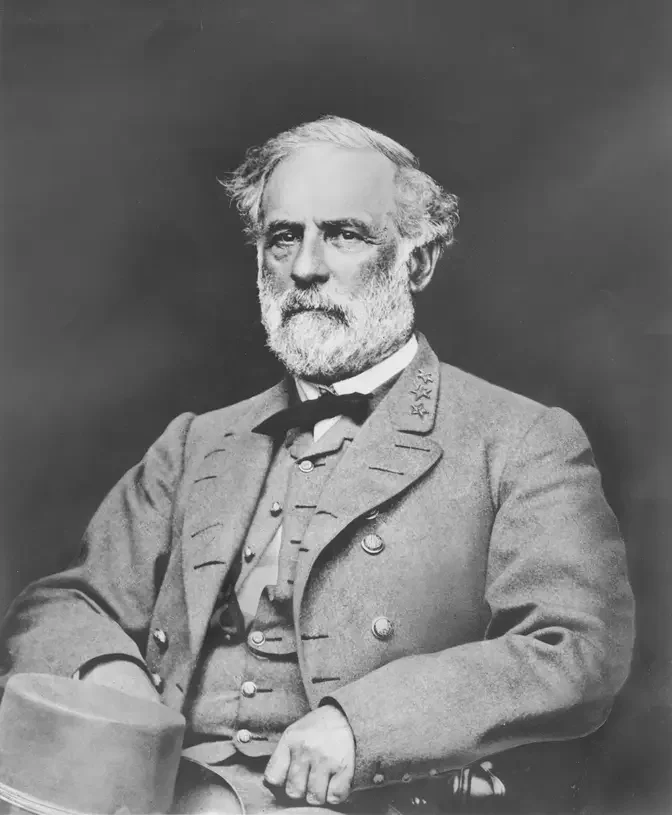
Robert E. Lee
Robert E. Lee
Robert E. Lee (1807–1870) was an American soldier and educator who commanded the Confederate Army of Northern Virginia during the American Civil War. The son of Revolutionary War officer Henry "Light-Horse Harry" Lee, he graduated second in his class at West Point in 1829 without a single demerit, served as an army engineer and in the Mexican–American War, and was later superintendent of West Point. When Virginia left the Union in April 1861, he declined a senior command in the U.S. Army and resigned his commission to serve his home state, the defining decision of his life. He surrendered to Ulysses S. Grant at Appomattox Court House on April 9, 1865, and afterward urged reconciliation. As president of Washington College, now Washington and Lee University, he devoted his final years to education and the formation of character. Congress restored his U.S. citizenship in 1975.
Latest UpdatesLIVE




The American Civil War
During the American Civil War (1861–1865), President Abraham Lincoln led the Union and issued the Emancipation Proclamation. Ulysses S. Grant rose to command the Union armies, while Robert E. Lee led the Confederacy's Army of Northern Virginia until his surrender at Appomattox in 1865. Harriet Tubman served the Union as a scout and nurse, and Clara Barton cared for wounded soldiers before founding the American Red Cross.

 2.5K followers


America's Great Generals
George Washington commanded the Continental Army through the War of Independence. In the Civil War, Ulysses S. Grant led the Union armies to victory, while Robert E. Lee commanded the Confederacy's Army of Northern Virginia. During the Second World War, Dwight D. Eisenhower served as Supreme Allied Commander in Europe, and George S. Patton led the U.S. Third Army across France. Washington, Grant and Eisenhower each later became president.

 48 followers
 2.5K followers

 3 followers