
Finger Positions For Flute In Depth
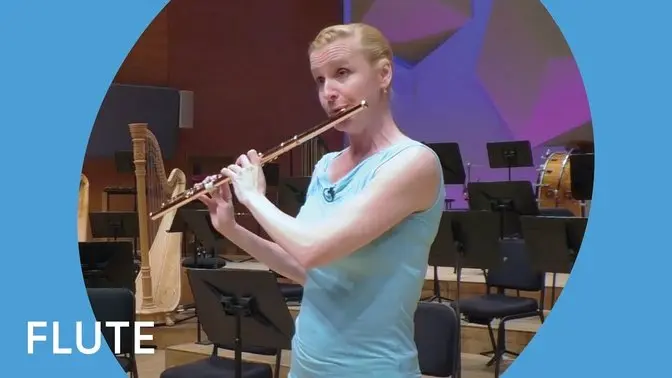
#Education #music # instruments # Flute # Orchestra # instrument demonstration
Hi it's Amélie. Today we're going to talk about our fingers.
I read a lot of comments about finger technique. Should it be very round? Should it be straight?
Also, even my technique, I have a finger that sometimes kind of blocks. So the first thing I
would say is that the best finger position would be slightly curved, you know, but not curved like
this. So you can try it, curve your fingers like as if you had an apple in your hand, you know,
like this, and then try to move it fast. And you can feel in your arm, well I don't know about you,
but I can feel in my arm that there's muscles working against each other, you know, and that
type of position is known to bring a lot of tendinitis and those types of things. Now if you
bring your fingers very straight, it's also a bit more, because you need energy to keep them
straight like that. But if you just curve them very slightly, that's the easiest way to move
them fast without too much energy, and they have the best motion. So slightly, slightly curved,
but not overly curved, and no need to bring them very, very straight. It's all about balance and
compromise, you know? So just like this would be the best. And then there's different things to
worry about. The left hand is usually more natural and easy. People complain less about the left hand.
If you have difficulties with your left hand, maybe it's because your ring finger is a bit
too extended, and maybe an offset G might help with that. If you change your flute, you can try
offset G, inline G. Personally, I'm used to the inline G, and I don't have pain or any
problem, so I stay like that because that's what I'm used to. But you can try it and see. Some
people say it makes a big difference for them, and it helps them tremendously. Then for the right
hand, there's usually more problems. You can look at our video about posture, the general posture.
I talk about the fulcrum points, because those are important. Because when you play, your fingers
shouldn't be holding the flute, because then they're not free to move and play, okay? So
you have to be able to hold your flute like this, so that your fingers can move easily.
Personally, I now use a thumb port. I've been using it for a few months. I've been playing
the flute for over 25 years, and I've been using a thumb port for a few months. I didn't even have
pain in my right hand, but I just tried it, and I loved it. Now I can't live without it.
Some people say it's cheating. I don't know what I'm cheating, because I'm not cheating my flute.
My flute doesn't care. It doesn't change my sound or anything. It just makes my life a bit easier.
And the important thing is the result, and to feel comfortable. So I really like that. That
might help you feel more secure, so that your fingers are free. Then you can check also the
alignment of your foot joint. You have to check the length of your pinky, probably,
and adjust accordingly. Personally, I have a short pinky, so I bring my foot joint a bit more inwards,
so that my pinky reaches in. Because I used to put it, like they say in the books,
directly in the middle, and then my full hand was out of balance, because I had to reach, you know.
If you have a longer pinky, maybe you want to push it a bit forward, so you can adjust that
to your own hand, to be comfortable. I don't think it's that important. Like,
when I play, sometimes my ring finger here gets very straight.
I don't know if it's doing it. Yeah, it's doing it here. I never had any pain from it.
What is known to cause a lot of pain is the very, very curved fingers. But I'm sure some people will
say, I have curved fingers and I don't have pain. So, you know, if it ain't broken, don't fix it.
If you don't have pain, if you have a good technique, it's moving well, you can play
everything, then you don't have to fix anything. If you have difficulties, then check your thumb
position, check the position of your foot joint, and make sure you don't overdo anything, like
over curve, over extend. Keep your fingers as close as each other as possible, because
extending your fingers like this strains the hand. And keep it as natural and painless. If there's
pain, there's a problem. If there's no pain and it moves easily, then it's probably fine.
Another tendency that we see in flutists that can cause pain, and also that can restrain the
movement of the fingers, is that some flutists bring their elbows up, you know, and that makes the
wrist like this. And you can't move your fingers very well when your wrist is extended this way.
Any movement that's very far in the range of movement will cause pain and, you know, you're
not supposed to be like this or like this. So try to keep everything as straight as possible with
your wrist, you know. So keep your elbows low, so that it stays in line, you know. Everything
stays in line and you just move your fingers. Sometimes we think that all the movement comes
from the fingers, you know, they're the only workers. But the fingers don't work alone and
they can be assisted by the arm. And you can rotate and help your fingers work less and not
work as hard by rotating. I'll give you an example. Let's say I do a D-trill. Instead of moving only
my finger, which is the ring finger, doesn't have a lot of mobility on its own, I do a slight
rotation. And if you try it, you can rotate very fast and there's no pain, there's no fatigue. I
can do that fast for a long time and you can try it. So it's an easy way and I can go...
So I'm not even really moving my finger. I'm not working those muscles. There's no pain. I'm just
going like this. And this way, it's way easier. And when I do...
My arm goes like this and goes back when I go down.
So the fingers are working, but they're not working alone. And this movement here, you can
just do this with your elbow and move like this. And sometimes it's very slight. You don't even see
it, but it's there. And that can assist your fingers and help tremendously so you don't hurt
yourself and you can be more efficient with your body. So there might be other things that I haven't
covered that can cause you pain or problems in moving your fingers. If you have any questions,
comments, just leave them in the box below. And if you like the video,
please like it. If you haven't subscribed yet, please subscribe. And thanks for watching!