
How To Play The Flute (For Beginners) | Quick Tutorial
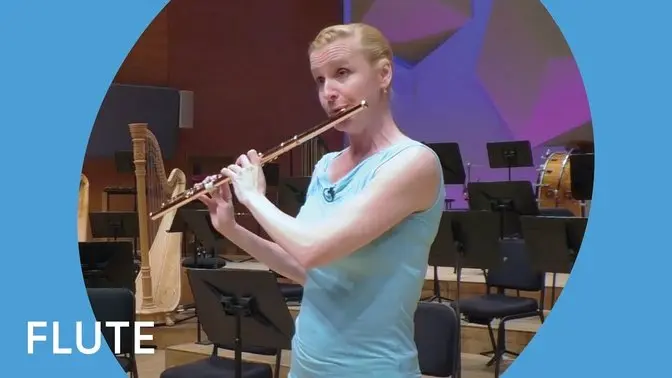
#Education #music # instruments # Flute # Orchestra # instrument demonstration
Comments are disabled for this video.
Hello everyone! In this video I'm going to teach you how to play the flute. I'm going to make this
as quick as possible so you'll be playing the flute in no time, and hopefully by the end of
the video you'll be able to play hot cross buns with me using just the three notes that I taught
you in this video. And of course if you need to learn anything else about the flute I have plenty
of videos on my YouTube channel to help you along your way. I just want to preface this by saying
that the flute is a very difficult instrument to learn and it's going to take longer than
probably the five minutes that this video is to fully learn how to play the flute. This video
should just be used as a quick getting started guide to help you make your first few sounds.
When you first open your flute case there will be three different parts. The first part is the head
joint, the second part is the body, and the third part is the foot joint. To start I want you to get
your head joint out. This is the only part of the flute that doesn't have any keys. When you first
get your head joint out take a look at the hole. The hole is connected to the tubing of the flute
via this lip plate. This lip plate is what you're going to put under your lips on your chin. Not so
much down here, but in the area between your chin and the bottom lip like this. Your bottom lip should
just be partially covering the bottom end of the hole. You will know that the flute is in the right
spot when you can partially feel the opening of the hole on your bottom lip. Before you start
playing a note, cover the end of the head joint using your right hand. Now you can try to blow.
The sound is not going to be beautiful because this is just the head joint, but hopefully a
sound came out. If a sound didn't come out that's probably because your lips are directing the air
in the wrong direction. How the flute is played is air blows over the hole, part of the air goes into
the flute, and part of the air goes over the lip plate and out of the flute. This is how the sound
is created. If a sound didn't come out that would be because the air was directed too far up and out
of the flute or too far down and not into the flute. The most common problem with beginners is
that the formation of the lips, what we call the embouchure, is not in a correct position. Often
beginners will try to make a kissy face with their lips, sort of like this. You can tell that this is
not going to make a very good sound. So as carefully as possible just try to blow.
And remember you're trying to point the air down so it can both go in the flute and out of the
Now if the sound is too weak you can simply blow more air.
Or if it's too strong you might want to back it off a little bit.
Again, finding this balance is going to be very difficult. Now the first exercise I want you to try
is going in between a low note and a high note. And you can do this just using the head joint.
Notice I didn't have my hand covering the end of the hole.
To do these two separate notes simply just hold the head joint with your left hand. If you blow
that is likely the note that will come out. But if you speed up the air using your abdominal muscles
and point the air just a little bit higher, a second note will come out. And this will be a
higher note. Practicing this can be very tedious and loud, but I promise it will help you immensely
when you put the flute completely together. Once you've successfully gotten some sounds out and
you can create a lower pitch and a higher pitch just using the head joint, it's time to put the
flute together. To put the flute together, hold the head joint in the left hand and hold the body
of the flute in the right hand. Make sure you hold the body where there aren't any keys because you
don't want to mess the flute up. You can slide the two together and you might want to wiggle it around
like so. Now you want to take the foot joint. Make sure you hold it like this. Put your pointer finger
on this key, which is all by its lonesome on this side, and pinch it sort of like this. Now taking
the body of the flute, put it together just like you did with the head joint. And you can wiggle
it into place and boom. Now it's important to align the flute so it works well with your body posture.
And a good rule of thumb is to align the hole of the head joint like this up with the first key
here. You can do this by looking down the flute like this and making sure that those holes align.
You also want to align the foot joint with the body of the flute. In this case, this rod here
should be aligned with this last key on the body. It should look something like this.
And just so you're aware, my flute does have holes in the keys. That's called an open hold flute
and most professional flutes are made like this. But if you're a beginner, the flute you probably
have doesn't have these holes and that is completely fine. It doesn't affect anything,
it'll actually make it easier for you when you're first beginning the flute. To hold the flute,
first put your thumb on this thumb key here. This is what that should look like. Now that your thumb
is there, you can rest the body of the flute on this divot in your pointer finger right there.
Then put your pointer finger on this key here. Then put your middle finger on this key
and your ring finger on this key. Your pinky will sometimes use this. With your other hand,
put your pointer finger on this key, which if you're confused is the first key after this little
trill key right here, and then the middle finger and the ring finger. Your pinky will use the foot
joint exclusively. It can use any of these keys, but it should be usually resting on the first one
closest to the body. Now you know how to hold the flute. I'm going to really quickly teach you three
notes that you can use to start playing your first piece, Hot Cross Buns. The first note is B. B is
played by having your thumb on the thumb key and your pointer finger on the pointer finger key.
Your middle finger and ring finger should not be down. They shouldn't be touching these keys. They
should just be sort of up in the air right now. You don't want them really far out. A lot of
beginners would do that. Just have them somewhat close but not touching the keys. On your right
hand, you don't want any keys down, so just hold your fingers up and you can hold the flute,
stabilize it by using your right thumb and putting that under the flute like this, and put your pinky
key down on the foot joint. So it should in total look like this. Now hold the flute up. It doesn't
have to be held at a complete 90 degree angle like it does sometimes in marching band. It can be sort
of held comfortably like this. Now you can blow like you just blew into the head joint.
Congrats! You've made your first note on the flute. This is the note B. The second note that you'll
want to learn is A. And A is really easy. All you have to do is finger what you were just fingering
for B and then put your middle finger on your left hand down.
Last note you want to learn is G. If you caught a trend here, we're just going to
add the next key in the line which is your ring finger.
To play hot crust buns, start on B, the first note we learned,
with just the pointer finger down and thumb and the pinky on your right hand.
Play A just by adding your middle finger on the left hand,
and then G by again adding your ring finger on the left hand.
If you're having to huff to get the notes out like this,
that's because you are not articulating. Just like when we're talking, you have to articulate
to make your notes sound clear. To do this, simply practice ta ta ta ta ta.
When you're playing the flute, simply do that and blow at the same time.
And the goal isn't to make the prettiest sound here. Again, you're just playing the flute for
the first time. And remember, this is going to take a lot of practice. You can't just pick up
the flute for the first time and play hot crust buns perfectly. If you did, send me a video. I
would love to see it. You might be considered a prodigy. But most people have to practice this
for a long time to get it down smoothly and evenly. And with this, it's important to practice
daily if possible. If possible, please aim for about 30 minutes a day of just practicing the
flute alone. I know this is a hard dedication to make, but if you want to become proficient at the
flute, it's going to take some work. And if you're looking for some help on your flute journey, I
would recommend the Trevor Y practice books. There's six Trevor Y books all about different
topics on flute playing, and you can get a whole bundle of them. Just order it on Amazon, and these
books will teach you everything you need to know about playing the flute. If you're not a book
person, you don't want to read about playing an instrument, that's totally fine, and I understand.
I have plenty of videos on my YouTube channel teaching you how to play the flute, different
specific topics. For example, a recent one I made is about how to play the low notes and how to play
them loudly, which can be quite the challenge. But I will say that if you're really serious about
playing the flute, getting a teacher is probably the best route to take. If you like my teaching
style and you'd want to study with me personally, my website is devinflute.com. On there, you can
book lessons with me, and I'll reach out to you, and hopefully we can set up a time to meet. On there,
I teach lessons online to anyone in the world. Of course, this video went over the basics of playing
the flute and definitely didn't teach you everything you need to know about playing, even
just hot cross buns. I left out breathing, a lot of important information about articulation, and
of course, musicality and phrasing, vibrato, things that are very important if you are serious about
playing the flute. So please subscribe to my channel and let me know in the comments what
specific topics you'd want me to cover in future videos. Anyways, thank you so much for watching
this. I really hope that I helped you play your first few notes on the flute.