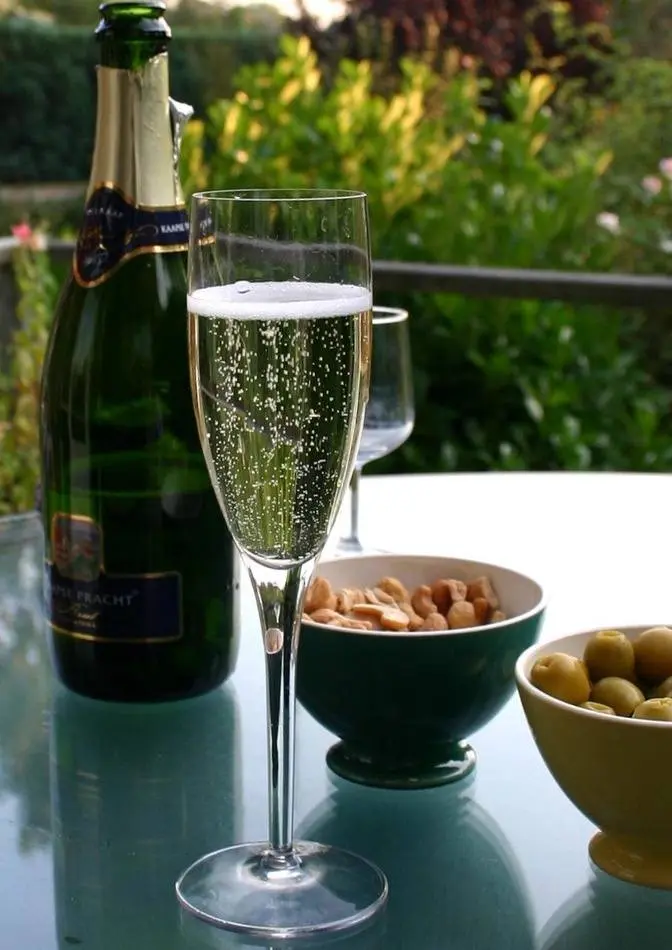
A Polish soldier, a French village, a love story, and a champagne house born in the aftermath of World War II.
David Jackowiak-Rondeau – grandson of the founders of the Jackowiak-Rondeau champagne house – joins TVP World's Klaudia Czerwińska to unveil a remarkable family saga woven from the threads of war, love, exile, perseverance, and generations of champagne-making tradition.
In this conversation, David Rondeau tells the extraordinary story of his family’s champagne house, founded in 1948 by his Polish grandfather and French grandmother, Martha. From a prisoner-of-war camp and a new life in France to the vineyards of Champagne, their journey is one of resilience, love, and the courage to build a new future far from home. At the heart of the story is the Polish White Eagle, proudly displayed on the bottle – a symbol of a homeland his grandfather couldn't return to, yet never stopped carrying in his heart. Our guest also shares how, in 2012, he and his wife chose to leave their careers in research and continue the family legacy, becoming the third generation to carry the legacy forward.
This is more than a story about champagne. It's a story about identity, memory, love, family, and the extraordinary ways in which the past can live on through what we create.
This video tells the poignant story of the Jackowiak Rondeux champagne house, founded in 1948 by Władysław Jackowiak, a Polish WWII veteran, and his French wife, Marta Rondeux. Through an interview with their grandson, David, the narrative explores the intersection of Polish heritage and French tradition, emphasizing a legacy of love, resilience, and family values across three generations.
Three generations of tradition and champagne making and a history reaching back all the way
to the end of World War II when a Polish officer, Władysław Jackowiak, made his way to France where
he fell in love and started a champagne house in 1948 with his wife, Marta Rondeux. This could
be a screenplay for a movie but it is my honor to tell the tale today. The grandson of the original
founders, David Jackowiak Rondeux, joined me in conversation to share the story of his family.
David, thank you so much for having us here at Jackowiak Rondeux, your beautiful champagne
house. I appreciate that. Thank you, thank you for everything and thank you for being here.
So let's start from the beginning. Władysław Jackowiak, your grandfather,
how did he make it all the way from Poland to France, particularly to the Champagne region?
Well, my Polish grandfather, when he was young, enlisted in the Polish army. He became a
non-commissioned officer and after the war began around 1940, according to what we found in the
documents, he was taken prisoner and remained one until 1945 when he was liberated by the Americans.
After his release, he was taken to France, specifically to one of the villages just
around here. He settled here after meeting my grandmother.
So it must have been difficult for him, wasn't it, to have to leave his country of origin,
to have to leave Poland and come to France. When you spoke to him, do you remember any of
the stories that he brought about when it came to his time in Poland and World War II?
Well, when I could have talked about all this with him, I was just a child and it's true that
now I regret it. I don't think I asked enough questions. I mainly got information about his
life during the Second World War and about his life in Poland. I learned about it primarily
through my mother's stories. She talked with him a lot, but it was always very, very difficult for
him to talk about his life in Poland and even more so about his life in the army and his time as a
prisoner of war. When he was released in 1945, he weighed 45 kilos. I can't even imagine just how
difficult it must have been for him. But unfortunately, I don't have much information directly from him.
And finally, when we think about what happened to him
here in France and how he started his life, he stayed here in the name of love. He met Martha,
Martha Rondeux, your grandmother. So tell us more about that story. How did they meet?
So my grandfather was brought to France after being liberated from a POW camp. He came to France,
as I was saying, to the village just next door. And I've heard several fragments of the story.
Apparently, they crossed paths several times on the road.
So at first, my grandfather was guarding German prisoners and he passed my grandmother several
times on the road, apparently on foot. Then he started doing some small jobs. He worked as a
gas station attendant in the neighboring village. And apparently, the first time they started talking,
my grandfather didn't speak any French at all. And the first time they had a few exchanges was
when he put gasoline into the car of my grandmother's father.
So where did that idea to start a champagne house come about? I know that your grandma's family has
been involved in champagne before she met your grandpa. But there was also an element of
involvement when it came to Mr. Jatzkowiak.
Yes, my grandmother did indeed come from a wine-growing family. So they had a few plots
of wine. But my grandfather started out in his first job as a farm worker. So really working
in agriculture in the village that's there, just a little further down. A farmer took him on as a
farmhand and he got a few vines through his wife's family.
So during the day, he was a farm worker. And in the evening, he would go and work his vines to
learn how to start producing his first grapes. And little by little, he acquired new vine plots.
And soon enough, he stopped working as a farmhand and devoted himself entirely to grape production,
so that he could build their champagne house in 1948.
When I looked at the bottle, I remember the first time when I saw the Jatzkowiak
Rondeau Champagne. And I remember seeing the bottle and I was so extremely moved.
There is a very particular element on that bottle. We see the Polish white
eagle and a crown. And we decided to keep it. Why this particular symbol?
Unfortunately, I can't answer for my grandfather. But I can answer based on what I felt or on the
things that have been explained to us as to why he had done it. He couldn't return to Poland,
because at the time, Poland was under a communist regime, and at the same time,
was extremely attached to his homeland, the place where he grew up, where his family still was. And
he couldn't go back there. For him, having a symbol of Poland, a symbol of his roots,
and a bottle, a French product, but made by an extremely humane person,
who wanted to have something that reminded him of home and his product,
was extremely important. He wanted to make the simplest label possible,
a white label with the two names, his own name and that of his wife, Rondeau,
which for him was inseparable. It really was a couple's brand. It was a champagne house,
created by a couple, by two people with two different origins, but a common goal.
And so he wanted the simplest label, the simplest bottle, with strong symbolism on it,
the double name, but also the Polish eagle, which was really, how can I put it,
what connected his heart to his homeland.
So, when you look at your champagne, how do you marry both of these cultures? Because you
have champagne that is a French product, it's one of the staples when it comes to France,
but then you have that element of the Polish heritage. And your wife, when I spoke to her
earlier, she mentioned that there were elements that your grandpa brought from Poland and that
were reflected in the champagne. So how do you marry these two together?
It is obvious that champagne is a French product. On that point, to say that we put a particular
signature on the product because of its maker's Polish origins is not possible. So the know-how
and work are based on a French product, but our personal touch is that it's made with love.
My grandfather was an extremely humane person. He loved his staff, he loved his children,
he loved people, and you could feel that in his work. For him, work always had to be done well,
but always with respect to the person. And I think that's where Champagne Jacobiac Rondeau
really came into being.
It was when he put his touch, really his Polish imprint on this French product,
and I think that's why we've always had, how can I put it, we've always felt that we have to respect
people, the product, the customer, the staff we have, and to be able to find fulfillment in what
we do, so it can be felt in the product. Actually, it's not that it can be felt in the product.
It's simply that all of this happens that way, and it comes through in the product.
At a certain point in life, you had to make a decision because this was
a heritage brand started by your grandparents, then it was your parents, and then somebody had
to take over. You made the decision to take over the company with your wife. Was it difficult,
or was it something that you just felt had to be done?
That's a good question. I worked in research. My wife did too. We loved it. But unfortunately,
my parents fell ill. I'm an only child. I don't have any brothers or sisters.
So the question was, do we end this story of the Champagne Jacobiac Rondeau, or do we continue it?
I loved my grandfather enormously. I don't even know how to say it. He was so genuinely humane
and kind. In my eyes, he really was an absolute perfect man. And I also loved my mother,
who was a secretarial studies teacher. Then my grandmother and my father too.
They had put an enormous amount of energy, soul, a lot of emotion into this work.
We have wonderful customers. I even have people who are my age who are customers,
and their grandparents knew my grandparents. And that really is a privilege. It's fabulous.
So in 2012, my parents asked me, what do you want to do? Are you coming back,
or do you want to stay and continue your work? My wife and I asked ourselves what we were going
to do. And in the end, we took the business over. And in hindsight, it was a very, very good
decision. But what's good about this story is that it has always been couples at its heart.
It was my grandmother and my grandfather. Then it was my mother and my father. And today,
it's my wife and me. And it's always moving forward as a couple and trying to improve
things without ever forgetting where we come from, without ever forgetting the values that
built the business, and always moving forward while respecting the people we work with
and the people for whom we do this work.
Do you think you have two lovely sons, which I had a pleasure of meeting today with your wife?
And do you think that they're going to take over one day, that they will have a similar
push to want to take over? I don't know at all.
Do you hope?
No, well, it's not a no. I don't know whether I'm hoping. It will be their decision.
My wife and I will do everything we can to prepare the ground as well as possible. Then,
if they want to take over, they will. If they don't want to take over, that's okay.
For my grandfather's sake, I would like them to. But after that, we open the doors to our
children and they will make the best choice for themselves. And that's the most important thing.
David, thank you so much once again for sharing this beautiful history.
That is definitely a great idea for a script for a movie.
I really appreciate you having us here today. It's an absolute pleasure.
And to all of you, thank you so much for watching us here on TV Pirol,
and I hope to see you back here very soon.