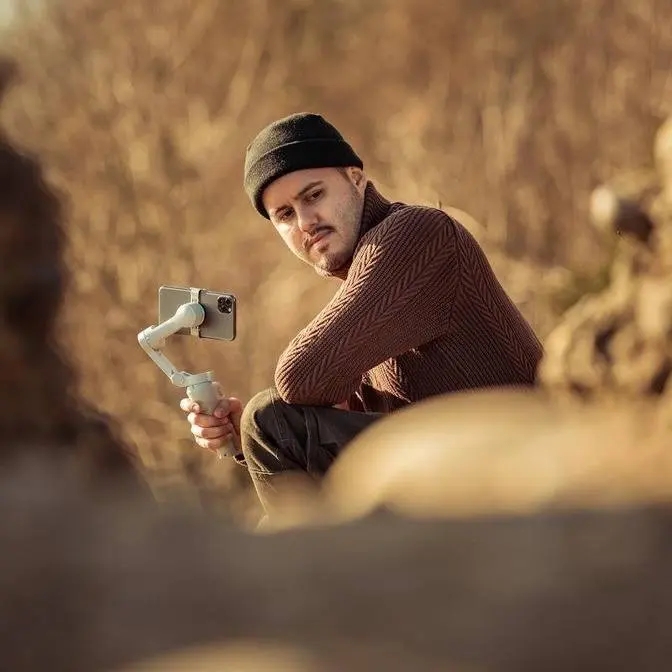
DISCLAIMER Some links are affiliate links, where I earn a small commission if you click on the link and purchase an item. You are not obligated to do so, but it does help support this YouTube channel and allow me to continue making videos for you. I appreciate your support!
This video provides a comprehensive comparison between the DJI Osmo Pocket 4P and the Insta360 Luna Ultra, focusing on their suitability for daily vlogging. While both cameras share core features like dual lenses, three-axis stabilization, and subject tracking, they cater to different needs: the Luna Ultra emphasizes creative flexibility and convenience, while the Pocket 4P targets professional image quality.
What is going on, folks? In today's video, we will be comparing both the DJI Osmo Pocket 4P
and the Luna Ultra. I'm currently filming on both. Can you tell which is which? Now,
on to my left side, I'm using the DJI Osmo Pocket 4P and to the right, the Insta360 Luna Ultra.
Now, I've been using both of these cameras for the past weeks for daily vlogging. They're both
really great, but they're made for two different creators in mind. Now, this isn't about which one
is better. It's about which one is better for you. Now, I'll be filming with both of these cameras
throughout this video so that you can see how they keep up when it comes to daily vlogging.
Now, by the way, this video isn't sponsored by DJI or Insta360. This is my honest thought that
I'll be giving you throughout this video. I'll be mentioning the good stuff and the bad stuff,
what I like, what I don't like, so that you get really an honest review. So, I want to start with
the similarities both of these cameras share. So, both have a dual lens design, which means you get
more focal length options, and therefore, also more variety of shots in your video,
making them more dynamic. Now, both of these cameras feature three-axis stabilization,
so you get smooth footage when shooting handheld. They also both have built-in
trackers so that when you're vlogging and filming yourself, it keeps you centered in the frame. Now,
both of these cameras offer log profiles on the DJI Osmo Pocket 4P that would be D-Log and D-Log
2, and on the Insta360 Luna Ultra that would be I-Log. And by filming in Log, it gives you more
dynamic range, preserving the details in the highlights and shadows, and gives you more
flexibility when color grading. Now, both of these cameras are compact and portable and easy to bring
along, and that's how a vlogging camera should be, as you're more likely to bring them with you
than something like a DSLR camera that is bulky. Now, both also support accessories to expand your
creative options. Both also come with their companion app. The DJI uses the DJI MIMO app
and the Insta360 app. So, let's talk about image quality. The Luna Ultra records up to 8K at 30
frames per second or 4K 60 frames per second. The main lens is a 20-millimeter focal length
with an f1.8 aperture, giving you up to 14 stops of dynamic range. The Pocket 4P, on the other hand,
records a 4K up to 60 frames per second, also has a 20-millimeter focal length, but an f2
aperture, and gives you up to 17 stops of dynamic range. Now, with the Luna Ultra being able to
shoot in 8K, you're able to crop in without losing much quality, therefore giving you more flexibility
for framing. Now, the Luna Ultra has a wider aperture, so that also means that you get more
of that background blur. So, now we're going to do an on-screen comparison. We're going to compare
first the normal 10-bit color profile. Now, we're going to switch over to their log profile,
starting with iLog versus D-Log with their conversion LUT applied. Now, we're going to
switch over to D-Log 2 versus iLog, also with our conversion LUT applied. Now, from the tests I've
done, you can clearly see that D-Log 2 gives you more dynamic range, really preserving those
details in the highlights, especially in more contrasty scenes. I also compared D-Log with D-Log
2. Again, D-Log 2 clearly offers more dynamic range and holds on to the details in the skies
and highlights much better. Now, the trade-off when filming in D-Log 2 is that you can't use
any other focal length than the 1X. You also have to manually set the ISO, even though you're using
the auto settings, and the ISO caps at 3200, whereas when using D-Log, you can go all the way
up to 6400 ISO. Now, overall, I do find that the Pocket 4P produces a more brighter image,
whereas the Luna Ultra is darker and more saturated and contrasty. However, you still
have those details in the shadows when you lift them. Now, when filming iLog on the Luna Ultra,
you have no LUT preview, so you have no exposure tools or meters to see whether your highlights
are blown out or not. Future Bennett here. So, Insta360 just came out with a new firmware update.
I'm not going to go through all of the updates, but one of the most important ones is color
recovery. So, now, when shooting in iLog, I can enable that so that I can judge the exposure and
image overall better. So, with that said, let's continue with the video. Now, if you're interested
in the colors that you're seeing right now, I do have LUT packs available for iLog, D-Log,
and D-Log2. It's a one-click solution where you can apply those LUTs without needing a conversion
LUT to your flat-looking footage to instantly create a stylized look in your video. On top of
that, also, my go-to camera settings are included for the Luna Ultra and the Pocket 4P. This way,
you can set it once and forget and achieve the same results like you're seeing right now
in your vlogs. So, if you're interested in that, be sure to check out the link
in the video description below. So, let's talk about their dual lenses. Both of them can zoom
up to 12x, so 1x and 3x being optical zooms, and 6x being lossless zooms, and 12x being digital
zoom. So, for optical zoom, it actually uses the lenses so you have no quality loss. Lossless
crops in on the sensor, which you also have no loss in detail, and with the digital zoom,
that is where you notice quality loss. And for that reason, I usually avoid zooming beyond 6x.
Now, zoom while recording is supported on both, allowing you to switch from the main lens to the
tele lens. Now, for some reason, it might be a lossless zoom on the Luna Ultra as it just shows
2.9x. So, I'm not sure why it can't go to 3x. Now, both have a short close focus distance,
so you're able to get really close on a subject to capture detailed shots. And when it comes to
photos, both shoot at 37 megapixel, and the photos look great on both. What's great about the Luna
Ultra is that you have built-in film tones, which bakes in the look straight into your photo. This
great if you want something ready to post on Instagram. On the Pocket 4P, the normal image
looks great, but you do need to edit it afterwards if you want to create a stylized look. When it
comes to slow motion, the Pocket 4 supports up to 4k 240 frames per second, while the Luna Ultra
is capped at 4k 120 frames per second. The only thing with the Pocket 4's dedicated slow motion
mode is that you can't film in a log format. You're only able to record with the normal color profile,
whereas on the Luna Ultra, you're still able to record 120 frames per second in iLog. Now, the Luna
Ultra's 120 frames per second just looks better to me than the Pocket 4 Pro's 240 frames per second.
DJI really needs a way to film slow motion in iLog. It just looks way too over sharpened. Now,
the Luna Ultra does support 240 frames per second, however, in 1080p. So, when it comes to audio,
both have built-in internal mics, and I've been switching between both of them throughout this
video. Now, you can also use a wireless mic. The Pocket 4P has the DJI Mic Mini 2, while the Luna
Ultra has the Mic Pro, and they connect wirelessly without needing a receiver. So, it's quite
convenient. Now, the Luna Ultra also has a built-in wind guard, but when vlogging, it's not as effective
as it's placed on the other side. Now, the Luna Ultra has a unique feature, which is the detachable
remote controller that I'm using right now. And the great part is that it has a built-in
microphone, which means I don't necessarily need to use a wireless mic to record myself
from a distance and capture high quality audio. In fact, you're listening to the audio right now
coming from the built-in mic on the detachable remote controller. To me, it sounds really good.
So, here's a quick audio test between the two using their internal mic. So, I'm around an arm
length away, and this is how it sounds like. No post-processing has been done. I did increase,
or I will increase, the volume so that you can, you know, hear me a bit more clearly. But other
than that, no post-processing has been done. And yeah, let me know which one sounds better to you.
Now, to me, I find the Luna Ultra does deliver cleaner audio on their internal mics when it
And also, the remote mic just reduces the need of having to connect or bring a wireless mic with you.
When it comes to wireless control, both support it, with the Luna Ultra using the detachable
remote controller and the Osmo Pocket 4P, the Osmo Frame Tap. Now, I like the detachable remote
controller more because it's part of the Luna Ultra, and it's not something I need to carry
with me extra, like the Osmo Frame Tap. What's also great about this remote controller is that
I can turn it on and off, I can switch the camera settings, change profiles, which I can't do with
the Osmo Frame Tap. And also, with the Osmo Frame Tap, it's usually an extra purchase. It's something
you have to, you know, carry with you extra. And also, with this one, you also need to carry an
extra charger with you, whereas this one, you know, once you attach it to the Luna Ultra, it
charges. Also, the Osmo Frame Tap is limited to 10 meters, while the transmission range on the
detachable remote controller on the Luna Ultra is 20 meters. One downside to the Luna Ultra is that
currently you don't have any support for custom buttons, so if I want to switch to maybe, you know,
50 frames per second or another shooting mode, I can't set it, whereas on the Pocket 4P, I am able to
add custom presets. In terms of tracking, I've tested both side by side, and I've tested it with
the 1x lens and 3x lens, including hiding behind an object and reappearing to see how well these
Pocket cameras re-identify the subject. So, in this first test, I'm using the 1x lens, and both cameras
respond really well. Even when running back and forth quickly, the tracking kept up without any
hiccups. I also hid behind the rock, and when I reappeared, both re-identified me quickly, almost
instantly. And honestly, I can't really find a difference between them. Both of their trackers
are very advanced and responded really well throughout this test. For this next test, I switched
to the 3x lens. I was around 10 meters away. Same story, both nailed it. While tracking was responsive
on both, I was out of focus on the Luna Ultra, which I just realized, so I might have to retest that.
What's really cool is that both also support multi-person tracking, which is especially great
when vlogging. So, if you have multiple people in the shot, it will balance out the framing.
In terms of battery life, on paper, they both last around 4 hours, but in real-world use, I
got around 2.5 to 3 hours. They both have around the same battery size. Now, a big difference is
the internal storage. The Luna Ultra features 47 gigabytes of internal storage, while the Pocket 4P
has 103 gigabytes of storage. Now, both also support microSD. Now, they both have around the same weight.
The Pocket 4P weighs 230 grams, while the Luna Ultra weighs 233 grams. Another thing I noticed
is the wired transfer speed. On the Pocket 4P, you got 800 megabytes per second, whereas the Luna Ultra
has 450 megabytes per second. So, the big question is, which one should you get? I would say, go with
the Luna Ultra if you want really creative freedom. It shoots up to 8K, gives you a lot of cropping
flexibility. Especially, the detachable remote controller allows you to control the camera from
a distance without needing to bring any accessories with you, and the built-in mic really makes it
great to just instantly record good audio quality while still being further away from the camera,
not necessarily needing to use a wireless mic. And honestly, it's great to see how Insta360 really
removes every friction, allowing us creators to express ourselves more creatively. And this, to me,
makes just capturing the day-to-day moments more easy and enjoyable. Now, I would say, go with the
if you use it for professional work. D-Log 2 gives you that 17th stop of dynamic range and also gives
you a more predictable color grading workflow. You can really see that DJI is pushing their
image quality and dynamic range to their limits, refining their gimbal, and building an ecosystem
that's really hard to get away from. Now, you really can't go wrong with either of the two. They're
both great vlogging cameras for traveling. In the end, it really comes down to your shooting needs
and your workflow. Now, let me know in the comments which one you would choose, and don't forget to
check out my LUT pack for i-Log, D-Log, and D-Log 2. Other than that, thank you so much for watching,
guys. Take care. I'm going to enjoy the rest of the day, and I'll see you in the next one.