
Life and work of Albert Einstein (1879-1955)
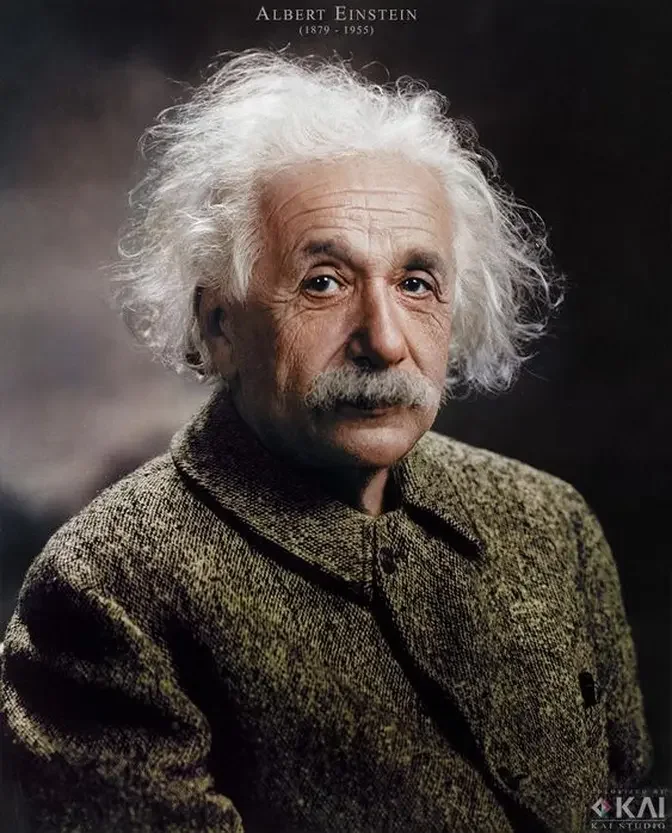
Well, gentlemen, perhaps we'd better start now. Many years ago there was a dinner in honor of Einstein
at which George Bernard Shaw made a speech where he said, among other things, that there were
many great people in the world who could be said to have constructed the world,
but very few who could have been said to have constructed a universe.
One of those very select few was Albert Einstein, and we are privileged today to talk about him,
his character and his work, and with me there is Professor Cornelius Lanchos,
who comes from the Institute of Advanced Studies at Dublin.
He's a very well-known mathematician who studied with Einstein in 1928
and has also made contributions in his own right to applied mathematics.
And also Professor Tom Cowling, who is Emeritus Professor at the University of Leeds,
who is an eminent astrophysicist, and Professor Koppel from the University of Manchester,
who in fact leads the Department of Astronomy in the university.
So there's the four of us going to talk about Einstein.
His greatest achievement probably was his paper on general relativity,
but ten years before then, in 1905 or thereabouts, he had written three or four very important papers
which set the seal on his work.
And in a way, these are the ones which we are going to discuss now.
So perhaps we might start off, Professor Lanchos, what sort of man was Einstein in 1905?
I mean, was he married or had he done much scientific work before then?
Well, in 1905 he was just 26 years old.
Probably his papers were written maybe a year earlier, in his 25th year.
They were published in 1905, and it was a tremendously happy period.
I think it was his greatest intellectual period that he spent in Bern as a clerk in a patent office.
And he had a few friends with whom he, I mean, particularly Konrad Habicht, teacher of mathematics,
and Maurice Solowin, who was a philosopher.
And these three, he founded the so-called Olympia Academy,
and then they had very vivid discussions on all kinds of things.
Einstein never cared to read very much, but he was very happy if somebody else read,
and then they discussed these questions.
Somehow, I mean, he was just recently married, and he was in a very optimistic mood.
And what he has accomplished in this one year, I mean, this is just out of the world.
I mean, we know that these three papers, every one of them would deserve the Nobel Prize.
Brownian motion and photon hypothesis, special relativity.
I mean, every one was a tale-blazing paper.
And so it was undoubtedly a very happy period.
It is possible that we do not know many details of those years,
but he was very cheerful, he was in an optimistic mood, he had friends,
and he was not launched yet as a world celebrity.
So many features came together, which perhaps somehow were responsible
that so much came out in one year.
And then in 1907, basically, he added all those great ideas, which came later.
Why was it that he was in the Patents Office rather than in a university position?
Well, he just didn't get a university position,
because, first of all, he just finished his studies,
and it was just after graduation.
He took it a little easy.
He says in his autobiographical notes that he disliked the whole university setup,
although today the students have to do much more,
and they are much more engaged in subjects.
But in those days, he didn't like the idea that you should take subjects,
you are responsible for subjects in which you are not interested.
For example, Minkowski's geometry or numbers and such things.
So that he says that after graduation, for a full year,
he didn't take a single scientific book in his hand.
He developed such an aversion against academic occupations.
And then he was, for a while, teaching, giving a kind of private tutoring,
but when he got this position, that was ideally suited for him,
because he had plenty of time.
It was almost like an academic position,
because he was only there as a consultant.
They consulted him on questions of physics and engineering to some extent,
and so he could do that easily enough,
giving his opinion on certain patterns,
and he had plenty of time to meditate.
Was the fact that his education was a little,
not according to the usual pattern, against him in the academic world?
After all, he had only, with a certain amount of difficulty,
been able to get into the Technical Institute at Zurich.
He'd had to spend an extra year studying in order to satisfy the expectations.
It's true, because his high school days were interrupted.
When his father, he was first in Ulm, he was born in Ulm,
then he came to Munich.
His father had an electric shop,
and was very much an enthusiast and a kind of daydreamer,
and he went bankrupt and went to Milan.
And when he went to Milano,
then Einstein, who also accompanied him,
but he wanted to continue his studies in Switzerland.
So he lost half a year, a full year,
because he had to finish his second year studies in Switzerland, in Aarau.
And he always remembers this year in Aarau with great love.
They wanted, if I remember rightly,
him to stay in Germany when his father went to Italy,
so as to be able to graduate at the gymnasium,
but Einstein refused to stay there,
and followed his father into Italy.
Well, I don't know.
Basically, the school in which he graduated in Switzerland was also a gymnasium.
I mean, that was also a humanistic gymnasium.
And whether it is really true that he hated this kind of military system,
I doubt it very much,
because I doubt whether there was a certain discipline in the German schools,
and he was not a man who could submit himself to a very definite discipline.
But I would very much be surprised if such a great mind would really fail in a subject.
I think he just got through. Maybe he just scraped through.
But there was no difficulty in really finishing his studies.
So what the motivations were, I don't know.
But he didn't want to stay longer in Zurich when his parents moved to Milan.
I think it's true that no matter what the military atmosphere may have been in Germany,
the atmosphere in the Central European universities at that time were not very different.
I think it's something that our present generation of students will probably find hard to believe.
But it would have been unthinkable, for instance, for a man just graduating,
to think of a university appointment for another several years.
So I think that Einstein followed from this after graduation,
took up his position at the patent office, was only a natural step.
Well, actually, he tried for a teaching post before he...
Secondary school teacher.
Yes.
And he wasn't successful at that.
Presumably for a good reason.
Because I think from all that we know of Albert Einstein,
and unlike Professor Lanczos, I heard about him only through his other pupils,
he would not have been a very successful teacher at the secondary level.
Would you say so?
And he also, he was not a particularly brilliant student in those years, you know.
There is this famous story of Minkowski, who was one of his professors at the university,
and when Einstein published his 1905 paper on special activities,
and Minkowski said, is that the same Einstein whom I had in my class?
At that time, he didn't know anything.
That's what he said.
So there's a difference between being brilliant at studying and being a brilliant student.
Yes, of course.
Would you say, Professor Lanczos, that in view of this,
that Einstein, like Newton, was what you would call a slow developer?
Well, certainly he was a different, he was always an outsider in a certain sense.
But he was no prodigy as a young man.
No, no, he was no prodigy. Absolutely no.
Well, he himself claimed later on that he got the idea of relativity when he was 16.
Yes, that's true.
Just by thinking, what would happen if you had somebody able to move at the velocity of light?
That's right.
And he would see a frozen landscape of standing waves,
and he says that to him looked impossible.
Yes.
That's true.
But, of course, the same ideas were very much in the air at the time.
But not among boys of 16.
This is true.
It would be interesting to see if he was inspired or interested by reading,
if it occurred to him independently.
But the subject was being discussed in the 1900s, early 1900s, by a number of people.
And Poincaré, one of the great writers of all those days,
also was a superb presenter.
His books, his popular books, were such as they could have easily come into the hands
of a bright young man like Einstein if he read French.
But not in his high school days. That was later in his career.
I think if it had been four years later, that might have been the situation.
Later, yes.
Poincaré wrote, as far as I know, all his works in French.
Was Einstein able to read French early in his life?
Well, certainly after he went to Switzerland.
I doubt that in Germany, I doubt whether he knew enough French.
But after he came to Switzerland...
At the gymnasium, he would have had probably lessons in French.
And in Switzerland, even more so.
In Switzerland, it was automatic.
Presumably, some of the popular writings of Poincaré could have been accessible to him around that time.
Yes, and Poincaré's books were certainly translated.
Yes, yes.
Poincaré, in those days, was like Edith Pugin's later.
Yes, yes.
The popular books.
Yes.
But Einstein was basically not a good reader.
He always had to discover everything for himself.
Like Ferdinand.
Like?
Like Ferdinand.
Yes.
And so he always was very grateful if somebody else was reading,
and therefore they had, in the so-called Olympia Academy,
they had discussions on books, which they read also together,
but they prepared themselves in advance,
and he was very happy if they read together something.
I heard from Philip Frank, who knew him, say, perhaps ten years later,
that it was his first wife who performed largely this function for him,
and this may have been the reason of the early marriage, which later split up.
Yes.
She was the one, I think...
She also was a student of physics.
And she read, and her husband listened.
Aha.
She was just reading directly.
Yes, indeed.
On special relativity, was his paper on special relativity completely new,
or was it a climax to a number of other contributions,
from Poincaré and Lorenz?
Well, I'm sure he was not influenced.
He didn't know about Lorenz.
He didn't know about Poincaré.
The paper of Poincaré came simultaneously with Einstein.
And the detailed paper came only one year after Einstein.
But the approach was completely different.
I mean, the ingenious approach of a physicist.
Postulate A, postulate B, and everything follows from that.
Whereas Poincaré was a mathematician
who investigated the transformation properties of the Maxwell equation.
But these two things are very different, terribly different.
And, of course, Einstein always shied away from priority haggling.
And so when they asked him about the others,
he says, well, it was in the air anyway.
Somebody would have found it anyway.
But he did point out that his viewpoint was different.
Because he says, I could not start with the Maxwell equations.
Because I knew that the Maxwell equations do not hold in very small wavelengths.
That means in micros...
They only hold macroscopically.
So I could not base my discussions on any set of equations.
I thought something much deeper is involved.
And that is a tremendous difference
between investigating the transformation properties of a certain set of equations
and starting with these two tremendous postulates
and come out as a physicist would do it.
And what he did in about 10 pages
was much more than what Poincaré did in 50 pages.
It was a short paper. All the three papers were short.
The paper for all that was entitled
On the Electromagnetic Equations.
I thought it was called On the Electrodynamics of Moving Bodies.
The Electrodynamics of Moving Bodies, yes.
Because the principle of special relativity did not exist at that time.
It did.
Poincaré had stated in 1904, the year before,
what he called the principle of relativity.
Yes, but not special relativity.
The principle of relativity, which he stated in this form,
the laws of physical phenomena must be the same for a fixed observer
as for an observer who has a uniform motion relative to him.
That's what he called the principle of relativity.
I think the point was,
Poincaré had actually been groping in that direction then for three or four years.
But he stated the principle,
but it was rather, somebody ought to do something about producing equations
that will satisfy this.
Yes, yes.
There was Lorentz also in 1904.
He had a paper in which what we know as the Lorentz transformation appears.
But he was rather dubious as to whether the time that he introduced in that
to satisfy the, to make the equations invariant,
had any real physical meaning.
Yes.
And this was true even half a dozen years after Einstein's work.
He was still doubtful about the meaning of the time.
Einstein had much greater definiteness in his statement,
and also it was a much more powerful discussion than the other people had produced.
And in addition to that, I think that there is a very essential difference in viewpoints.
Because Lorentz assumed that if an electron moves, or a body moves,
then it changes its shape, the Lorentz contraction.
Whereas Einstein said, no it doesn't, it depends who observes it.
That's a tremendous difference.
It doesn't change really its shape,
because if somebody moves with the object, he just sees a sphere.
But the other observer, relative to whom the shape, this sphere moves,
he sees an ellipsoid.
So it's not a real contraction.
It depends on the observer.
That's a terribly big difference.
It is probably true to say that Einstein scored his triumph,
and that the world received relativity from his hands,
because he was more of a physicist.
Yes.
He thought more in concrete terms, rather than in terms of mathematical abstractions.
Yes, and he knew what is involved.
I think he knew much clearer.
Even if you have the mathematical equations,
it's not enough to have an equation.
The way how you interpret it.
I was told by my Prague teachers, who remember Einstein
from the days of his greatest creative activities later on,
that his was always an approach, as I was told, of an engineer.
He was not satisfied with generalities.
He wanted to know what does it mean.
One could perhaps say a philosopher,
but he wanted to know what it means.
He wanted to have a conception.
He wanted to relate any idea with the physical world of which we were part.
So among the, say, Prague mathematicians,
whom I knew from the days of my student years,
they would still look down upon him as a mathematician.
He would say, oh, he was no mathematician.
He was all fine, he was a great physicist, philosopher,
but he was no mathematician.
That is, he was not, emphatically, an epsilon-grade mathematician.
I think Tom, he would probably agree with us,
there is more to mathematics than only the epsilons and deltas.
Oh, very much so.
And Einstein, I think, was a living example.
What one can do without them,
I think in all Einstein's work as published,
you will not find a single trace of epsilons and deltas, or their spirits.
It took a long time for some of his work to be recognized,
as it were, semi-popularly from the teaching point of view.
Was this true of his original papers, do you think,
that they were noticed by a few interested scientists, but not by...
I think the early papers scored triumph almost all,
registered almost immediately.
He got his Nobel Prize very promptly,
though not for relativity.
No, but the Nobel Prize came only in 1921.
It came much later.
Oh, sorry, sorry, aha, I stand corrected.
For example, he was...
Recognition came soon.
He was delegated to the Solvay Congress,
which was a very great honor,
and he was the youngest member of this group of Solvay Congress.
And I think, very few years after, he was made ordinarius, full professor.
In 1909.
Which was then, in fact, earlier than yesterday,
which was then a great distinction.
Usually you had to wait 20 years longer before you would become one,
and he became ordinarius.
Well...
At the recommendation of Max Planck.
He would have been 30 then.
No, he was...
He would have been 30 in 1909.
That was in 1900.
And when he came back from Prague,
I mean, 1909, he became extraordinarius.
Then he got the call to Prague as a professor,
and then the ETH, I mean, this E-T-H,
I mean, the Eidgenössischer Technische Hochschule,
the Polytechnicum, called him back in Zurich.
They made him full professor.
I think his full chair was in Prague,
and he got it on the recommendation of Max Planck.
Max Planck was his promoter.
Yes, Max Planck.
Planck realized this,
and Planck was also instrumental later in bringing him to Berlin.
Absolutely.
But his full chair was given to him
by Emperor Francis Joseph in Prague.
And we believe, we who were born there
or had a chance to study there,
we believe the years or time Einstein spent in Prague
was the zenith of his creative activity.
Prague may have nothing to do with it.
It may have been accidental.
But nevertheless, his general relativity was formulated,
and to a large extent, it got discovered there.
And Einstein used to teach in the rooms
where I used to attend lectures as a student.
Could we just go on to one of his other papers
that he wrote in 1905?
That was on Brownian motion.
Now, this was another notable achievement.
I wonder if anybody would like to...
Well, this, in fact,
continued work that he'd been doing
in the previous three years.
He produced papers on statistical mechanics,
which effectively followed the same lines
as the papers by Gibbs,
of which Einstein was unaware,
which were published in 1901.
But what Einstein did
was to say,
if you're going to have every molecule
moving about with a certain energy in the mean,
then you ought to be able to extend it
to small suspended particles in air or water.
And he gave formulae
indicating the way in which they would dance about.
You will find that in the first page of that,
he said, somewhat dubiously,
the theory I'm going to describe
may have something to do with Brownian motion.
But he didn't mention Brownian motion
ever after in the paper.
On the other hand,
there were people who knew something about Brownian motion
and promptly got excited.
And, finally, Perrin started measuring,
chasing the particles about
so as to be able to test the ideas that Einstein had got.
And, virtually speaking,
it got about that the Brownian motion
was illustrating the motions of molecules.
Now, it may seem rather surprising to think about it at this stage,
but even in those days,
there were physicists who denied the reality of molecules.
Ostwald, for example.
And in this paper by Einstein,
Ostwald said,
well, I'm convinced there must be molecules.
He hadn't seen it.
Yes.
This paper had a lot of experimental consequences.
It had a lot of experimental consequences
which were not fully realized by Einstein,
but Einstein gave the formulae
which could be made use of
in order to make the required tests.
Yes, Perrin was a man.
He, for example, obtained the Avogadro number
from Einstein's formula.
I mean, of course, one can measure various things,
but one of these,
and for Perrin, the most important thing was this Avogadro number
which was not known with very great accuracy.
So he measured, actually, out not only the path
but also the other constants with high accuracy
so that n, the Avogadro number, was unknown.
And he got very good results.
Were there any other points which might be uses
of the Brownian motion of that formula?
Well, there was another paper that turned up later,
but I think you'll have to turn to think about
the photoelectric effect before one can mention that
because he managed to tie together the two
a couple of years later.
Oh, let's go on to the photoelectric effect then.
Well, the photoelectric effect, again,
started off from his statistical studies
which he established.
He established that Planck's law of radiation
was completely inconsistent with the sort of statistics
that he had, up to that day, developed.
Now, he wanted to know what was the explanation of this.
And there was one law that was derived statistically,
Wien's law, which was not Planck's law
but a slightly different one.
He was able to deduce from this
that it was inconsistent with having radiation
as a continuous wave only.
It had got to be in small packets,
the quanta.
And he argued rather along these lines.
Supposing you've got a material that is subject
to very weak radiation.
That is to say, it's radiation from a very distant source.
And you're trying to experiment on the photoelectric effect.
If you've just got waves,
then these will be very weak waves
and you will never get the atom building up enough energy at once
in order for it to have enough energy to send out an electron.
But if, on the other hand, it's in packets,
well, you will weaken the number of packets that arrive
but every packet, when it does arrive, will produce an electron.
And that, of course, was what was observed.
He went further than that in the statistical theory.
But essentially, up till then,
Planck had been trying as hard as he possibly could
to include radiation in the classical theory.
Einstein's point was that he showed decisively
that you could not adopt that
in which you didn't assume quanta as particles, effectively.
Now, there was this question about the Brownian motion.
What he said was, supposing instead of particles
that are subject to a Brownian motion,
you have a wall of a vessel that's full of radiation,
the wall will have to dance to and fro
if it's just suspended in such a fashion that it can
move to and fro because of the radiation that's on it.
It's a consequence simply of the fact
that there's a certain temperature about.
Now, how does this arrive?
Well, classically, you'd say that there are waves
that are travelling in different directions
and they're interfering with each other.
He worked out how much you could get that.
He discovered that there wasn't anything like enough
random effect to produce the desired amount of Brownian motion.
But if you had particles hitting against the walls,
that was just enough to provide the necessary motion
if Planck's law of radiation was correct.
So he tied the two pieces of work together in that sort of fashion.
And this was a very important step,
because after that practically all the quantum,
well, the so-called quantum developments came along, weren't they?
And X-ray photography and all this really was an inevitable result of this project.
This came somewhat earlier, but I think the most important application of this
was in the construction of Bohr's model of atom, of the atom.
This came shortly after.
This provided one of the essential tools Bohr needed
to construct his model in 1912.
Yes?
Well, those are three things.
Which do you think is the most important of those three?
You haven't given all the three,
in that in addition to the three papers that one's mentioned,
there was the one in which the equation E equals mc squared appeared.
I was thinking of 1905.
But that was 1905.
I thought that was later.
E equals mc squared was mentioned there,
though there was a doubtful constant that was left lying about,
which was only cleared out a couple of years later.
But E equals mc squared certainly did appear in 1905, but in the fourth paper.
Well, let's put that as four.
E equals mc squared, special relativity, photoelectric effect, Brownian motion,
which all are diverting.
Would you put the E mc squared equation at the same level as the other achievements,
or was it merely a consequence?
I think the E equals mc squared equation attained undue notoriety in postwar years,
so that it's now either intellectual equipment or primary school children.
But it seems to me it's only a consequence of much deeper and more important facts
or more important results contained in the other three papers.
E mc squared equation, in fact, isn't this only an embellishment
of the work which Einstein did in the earlier years?
You would put this number four.
Definitely.
I would say that it couldn't be dissociated from the special relativity paper.
It explicitly said one thing that we derived in the special relativity paper was so-and-so,
and then he spent the rest of the paper drawing the consequences,
one of which was that you could derive an experimental check of the principle
by telling the change in mass that is produced in the radioactive process.
Yes. But I think the essential point is that in his 1907 paper he says every mass has an energy value,
every energy has a mass value, that this is a fundamental principle of nature,
whereas he had the dynamical equations, and from the dynamical equations
he got that E is equal mc squared.
But the fact that every energy has a mass value and that the two things are equivalent,
mass and energy, that was a tremendous achievement, I think.
In this, though, to a limited extent he was anticipated, wasn't he?
He provided a different justification for it.
But that is the idea.
Quite, quite, quite, oh yes, indeed.
But say, Hasenrath was not a great man of physics,
otherwise one could say great minds think along similar lines.
This is not the case in here.
But nevertheless the idea, again, would you be entitled to say,
what do you think, Professor Lanczosz, that the idea, too,
hung in the air around the time...
Well, I mean, Hasenrath only thought of electromagnetic radiation.
Yes.
That electromagnetic radiation in a cavity generates a certain inertia.
But he didn't have in mind such a tremendous sweeping principle.
Einstein always thought in sweeping principles.
Yes, indeed.
And that, I think, is characteristic.
Indeed, I think Einstein would have preferred to be characterized,
above all, as a philosopher, wouldn't he?
In fact, he was inquiring into the nature of things.
Yes, rather than...
For him, physics was only part of an activity,
but he wanted to understand nature.
He was one of the last great natural philosophers.
Natural philosophers, yes, that's right.
The one to whom this term would fit.
I think you could say that Hasenrath's result, in any case,
had been in part anticipated by Poincaré in 1900,
when he showed that with any flow of electromagnetic energy,
you had also associated proportional electromagnetic momentum.
I see, yes.
Momentum rather than inertia, but it's something of the same idea in it.
One of the things I wanted to ask you was
this curious fact that Einstein, later on in his life,
seemed to have separated himself a little from other physicists.
One of the ways was to do with quantum mechanics, for example.
He didn't seem very willing to accept the statistical approach of quantum mechanics.
He believed in determinism for matter without equivocation.
Is this real, do you think, or is it implicit in any ways?
I mean, when his statistical work, for example,
one would have thought that as a result of this,
he would adopt quite a different approach than he actually did.
I think not on philosophical grounds,
but I think on other more elementary, more fundamental grounds.
I think, and this was the question I was hoping to ask Professor Lanczos all along,
it would appear from the record that Einstein's creative genius
was more or less spent in his late thirties.
And from there on, he has still about half of a lifetime to live,
but from there on he created nothing comparable with what we did in the first half.
I think the same was true of Newton three centuries before.
It's very much the same story.
But I think in this, if we can generalize this,
in this observation may lie the answer to your question,
I think Einstein was no longer, say,
after tremendous effort of his first forty years,
he was no longer on the vanguard.
This brings to mind the fact that Lord Rayleigh,
the great physicist of those days,
had a general theory of relativity.
He would not accept it.
Rayleigh accepted the special theory.
This also was something tangible to him as a physicist.
But the general theory, when it filtered into England during war years,
Rayleigh would say that this, in fact, doesn't make sense to me.
It's on record.
The same was true of Kelvin in other connections earlier.
I think it's only, George, I think it's only a reflection of age.
You can't stay, even men like Einstein can't stay on the same level for too long.
Newton outlived Einstein in years.
He died an older man.
Yet for the better half of his life,
if you knew Newton only in the second half of his life,
he would have been a commonplace man.
Or at best, a clever mathematician, but not more than that.
The years when his genius spoke to him were all over before he was 40.
And with Einstein, it may have been similar.
That's why I think he was no longer in a position to follow
subsequent twists and turns of the evolution of physics,
as well as he would have done had he been a younger man.
I personally doubt, I mean, I have the feeling that this question,
even if he would have stayed on the same level and created wonderful things,
but this idea that he did not accept
the wave mechanical interpretation as a primary mover,
I mean, of course he was a tremendous statistician,
but that's not the same as saying that the elementary process is undetermined.
In other words, statistics is a primary mover.
He had the greatest admiration for Schrodinger's equation.
He says it's wonderful, but it's not the last word.
I mean, this is very fine.
You give us a certain statistical ensemble and a certain statistical description,
but it's not the full description.
And I think he would have always, even if he would have become 100 years old,
he would have always sticked to that idea.
But is it not true that Einstein spent, in fact, the second half of his life
in quest for a unitary theory, which in fact turned out to be idle?
Then he was beating his head against the wall, wasn't he?
Like so many others.
That is not really quite true,
because one can point to a fair number of important papers
that were published subsequent to 1920.
Actually, the earliest reference that I can find
to the doubts about the quantum interpretation
was in a paper in 1917,
the one that you will remember as introducing the A and B coefficients.
It finished up,
the weakness of the theory is that it leaves the time and direction
of elementary processes to chance.
Yes, I know. This is what he was against.
Yes. But it was 1917,
so that he must even then have had the same doubts,
and perhaps he was simply formulating them more clearly in later years.
Well, was this in fact, in erudite language,
what he said later on in a more popular, intelligible terms,
that according to his opinion, God doesn't throw dice.
Yes.
This was it, wasn't it?
That is right, yes.
And this in fact is a philosophical expression of conviction.
Yes.
But beyond this, he was unable to connect it
by means of mathematics with the rest of his world structure,
as he was able to do up to the point of general relativity.
I agree with you he published many papers since,
but would you not agree that none of the papers published after 1916 or 1917
was of the same caliber as the contributions published before?
All the contributions published before.
I mean, we would probably agree that, say,
the spinnacle is the general theory, and this was the 1910s.
These were the war years, years of the World War,
when he created this, really.
And this was the top.
And I think, is it right, Professor Lanczos,
to say that from this top, Einstein went only down?
You mean after his general relativity, which was a tremendous achievement?
He didn't do anything comparable to that.
Right, right.
I think that's correct.
But one must not forget that every person has his limitations,
and Einstein had his mathematical limitations.
And it seems to me that to come beyond general relativity along the same lines,
you need more mathematics than what he could handle.
I don't know if mathematics is the word, Professor Lanczos,
with all due respect to my colleague sitting on my left.
I think you need something more than mathematics.
You need fundamental understanding, which still is not in the air.
And I would base this assertion on the observation that nobody,
Einstein or anybody else, has been any luckier in the past 50 years
in any attempt to create the unitary theory.
Same was true of Schrodinger.
Same was true of all the rest of them who tried.
They burned their fingers.
That is right.
So this is a problem which is not yet ripe.
It does not hang in the air as yet,
as general relativity may have by the turn of the century.
Now, the reason my viewpoint is only based on the fact
that Einstein, from the Riemann tensor, by this very ingenious contraction,
got this r sub i k and put it equal to zero.
But anybody who, without prejudice and with the proper perspective,
studies Riemannian geometry would find
that there are tremendous possibilities in Riemannian geometry.
Why should just r i k equal zero be the right field equation?
Now, Einstein, for example, never cared much for variational principles.
And I think that is a certain weakness
because I have the feeling that variational principles
are terribly important and terribly powerful.
And if one changes Einstein's variational principle
which leads to these equations to a quadratic action principle,
then much more comes out of it.
And that one can actually show that electricity and gravitation come out together.
I mean, I don't say that this is enough because of quantum phenomena and so on,
but I see certain features of Riemannian geometry
which Einstein left out purely because, for him,
he came so directly to these equations that he never saw any other way.
I mean, if something is so plausible,
then if there are other possibilities, you just don't see them.
In defense of these equations...
Could I draw this point about how it arose?
I mean, the thing that always strikes me as sort of half a physicist
is that special relativity is simple algebra,
but general relativity is very complicated calculus.
Yes.
And I was wondering, Einstein made this transition mentally.
Yes.
When he started on his ideas of general relativity,
the basis of his ideas on general relativity,
what was it that led him into this?
I mean, what were the difficulties in special relativity?
Yes, that is very interesting.
Because in 1907, he enunciated the so-called equivalence principle.
That was not the mass and energy,
but the equivalence of a gravitational field
with an accelerated frame of reference.
And then he said, on the basis of this equivalence principle,
we can always investigate what happens in a gravitational field
by just putting ourselves in an accelerated frame of reference
without any gravitation.
Now, what do we observe in an accelerated frame of reference?
That the light coming tangentially goes in a parabola,
and that the light velocity is not constant,
but changes with a gravitational potential.
This was a tremendous shock to him,
because it showed what he has done two years ago is no good.
In the presence of a gravitational field, the theory collapses.
In other words, he saw, although gravitation is a very weak effect,
but he saw that there is a tremendously important principle involved
which you can only formulate properly
by a complete re-modification of the whole structure.
To this has to be added that in 1907,
he already was very dissatisfied
with the idea of privileged reference systems.
And he said it should be possible to formulate the laws of nature
in such a way that all reference systems should be equally good
for the description of the laws of nature.
Now, he couldn't solve that, but he worked on it for another eight years.
But he solved the problem.
And when he learned from Marcel Grossmann
that this problem has been solved already,
then he saw, because he learned very quickly, of course,
that in all equations, if you express everything in generally covariant form,
there is this GIK coming in.
So he asked himself, what is this GIK?
Is this also a field quantity?
And we should have field equations for that.
That brought him to Riemannian geometry in a very natural way.
So I think if one knows his development through this equivalence principle,
then one notices that it was an inner development
which had to come that way.
The essence of the equivalence principle
was that the same mass turns up in gravitation and inertia.
Yes, that was automatic.
Yes, but that was the fundamental idea that he was working on.
That was what gave him the strength to consider that
as the fundamental principle of nature.
Yes.
And I should like to say that this was, in fact, his greatest triumph
because this axiomatic basis was later vindicated by experiments
to correspond to nature.
At the time when Einstein put forward these hypotheses,
it was only what you might call disrespectfully
bubbles of pure thought.
But these bubbles of pure thought withstood
all the observational tests applied to it
and the resounding tests which confirmed it came only in the past ten years.
Einstein died without knowing it.
Experiments really confirmed his theory,
but the experiments were not sufficiently accurate.
It was only in the past ten years about
that the experimental techniques reached precision
where acute tests could be made.
And they all were positive in favor of the theory.
They confirmed it.
But there were a few earlier experiments.
There were, but you know, the deflection of light.
I was a student.
Oh, surely.
But you see, what they didn't teach you when you were at school
or what they didn't teach me when we were at school
were the probable errors.
No, that's very true.
And to consider a given test, say, successful,
you must make it sufficiently significant.
The indication that, say, light is deflected in the gravitational field
were with us since 1919.
But until the advent of radio techniques,
when we are now measuring as a matter of routine
occultations of radio sources by the sun,
we were not able to observe it with sufficient accuracy.
No, we can't.
This came now in the past ten years,
and it was by techniques unknown to Einstein
at the time when he died.
And the application of this test was a resounding success.
And this makes us see Einstein's intuition.
His stature has grown as a veritable giant of science,
having, since 1917,
we have better part of two or three dozens of cosmologists
which failed one after another
on trips over this or that experimental test.
And general relativity came through with flying colours.
There's never been an experiment which contradicts it?
No.
There have been errors in the application of the test,
but the errors have tended to go down steadily as applied.
Recently, they've been developing a whole set of theoretical models
which possessed certain similarities to Einstein's,
based on a metric,
but they were not totally the same.
They were able to characterise them by certain constants,
and the constants have steadily tended to the Einsteinian values.
I think when Professor Lanczos visited us for the last time at Manchester,
this would have been 16 years ago or 15 years ago.
At the time, I think I dared to hold reservations in discussions with you
whether or not the general theory was right,
because the errors of the tests then available
was not sufficiently conclusive.
Now, what we have witnessed since that time,
especially in the past eight or nine years,
has been resounding confirmation.
All these doubts have been removed.
Yes, I found Repke's experiment.
Yes.
The general theory, or the axiomatic basis of the general theory,
has its flags flying higher than ever.
And this makes us really see Einstein as a giant he must have been.
Or rather, as the millateral gods who, by intuition,
foresaw the choice of the right principles,
which in fact 50 years after were fully recognised.
All the alternative cosmologies, I think all of them,
they in fact stumbled upon one experimental test or another.
Will, there are some of them that aren't wholly excluded yet.
Well, those that have a certain parameter in,
which enables the theory to differ somewhat from Einstein's.
But the parameter tends to get smaller and smaller as time goes on.
It might be interesting.
There was a friend of mine visited Einstein
in the days when people were expressing considerable doubts
about the experimental tests.
And he proceeded to put these to him.
Einstein listened, his smile steadily getting broader,
and he finished up.
Wow, these practical people all think that their results
are more important than they are.
Well, I can add one little footnote to this.
One of the earliest converts to relativity in this country
was Sir Arthur Eddington, who in his early thirties
was among the first to test the theory by experiment.
And Eddington, you know, later in life turned out to be a very tolerant man.
And from what I have seen of him towards the evening of his life,
if anybody were to argue out any of his views,
which later became rather provocative,
he would not stand up for them.
He would say, oh yes, you are right, you are right.
He would not argue out with anybody, say with most people,
but at one point he was adamant.
He would never give in to anybody under any conditions
that general theory was right.
There is a story that is told about what happened on the way
to make the eclipse tests of the general theory.
The astronomer Royal was explaining to one of the assistants
what it was that they were going to test.
And if the deflection is 0.85 seconds of arc,
then Newton was right.
If the deflection is 1.7 seconds of arc,
then it's Einstein that's right.
If it's double, that is to say, the Newtonian.
Well, what happens if it's three times?
Oh well, then Eddington commits suicide.
Just to wind up this, I wonder whether we might spend a few minutes
on the last part of Einstein's life,
when he didn't do very much scientific work or so great importance.
He did become wider known publicly
because he made statements about the use of atomic energy
for military purposes and things like that.
Is there anything which we ought to just put in here
to indicate his general humanitarian interest?
You perhaps know something about it.
Certainly, it was the darkest day of his life
when he heard about Hiroshima, you know.
Because in a certain sense he felt himself responsible for it.
And he went up and down in his study and said all the time,
Owe, owe, that means vote to me, vote to me, for 20 minutes.
I mean, he was absolutely desperate.
And, see, he was a great... he believed in freedom.
He was absolutely against any kind of compulsion,
against militarism, against any kind of...
I mean, he thought human dignity is a terribly important thing
and everybody should participate in human dignity.
Therefore, he rejected the use of science for military purposes
because he rejected militarism altogether.
He modified his ideas somewhat under the Nazi onslaught
because he thought if the world would not have been prepared,
then the Nazis would have destroyed the whole civilization.
So he became, in a sense, a conditional pacifist.
But he never gave up the idea that militarism is wrong.
Well, he may have been encouraged in this
by some of the early receptions of his ideas that you refer to
by the American military.
I heard one delightful story,
which I think we should record on the tape or feel be forgotten,
when Zillert and the rest of the colleagues of Einstein,
who acted as his legs in Washington in 1939,
before they approached, in fact, the White House,
they went around to the Ordnance Department of the Army
to try to arouse their interest only in the implications
that such a thing is possible.
And I was told by Zillert
that one of the colonels they went to see,
a very benign old gentleman of the old school,
listened to them with patience
and listened to all what they had to say,
then took leave of them, patting them on the back,
and said, well, you know, it's all fine,
but please keep in mind, gentlemen,
wars are not won by new gadgets
but by the righteousness of the cause.
This was 1939.
Well, that seems a very good time,
which is to end this discussion.
I think we've covered most of the points,
which are of importance.
I'm sure we could go on for much longer, really.
There are a lot of stories, one way or another,
about the scientists who knew Einstein.
Perhaps that's the best time to finish.
Well, thank you very much indeed.
You know, Mr. Winchell,
I think that we didn't take up quite enough
of Einstein's philosophical attitude
towards the mathematics.
I mean, things like his statement
that the creative principle rested in the mathematics.
So he said, in a certain sense,
I hold it to be true that pure thought
is capable to comprehend the real
as the ancients dreamed.
It's nice to know what his feeling about physicists was
as opposed to mathematicians.
If he was a physicist,
he should hold strong views about mathematicians.
But when he thought creatively,
he had a different idea of it.