
Albert Einstein (General theory of relativity)
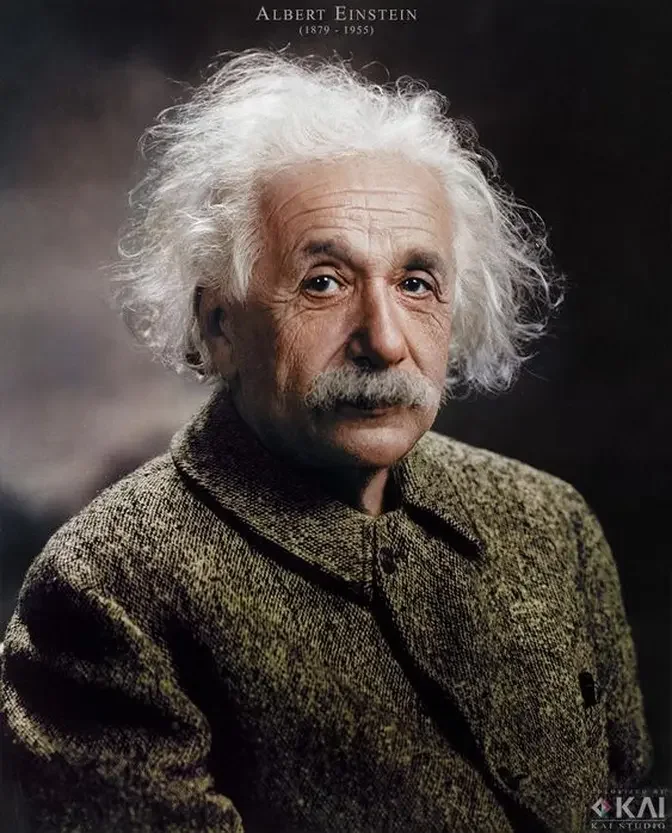
Albert Einstein, the icon of genius.
Why? Because he figured out E equals mc squared?
Because he didn't like socks?
Nope, because he came up with the most powerful idea in science, general relativity.
His masterpiece is now 100 years old.
And while the physicists are partying,
the rest of us are left wondering what the f*** it's all about.
Well, here goes.
At 26, he figured out nothing less than a new theory of space and time.
It led to a nifty way of simplifying physics
by treating space and time as one thing.
Space-time.
But Albert was just warming up.
He wasn't happy with Isaac Newton's mysterious force of gravity.
Naturally, he started working his own theory.
And sure enough, he cracked it.
Mass causes space-time to curve.
The natural motion of things is to follow the simplest path through space-time.
But since objects with mass curve space-time,
stuff moves towards the most massive object.
That's what you feel as gravity.
It's warped space and time that's keeping your feet on the ground.
Warped space.
Might sound too sci-fi to be true.
We can measure the bending of starlight
as it passes through the warped space around the sun.
Warped time sounds even more ridiculous.
But take an accurate clock to the top of a building
and you'll see it runs slightly quicker than one on the ground.
That's because as you move away from the centre of the planet,
space and time are less warped.
Most amazing of all, Einstein's theory told us that our universe has a beginning.
Everything is expanding out from a hot, dense origin 13.8 billion years ago.
But here's the catch.
We've spotted that the universe is expanding faster than Albert's theory predicts.
Could the old genius be wrong?
To stick with his idea, we've had to invent a made-up energy.
Dark energy.
To account for the speedy expansion.
And we've had to assume there's an exotic form of dark matter
we haven't detected yet either.
These two unknowns should make up 95% of the universe,
yet we've never detected them.
That's the sort of thing that keeps physicists awake at night.
So they're plotting some seriously big experiments
to put Albert's theory to the ultimate test.
For the last hundred years,
Uncle Albert's great theory has passed every test possible.
If it succeeds again, physicists will party.
If they find its limits and it finally fails, they'll party too.
Physicists are funny like that.