Trout and potatoes has long been my favorite backcountry meal! I've been cooking this particular camping meal since I was a Boy Scout. I've tried every iteration you could possibly imagine not only changing the recipe and technique, but also testing different stoves and cookware always trying to get the best performance possible without needing to carry too much weight in my backpack.
My: "perfect trout and potatoes meal quest" is really what started me on my journey of being a inventor and manufacturer of specialized camp cooking gear. It's how I ended up launching my own company located in beautiful Utah USA where we do much of our own manufacturing in house, but we also ship our products all around the world to folks who appreciate having the best quality and performance in their camp cooking gear possible. The philosophy is quite simple. We at Firebox Outdoors llc. Develop and sometimes manufacture the gear that I want to enjoy on my own adventures. Then I make these videos to share my experiences so my customers can learn about and hot to use our products while I also continually look look for improvements to make in quality, design and durability.
Here are links to some of the gear I used in this video:
The video follows an outdoor cooking adventure where the creator catches rainbow trout and prepares a gourmet meal using a specialized portable stove. After demonstrating fish skinning and cooking techniques, the creator tests the stove's oven capabilities by baking orange rolls.
The first thing I saw when I came down here was these blue dragonflies.
So, I tied on a blue dragonfly.
I'm pretty sure they're not dragonflies, but they sure do look like it.
One just jumped up my bubble.
Whoa! Oh! That was a bite!
Oh, it's just a little rainbow.
Man, that's a small fish.
He's dinner-sized.
Maybe I'll just keep him in my net here.
He might escape, but that'd be okay.
Pretty cute little rainbow.
Whoa! Got one!
Oh, this one feels a little bigger.
Oh, yeah. That's a nice trout.
He would definitely take care of dinner.
Oh, yes!
Woo-hoo!
Look at this guy.
Yeah. That's dinner.
All right, little guy. See you later.
I'm just going to find a clean log or a clean rock that I can set it on
and let it just dry out just a little bit, just enough that the skin isn't so slippery,
and then I'll skin it.
I've got another one. This one feels pretty big.
Oh, what a beauty.
He's putting up a great fight.
What a beauty, huh?
Look at that guy.
Let's let him go.
Woo!
There you go, buddy.
Wow, that was fun.
I've got another one.
Yeah, buddy. Yeah!
Woo-hoo!
Very fun.
Let's let him go.
Okay, let's see if this is dried out just enough that it's not so slippery.
There's still a little bit of moisture there, but I don't think it'll be too bad.
I always start with these fins down here on the bottom,
kind of pull them back while I'm pushing my fingernail between the meat and the skin,
and then you can just kind of keep doing that
as you make progress pulling the skin away from the meat, just like that.
When I get about this far, I usually switch and go to the other side.
And then when I get to the dorsal fin, I usually just use my thumbnail and forefingernail
and pull those bones up and out.
See how that took a little bit of meat with them, but not very much.
Then from here on out, you just kind of pull it out, other than I pull this fin out as well.
Just a little bit of constant pressure, and then it'll finally just release
and those bones will pull out along with the fin, just like that.
When I pull it back, I try to get as much of that good tail meat as I can,
and then I cut it off right there.
I threw my line in one more time, just like I always do, but I caught a fish.
Definitely putting up a good fight.
That should be plenty of potatoes.
Let's get some garlic and see if I can smash it.
That'll probably be enough garlic.
And get a little bit of this red onion.
This was the smallest red onion I could find.
Freaking huge.
I think that's probably enough onion, too.
Let's get our stove set up. We've got some camp robbers up here.
Come on, buddy. This one's not very shy.
He's looking to see what I have.
See what he can steal.
He's burgled other people's camps, I'm sure.
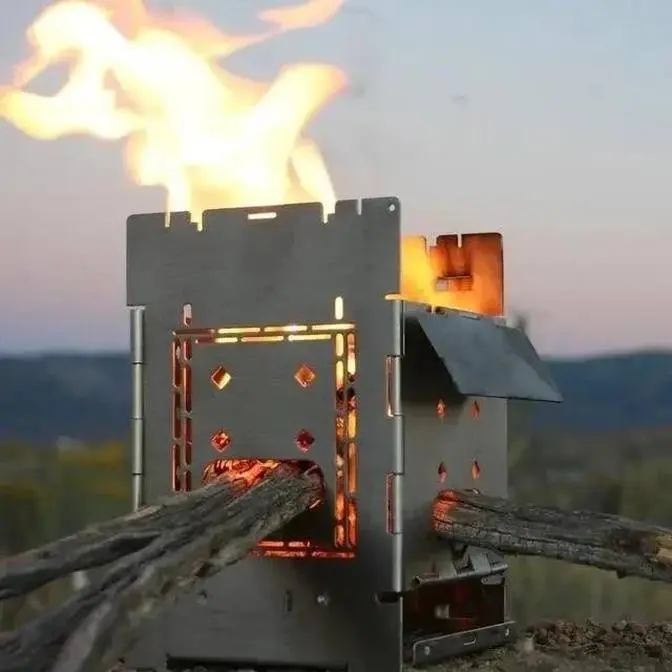
Like I was saying, I'm going to be cooking with the Hexagon today,
and I actually have some new products that I'm going to be testing.
So let's get the Hexagon out.
The whole kit fits in this one fire pan tin.
This is the actual stove.
Then down below we have our fire sticks.
Set this up just like this.
We'll put our folding fire grate down into place.
Let me show you our side burner brackets.
Now I've got two different versions here.
This one is to attach back here.
And that's so that you can have your oven set up.
Just like that.
Then we have the side burner brackets that you would use on the inside.
Just like this.
You could set up one on the other side, and you can set these up at different heights.
This whole burner could be put on the outside.
Take it out, and I could put it here.
I'm going to use these side burner brackets on the inside,
and I'm going to set this stove up with the locking fire sticks.
So let's go ahead and just set this up here.
I think I'm going to go a little higher.
Go into this position.
And then this is where I'm going to cook my trout.
Let's get our locking fire sticks in place.
Once again, they go in the hole, and then you rotate them into the slot.
Just like that is how I like to set them up.
Perfect.
Get our heat diffuser plate on, and we'll light our burner.
I have some beautiful beef tallow that I'm going to be cooking with tonight.
This was given to me by a friend, and it is wonderful.
Let's go ahead and get our potatoes in first.
They'll take the longest to cook.
All right, those are nice and golden brown.
Let's see if I can just flip them with this shape of the saute pan.
All right, I'm going to kind of leave them piled over there.
Toss this a little bit, because this is all going to continue to cook along with the trout.
Let's add our beautiful rainbow trout.
Look at that.
Then we'll cover it up.
Let's see how things are looking.
Look at that.
Oh man, that's beautiful.
Maybe what I'll do is set it over here on this plate for a second,
so I can make sure I'm not getting stuff too brown underneath.
Keep things moving around a little bit here and there.
Does that look beautiful or what?
All right, let's put our trout back in.
I think it's going to be ready to take those bones out pretty darn soon.
At least the tail meat.
I think we need to give it just a little more time.
Let's take a quick peek.
There we go.
Look at that.
Then I should be able to just lift that skeleton right out of there.
Just like that.
There we go.
The bones are out.
Now what I like to do is spread this trout around,
so I can hit it all with a little bit of lemon juice.
Make sure we get these straggling bones.
The last couple bones here in these edges.
Oh, there the seeds are.
They're all coming out now.
They were hiding.
All right.
And one more right there.
I want to add some Hakata spice out of the end of my spatula handle.
This is a special Japanese spice.
Hakata spice.
I don't know how many places it's available in the U.S., but we do carry it.
I won't add salt, because Hakata spice is salt-based.
So we'll just add some pepper.
There we go.
Let's just turn some of this over so we can see some of those pretty veggies.
Onions and garlic.
And maybe what we can do is get some salt and pepper on these potatoes,
because they didn't get anything.
A little bit of salt.
I'm trying to just get it just on the potatoes, but hopefully things aren't getting too salty.
Look at that big slab of trout meat.
It's a beautiful thing.
A little bit of trout, potatoes, and onion.
Oh yeah.
The seasoning is perfect.
I'm going to go find a nice place to enjoy my dinner.
That trout is perfectly cooked.
It's not overdone.
If you get it right, it melts in your mouth.
Wow.
I've cooked trout and potatoes a lot of times, but I've got to say, this has got to be one of the best.
It turned out really, really good.
I literally just scarfed that down.
Every last bite.
Wow, that was good.
I was just setting up this oven.
Now if I put this oven lid keeper,
and then I just lean it forward far enough that it captures that first layer.
And just like that.
So let's go ahead and get our air bake pan in there.
I'll go over and grab some cinnamon rolls.
Actually, I have orange rolls tonight.
Did not set a timer.
So I don't know how long these have been going, but let's see how they're looking.
They're raising. Rising.
They're not browning up yet, but it would be a little bit early for that.
I might go ahead and just turn it up a pinch.
It's been a few moments.
Oh yeah, look at that.
Getting brown on top and on the back.
I should have oiled the pan first.
They're sticking just a little bit.
All the sugar is what's sticking.
Alright, so that should work great.
Something like that.
A few moments later.
I am going to go ahead and turn the burner off,
because I'm a little bit worried that they might be getting dark on the bottom.
Let's look at that and see what's going on.
Just going to slide this back.
Get a hold of our air bake pan.
And let's see if these are getting dark on the bottom.
Ooh, they are. They're perfect though.
I stopped them just in time.
Let's hit it with some cream cheese frosting.
I took the frosting that comes with these and I mixed cream cheese into it.
I've got this orange here.
Since these are orange rolls, we're going to use some orange zest.
Oh, that bottom is just brown enough to be crunchy.
Well, the results were good.
These orange rolls turned out really nice.
And as far as baking experiments,
that actually went really well.
For being the first time of using gas with this hexagon,
success.