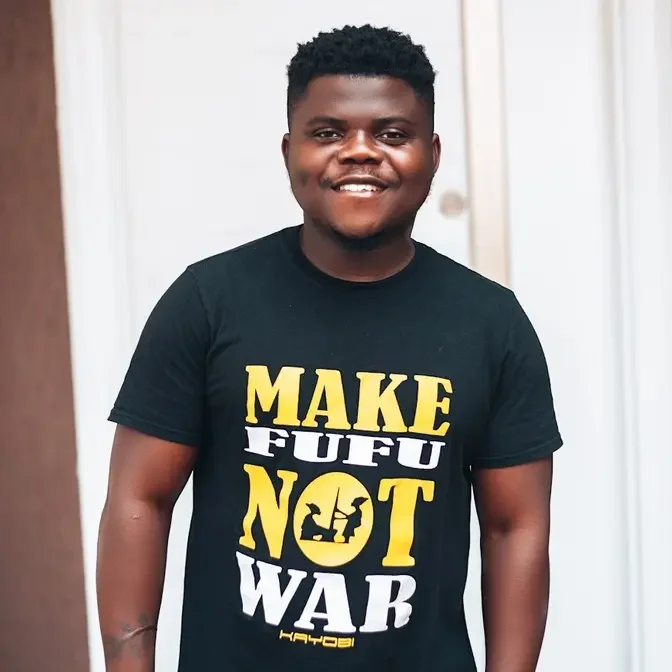
The Image of AFRICA has been DISTORTED around the WORLD & We are CHANGING the NARRATIVE via YOUTUBE videos One Country At Time.Until the HISTORY of AFRICA is told by AFRICANS, the story of GREATNESS will always GLORIFY the IMPERIALISTS!. We are currently in the 6th Region Of Africa which is the AFRICAN DIASPORA to CONNECT the Dots by Bridging the gap between Africans across the Globe
An African entrepreneur is empowering thousands of women in Northern Ghana by monetizing indigenous skills in shea butter production and basket weaving. By prioritizing traditional knowledge over Western economic models, the initiative provides fair income, improves healthcare and education, and fosters financial independence for rural communities.
You know most of the world they're talking about Accra but there's so much more to Ghana than Accra.
When you hear the name Ghana the first place that comes into your mind is Accra which is our
capital city but Ghana is made up of 16 different regions and I believe that each and every region
got something unique to offer hence the reason why I am taking you on a journey to the north.
And so when we came here to the north I was like wow these people are smiling, they're peaceful, they're friendly.
But I really want to know yeah is this the happiest region in Ghana?
I found myself in here I was happily infected and I'm not even complaining.
So the big question is why am I here? Let me explain.
So I found an African born in Togo currently investing and empowering over 10,000 women
in a country where I was born. Currently how many women are you empowering?
The direct employment in upper east region of Ghana in the north we have 6,000 women
that weave in baskets as you can see and we're working toward 10,000 that's direct employment.
Imagine each of those women have a family that depends on them. So we're talking about quarter
million of indirect empowerment. That is different from the share product? That's different and for
the shared nuts we have 1,451 women. They collect shared nuts and then we have a center that turned
the shared nut into share butter and there we have 160 women. This is why I am here to celebrate him.
You see in Africa when you see project this mega you might think that there is a white person
behind it. But no this is owned by an African. He is a village boy. You're a village boy?
I'm still a village boy. So we're farmers that's how life was.
Working the farm, growing beans, growing peppers to sell in the market and by sixth grade like all
of us typically do in the village drop out school. After that I helped my mother in the farm
that was the reason to drop out. He lived the village life. How was life when you were growing
up in the village? Life in the village I always said that it's like a typical West African market.
It's noisy, it's chaotic but within there's an order. My father has 42 children and my mother
has eight children. That's how life was. Left the village to the west and then I met a lady and I
end up in the state and I end up going back to community college and we end up at the university
where I study capitalism and I got to understand that the world is against Africa economically.
Return to empower the village by establishing a megasheep butter factory.
And then I went on to learn about colonization and neocolonialism and I look everything that
has been done in Africa and I thought that me as the son of Africa coming from Togo
what would I do? And when I look my mother that never set foot in school
I thought then she matters. She's a person, a human being that matters but she has skills not
because she didn't go to a western school that she doesn't have anything to offer.
So that got me to start thinking maybe we got to do something a little bit different.
Maybe we need to use our traditional ways of life and bring that to sell to the world as opposed to
trying to adopt the western world and somehow get our poverty out of it. I'm not saying that's not
the way but I felt that we got to find a different way because it's not working. Our people are
suffering. So 20 years ago I decided that we can inform our women to use the traditional knowledge
that we have and mobilize them if it's a shea butter, if it's a basket weaving, whatever is
traditional that we know that we don't need to go to a western school and then bring that to the west
and bring the money back home so that we can reinforce our own communities and build the next
future. What an incredible guy man. What I can tell you is how it was for me when I was growing up.
We didn't have a place that my mother can go work and earn a fair income. We didn't have a place
where my mother can go sell the shea nuts that she collect and have a fair income. So the difference
is it's about fair income for our traditional contribution to the world. So now that difference
translates to something meaningful. Ability to have food, ability to have gender equality
mean that I as a woman can provide for myself. Ability to be able to send your own child to
school and most critical thing that keep all of us alive is health. Ability to take care of our own
health. We always use the shea butter money to go and farm. Sometimes we use it to send our children
to hospital and we use it to buy books for our children and the way you come and buying we are
happy and we like what we are doing. There is no work here unless the farming and then
the shea butter selling that we are doing. You're saying that the only work in the community,
the big community here is only farming and shea butter or shea nuts. Yes.
I think it's empowerment because if they were not doing this what would they be doing.
So I believe that this is a second chance in life man to make money for yourself,
take care of yourself and the family because it's not just you because these are women,
they have children, they have husbands. So it's about time yeah for them to take care
of their families and a big shout out to IEA for making that possible man.
IEA is life in my native language. IEA life has become synchronized. Wow. You mean life in balance.
I think the biggest part too is that it's not having the people change their culture.
So everything that they're doing is something that's been passed down for tradition from time
from generation to generation and now just pointing a light in the US, in the west to buy
full circle and also they keep their dignity and knowing that they have value.
About 23 years ago at the age of 22 decided that African knowledge must be the reason,
the path for African future and that means to use back to my mother that we can use our
traditional method as you see behind you all around you to have a product that we can sell
to the world that come from our tradition and then we can use the funds from that to pull back
into our communities so that the next generations like myself dropping out of sixth grade at school
will not drop out otherwise.
You know what you need to do for me? We are on a journey to take this channel to 3 million
subscribers. Have you subscribed yet? Are you new to the channel? Join the best African family on YouTube.
Mommy. What? This is the craziest thing that's ever happened man. She asked what if my hair comes like
this or did I spray it like dye it to be this way. I told her I dyed it and will you show me?
Show me. I don't know how to. God dyed it for me. God dyed your own?
But I'm even super excited to be going on this particular mission with my biggest inspiration
on YouTube. Literally this is the man who inspired me to be on this particular journey.
My brother. The first time I met him I was shaking man. I couldn't even interview him because this is
the guy that I look up to. I mean he inspires me a lot and guess what the day he tested me that
yo where are you? I'm on my way to the airport just come and meet me. I'm like yo I'm from the
village man. I'm in the village that time at like 2 a.m. I was on my way from Takradi to Accra
just to meet him. You know I was stuck in my room way back in 2017 and I started watching YouTube
videos and your videos popped up and guess what I'm like I want to be like that brother man.
But you know the kind of trouble that he does I'm like I can't afford man.
And you can't create something like this without being worldly. It's beyond money but yeah you
won't really catch anyone here without it though. The experience is unforgettable and that's the
way you should be living life. I can't afford but I'm gonna go back home and I'm gonna do a lot by
Guess what here we are today. Let's go baby. But is it not even more beautiful knowing that
where we're staying is owned by a fan. And you're the one behind this. How long did it take you to
build this place? We started at 2014 and then we break for a while and then we pick it up in 2019.
So I think completion was this 2023. I made my mind that we have to put it in a good
standard so when people come they'll enjoy really enjoy Borga. Yeah. She's a fan that's why I have
to do this for her. Yeah. I said when you were in China, when you were in bars, when you started
doing your videos in the hostel and they were laughing at you I saw all that. So when I saw
your crew yesterday I said I know you somewhere. I was so excited. I quickly called my husband.
I said my man is here. It's a pleasure.
You know what come along with us we're just gonna have a very busy day. I don't know what's gonna
come up or whatever happens I will let you know. And on our way to the village we encountered our
first major problem. We literally got stuck in the mud. We've been here for more than 30 minutes.
It means with an ambulance or with a smaller car with a pregnant woman. They would be stuck in this
for a longer time. The sick woman would be in the car at this time. This pressure on the car
could induce forced labor. How does this work if someone's pregnant in the car right now?
They're likely dead by now. What I'm seeking for is our area here. There's no shifts compound.
There's no clinic. So for that one you are suffering. If anybody is sick or the person
is on labor we have to send a person down there and it's far. There's no car. I personally love
exploring Ghana beyond Accra but I weep for this country when I leave the capital city
because it seems like we're building our country as if the entire country is just Accra.
Because I personally don't understand why ballot boxes always make it to this part of the country
on time. But basic amenities like water, electricity, clinics barely make it up here.
Sometimes we can have three women in labor where you have to keep one outside.
Deliver the baby outside? Yes sometimes we do deliver them outside on the bed here.
That means that the space is not enough. So you want to create room for the baby to come out.
But it's when there's a problem with the baby, baby cannot breathe well or something,
then you separate the baby, put the baby here, and work on the baby. Afterwards you give the
baby back to your mother. But if you need to refer or baby needs a warmer and oxygen,
then we put the baby here for the heat. Then we apply the oxygen. But currently the oxygen is
not used. Our communities really deserve better and it's about time.
So my brother, we're at a special place. I know we're in nature, but I know we have
something super special today. So I'm super special for you. But can you explain to us
where are we right now? What's the area? And why are you bringing us here?
Well I'll tell you what's the area. We're in Africa first of all.
And this area is the upper east. And we're in the village of Senegu.
And what we see here, all around us, is chia trees. Nowhere else in the world chia trees grow.
Look, that's chia tree, that's chia tree, that's chia tree. And chia tree is called life.
So where we are today, here has what we call a village that all my brothers and sisters come
to witness and to see a woman using the century of centuries age way of doing things.
That is how do we make shea butter traditionally. I really want to know, yeah, who made us believe
that shea butter is literally for poor people. Because when I was growing up in Ghana, shea
butter was my only lotion because we're poor. And that was the only lotion that we could afford.
But did you know the shea butter industry in the global market worth 4.1 billion dollars?
So if that is the worth of shea butter in the global market, then let me ask a thought-provoking
question. How are the people from our villages benefiting from this mega billion dollar industry?
Whenever you find yourself in the northern part of Ghana, there is one tree that is so
common in the entire region. And that is the chenat tree.
Look at my background. Every single tree that you see is a chenat tree. And guess what? I thought
it's more like a plantation that people do it, but apparently it's free for everyone. I just want
to know, yeah, do you guys have a plantation for chenat or you just grow it by yourself?
Just recently our company is trying to plant the, grow the seeds and then we'll find a place and
plant it. But everywhere you go in this region has the what? The chenat tree. Actually what we do is
we have cooperatives in the villages where we have formed the group women into groups.
Then train them on how to pick the shea nuts in organic way. When I say organic means
we pick the nuts in such a way that they are not contaminated with chemicals.
Is this where you guys keep your raw material? Yes, this is the raw material warehouse.
Okay. So you, you buy the raw materials from the villages? Yes. So even when it's out of season,
you still have enough. Yes.
I love the fact that they hype me up. So even though I'm tired, when I hear the sounds that
are coming up, I'm like, I need to keep going. This is what women empowerment looks like.
Giving them craft, allowing them a skill and then allowing them to make something beautiful.
This is what we need. It's each one teach one with those who are given much, much is required
and this is our responsibility. This was like a therapy because your feet, your fingers, all,
all of them are literally enjoying. But the thing is like, if you have never done this before,
don't try it at home because you got to have a good waist because all the time you have to bend.
I just feel like I just did a morning workout. Like gym? Yes. Like I'm sweating. Can you see?
So when I came in here, they were washing the chenat and I'm like, what a best way to join
them to wash. And guess what? After all that music and dance, while I was washing, we had to now
carry it. Basically the chenat will be here for two days, depending on the weather. So if the
sun shines the entire day, two days is enough. But if you have a little bit of rain droplet,
it's going to take you three days.
You see that? I can't see properly. Sweat in my eyes. Don't say I never worked in Ghana.
It's not just champagne. So there's, so there's seven steps. How long does it take
to go from that to that in there? So from this nut at this end to start from here
to get all the way doing all of these steps to here, 24 hours, the traditional way.
Hey, so how many of your girlfriends or people that you know would know this process? None?
How many of your friends would want to come and see the process? All of them.
Who are you going to bring? All of them.
I'm actually trying to show you the process from nuts to your shea butter. So this is actually
the crusher unit where after drying up, they need to bring it to a machine. So come close.
So they pour the nuts into the machine.
And after crushing, you come and roast it in here. So that's what I'm about to do.
So this is the roasting area. I love the fact that it's now mechanized. You know,
this is the difference between the local way of making things and empowering the local
so that they can produce more. One of the things that I really appreciate about Ayeya is the fact
that the health of the women working here is their pride. So if you can see the women working
in there, they all have the gears for their eyes and their nose.
What made you bring such an innovative idea to Ghana?
It's not that I brought the idea to Ghana. In reality, there's no Ghana, there's no Togo in
my view. And when you step outside Africa, you begin to see that we're all African. And if one
place in Africa has been oppressed, all of us have been oppressed. So what I'm trying to say
is that I believe in Pan-Africanism. I know that I cannot reduce all the poverty in the world.
But what I know I can do is demonstrate a model that the future generations can follow that there
is a way for young African man that somehow we belong to the world market in our own terms.
This is one of the models?
That is one of the models, yes.
And how long has this been in existence?
It took us two years to build this place. And there's 20 hectares land, as you can see all
around you. And you can also see that with Ayeya here, it's built in a traditional setting.
The last seven months, we start here making shea butter. And then with that shea butter,
we take it to all the way to Accra. And then in the eastern region, Kede, we'll make soap
into black soap, all in Ghana, and then bring it back to Accra to make finished product and then
ship it to US for the shelf before the money comes back to Ghana and Togo. Right as I speak,
for the first time ever, we are making 100%. I won't even say Ghanai made, African made.
I love that. A round of applause. Thank you.
So after stirring it for hours, they need to leave it for 24 hours. Right after 24 hours,
they have to what? Now scoop it into a rubber. When you put it in a box.
You put it in a box for another 24 hours.
This is where your shea butter comes from.
From, I've talked to many of the women. I first came here about six months ago,
and they were telling me we didn't have consistent income. Okay, we might sell one basket or someone's
trying to pay us under price for our work. Now they have a standard price for everything
that they do. Me, I tried to do this and... You failed.
It was disaster. At the first, if you don't weave, you can't get food.
You can't get food to eat. Food is problem. But the money, if we are weaving,
if the money come, we use the money for paying our children's school fees.
And second, we use the money to buy our clothes, food, and everything you want.
There's no machine in here. It's just the hands, which shows that Africans are super creative.
How much do you weigh? Do I even know? 75.
75. I promise you, this bag can pick you. Are you sure this one can carry me?
See, the basket can carry me, and it's still okay. Look at that.
What does that say? IEA basket. What else? Edna, the person made by Edna. Oh,
the name of the person who made it is in there. My name is Edna. The time that we start IEA
basket weaving, that time we couldn't get money to do our home choice. But now, we can even get
money and buy our home choice. Even because our children go to school nowadays, we can pay the
school fees. You can see each basket custom, so you can trace it back to where it's been built.
It's so beautiful, man. Listen, it's about time for us to empower our own people.
There's an African empowering Africans. This is crazy, man. I'm so inspired with what this guy
is doing in here, and I feel like as soon as I leave in here, I should also go out there
to do something in order to touch thousands of lives like this one.
I remember yesterday, you said, I'm from Ghana, and I've never seen this in Ghana myself. See,
the reason why I said that is the fact that the guy who is behind this project is from Togo,
and he is in Ghana to do a project like this. So, first of all, he believes in the ideologies
of Nkrumah, which makes him a Pan-African, and this is what we call the African dream. It's about
time for Africans to move from one African country to invest in another African country.
So, literally, why I'm saying that I've never seen anything like this before,
it's like 10,000 women being empowered in a country that I am from, and the guy who is
empowering them is from Nesdo. And I'm like, you know what? This is beautiful. This is more like
taking people out of poverty in your own way. We have to be pragmatic as Africans. We need to
stop talking about, oh, we have to do this. This guy is on the ground doing it. So, if you ever
feel like getting the ----, brother, reach out to us, and we're going to deliver at your doorstep.
So, we're here in Boga with my sister Brenda, Rotemaya, and the reason that we're here,
my big brother, Big O. Tell them why. I'm not big.
The real big people is what you do for the community. That's what defines how good you are.
When I was a kid, I grew up in a village called Kabole in Togo, and we have to go down the stream
to get water. And from there, I learned that water is not just a necessity to be alive.
It takes all your time. Now, we're in northern Ghana because all Africa is together,
and we're opening a water well that will give 400,000 people water. And I learned that from
where I started. So, that can only happen because you have to sell the product. And the product we
sell is called ayaya, and the ingredients come from here. So, something has to come from here.
So, I know everyone is getting praise, but one big thing I know,
from time last night, people are working overnight that maybe are not getting the
credit that they deserve. I know you're here for mourning, to make sure that this happens
on time. So, I just want to say thank you to everyone, and I truly appreciate you. Thank you.
Oh, me? Yes. God bless.
The water is sweet.
Thank you. Thank you. Thank you. Thank you.
How do you feel after tasting the water? I feel refreshed. I feel alive. You feel alive. I feel
alive. This is something that did not exist, that you brought it in here. Yes. I mean, how does that
make you feel? It makes me feel honored. Like, it makes me feel honored. I feel grateful, and it
makes me want to do more. Because I know water is life. Yep. When you go so many different places,
sometimes you need a different perspective on life to understand life. And I understand what
means to this community. So, I just feel proud. This is a thousand people living in a community
that they had to, you know, walk far away, miles away just to get water. And just,
within how many minutes does it have to take you all to get water? Actually, before this,
people used to spend 30 minutes, some even try even 45 minutes, sometimes an hour. Because you
get there, it's too crowded, and you need to spend an hour, sometimes more than an hour to get water.
Just to get water? Yes. And how long is it going to take you guys now in order to get water?
Just some five minutes, some 15 minutes from the school block to this place, some five minutes,
you're okay. How does that make you feel after hearing that? I just, like I said, I feel so
honored that, you know, you can put in work, and then you can bless someone else. And you know,
now the children are going to be able to go to school easier. People are going to be able to
work easier. Life is easier. That is what you want for your brothers and your sisters. So,
I just feel like I'm helping my family. And that's how it's supposed to be.
The passport heavy that we all know, is that man who sit on the arch? Is that man who always talk
about private jet? Is that man who always uses business class? I mean, this is like going back
to your roots. Yes. And this is something unique. Are we going to see a different passport heavy
now? Ah, you'll see just a more balanced passport heavy. This has been in my spirit.
My brother here, he helped awaken that spirit even more. But it's been here. I've been helping
people in different ways. But here on the continent, it's because of my brother. He's
helped me to see more. All right, so guys, we are here. We are going to be planting the Maya tree,
right? What are we doing? We'll plant the tree together. And what's your responsibility for the
tree? And you'll use the water from the well to water this tree? Yeah. So when we return,
we'll come back and you will show us what this tree we've named it Maya, how this tree has grown
using the water that Jabiru has blessed the community with. Yeah. All right. So now we'll
plant together the Maya tree. We are planting the Maya tree. Everybody say Maya! I have to go in
there? This is the first of many. We want to encourage the youth to take care of the community,
to plant and grow. Because with one, each one teaches one.
It's so incredibly important. And we must inspire and empower the youth.
I thought you had something in your eye. No, I didn't. What happened?
It was very emotionally overwhelming. And to see this community empowering women,
empowering them to be independent, to have their dignity, to have a space that they can call their
own, that they can craft. It was just so incredibly overwhelming because I know what it means.
I know what it means for them. I know what it means for their future. I know what it means
for society. And so to see this, to see what AYEA really is and all the things that we're
supporting was very overwhelming to see because it's something that I truly, truly want to see in
the world. And to see it happening and on such a scale so well organized is so incredibly beautiful.
And I'm just honored to be playing such a small part. The main thing that my parents instilled
in me was to make sure that the opportunity that was given to me that I extended to other people.
So my heart has always been to gain knowledge, to gain experience, and to come back and invest
in the communities that I know need my help. So I think that's why it's so emotional for me to
see it happening and to see what an impact this center and all the centers like it have on the
community because if the women are taken care of, the women are empowered, the community advances
forward. So AYEA is here to stay. And listen, I've never been paid to say this, but I want to be the
official ambassador for a product like this. So you know how we do it. I'm not coming here to beg
you. Like I said, it's a revolution for Africans to start supporting Africans. So you know what?
You're a diaspora. You love my videos. You want to give back to the community.
Go to that. Where can they get it? Amazon? They can go to Amazon. They can go to AYEA.com. A-Y-E-Y-A.
That's it. I'm out.