
How to Play Low Notes on the Flute
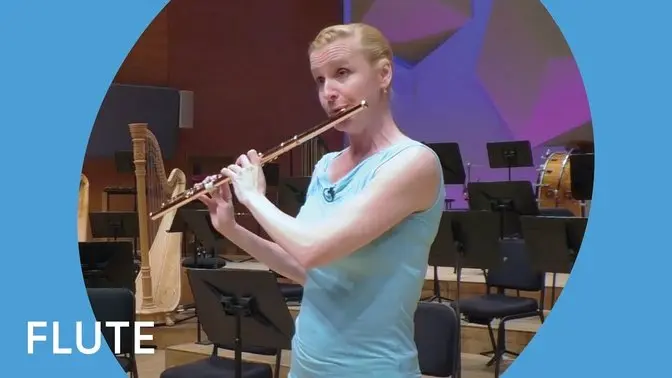
#Education #music # instruments # Flute # Orchestra # instrument demonstration
Comments are disabled for this video.
Hi, it's Amelie.
Today, I'm going to talk about the low register.
To play the notes in the low register, you need to blow warm air because it's going to go slower.
You need the air to go a bit slower than in the high register.
So to do that, the first thing we'll do is that we will blow warm air in our hand.
Like this.
And then you can try fast air as well.
That is cooler.
So then we take our flute and I'm going to take a G and I'm going to go down.
And I'm blowing warm air.
So that's the first thing that could help with the low register.
The second thing that I see very often in students is that people want too much
and then they want to go low so they think low and they cover the hole because they go like this.
Like this.
But the problem is that by doing this, you cover the hole.
And then the angle in which the air streams hits the embouchure plate is not the right one anymore.
So just keep a straight head, do less work in a way.
I play in the high.
There's not a big movement.
There's no movement of my head like this anyways.
So that's something that could help.
Be careful not to change the angle of the air too much.
There's a slight movement here when I go from one octave to the other.
As you see.
So when I go higher I push a little bit my lower lip.
But most of the time I'm not even aware of that.
So I wouldn't put too much emphasis on that.
Another thing would be in your belly, how to feel it.
In the high register you'll feel the energy a bit higher.
The air coming faster with the energy coming from your upper part of your belly.
But when it's lower I tend to feel the energy lower as well.
The air, everything being more...
More like that.
So I try to think of a relaxed way of blowing.
But you still have to support the air but it's a bit lower.
And the big thing everyone always wants to do is play the low register louder.
It's a big thing.
So what I try to do when I want to play louder in the low register.
I try to go with the colors more than the decibels.
And I use my nose.
I go...
A little bit in my flute.
Which is totally different from a more...
Like that would be very dark.
And if I do a more transparent color.
So that.
And of course there's the intonation.
To do the more transparent sound in the low register.
Instead of going in my nose like this.
I think more of...
A sound like...
A softer sound.
Not in the nose.
More in the mouth.
More a bit back.
So you can play with it and try to find your colors.
Find different sounds that you can do with your flute.
There's different things you can do to improve your low register.
You can do long tones.
So you start with a note and you go to the next semitone.
And you go to the next semitone.
You do the whole register of the flute like that.
But let's just do the low register right now.
I'll start with a C.
And I'll do three notes.
I'll do C, B, Bb.
Then I'll breathe.
And I'll do Bb, A, Ab.
And then I'll breathe again.
And I'll do Ab, G, F sharp.
And I'll go like that.
You can say...
One day you practice it soft.
One day you practice it loud.
One day you practice it in the middle.
I'm going to do it in the middle right now.
Try to find a note you like.
And keep the same sound quality throughout the whole exercise.
And just blow pretty much the same.
And keep the air high.
Not too much inside.
Another thing when you play low notes
is that sometimes when you want to do a hard attack
it's a bit slow to deliver.
So I practice sometimes playing loud.
And going...
Just no tongue first.
I go...
And then I go...
I give a big tongue.
And then...
Again.
Just to...
I don't use that necessarily as much in repertoire.
But it kind of widens my possibilities.
And then I explore.
Sometimes it cracks.
It's okay.
When you practice it's time to try things.
And crack.
And it's okay if it doesn't sound good.
Because you're just trying to widen your possibilities.
Explore.
Find ways to do things.
If you found this video helpful, please like it.
If you have any questions or comments, leave them in the box below.
And if you haven't subscribed yet, please subscribe.
There are more videos to watch here.
And thank you very much.
Hope to see you next time.