
Burmese Bronze Pagan Buddhs Statue with Maras daughters
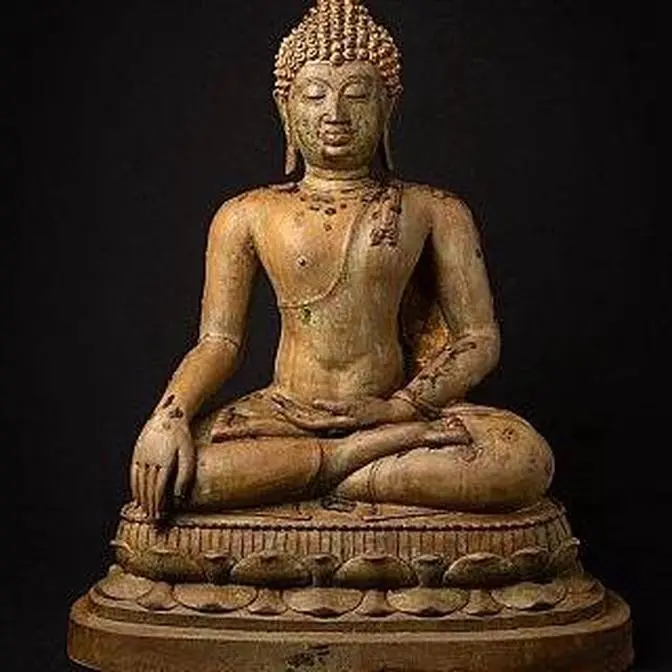
A rare Burmese bronze pagan Buddha statue with hand gestures in Pumaspasa
is seated on a pedestal with images of Mara's daughters in relief depicted across the front
of the base. This pagan Buddha statue, judging by the marks on the side, suggests that it once
had a reridos in which it slotted into. In Buddhist texts describing Mara's relationship
with the Buddha, his main objective was to divert and distract Gautama Siddhartha,
to prevent him from attaining enlightenment. In Buddhism it is acknowledged that Mara is
both a literal and psychological interpretation of one's thoughts and can be interpreted as either
an internal voice that is manifested in one's mind or giving in to the temptations emerging
from our deluded impulses. Mara has been mythologized as a battle between good and evil.
Although the most popular story related to the enlightenment of the Buddha
mentions Mara's three daughters, some Buddhist texts mention five daughters,
which include two lesser-known daughters named Pride and Fear.
Possibly the scene across the base of the pedestal in which the Buddha is seated
shows the three half-naked dancing women in the center as the daughters of Mara,
Tanha, Raga and Arati, with a seated figure on each side of Mara's daughters,
being the lesser-known daughters Pride and Fear, each with their hair in their hands described by
Charles Duroisel, a French-born Burmese historian and archaeologist and co-founder of the Burma
Research Society in 1910 as well as a scholar in the Pali language.