
19th Century Burmese Yadnarapon Alabaster Buddha Statue
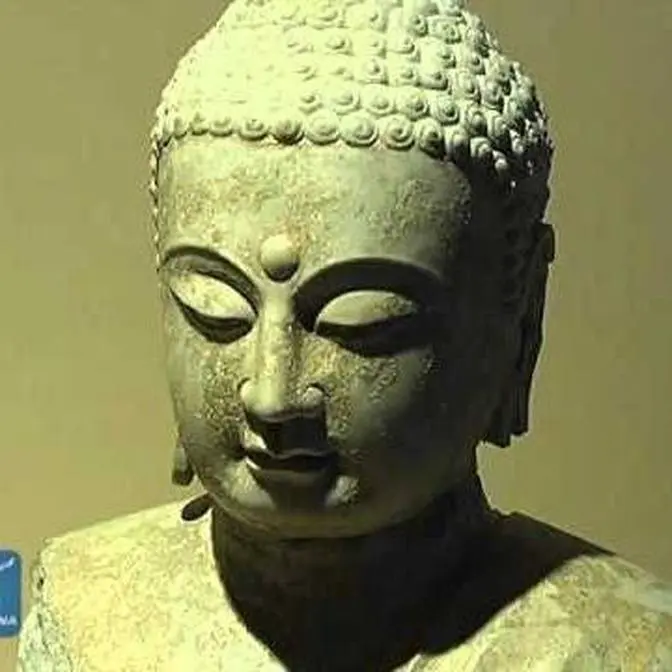
19th century Burmese Yadanapon Buddha, early Mandalay period.
The Buddha is seen here seated on the back of three elephants, converging into two at the rear.
This Buddha statue is shown with a frilled lapel seen in most Mandalay-style statues,
with hair curls carved into the stone and rounded ushnisha.
The fingernails of the statue are meticulously defined and proportionate as are the hands.
Yadanapon, located in the district of Mandalay,
was the last capital of Myanmar's Khonbaung dynasty,
founded six days after the full moon of Khaosan in 1859 AD.
Whilst historical records state that the city was established through the contributions and
involvement of King Mindon, who reigned between 1853 and 1878, his younger brother Prince Kanung
also played an important role in shifting the capital from Amarapura to Mandalay.
Elephants in Buddhism are symbols of wisdom, strength and compassion.
They are often depicted as the vehicles of bodhisattvas,
enlightened beings who help others attain enlightenment.
Elephants are also associated with the Buddha himself,
who was said to have been born from a white elephant that descended from heaven.
Elephants are revered for their intelligence, loyalty and gentleness,
and are considered to be protectors of the Dharma, the teachings of the Buddha.
In Buddhism, the uncontrolled mind is symbolized by a grey elephant.
It can run wild at any moment and destroy everything in his path.
The controlled mind is symbolized by a white powerful and strong elephant,
which can be directed wherever one wishes and can destroy all obstacles in his path.
In the forest, when he encountered an angry elephant,
the elephant had been wounded by a hunter and was in great pain.
It charged at Buddha, intending to trample him.
But Buddha did not run away or fight back.
He calmly looked at the elephant and radiated compassion and kindness.
The elephant felt the peaceful energy of Buddha and stopped in its tracks.
It lowered its head and bowed to Buddha, then turned around and walked away.
Buddha had saved himself and the elephant with his wisdom and love.
Another version related to the Nalagiri elephant and the Buddha
is when his maternal uncle Devadatta, being jealous of Buddha, endeavored to kill him.
Failing to kill him, he unleashed a drunken elephant upon him.
As the animal advanced upon the Buddha in rage,
the Buddha extended his hand, touching the elephant on the forehead, stroking it gently.
Calmed by the Buddha's loving and gently touched,
the elephant became calm and bowed down before him.