
Burmese Bronze Pagan Buddha Statue with Lotus bud Hair style
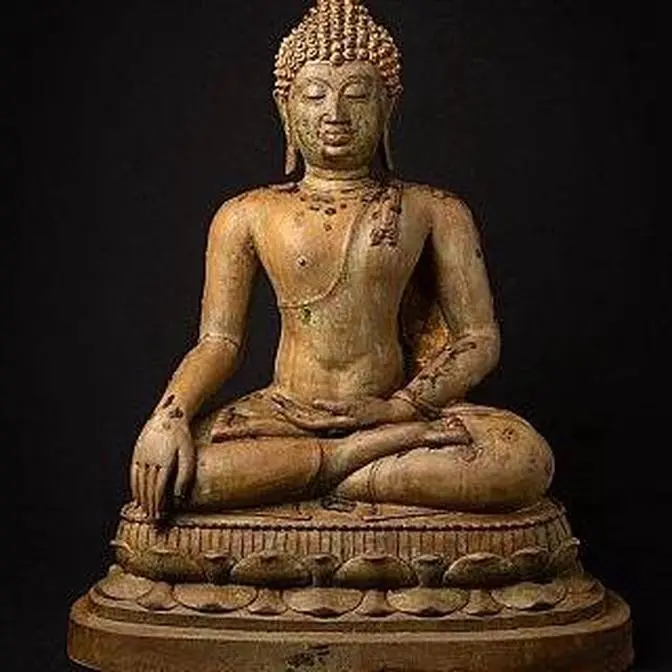
a Mies bronze pagan Buddha statue with a lotus bud seated on top of his head
extending across the forehead down behind the ears and crossing the base of the skull.
The large raised urna on the center of the forehead is referred to as the eye of wisdom
or third eye an auspicious mark seen on many Buddha statues symbolizing wisdom
consciousness and enlightenment. This statue was once fully gilded but now worn with a nice patina
The hand gesture known as Bhumispasa Mudra symbolizes the moment when the Buddha achieved
enlightenment. This statue is wearing a modest monk's robe with the lapel extending to the
middle of the chest ending with a frill. This frill is also visible at the center on top of
the lotus pedestal. The fingernails of the statue are meticulously defined and proportionate as
are the hands. It is worth noting that the lotus bud hairstyle depicted in this statue is rare.
This masterpiece with this lotus bud seated on top of his head likely represents the status of
a newly enlightened Buddha. The lotus flower in Buddhism symbolizes purity and spiritual awakening.
Most Burmese Buddha statues typically feature hair curls represented by small bumps
resembling peppercorns either with or without a finial. In the case of many pagan Buddha statues
a triangular finial is often present which may have once held a precious stone in the center.
The pagan empire reached its pinnacle of power under the rule of King Anuradha
the first king of pagan who reigned between 1044 to 77 AD. After embracing Buddhism King Anuradha
encouraged his subjects to follow the Theravada school of Buddhism and thus unified the whole of
Burma. Due to the unification of Burma and the adoption of Theravada Buddhism the crafting of
Buddhist iconography flourished. In a section of the Tipitaka, the Theragatha, verses of the elder
monks there is a poem attributed to the disciple Udayin. As the flower of a lotus arisen in water
blossoms pure-scented and pleasing the mind yet is not drenched by the water in the same way born
in the world. The Buddha abides in the world and like the lotus by water he does not get drenched
by the world.