
3: Shipwrecks and Ruins
7 Video Views·Mar 18, 2025
This week, we talk about Hubert Robert's The Shipwreck, accession number 1927.34 at the Worcester Art Museum. It's such an incredible piece, you might think that the artist spent his entire life painting naval landscapes and shipwrecks. But he didn't. So why did he paint this one? The notes for the show can be found online at accession.fm.
Follow the show @accessionfm
Instagram
Twitter
Facebook
Tumblr
Welcome to Accession. Today, we're back at the Worcester Art Museum.
Go to the mosaic court and head up to the second floor. Once you can see the giant mural above the
mosaic on the northern wall, head to the back corner away from the woman with a glass on her
ear. In this corner, you'll see two doors, and while we'll certainly go through the one on the
left in a later episode, today I want you to head into the door on your right. In front of you
should be two sisters looking on at the last few moves of a game of chess, and a couple arm in arm
going for a stroll towards the chess game, he with his hat and her with her parasol. He's almost got
the checkmate. If you look on the opposite end of the room from where you came in, you should see a
giant painting, where the top of the canvas is not squared off, but arched. And while that is somewhat
curious, we'll have to move beyond that, because there's something even more curious about this
painting. Today, we're looking at Worcester Art Museum, Accession number 1927.34, Hubert Robert's The Shipwreck.
Now, if you've spent any time walking through the European wing, I am almost certain that you've been
stopped by this piece. Almost every time I visit the museum, and I visit quite a lot, I find myself
sitting on the bench in this room, looking up at the shipwreck. In fact, its majesty is so clear,
I've had to think long and hard about whether or not to even write this story.
If you haven't yet, just sit here, and look up at the waves crashing on the shore,
the people fleeing the wreckage, the city folk running to the cliffs to look on,
and all underneath a brilliant sky that sings of the hope of the calm after the storm to the viewer.
All this on a brilliantly arched canvas, which is the kind of mysterious delight that needs no
further investigation. We can simply look in awe at its remarkable shape, wonder, and be content.
There is so much being accomplished by this master painter in this masterpiece
that needs so little explanation. The canvas, in this case, truly does speak for itself.
But there is one story about this painting, one little rip in the jeans that I want to stick my
finger into and spread open wider. Because while I am of the opinion that there is no
problem with this painting, there is a problem with its story. Its painter was a man who called
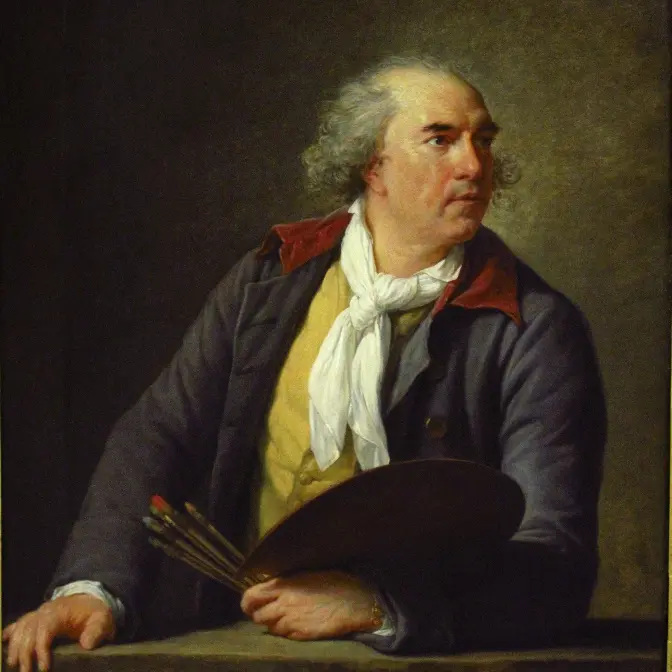
himself Hubert Robert, a man of two first names and very little respect for the pronunciation
of the t's on the ends of either one of them. You hold the t's for added panache.
He was born in Paris in 1733, what then certainly must have seemed like an auspicious time for a
young painter, but now with hindsight is a rather inauspicious time to be a young Frenchman.
Before the end of his life, Robert would be imprisoned during the revolution,
released just before the fall of Robespierre, and only barely make it out with his head.
A clerical heir sent another man to the guillotine in his stead. But before all that,
and before his time as one of the committee members of the new museum in Paris, the Palais
de Louvre, and before he died of a stroke just a month short of his 75th birthday,
Hubert Robert was fresh out of schooling with the Jesuits and had just spent a few years working
with a sculptor who had turned his attention towards painting when he took a fateful trip
to Italy, as many 21-year-olds are wont to do. And as 21-year-olds are wont to do,
Hubert Robert fell in love. Not with people, though that may or may not have occurred,
the records are unclear. What is clear is that he fell madly in love with the city of Rome,
with its ruins and its temples and its amphitheaters and its colonnades. When
Robert visited these scenes, they were all overgrown with a plant life that had been there
for centuries, seeds carried over by the animals that were imported into the Colosseum, and a few
years later, along with Jean-Honoré Fragonard, he took a trip through southern Italy on a drawing
expedition. And this, this fateful trip, began Robert's lifelong obsession with painting Italian
ruins. We call this kind of landscape painting a capriccio, an architectural fantasy. These
paintings bring together Roman, Greek, and sometimes Egyptian and ancient Near Eastern ruins,
oftentimes not in their precise locations. For example, Robert once painted the Colosseum and
the Pantheon right across the street from each other, when in fact there's really a mile in
between them. But the key of the capriccio is that the architecture is the primary focus,
and the human figures, if there are any, take a secondary role in the subject of the painting.
This puts these capriccio in an interesting place in the history of art in France. In Robert's time,
the main movement was rococo, art which focused on people, class, and emotion. On the other end
of Robert's life came the neoclassical period, which depicted the ways of the ancients with
a focus on the classical ideas of balance and order. Robert falls perfectly in between these two,
and his capriccio landscapes help to show us the transition between these movements.
In fact, Robert was so well known for his capriccio landscapes that he got the nickname
Robert de Ruins, or Robert of the Ruins, which is not bad as far as nicknames go.
But if you're looking at the same piece I am, you may now start to see the small hole I referred
to earlier, the question burning at the center of the piece. This isn't a capriccio landscape.
In fact, it's one of the very few Robert paintings that aren't a capriccio landscape.
Sure, the city up on the cliff is a sort of ruin, but the architecture is not the subject
of this painting. However, before we can figure out what is the subject of this painting,
there is one more man that I would like you to meet. A Rococo painter, and a contemporary of
both Fragonard and Robert. This man is Claude Joseph Vernet. He also had little respect for
the T at the end of his name, which, once again, is held for added panache. Vernet is the other
artist in this story. Sometimes friend, sometimes rival, as good contemporaries often are.
He was a little bit older than Robert. He made his, as 21-year-olds often do, trip to Rome in
the year of Robert's birth. But instead of falling in love with the ruins, he fell in love with the
sea. He studied from the great maritime painters, and, like Robert, chose a subject matter for his
painting that would define his career. He was not a frequent painter of capriccio, he was a
frequent painter of naval landscapes, always with the subject balancing somewhere between the natural
beauty and the power of the sea, and the ship that is doing its best to navigate it. And this
isn't a time before TV, so to heighten the drama of looking at a painting of a ship in the sea,
the ship didn't always make it.
Hence, some have called him Vernet de Naufrage, Vernet of the shipwrecks. Okay, no one actually
called him that. I came up with that nickname for him just now. But I think it's pretty good.
There is a really famous Vernet down in the National Gallery in DC. But if you're looking
for a Vernet at the Wham, the closest you're going to get is this Robert painting in front of you.
Because we know that this painting was painted sometime in the last decade of Vernet's life,
or perhaps in the year just after his passing, before the revolution, and the head loss,
and the fall of Robespierre. In that decade, Robert took up his rival friend's subject,
and painted the shipwreck in front of you. And that, that is the question at the heart
of this painting. Why did he do it? Why did Robert abandon the Capriccio to paint in the style of
Vernet? Was it homage? Or was it superiority? Perhaps they are one in the same. Let's see
if the painting can help us sort this out. Imagine first that it is the homage.
The eyes are whipped about by the tempest, the boat tilting into the waves that hold her aloft,
and crash against the immovable dark cliffs, the only thing not in motion. The townsfolk,
descending from their cliffside seat, look upon, as a family, maybe survivors,
maybe just more townsfolk, race along the beach with so much despair. The eldest daughter reaches
back to the townsfolk with so much hope. It's only then that we see the hand that the father
is reaching for, jutting up from the shadowy brine, with not much hope at all. Robert is
telling a story, like Vernet, like the Rococo painters he grew up with, focused on the drama
and the temporality of the human condition. He calls us to imagine what it is like to be the
in the town, and the daughter, and the father, and the hand that has no more purpose in life
than to reach. He gives us a brief window into each one's world, and helps us to know better
who we are through the process. And so Robert says to Vernet,
how brilliantly you tell a story, and capture emotion in the motion of the eye,
and make the painting hope and fear at once. There is always something beneath the surface.
But now, on to the second. The superiority.
Sure, the lower half of the painting contains story, intrigue, the typicalities of a Vernet,
but above, above it all is a city, abandoned, cast against an engrossing sky with a cut of blue and
a dash of sunlight. The family that stand on the beach are but tiny figures to the wave that looms
above them ready to consume. The people of the town are insignificant specks, able to affect
nothing, shadows engulfed in shadow. Even the ship, the other abandoned human creation,
we know will soon be lost to the depths below, swallowed up by the sea. The only thing that
survives is the nature, ever present, and the city, ever crumbling, the only thing not in motion.
Robert is making a statement, like he always did, like the neoclassicists who came just after him,
expressing the balance of nature and mankind, the beauty in both, but the eternality of nature's
glory and the crumbling nature of man. And so Robert says to Vernet,
How foolish are those who flock to watch the shipwrecks time and time again, the fate of
every ship that has ever been, when there is true beauty and intrigue to behold up here.
There is always something above the surface.
These are the two narratives we might read in this canvas, and I think the canvas speaks both
with equal volume. Perhaps there is some capriccio out there painted by Vernet that could help us
round out our story, but I'll leave that to the Vernet scholars. Still, I think the canvas speaks
We cannot know for sure if either one holds any truth. We can only gaze upon that marvelous sky
and that terrible scene, and imagine our painter, who had painted so many paintings of ruins before,
take a break from his routine style to take up the style of a colleague. Be it as a friend,
or as a rival, or maybe just as a colleague, maybe that's all it was. I'm personally glad
that Hubert Robert came to paint this arched canvas, and I'm glad that it hangs here in the
Worcester Art Museum. And I am especially glad that even though it is a beautiful masterpiece,
even though I could look upon this piece for hours and become lost in all it has to offer,
I'm glad that even here, there is something to make the viewer stop, and question, and wonder.
There is always something.
Thank you for listening to this week's episode of Accession. Our special thanks this week goes out
to Professor Layla Philip at the College of the Holy Cross, who has inexhaustibly supported this
project from the very beginning, and has fought and pushed for me to produce it. She also read a
very, very early version of the piece you heard today, before either of us knew it was going to
be an audio story, and her notes, as they always are, were incredibly helpful. The piece of drum
music that you hear at the beginning and the end of the show is performed by Mike Harmon,
with recording, engineering, and editing talent from Casey Dawson. You can hire him to make music
for you at caseydawson.com, or follow him at facebook.com slash caseydawsonsound. The show art
was made by V Silverman, whose portfolio you can find at vcsilverman.com, where you can also hire
them to make art for you. But you should also be listening to their amazing podcast, Fuzzy Logic.
It's the kind of fortnightly podcast that makes me have to go back and download one of the older
episodes on the off weeks because the anticipation is just too much. All of the music in this episode
was period and french, and a complete list of the music can be found in the show notes on our
website. I also did some interesting things with the music choices, so I might write up a little
bit about that and post it on the website as well. This episode was produced, written, recorded, and
edited by me, thponders. You can follow me most places at thponders, and follow the show
most places at accession.fm. And as always, you can find the notes to the show,
links to the art, and maybe a few other goodies on our website at accession.fm.