
Banyo Havuzu | HUBERT ROBERT | The Bathing Pool
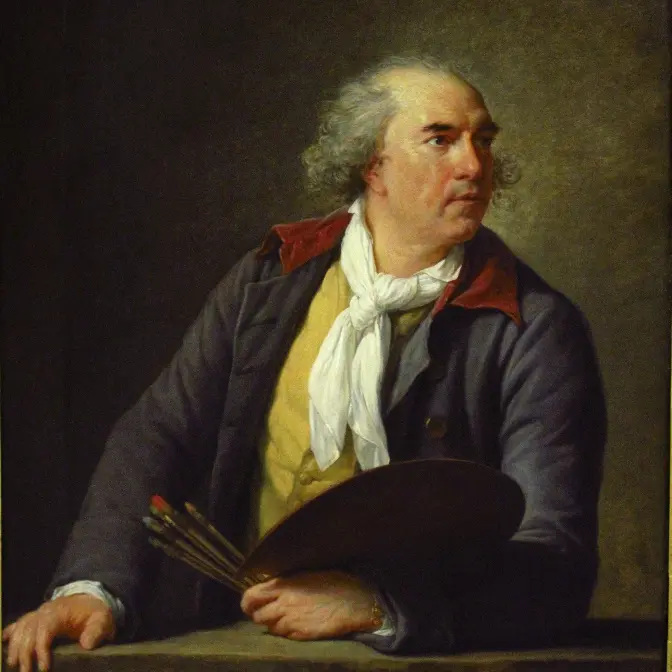
Hubert Robert died on April 15, 1808, but it was a great luck for him to have seen these years.
Hello.
The subject of our video today is Hubert Robert and his painting, The Bathroom.
As some people are born lucky, we have all heard the cursive sentences in our lives.
These sentences also have a counterpart. Some people create their own luck.
When we look at Hubert Robert's life, we can see that he has both.
Hubert Robert was born on May 22, 1733.
His father is a young man who works for a rich family.
And this shows us that he was not born in the suburbs.
Because his father's employer was a rich man, he was educated in very prestigious schools.
First of all, we know that he was educated in Collège de Navarre.
In 1754, he left Paris to go to Rome and continued to study at the French Academy there.
In 1765, Hubert Robert returned to Paris and became a member of the French Royal Academy in 1766.
A talented artist, Robert has always inspired his works in Italian paintings.
Since 1767, he has regularly exhibited his paintings in the Paris Salon.
Hubert Robert is a productive artist known for his emotional scenes, consisting of landscapes, ruins and fountains above all else.
He spent 11 years in Italy, where he achieved success at a relatively young age.
He painted small panels that could be easily transported on a large scale.
He has a remarkable talent for painting the destruction of the Notre-Dame Bridge and the romantic view of the ruins, which are not very old.
Robert's romantic, antique views have made him popular in his time.
With the beginning of the Romantic period in French painting, his works had a very significant impact in the early 1800s.
Hubert Robert died on April 15, 1808, but it was a great honor for him to have seen these years.
Because ten years before his death, that is, in the second half of the French Revolution, he was imprisoned and sentenced to death.
But instead of him, he was accidentally taken to another person's guillotine.
He continued his work during his imprisonment.
As we mentioned, his works are usually romantic, ruins, landscapes, and they are all precious to each other.
The reason we chose this painting today is that it is my favorite work.
Frankly, I had a hard time researching information for this video, because I did my research in all the languages I knew about him, and I could find very little information.
I hope it doesn't seem like insufficient information to you.
Now we move on to the painting analysis.
The Bathtub was painted with oil paint on canvas by French painter Hubert Robert in 1777-1780.
It is one of the six paintings he ordered from Charles Philip Robert.
It depicts an open forest temple with an antique Venus statue in the center of the stage.
The ruined building is surrounded by trees and has a ladder that goes to a pool where water flows in four fountains.
The fountains on the edge were decorated with sculptures.
The Venus on the left is the statue of Mercury, which connects the sandals on the right.
It stands at the head of a group of six people among the costumes from the 18th century.
A woman drying her feet next to the Venus statue in the lower left,
while two naked women in the pool enjoy the moment.
The painting depicts a dreamy place with contemporary visitors.
In other words, there is no such place in reality.
The French pelerins and hoods of the 18th century definitely have modern elements,
such as a woman marking a statue like a tourist and a pair of pink shoes belonging to a swimmer.
Contemporary imams do not get used to nudity.
Paintings of the 18th century are usually limited to nakedness, mythological and allegorical subjects.
Hubert Robert is a popular academic painter known for his dreamy landscapes full of real ruins in France in the 18th century.
Although he passed his history as a painter of ruins and landscapes,
he is one of the greatest poetic image creators of the 18th century above all.
Hubert Robert, who has an endless questioning mind, is a real enlightenment man.
In the middle of the 18th century, he followed an extraordinary path that led him to the French palace,
where he produced some of the most magnificent decorations in the bright 10 years before the French Revolution in Rome.
As a historian of the stormy history that shook the ends of Paris and its period,
Hubert Robert ended his chosen career as a thoughtful and determined curator of the Museum Central d'Arts.
These visions are both eclectic and extremely consistent in the work of the artist.
It covers a wide range of genres.
It is an eye-catching and innovative design for poetic landscapes, archaeological work, gardens and palace decorations.
The movement he follows is defined as rococo.
If you want, let's briefly examine what the rococo movement means.
Rococo art and architecture carry a strong theatricality and drama that is influenced by the stage designs.
The effect of the theater creates a completely attractive atmosphere,
and it can be seen in innovative ways that pictures and decorative objects touch various environments.
Detailed works were also developed during the rococo period.
Symmetric patterns, sculptural arabesque details,
yaldız, pastel are the most attractive methods used to ensure the perfect integration of eye-catching art and architecture.
The rococo painting is usually characterized by a mythological and wolf-themed design,
comfortable, unadorned, rich and delicate brushwork, a relatively light tone key and emotional coloring.
We have come to the end of our video for today.
Now I leave you alone with Hubert Robert's works of art.
I am sure you will like it very much.
Thank you for watching me.
See you in the next video. Goodbye.