
Albert Einstein: The Man You Know, The Story You Don't
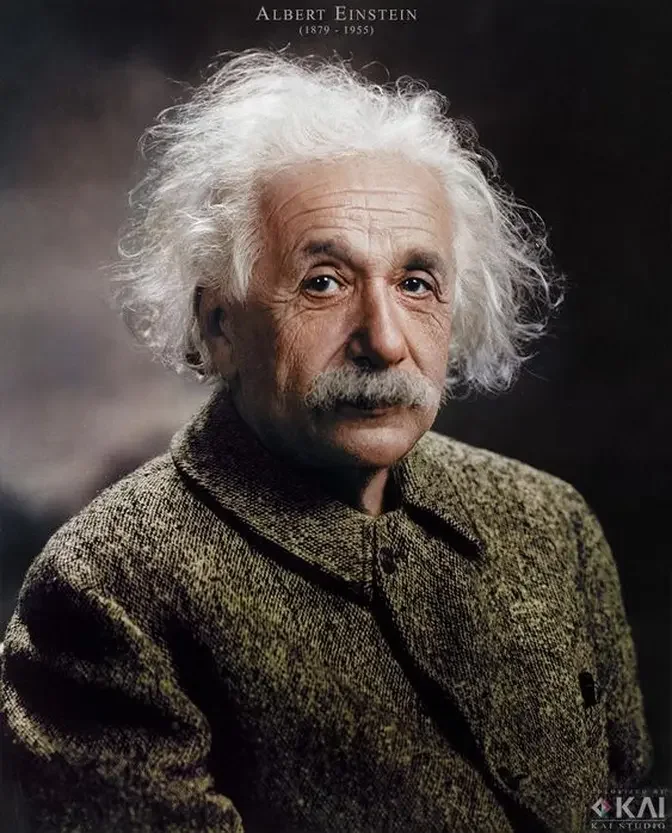
Albert Einstein's father died thinking his son was a failure.
Yes, it's true. Before Einstein became that Einstein, he was a struggling young man in Europe.
He skipped classes, and his professors never took him seriously.
Moreover, Einstein never performed spectacularly in school.
He did so poorly that he nearly decided to drop out, and just sell life insurance.
Things got worse when he got into college.
His carefree attitude towards conventional learning offended his professors.
Hermann Minkowski, his mathematics professor, used to call Albert Einstein a lazy dog.
Interestingly, Minkowski spent his later life developing a geometric representation of
Einstein's special theory of relativity. Because of his poor reputation as a graduate student,
Einstein failed to secure a job. Some of his friends went on to work in reputed labs and
universities, but Einstein remained jobless. He also started tutoring schoolchildren,
but his students could not score good grades because Einstein always went too far.
He always believed in the application of knowledge rather than cramming of mathematical formulae
and scientific concepts. This was something not practiced by the schools.
To make matters worse, Einstein also suffered emotionally.
He lost his father and, a few weeks later, his newborn daughter.
This loss devastated the young and jobless Einstein.
His failures destroyed his confidence, and he had nowhere to go.
To support his family, Einstein reluctantly took the job of a third-class patent clerk
in Switzerland. He had never thought he would end up at a place like this.
But, nature had some other plans for this genius.
At the patent office, Einstein would quickly complete his work,
and spend the rest of his time thinking about some of the unsolved problems of physics.
In 1905, Einstein published his first paper on the photoelectric effect.
He had thought that this paper would bring him to the limelight.
But, the scientific community completely ignored this paper that came from a patent clerk.
Interestingly, 16 years later,
Einstein was awarded the Nobel Prize for Physics to research the photoelectric effect.
Einstein then turned his focus on the microscopic world.
His second paper explained Brownian motion,
which later led reluctant physicists to accept the existence of atoms.
To his despair, no one was talking about it.
Even his second paper failed to leave a mark in 1905.
Although the young man was disappointed, he did not give up.
Then came the third paper that changed the course of science.
This brilliant paper introduced the special theory of relativity.
It landed on the desk of the father of quantum physics, Max Planck.
His assistant told him he had never seen something like this since Newton's work on classical physics.
The special theory of relativity describes what happens
when something travels close to the speed of light.
This paper brought him fame and recognition among scientists.
But he didn't stop.
In 1905, he published his fourth paper introducing the flagship equation of physics,
E equals m c squared.
This equation tells the relationship between mass and energy.
Einstein's special theory of relativity later found applications in particle physics.
The construction and working of accelerators such as the Large Hadron Collider in Geneva,
would not have been possible without this equation.
However, Einstein realized that this theory was incomplete.
It did not incorporate the two most important parameters of the universe,
gravity, and acceleration.
Einstein spent the next ten years of his life developing the general theory of relativity,
which became one of the two pillars of physics, the other being quantum mechanics.
The most important thing that we can learn from Einstein,
is that no matter what, we should never give up.
Despite all those difficulties and rejections, Einstein never stopped doing what he loved.
Had he given up at any of those failures,
he would not have become the most celebrated scientist in history.