
Albert Einstein: A Pillar of Modern Physics
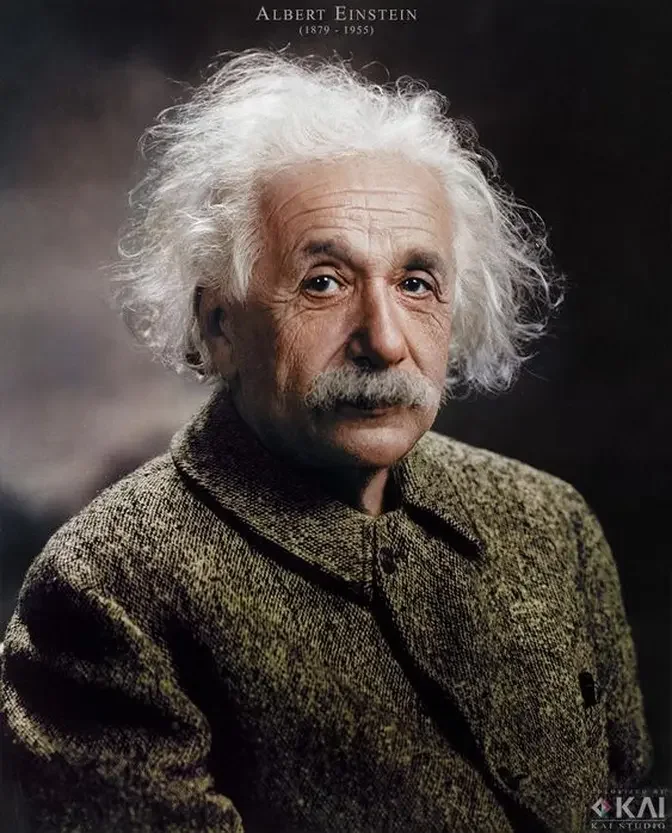
He is known as one of the most intelligent men to have walked the Earth, yet his private
life was nothing short of chaotic.
He was the world's most celebrated scientist, yet he shunned the limelight.
He ushered in the Atomic Age, but he was a lifelong pacifist.
In this week's Biographics, we delve into the contradictory life of Albert Einstein.
Hermann and Pauline Einstein, a Jewish couple married three years earlier, welcomed their
first child, Albert, on March 14, 1879.
Six weeks after his birth, they moved from Ulm, Germany to Munich as a result of failed
business endeavors.
In Munich, Hermann joined forces with his brother in an electrical engineering business
which was propped up by Pauline's parents.
Three years later, they had their second child, Maria.
With the influence of his musically talented mother, Albert started musical studies at
the age of five, learning the piano and then the violin.
Einstein developed an appreciation for music at an early age and later wrote,
If I were not a physicist, I would probably be a musician.
I often think in music.
I live my daydreams in music.
I see my life in terms of music.
I get most joy in my life out of music.
He was enrolled in a Catholic school in 1885, switching over to the more advanced Luitpold
Gymnasium in 1888, which is now known as the Albert Einstein Gymnasium.
He proved to be an adequate, but by no means outstanding student.
By 1894, the electrical manufacturing business that Albert's father and uncle ran was facing
serious difficulty.
For the last decade, they had been making DC current componentry.
But now AC current was gaining ascendancy and demand for their services dried up.
With no income coming in, Hermann decided to move the family to Italy, where job prospects
looked brighter.
However, 15-year-old Albert stayed behind to complete his schooling in Munich.
Albert did not enjoy his schooling and often butted head with the strict rote teachers.
He chafed at the strict discipline and the lack of freedom for any creative thought.
The subjects that were taught to him held no interest for him, except for mathematics.
He had a natural affinity for the subject and quickly mastered any work that was presented
to him.
From around the age of 12, Albert began teaching himself advanced mathematical concepts, starting
with algebra.
His father engaged a tutor, Max Talmud, but soon Albert was out-thinking even him.
Talmud presented the boy with a geometry textbook.
He later commented, Einstein had worked through the whole book.
He thereupon devoted himself to higher mathematics.
Soon, the flight of his mathematical genius was so high, I could not follow.
Einstein started teaching himself calculus at age 12 and, as a 14-year-old, he says that
he had mastered integral and differential calculus.
Soon after his family's move to Italy, Einstein forged a doctor's note which convinced the
principal of the Luitpold Gymnasium to allow him to quit school and join his family in
Italy.
He still had a year to go before completing his required schooling.
In an attempt to skype out of attending his last year of high school, Albert took an entrance
exam at the Swiss Federal Polytechnic University in Zurich.
He came out with excellent results in maths and physics, but failed in every other subject.
His scores in physics and maths were so outstanding that they caught the eye of the school's
principal.
He encouraged the family to send Albert to the Kantonschule in Aarau, Switzerland, in
order to increase his knowledge.
It was arranged for the 17-year-old to stay with the family of a professor of the school,
Jost Winteler.
During his year with the Wintelers, Albert fell in love with Winteler's daughter, 17-year-old
Marie Winteler.
They had a brief romance which came to an end when Marie moved to Olsberg to start her
teaching career.
Having found his academic passion, Albert applied himself to his studies in Switzerland.
He passed the Swiss Matura with outstanding grades in physics and mathematics and then
reapplied to the Swiss Polytechnic University in Zurich.
This time, he passed and was admitted into a four-year physics and mathematics teaching
diploma program.
It was around this time that Albert also renounced his German citizenship in order to avoid compulsory
military training that would face him in a few months when he turned 18.
Albert soon became friends with the only girl in his class, Mileva Maric.
They both shared a love for science, being at the top of that class.
Mileva spent a semester in Heidelberg, Germany.
When she was away, she and Einstein wrote each other almost every day.
Once she returned, their friendship turned into a relationship.
Einstein's parents opposed the union due to the difference in religion, culture and
age.
As the couple's relationship flourished, Mileva started to struggle with her studies.
In 1900, Einstein passed the final exam, but Mileva failed.
Afterwards, she worked at raising her knowledge so that she could retake the test.
It was around this time that she found out that she was pregnant.
Mileva decided to move in with her parents.
In early 1902, she gave birth to their daughter, Lysol.
No one is sure what happened to Mileva and Albert's daughter, with many thinking that
she was either adopted or died of scarlet fever.
Albert struggled to find a teaching position following his graduation.
This was partly due to the fact that he had alienated many of his tutors over the four
years of his studies.
He gave off the impression that they had little value to impart to him, and he preferred to
do his own independent study.
He finally secured a job, but it was one that was totally unrelated to his course of study
and thought by his contemporaries to be below him.
Having gained his Swiss citizenship, he became eligible to work for the Swiss government.
He secured a position working as a clerk in the Swiss Patent Office for Intellectual Property.
Einstein's job was to assess patent applications for all manner of devices.
Quite a number of the patent applications involved the transmission of electrical signals
and the electromechanical synchronization of time.
These concepts gelled with Einstein's area of personal fascination and served as the
impetus for his investigations exploring the nature of light and the relationship between
space and time.
While his days were filled with patent applications, Einstein spent his evenings working on his
scientific theories.
He started a discussion group with a few friends, Conrad Habicht and Maurice Solovine.
He called this group the Olympia Academy.
Albert and Mileva reunited in 1903, and they got married that same year.
The couple went on to have two sons, Hans, born in 1904, and Eduard, who arrived in 1910.
1905 was a turning point for Albert Einstein.
Over the last couple of years, he had been building a reputation as an up-and-coming
intellect among the scientific community.
In April of 1905, he completed his thesis in association with a professor of experimental
physics by the name of Alfred Kleiner.
Einstein received a PhD from Zurich University shortly thereafter.
During the second half of 1905, Albert produced four scientific papers.
The subjects of his dissertations were photoelectric effect, Brownian motion, special relativity,
and the equivalence of mass and energy.
Each of them was received enthusiastically by the intelligentsia.
However, it was the fourth paper that gave the world its most famous equation.
E stands for energy, m stands for mass, and c squared for the speed of light multiplied
by itself.
What it meant, in practical terms, was that mass could be changed into energy, and vice
versa.
As a result, tiny packets of mass could be converted into huge bursts of energy.
The 26-year-old Einstein had, with the publication of his paper on the equivalency of mass and
energy, ushered in the Atomic Age.
Among those who heaped praise upon Einstein for his work was one of the most pre-eminent
quantum theorists of the day, Max Planck from Germany.
His backing gave Albert instant credibility.
He began receiving speaking requests from all over Switzerland, along with offers of
teaching positions.
His days at the patent office were over.
This is a Biography Channel and we're not diving into the depths of Einstein's work
today.
But if you'd like to really get an understanding of just what he worked on, you should check
out today's sponsor, Brilliant.
Brilliant are a science learning platform that allow you to learn through something
called active learning.
Basically, to sum this up, this is kind of the opposite of that feeling of reading a
complex paragraph about some principle and then just having no idea what's going on.
And then you probably read it again and you still don't have any idea what's going
on.
Probably not just me.
It's kind of just that inability to absorb complex information.
It's totally normal.
It's also totally not the best way to learn.
Brilliant take even something like special relativity and make it easy to understand.
They give you something super short to read and then you immediately apply that to a problem
and just rinse and repeat and suddenly you're understanding all sorts of crazy stuff that
you didn't think you'd ever understand.
I've used Brilliant and I think you should just go and try it out to see how fascinating
it is that you can learn a complex subject so quickly and easily.
It's just remarkable how quickly you can grasp something.
Whether you want to learn about paradoxes in space-time and their place in special relativity
– useful for today's video – or maybe something completely different like advanced
stats, well, Brilliant is where you should do it.
Support Biographics by going to brilliant.org forward slash Biographics and let's go back
to Einstein, shall we?
Einstein worked the lecture circuit and then took up a position as a lecturer at the University
of Bern in 1908.
During that year, he also returned to his alma mater, the University of Zurich.
The university authorities were so taken with the budding genius that they created a position
just for him, as an associate professor in their theoretical physics department.
He transferred there from Bern University in 1909.
Two years later, Einstein gained a full professorship when he took up the position at the Charles
Ferdinand University in Prague.
To take up the position, he had to take out Austrian citizenship.
But he would only remain in the position for 12 months.
Over that time, he published a total of 11 scientific papers.
Then, in 1912, he returned to the University of Zurich, where he took up a full professorship
in the theoretical physics department.
He was able to work alongside his longtime friend and collaborator, Marcel Grossmann.
As well as teaching the laws of thermodynamics, he also lectured on analytical mechanics.
That same year, Einstein began an extra-marital affair with his first cousin, Elsa Lerventhal.
Einstein was not really there much for his family, putting all of his time and energy
into his work and research.
For several years, he had been emotionally distant from his wife.
Recently, letters were found that he wrote in 1910 to his first love, Marie Winteler.
In them, he professed his undying love for her and lamented the life they had missed
out on together.
In 1914, Einstein uprooted his family yet again and took up a position at the Kaiser
Wilhelm Institute for Physics, located at the University of Berlin.
He would remain in Germany for the next 19 years and was soon appointed Director of the
Institute.
The position gave him professorship without teaching duties, which afforded him time to
work on his scientific studies.
Another major draw for the return to Germany was that it allowed him to be closer to his
mistress, Elsa.
Towards the end of 1914, Maleva moved back to Zurich with her sons after finding out
about her husband's affair and coming to the realization that Albert was not capable
of being a family man.
Einstein divorced Maleva in April 1919.
Then, in June, he married his cousin.
In 1916, Einstein published his Theory of General Relativity.
This was a groundbreaking achievement in the world of physics.
It theorized that what we see as the force of gravity actually results from the curvature
of space and time.
As a result, the Earth is not actually being pulled towards the Sun by gravity, but rather
by the interaction of space and time, which dictates how the Earth moves.
Einstein predicted that light from another star would be bent by the Sun's gravity.
During a solar eclipse in 1919, that prediction was confirmed.
The publicity that surrounded the confirmation of this theory went around the globe and for
the first time, the name Albert Einstein became internationally known.
In the early 1920s, Einstein became a celebrity among the scientific community in America.
He was invited to New York to kick off a three-week lecture tour in April 1921.
He lectured at Columbia and Princeton, among other places of learning.
He also managed to get in a tour of the White House.
Einstein's first impression of America was a positive one.
Shortly after his return, he published an essay called My First Impressions of America.
In it, he wrote,
What strikes a visitor is the joyous, positive attitude to life.
The American is friendly, self-confident, optimistic, and without envy.
In 1921, Einstein's popularity reached a new high when he was awarded the Nobel Prize
for Physics.
Because his theories on general and special relativity were not yet widely accepted, this
award was given for his explanation of the photoelectric effect.
Throughout the 1920s, Albert and Elsa undertook a number of international tours that saw them
being received in such far-flung places as Singapore, Japan, and Palestine.
In December of 1930, he made a second trip to the United States.
This time, he wanted to fly under the radar, feeling that he had received far too much
attention on his first visit.
But try as he may, he still found himself being overwhelmed with offers to speak and
invitations to receive awards.
All of them, he turned down.
However, when he tried to slip into New York City, he couldn't avoid the celebrity of
being awarded the keys to the city by Mayor Jim Walker.
When he visited the New York Riverside Church, he was surprised to find that the congregants
had created a life-size statue of him.
He then moved on to California, where he was introduced to a number of movie stars, including
Charlie Chaplin.
These two men remained lifelong friends.
On one occasion, Chaplin and Einstein appeared together in public to great applause.
At that point, Einstein turned to Chaplin and said,
They are cheering us both.
To this, Chaplin replied,
They are applauding you because none of them understand you and applauding me because everybody
understands me.
Back in Germany, things were beginning to look rather ominous.
With the rise of the Nazi Party, the rights of Jews rapidly diminished.
They were no longer permitted to hold positions of authority, so Einstein was removed from
his directorship of the Kaiser Wilhelm Institute.
Despite being the most famous scientist on the planet, he couldn't even teach in the
local secondary school.
While he was on his overseas tours, his home was raided by the Gestapo.
In February, 1933, Einstein was on another tour of the United States with Elsa.
With Adolf Hitler having been proclaimed Chancellor of Germany just a few weeks earlier, Albert
knew that there was no future for him in the country of his birth.
The couple sailed to Belgium in March.
Upon arrival in Antwerp, Einstein went directly to the German consulate and renounced his
German citizenship.
The Nazis later sold his boat and converted his cottage into a Hitler youth camp.
The Einsteins rented a house in Dahan, Belgium for a couple of months.
During that time, news of the Nazi book burnings reached them.
It was reported that all of Albert's writings had been consumed in the flames.
A German magazine published a list of enemies of the state, and it included Einstein.
Alongside his name was the caption, not yet hanged, offering a $5,000 bounty on his head.
In July, 1933, Einstein was invited to London for six weeks, at the request of an old British
naval officer friend.
While there, he had an audience with Winston Churchill.
He asked for British assistance to bring as many Jewish scientists out of Germany as possible.
Churchill was immediately receptive.
Over the coming years, Einstein used his influence to arrange for placements of more than a thousand
scientists in teaching positions at universities outside of Germany.
On his return to Belgium, Einstein was offered a residence scholarship at Princeton University.
In October of 1933, he and Elsa sailed again for the United States.
Einstein took up the position at Princeton University in the Institute for Advanced Study.
In 1935, he was granted permanent residency in America.
He got his US citizenship in 1940.
In 1935, a new tribulation arose for Einstein.
His wife, Elsa, was diagnosed with heart and kidney problems.
The following year, sadly, she died.
This was to be his biggest trial yet.
Now, Einstein was not one to show his emotions, but it was said by a friend, Peter Burkey,
that he shed a tear after Elsa's passing.
This might not sound like much, but throughout their whole friendship, he had never once
seen Albert cry.
In 1939, a couple of young Hungarian scientists named Leo Szilard and Eugene Wigner discovered
the science behind the atomic bomb.
They tried informing those in positions of power, but they had no influence, so they
were ignored.
Then, they decided to reach out to someone who would have credibility with those in high
power.
That was when they contacted Albert Einstein.
Szilard and Wigner explained their theory to Einstein, and he was quick to understand
the concept.
Szilard wrote a letter to President Roosevelt with Einstein's signature on it.
The letter urged America to create the first atomic bomb before Germany did.
It is generally agreed that the addition of Einstein's signature was a key influencer
in President Roosevelt's adoption of the Atomic Bomb Development Project, known as
the Manhattan Project.
The US government launched the Manhattan Project in December of 1941.
Amazingly, Einstein's application to be a part of the project was turned down.
The reason for this was simply that he was a German, and people were worried that he
might be a spy for the Nazis.
On August 6th and August 9th, 1945, the atomic bomb was used on the Japanese cities of Hiroshima
and Nagasaki, killing at least 129,000 people.
Five months prior to his death, Albert said that his greatest mistake in life was signing
that letter to President Roosevelt concerning the atomic bomb.
He stated,
I made one great mistake in my life when I signed the letter to President Roosevelt recommending
that atom bombs be made.
But there was some justification, the danger that the Germans would make them.
Einstein was never comfortable about his fame.
He once said,
In the past it never occurred to me that every casual remark of mine would be snatched up
and recorded.
Otherwise I would have crept further into my shell.
By the time that he was settled into his life in America, however, he realized that he was
able to use his celebrity status as a vehicle toward promoting important causes.
Einstein had been a lifelong pacifist and humanitarian.
Now he used his platform to bring these causes to the fore.
During the 1940s, he gave his support to the cause of civil rights in the United States.
He considered racism to be the worst disease in America.
He joined the National Association for the Advancement of Colored People, NAACP, and
became friendly with civil rights activist W.E.B.
Dubois.
When Dubois was arrested in 1951, Einstein's offer to be a character witness was enough
to get the case dismissed.
In 1946, he was awarded an honorary degree from Lincoln University in Pennsylvania, which
was the first in America to award degrees to black students.
He saw that racism in America was handed down from one generation to the next.
Einstein also spoke out against anti-Semitism.
He developed a friendship with the first Prime Minister of the new state of Israel, David
Ben-Gurion.
Regarding prejudice against Jews in various parts of the world, he said,
There are no German Jews.
There are no Russian Jews.
There are no American Jews.
There are, in fact, only Jews.
He did not believe in a person or God who concerns himself with the actions of humans.
He did say, however, that I am not an atheist, preferring to call himself an agnostic.
When asked if he believed in an afterlife, Einstein quipped,
No, and one life is enough for me.
And that life would end on the 17th of April, 1955, at the age of 76.
He had been suffering from internal bleeding caused by the rupture of an abdominal aortic
aneurysm which had previously been reinforced surgically.
The night before his passing at Princeton Hospital, when offered surgery, Einstein said,
I want to go when I want.
It is tasteless to prolong life artificially.
I have done my share.
It is time to go.
I will do it elegantly.
In a memorial lecture in 1965, nuclear physicist J. Robert Oppenheimer summarized his impression
of Einstein as such.
He was almost wholly without sophistication and wholly without worldliness.
There was always with him a wonderful purity.
At once childlike and profoundly stubborn.