
Walking tour Palermo #TravelLikeAPro #Sicily #GJWRisingStar
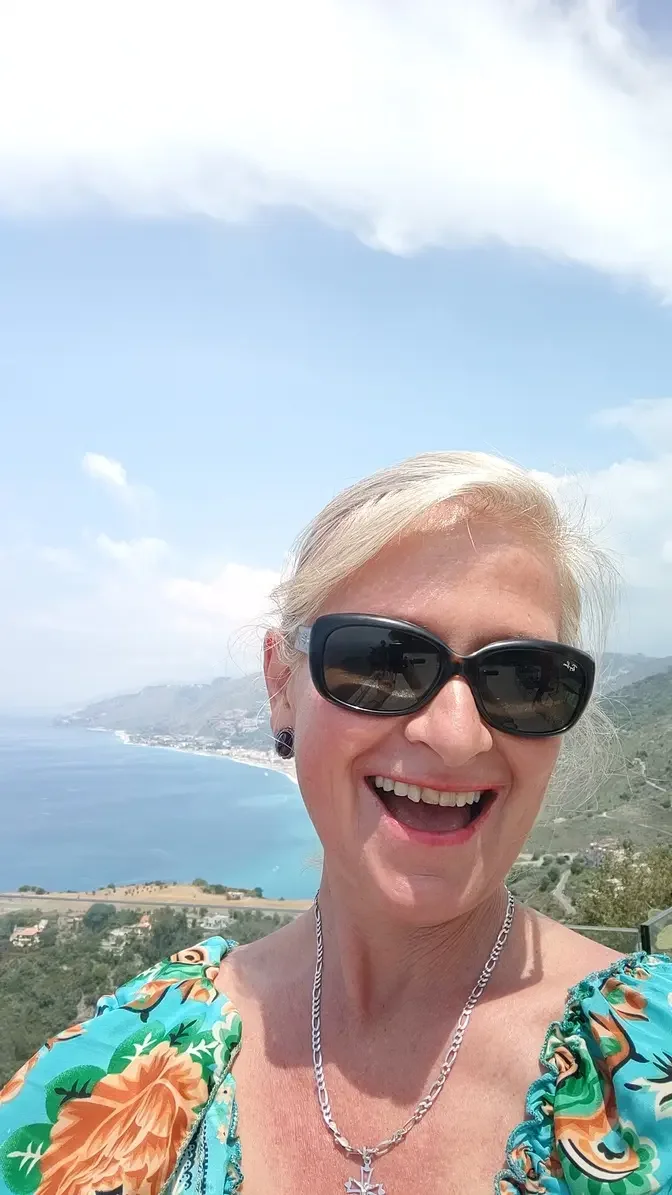
3.2K Video Views·Oct 8, 2024
Come on a walking tour of Palermo, Sicily and sample some street foods. We later go to Castellammare del Golfo.
That's it, ciao from Palermo and Ballarò. We're gonna go through this robust market.
I love Palermo.
I love Palermo too. We're gonna walk through this robust market, have a little bit of history of Palermo and so much more.
Look at this collection of street food. This is caponata with fish espada, swordfish, octopus.
Look at this, grilled, here's breaded swordfish, shrimp, gamberone.
I don't even want to say a word, just enjoy.
More, more, more, more and more street food.
What did you get?
I got arancini with meat and fish.
And I got the seafood platter which is the fried seafood.
Enjoy your meal.
Thank you, thank you.
Panella and croquette, which is a marriage between Arabs and Spanish.
Because the chickpea flour was brought by the Arabs and the croquette, which is potatoes, the potatoes were brought by the Spanish.
Incredible how the people that settled here or conquered here had such huge influence on our foods.
Yeah, definitely yes. They are generally served together in a bun. We put everything in a bun, even gelatos.
This tuna looks fantastic.
You can't get any better here.
Very magic, you love Palermo.
So now I have to show them our channel.
Just got another follower.
In a beautiful Palermo, in a beautiful Ballarò.
The trash is also beautiful.
Oh, this is quite a treat.
Typical Sicilian music.
Perfect.
So Ballarò, where does this word come from?
The word comes from a village which used to be in the current area of Monreale, near there, from the village of Ballarara.
There was a place where Arabs used to cultivate their lands.
They used to take products from Ballarara and they used to come down to Palermo to sell the products.
So this is how Ballarò has originated.
So this guy just started speaking to me in English.
Who are you?
My name is Rob, I'm here in Palermo in the fish market.
What are you doing here?
I'm just enjoying life.
Palermo really checks off a lot of boxes.
If you're looking for a place to live, that's a very good bang for your buck.
Economically, good people, good food, raising children, it checks a lot of boxes.
It's a good place for people to live.
This is perfect because this is exactly what our channel is about.
All about Sicily and moving here and living here.
That's awesome, that's great.
Nice to meet you.
Ciao.
There's been 16 major conquerors or settlers here in Sicily, making it a lasagna of influences.
Some sauces were thinner, some thicker, but it definitely shows.
Here in Palermo you can see a lot of the influences, including on the foods.
Because the foods of Palermo are not like the foods everywhere else.
And this is not Italian street food, it's Sicilian.
Olio and vino, two things every Sicilian has to have in their household.
Olio and vino.
You're looking at the beautiful Duomo, the Cathedral of Palermo, consecrated in 1189.
But actually, in this very spot, for over 700 years, there were places of worship.
The Byzantines, of course, the Arabs built a mosque, then the Normans.
So this place right here is holy.
That's all I can say about that.
But actually, in the Roman times, this was a forum.
Believe it or not, when the Arabs were here, there were about 300 mosques in Palermo.
Now there's one, maybe two.
You're looking at the oldest mosaic here in Western Sicily, by the Greek Orthodox that were here for a period.
When this became a mosque, they covered this up.
And when the Normans brought Sicily back into the Christian column, they uncovered her again.
And now it's beautifully displayed at the entrance of the cathedral.
The back of the cathedral is just as impressive as the front.
Behold the altar dedicated to Santa Rosalia.
One of the two patron saints of Palermo.
The other is San Benedetto.
Every time we go into one of these cities, I always say, make sure you go through the side streets.
There are all kinds of treasures.
This is in the back of the cathedral, a little street.
The original people of Sicily, the Illyminians, were the ones that lived here.
Of course, there were the Sicans and Sicils in the middle and on the east coast.
And then the Phoenicians and Greeks came about the same time, about 2,700 years ago.
During the Phoenicians, it was called Ziz.
Panormos was the name that the Romans gave it, and also the Greeks.
And then the Arabs called it Balar.
So there you go. And then it became Palermo.
Santa Rosalia, of course, rescued the people of Palermo from the plague.
And in this building, the people are asking for Santa Rosalia to save the people.
You guys know what this means?
Mimuzza, trash.
That's kind of cute, huh?
Because yes, even here, big trash problem.
On the outside, this may look just like a simple church.
But, oh boy, wait till you see what's inside.
This is a magnificent church.
Church of the Jesuit.
Built in the 1600s.
Little jewel here.
There's marble and stucco work.
Really, really breathtaking.
This is magnificent Baroque work.
Also with limestone.
In Italian, Hebrew, and Arabic.
So symbolic of Palermo.
You have one day in Palermo.
What to see? The cathedral.
Cappella Pellantina.
A market.
A market, a church.
Even I would visit the symbol of Palermo in modern days,
which is the upper house of the city.
Inaugurated at the end of 1800.
Bearing witness of different architectural styles.
Neo-classical and French Art Nouveau.
When you walk around Palermo,
by the way, this is Vittorio Emanuele Road,
and you may see some places with this logo right here.
You think it's a QR code, right?
Nope.
This shows how Palermo is divided.
The ancient city center.
The touristy center is divided.
And over here you have ALAB.
The Association of Free Handmade Atigiani Artists.
Balan.
Balan, by the way, was the name given to Palermo by the Arabs.
So you will see a lot of places with this,
a lot of stores with this,
meaning that everything inside that store is handmade.
Talk about handmade things.
This is beautiful.
Lots of movies being filmed in Sicily in these periods.
And today, we are lucky enough,
The Leopard is being filmed,
written by Tomás de Lampadusa.
Yes, the novel itself was written by the author Tomás de Lampadusa.
We are filming the series now, The Leopard,
which is about the aristocracy in decline,
the decline of the aristocracy at the end of 1800,
which was threatened by the forces of the revolution.
And there was the 1861 unification of Italy,
and that's when it started, this decline.
Exactly, it started right after the unification of Italy.
You know, a lot of Sicilians went to the United States and Canada and other places
right after this period.
Absolutely.
So the unification...
The first big migration wave occurred at the end of 1800.
The second migration wave was actually after World War II.
Okay.
So, I was about to say the first big migration wave
occurred after the unification of Italy,
so the second half of 1800,
and the second biggest migration wave was afterwards,
after World War II.
And so you can argue,
some people say that the unification was not good for Sicily.
There are many theories about this,
but many people support the idea
through real stories and episodes
that occurred at the end of 1800
that actually things were not like the ones described sometimes in history books.
It's kind of cool to see these guys in period clothes.
Extra.
Locals are extras in the movie.
How cool is that?
Imagine riding on one of these up and down the streets of Palermo.
Now here's a little tidbit that is very interesting.
Palermo made the Guinness World Book of Records for most traffic.
We're in the top ten.
Imagine that.
And you can see why this is one of the most traffic-y cities in the world.
All right, so now I'm in Castelmare del Golfo.
I'm going to take you a little bit around
and also check out what I had for dinner.
You're going to love it.
Actually, two night's meals.
Oh, this is so pretty.
We just came to this place for just a glass of wine,
a little aperitivo,
and look what they brought us.
On the house.
For free.
A little focaccia.
Oh, this is what I've been waiting for at Igesta in Castelmare.
A kebab with tina.
Caramelized tina.
I have to say.
Perfect. Very simple.
This is the best swordfish.
If you're going to get a swordfish, get a Messinesse.
If you're not going to get it grilled.
Sweet and savory.
Perfect.
If you're looking for a different dish,
try the swordfish Messinesse.
Buon appetito.
Okay, besides Piana della Bernese,
this is probably the biggest cannoli I've ever seen.
Madonna!
So, this is the scene here on a Friday night.
And yes, I'm right here behind,
and this is the pizza heaven.
Buono.
Look at that, and here's the margarita.
That has pistachio.
All right, I'm going to do it.
That's a beautiful concept.
I had some the other day.
This is living history.
Look at the bride and groom.
Auguri!
And this is one of the most beautiful arches
in all of Castellamare.
You know, there's not many attractions here
in Castellamare del Golfo,
but there's something about the atmosphere
of this bay and that walking town
with all the shops.
There's just something very attractive about it.
This is the best angle from the bay right here.
And in the morning,
all the fishermen stop right here
and sell whatever the catch of the day was.
And by the way,
Castellamare del Golfo is on our June tour
of the west coast.
One of the stops, actually,
our home base here,
so we'll come down here several times.
It's a beautiful town, for sure.
And here's the castle of Castellamare del Golfo,
built by the Arabs
and then, of course, perfected by the Normans
around 800.
Check out this view from the Belvedere.
So there you go, a little bit from Castellamare,
a little bit from Palermo,
a little bit of everything.
Of course, we have videos on Palermo
and what you see in the province of Trapani,
two separate videos that you may enjoy.
I'll leave a link in the comment below
and also in the description of this video.
Thank you so much for visiting with us
and we'll see you on another video
of You, Me and Sicily.
Arrivederci. Ciao.