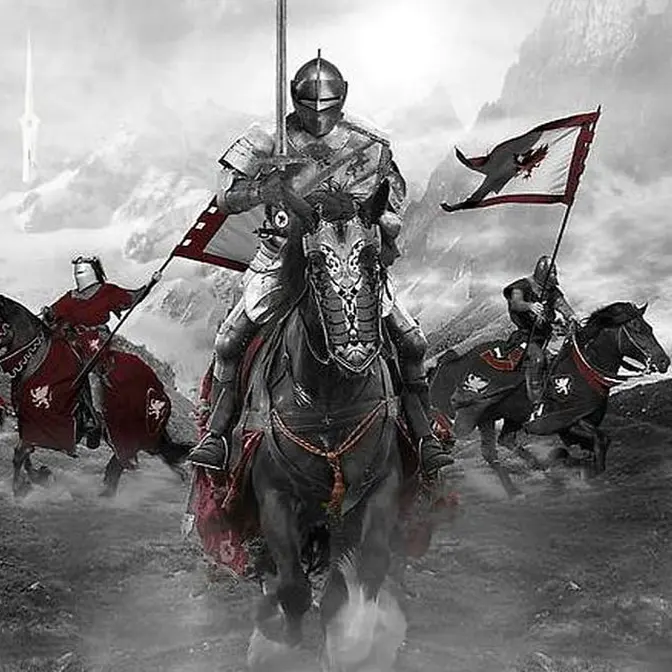
"From the Battlefield to the Renaissance of Charlemagne's Empire We all know about the Renaissance, a time of artistic and intellectual rebirth. But what if I told you there was another, earlier period with a similar spark? From the Battlefield to the Renaissance of Charlemagne's Empire Before we jump in, let's address the elephant in the room: the Dark Ages. This term is a bit misleading; it paints a picture of Europe as a stagnant intellectual wasteland torn by rivalries, tribal conflicts, and linguistic diversity. Sure, the Roman Empire's collapse led to a decline in literacy and centralized power, but there were pockets of learning kept alive, waiting for the right spark. Charlemagne's Empire. Charlemagne's Empire Today, we delve into the depths of history to uncover the forgotten tale of the Carolingian Renaissance, a chapter often overshadowed by its more famous counterpart. It was the era of Charlemagne, a visionary ruler whose thirst for knowledge ignited a cultural rebirth across the continent. (From the Battlefield to the Renaissance of Charlemagne's Empire) Charlemagne, or Charles the Great, born in 748 AD into the Frankish dynasty, inherited a patchwork of territories, a mere shadow of its former glory. This was a critical period, as the Frankish kingdom faced division and external threats. Could he forge a unified empire from these scattered lands?"#history#Charlemagne#Empire # Renaissance
We all know about the Renaissance, a time of artistic and intellectual rebirth.
But what if I told you there was another,
earlier period with a similar spark?
Today we delve into the depths of history to uncover the forgotten tale of the Carolingian Renaissance,
a chapter often overshadowed by its more famous counterpart.
It was the era of Charlemagne, a
visionary ruler whose thirst for knowledge ignited a cultural rebirth across the continent.
Before we jump in, let's address the elephant in the room, the Dark Ages.
This term is a bit misleading. It paints a picture of Europe as a stagnant,
intellectual wasteland, torn by rivalries, tribal conflicts, and linguistic diversity.
Sure, the Roman Empire's collapse led to a decline in literacy and centralized power,
but there were pockets of learning kept alive,
waiting for the right spark.
Charlemagne, or Charles the Great, born in 748 AD into the Frankish dynasty,
inherited a patchwork of territories, a mere shadow of its former glory.
This was a critical period, as the Frankish kingdom faced division and
external threats. Could he forge a unified empire from these scattered lands?
Charlemagne embarked on numerous military campaigns to expand and consolidate his empire,
often using force to impose Christianization and Frankish rule over conquered territories.
This approach led to resistance and conflict, as seen in the prolonged and bloody wars against the Saxons.
Charlemagne's territory stretched from the Atlantic coast in the west to roughly the Elbe River in the east, and
from southern Italy north to modern-day Denmark, which spanned present-day France,
Belgium, Holland, Germany, Austria, and Italy.
That brought to our king a big, big question.
How to rule over a diverse empire, with a multitude of different peoples,
languages, and customs,
comprising Germanic tribes, as well as territories with Latin and Greek cultural roots, all under one crown?
Charlemagne wasn't content with mere survival.
He also dreamed of something greater, to revive the Roman Empire in the west.
But a vast empire needs a common thread. His answer?
Education, a shared culture that facilitates communication,
cooperation, and loyalty among diverse inhabitants, would help a lot in maintaining order and stability.
As John F. Kennedy once said, in a time of turbulence and change,
knowledge is power.
Charlemagne understood this a thousand years earlier.
Charlemagne was not merely a warrior and ruler. He possessed an insatiable curiosity for knowledge.
Enter the Admonitio Generalis,
Charlemagne's game-changing document issued in 789.
This wasn't just a policy paper. It was a strategic move. It addressed governance,
education, and religious life within the Frankish kingdom.
One notable feature of the Admonitio Generalis
was its strong emphasis on the establishment of schools and the promotion of learning.
The document aimed to ensure morale and spiritual well-being
by reforming the church and educating both clergy and lay people.
By requiring monasteries and cathedrals to establish schools,
Charlemagne made the Bible and other religious texts more accessible, thus contributing to the spread of Christianity.
Let's break our outstanding ruler's vision bit by bit.
With the fragmentation of culture and the overlooked education,
there weren't many educated folks around to serve in his court or the church.
Imagine church officials stumbling over basic Latin. Yikes!
Charlemagne understood that knowledge was power, and by training the minds of those who transmitted knowledge,
the clergy,
Charlemagne aimed to create a powerful intellectual force that would propagate consistent thinking throughout his realm.
Therefore,
maintaining order and creating the Civitas Dei, the city of God,
required brains and brawn.
Thinking of doing so in the heart of his vast Carolingian Empire,
Charlemagne reformed the Palace School at Aachen.
The Palace School is a part of the Palace of Aachen, the White House of the Carolingian Empire, with
residential, political, and religious purposes chosen by Charlemagne.
The palace was located north of the current city of Aachen, Germany.
The Palace School provided education to the rulers' children and the nourished ones,
the aristocratic sons that were to serve the king.
The court fostered an environment where open discussion and learning from each other were the norm, and
intellectuals from various corners of the realm
elevated each other's learning in a highly competitive yet productive setting.
Charlemagne was like a curious student himself,
always wanting to learn more.
But where would the knowledge come from?
He wasn't afraid to look beyond his borders.
He summoned scholars,
sages, and thinkers from every corner of the known world.
He surrounded himself with learned advisors and scholars such as Alcuin of York, Paul the Deacon, and
Theodulf of Orleans, whom he invited from far away to his court to oversee educational reforms.
Palace School became a place where wisdom flowed like a mighty river.
Nourishing minds and transcending borders. With pen and paper, the scholars and Charlemagne himself
embarked on a quest more daring than any knight's charge.
They exchanged ideas, debated, and wrestled with language itself.
Driven by an insatiable thirst for knowledge and an unwavering desire to ascend the heights of scholarship and wisdom,
they cast their net wide.
Their inquiries spanned continents,
reaching the secluded cloisters of Byzantium,
the storied libraries of Baghdad, and the venerable monasteries of Ireland. Each repository held secrets,
ancient texts, and the accumulated wisdom of civilizations.
But they did not merely read. They absorbed. They questioned. They dared to challenge tradition.
It was like a giant research project, except instead of the internet, they had to travel the world to find information.
Then, who daringly emerged onto this grand stage of intellectual fervor?
Behold Alcuin of York, the brilliant scholar from an Anglo-Saxon kingdom in the north of England.
Once a humble monk, he now stands at the nexus of this revival.
He applied rational ideas to social issues for the first time in centuries,
providing a common language and writing style that allowed for communication
across most of Europe.
Back then, communication was a mess.
There were tons of different ways of writing Latin, even though people spoke the same language,
making communication a nightmare.
It was like everyone texting in their own special code, even if they all knew English.
The most common ways to script are Roman half-unseal and cursive scripts,
which in turn were derived from Roman capital letters and are used in Irish and English monasteries.
The uneven spacing between letters and words in Roman script made it hard to distinguish
individual letters and follow the flow of the text.
The upright or slightly slanted nature of Roman script might have made it less comfortable to write with a quill pen.
Alcuin, like a superhero of communication, came up with a new writing style called
Carolingian Minuscule, the universal font for everyone in Europe.
The development of Carolingian Minuscule,
influenced by Roman script, had clear rounded lowercase letters, spaces between words,
and even punctuation marks like commas and question marks.
It was a huge improvement over the old way,
where everything looked squished together and confusing.
Similar to how we have standard fonts on computers today, like Times New Roman or Arial,
Carolingian Minuscule made it easier for everyone to read and understand written information.
Copying manuscripts became faster and more accurate with clear titles,
subtitles, and proper use of lowercase and uppercase letters.
Alcuin basically invented a way to write Latin that was clear,
consistent, and user-friendly. A true revolution in communication for his time.
Remember how Carolingian Minuscule was like a universal font for everyone in Europe?
This new writing system made a huge difference for the monks who were responsible for copying and preserving knowledge.
They are like the historians of the medieval world,
copying important texts like the Bible and other historical documents.
Before the Carolingian Minuscule,
it was super hard for monks to do their jobs because everyone used different handwriting styles. It was like trying to read someone's messy notes.
Impossible to understand. But with the clear and consistent Carolingian Minuscule,
copying texts became much easier and faster. Like having a printer instead of having to handwrite everything yourself.
This was exactly what Charlemagne the King wanted.
He loved the knowledge of ancient Greece and Rome and didn't want it to be forgotten.
He saw Carolingian Minuscule as a way to preserve these important ideas for future generations.
Just like we have libraries today to share information,
Charlemagne supported special workshops in cities like Tours and Metz, where monks could copy and distribute knowledge
throughout Europe. In short,
Carolingian Minuscule was a game changer for education and culture. It allowed knowledge to flow freely across borders,
sharing knowledge way easier and faster,
helping to preserve the wisdom of antiquity and pave the way for generations yet unborn.
Charlemagne's palace school wasn't just about mastering fancy penmanship, and
Alcuin of York, the headmaster, wasn't just a teacher. He was like a master architect.
He designed a groundbreaking curriculum that would shape the minds of future leaders for generations to come.
Alcuin's goal was to create well-educated
clergy, the Middle Ages' religious leaders who could understand the Bible deeply and serve their communities effectively.
But his vision went beyond that. He wanted them to be critical thinkers and effective communicators.
Let's break down the special ingredients in his recipe for smart thinking. The trivium was the foundation,
focusing on language and communication skills. This threefold path focused on language and communication skills,
grammar,
dialect, and rhetoric.
Grammar wasn't just about memorizing rules.
It was about understanding the building blocks of language and using them creatively to express ideas clearly.
About dialect,
imagine this as a mental training program in critical thinking and problem-solving.
Students learned to analyze information,
identify logical fallacies, and form clear arguments.
Rhetoric wasn't just about flowery language. It was about the art of persuasion,
learning to communicate ideas with passion and elegance, just like politicians give speeches today.
The curriculum didn't stop at the trivium.
Alcuin, recognizing the importance of a well-rounded education,
incorporated the quadrivium, a set of four additional subjects.
Mathematics wasn't just about basic calculations. It introduced students to the beauty and logic of numbers.
Geometry wasn't just shapes on a page. It unlocked the secrets of the physical world, from architecture to navigation.
Music wasn't just hymns and chants. It was a way of understanding the world through harmony and rhythm.
Astronomy wasn't just stargazing. It opened their eyes to the vast universe and its mysteries.
Think of these subjects as elective courses in a modern school,
broadening students' understanding of the world and themselves.
The key here is that Alcuin's curriculum wasn't just about memorizing facts. It was about fostering critical thinking,
communication skills, and a broader understanding of the world.
This revolutionary approach, later adopted by universities, became the foundation of Western education.
Imagine a time when new writing styles and teaching methods were like magic tools.
They empowered religious leaders to preserve knowledge and share it more easily.
This led to a sudden explosion of schools popping up all over Charlemagne's empire, just like mushrooms after a rainstorm.
Charlemagne wasn't starting from scratch.
His father and grandfather had already been supporting big monasteries by giving them land and money.
Charlemagne kept this tradition going, even giving special privileges to some monasteries that made them almost like independent states
within his empire.
Monasteries have now become learning hubs.
Inside these quiet monasteries, where silence was golden and parchment was a precious treasure,
monks followed a rule called ora et labora,
pray and work.
Copying text wasn't just a boring task. It was seen as a sacred step into the world of learning.
Thanks to Alcuin's work in creating standard textbooks and vocabulary,
students could learn more easily from wise teachers by reading, writing, and discussing ideas.
These monasteries became major centers for education and scholarship, with Charlemagne providing generous funding to support their activities.
Cathedral schools were a different story. Here, students actively participated in church activities,
putting their learning into practice. For example, music lessons helped them sing in the choir, while studying astronomy
helped them figure out when Easter fell each year.
Both monastery and cathedral schools focused heavily on analyzing texts, both classical works and
Christian writings.
Students looked for moral lessons and practical advice that could help them live better lives.
This wasn't just about memorizing facts.
It was about learning to think critically and solve problems they might face in the real world.
In a time when books were rare and expensive,
memorization was a key learning tool.
Students memorized texts by reciting them out loud,
helping them remember the information, even if they didn't have constant access to books.
If you stick with us from the beginning of this video, you already know that Charlemagne's vast empire is a complex puzzle.
To maintain order and stability, he needed all the pieces to fit together.
One crucial piece in this puzzle was the close relationship between the church and the state.
Back then, unlike today's separation of church and state, these two institutions worked hand-in-hand
like two peas in a pod.
Charlemagne, a deeply religious man, saw a strong and unified
Christian faith as the cornerstone of a stable and peaceful empire.
Building a widespread educational system wasn't like flipping a switch. It was a slow burn.
Imagine planting a garden. It takes years for the seeds to sprout and the flowers to bloom.
Similarly, establishing a widespread
educational system requires building schools, training teachers, and creating curriculum, a
process requiring time and resources.
Religion, on the other hand, could work much faster.
By standardizing religious practices and beliefs across the empire,
Charlemagne aimed to create a common ground for his diverse population.
As a way to quickly spread shared values and build a sense of national identity,
Charlemagne hoped Christian virtues like kindness and honesty, as
well as a common moral code, would foster cooperation and stability within his empire.
Just like countries today often have a strong national identity based on shared values,
Charlemagne wanted this connection for his empire all the way back in the 8th century.
Imagine a sports team with a strong team spirit.
Everyone works together towards a common goal because they share the same values.
Charlemagne believed that by teaching everyone Christian virtues,
people would feel more connected and work together for the good of the empire.
This shared set of values would act like social glue,
binding the empire together and promoting cooperation and stability.
However,
promoting a single religion wasn't without its challenges.
Charlemagne's emphasis on Christianity could potentially alienate those with different beliefs.
Finding the right balance between secular education and religious instruction
would be crucial for the long-term success of his vision.
Then we can answer the question lingering throughout this video.
Why did the Carolingian Renaissance occur under Charlemagne and not before or after?
Charlemagne wasn't your typical ruler just interested in building castles and fighting wars.
He possessed a burning curiosity and a genuine love of learning.
Despite his limited formal education,
he actively sought out scholars and surrounded himself with intellectuals.
Imagine a king who amidst the demands of war and governance
carved out time for reading, writing, and engaging in stimulating discussions.
This wasn't just a hobby for Charlemagne.
It was a passion.
But passion alone couldn't spark a renaissance.
Charlemagne's position as emperor granted him the resources and authority to make his vision a reality.
He wasn't just a student. He was a patron.
He funded the copying and preservation of ancient texts, established schools at his court,
and attracted the brightest minds from across Europe.
Charlemagne's leadership was the final piece of the puzzle.
He wasn't simply a passive observer. He was a driving force.
He saw the value of education not just for personal enrichment,
but for the future of his empire.
A well-educated population could be a source of strength and stability,
a powerful tool for unification. In this way,
Charlemagne bridged the gap between his passion for learning and the needs of his vast realm.
The Carolingian Renaissance may have been a mere flicker in the grand timeline of history.
But within that brief period, a spark ignited,
illuminating a path for future generations.
It reminds us that progress isn't always a straight line.
Knowledge can endure even in the bleakest of times.
Charlemagne's leadership was the final piece of the puzzle.
His unique thirst for knowledge,
coupled with his power and influence,
allowed him to transform his vision into reality.
He wasn't just sitting back and admiring ancient texts.
He was actively promoting education and scholarship throughout his empire.
Fast forward.
Picture yourselves as time travelers who just witnessed this amazing period.
Let's raise our goblets in honor of Charlemagne and Alcuin, the masterminds behind this cultural renaissance.
Without their unwavering vision and dedication,
Europe's intellectual landscape might be a lot foggier and shrouded in darkness.
History isn't just about memorizing dates.
It's about the ideas and knowledge we pass on to future generations, like a burning torch held high by these two figures.
The Carolingian Renaissance was a bold leap into the future.
Charlemagne's vision extended beyond the confines of his kingdom,
laying the foundations that would reverberate across Europe for centuries to come.
He earned the title
Father of Europe because of his efforts to unify the continent.
Even rulers who came after him, like those of the Ottonian dynasty, built upon the administrative foundation he laid.
Leaders throughout history, from Napoleon to Hitler, though for vastly different reasons,
have felt the pull of his vision for a united Europe.
Charlemagne's love of classical models wasn't confined to education.
Roman architecture fueled the revival of early Christian basilica design.
The Palatine Chapel at Aachen, with its octagonal plan,
drew inspiration from Byzantine structures like San Vitale and Ravenna.
Even Carolingian art,
including manuscript illuminations, reflected a fascination with replicating classical motifs and models.
However, Charlemagne's reign wasn't without its flaws.
His reliance on warfare to maintain control and his inability to establish a lasting unified empire after his death
were significant drawbacks.
Uniting such a vast and diverse territory proved incredibly complex.
While he achieved some success in blending cultures, the inherent difficulties of managing such a sprawling realm
inevitably led to failures as well.
His successors, lacking his vision and strong leadership, ultimately contributed to the gradual decline of the empire.
Political instability, territorial disputes, and the pressures of external threats cast a shadow
over the once thriving centers of learning and culture.
The great libraries,
once vibrant with the exchange of ideas, fell silent as the winds of change swept across the landscape.
With each passing year, what remains of the Carolingian renaissance now lies scattered amidst the dust of ages,
a poignant reminder of the fragility of human achievement.
The manuscripts painstakingly preserved by scholars faded into obscurity, their wisdom lost to the sands of time.
The grand cathedrals,
once symbols of artistic mastery and spiritual devotion, crumbled into ruin,
their grandeur a mere memory.
And yet, amid the ruins of the Carolingian era,
traces of its legacy persist, offering glimpses into a past that still resonates with relevance today.
The manuscripts painstakingly transcribed by Carolingian scribes continue to exist in the archives of libraries and museums.
Their illuminated pages are a testament to the artistic skill and intellectual fervor of their creators.
The architectural marvels commissioned by Charlemagne and his successors,
though weathered by the passage of centuries,
still stand as reminders of a time when innovation and grandeur flourished.
From the towering spires of Aachen Cathedral to the majestic corridors of the Palatine Chapel,
these structures endure as tangible symbols of the Carolingian renaissance's architectural prowess.
Moreover, the educational reforms instituted by Charlemagne laid the groundwork for the development of medieval universities
and the preservation of classical knowledge throughout the Middle Ages.
The Carolingian minuscule script, a standardized writing style introduced during this period,
became the foundation of modern western handwriting,
ensuring the dissemination of written texts for generations to come.
So let us not mourn the passing of this golden age,
but rather let us celebrate the enduring legacy of the Carolingian renaissance.
In its fading embers, we find the spark of inspiration that ignites the flames of progress and enlightenment in our own time.
For in the words of Charlemagne himself,
to have another language is to possess a second soul.
And though the echoes of the Carolingian renaissance may have faded, its spirit lives on in the hearts and minds
of all who cherish the pursuit of wisdom and truth.
So, did the Carolingian era deserve the title of renaissance?
Let me know in the comments below.
If you enjoyed this journey through history, be sure to like and subscribe for more explorations of history's lesser-known chapters.
Thanks for watching.