
Why did Henry VIII create the Church of England?
If we were to travel back to the year 1500, we'd see every kingdom across Western Europe
declaring their allegiance to the Catholic Church.
And if you were to say that some nations were to break away from that church,
honestly, it wouldn't be the most shocking thing in the world.
There was mass corruption and heaps of power placed into the hands of one person,
the Pope, and many priests had little to no education or training.
And so when someone like Luther came on the scene,
much of the clergy were no match for him in debating what the Bible actually said.
But if you were to put all your money on one kingdom who would not break away under any
circumstances, you'd bet your life savings on England.
The priests were actually pretty well educated in comparison to the rest of Europe,
and there was much less corruption in England than elsewhere.
And most of all, the King of England and the Pope always tended to be pretty tight with each other,
yet somehow England went from being the least likely kingdom to break away
to the one that actually created its own church.
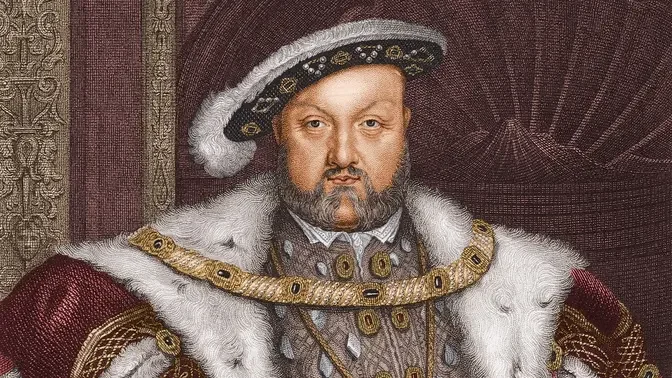
And to figure out how, we need to get to know this guy here.
Now, today's video is not going to cover the most common topics of Henry VIII,
such as his six wives, however it will look at something in my mind far more interesting.
How could one man make the most Catholic of all the countries,
actually become the country that is most openly opposed to the Catholic faith?
So young Henry was born in 1491 when his father, Henry VII, was sitting on the throne.
Now this is really important.
Henry VII didn't become the king with ease.
His claim to the throne was really weak,
basically he had an uncle who was the lover of the Queen after her husband died,
and he claimed his lineage from the Queen's lover, Jasper Tudor.
Not exactly someone who came from a long line of previous kings.
And so Henry VII became the king by successfully challenging Richard III,
then defeating him on the battlefield in 1485.
And if Henry VII didn't have a long list of fathers and grandfathers who were kings,
he needed to find another way of being seen as the right king.
And so Henry VII and the Pope became very tight,
and the Pope gave God's blessing, so to speak, upon Henry VII.
Now Henry VIII was not supposed to replace his father as the king,
because he was actually the second born son to his brother Arthur.
And so in 1501, at the age of 15, Arthur married Princess Catherine of Aragon,
who was the daughter of the King and Queen of Spain.
But tragedy struck young Arthur,
and he actually died only 20 weeks later from an unknown illness.
And so this left 10-year-old Henry as the heir to the throne,
but his father kept him out of public life, and he gave him few responsibilities.
Now Henry VII was keen to keep an alliance with Spain,
so he suggested to young Henry that he should marry Princess Catherine,
but Henry refused.
I mean, he was only 12.
So come 1509, Henry VII died at age 52,
and so 17-year-old Henry VIII became the King of England.
Now a few weeks before he was coronated,
Henry decided that he would actually marry the 23-year-old widow Catherine,
and they quietly married.
So Henry married his brother's widow.
And in 1510, Catherine gave birth to a stillborn,
and then in 1511 she gave birth to a boy who tragically died a few weeks after birth,
and then she continued to have miscarriages until 1516,
when she gave birth to a baby girl, Mary Tudor.
Now as all this was happening, Henry took some mistresses.
Now how many is a matter of debate,
but one of his mistresses gave birth to his son, Henry Fitzroy.
Now as Henry and Catherine were trying for children,
the Protestant Reformation had also begun in Germany.
Martin Luther had led the charge in criticising the Catholic Church,
and like his father, Henry decided to step in on the side of the Catholic Church.
He wrote a pamphlet called Defence of the Seven Sacraments,
and this impressed Pope Leo X, who gave Henry the title of Defender of the Faith.
But as Henry was being seen as a hero of the Catholic faith,
there still remained a child issue for him.
Henry needed to have a male heir,
it was the safest way to secure his line of succession,
and given that his family was new to the throne,
leaving no male heir was a surefire way to see his family thrown out.
So what do you do?
One option was to try and get the Pope to declare that his illegitimate son,
Henry Fitzroy, should actually be the next king.
But just as the church was getting accused of corruption,
Henry knew that this would be a terrible look for the Pope,
and that he probably wouldn't agree to it.
Another was to marry Mary off as soon as possible,
and have her give birth to a grandson to take over before Henry died,
but this was a highly risky move,
because Henry knew that he'd likely die before that point.
The final option for Henry was to try and divorce Catherine,
and marry someone else who instead would give him the son he longed for.
There were three options there,
but Henry increasingly liked the idea of the last one,
because a woman by the name of Anne Boleyn had actually caught his eye.
He tried to make her his mistress, but she said she'd only be his wife,
and with Henry head over heels for Anne,
he decided to try and get a divorce from Catherine.
And so in 1527, Henry went to the new Pope,
Pope Clement VII, and he asked for a divorce.
Henry actually appealed to the Bible,
and he picked out a verse from the book of Leviticus that said,
if a man marries his brother's wife, it is an act of impurity,
he has dishonoured his brother, and they will be childless.
And Henry argued that because Catherine had earlier married his brother Arthur,
his own marriage to Catherine was therefore never legitimate in the eyes of God,
and God had cursed them by them being childless.
I mean, imagine how his daughter Mary must have felt hearing this.
And so at the trial of Blackfriars in 1529,
basically Henry continued to argue that he should get the divorce,
and that Anne Boleyn should become his new queen.
Now, there was a big problem.
Because Europe was webbed together by alliances through marriage,
a lot of the monarchs were actually related to each other.
And Holy Roman Emperor Charles V, who we've seen in previous videos,
was actually the nephew of Catherine, and for him and the Habsburg family name,
it was utterly humiliating watching Henry discard his auntie like that.
And so the Pope then had a decision of decide with Charles, or decide with Henry.
Charles had actually sacked and imprisoned the Pope earlier in 1527,
and fearful of Charles, he sided with him and refused to give Henry a divorce.
This infuriated Henry, and in his eyes,
with Charles and Pope Clement so clearly conspiring against him,
he decided to break away from the Church.
The Act of Royal Supremacy in 1534 formalised the separation
and replaced the Pope with the King.
Henry was the new head of the Church of England,
and in terms of what the Church believed,
the Church was very much still Catholic in practice.
I say that cautiously.
They prayed to saints, they believed in purgatory,
they believed that people got to heaven by faith in Jesus as well as good works,
and they were still very much Catholic in their belief,
apart from the fact that there was no Pope in this new Church,
and the Pope had been replaced by the King.
Henry's original Church was, in some ways, Catholicism without the Pope.
And so Henry VIII attacked people on both the Catholic and the Lutheran sides.
He launched a campaign to have Luther and William Tyndale killed,
and you can check that out here,
for trying to supply England with English Bibles.
And at the same time, he executed his Catholic Lord Chancellor, Thomas More,
for refusing to recognise him as the head of the Church.
And so as Henry purged his office of traditional Catholics
who viewed the Pope as being the head of the Church,
he couldn't replace them with Lutherans
because their beliefs on things like purgatory
and being saved by faith rather than just works
and they didn't believe in praying to the saints,
well, those beliefs actually clashed
still with the mostly Catholic beliefs that the new Church had.
So Henry appointed some more moderate people into key positions.
He appointed Thomas Cranmer as the new Archbishop of Canterbury,
who would, for now, toe Henry's line on how the Church should be run.
Henry took six wives in total, killing two of them,
but importantly in 1536, his third wife, Jane Seymour,
gave birth to his long-awaited male heir, Edward.
In 1536, Henry also had a bad jousting accident,
injuring his leg and reducing his mobility.
After that, he became the quite obese Henry that we know today,
and there's a decent chance that he suffered brain injuries
that affected his behaviour too.
In 1547, Henry died at the age of 55,
and though some reforms had passed in the early 40s,
his new Church of England, for the most part,
remained a Catholic Church without the Pope.
As his son Edward ascended to the throne,
his Archbishop saw an opportunity.
Thanks for watching.
Make sure to come back next week where we look at Thomas Cranmer
and see how Henry's ousted daughter, Mary, returned from the fall.
Make sure to like the video and subscribe to the channel
so you don't miss anything,
and we'll see you next time for our next venture
into a fascinating part of history.