
Henry VIII's Mother & Grandmothers
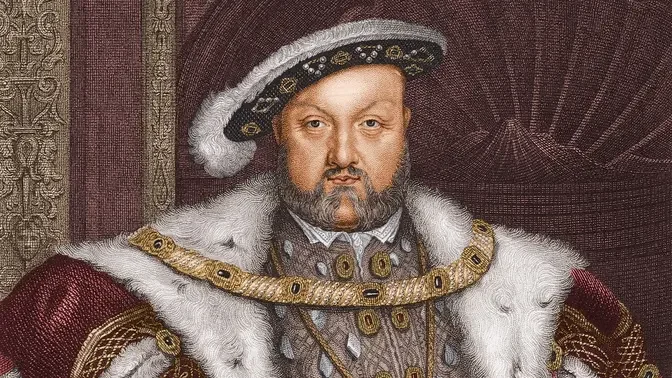
Henry VIII's Mother and Grandmothers
Henry VIII is infamous for his relationships with women.
The domineering king took six wives during his 36 years on the throne, and he disposed
of them with as much scandal as he wooed them.
Divorced, beheaded, died, divorced, beheaded, survived.
But three other women had an important impact on his childhood.
His mother, Elizabeth of York, and his two grandmothers, Elizabeth Woodville and Margaret
Beaufort.
They have been dubbed by popular historical fiction author Philippa Gregory as the White
Princess, the White Queen, and the Red Queen.
These women were caught in the brambles of the Wars of the Roses and fought tooth and
nail for their children and for themselves.
And it was these three women who brought an end to three decades of bloody battle and
restored peace to England.
The seeds of the Wars of the Roses were planted in 1376, when Edward the Black Prince died
of dysentery on the battlefield.
His father, King Edward III, died a year later, passing the throne to his eldest son's eldest
son, ten-year-old Richard II.
At such a young age, Richard was a weak king, and his adult uncles jostled for power.
They each founded rival branches of the royal family, the Lancastrians, who took as their
heraldic symbol a red rose, and the Yorkists under a white rose.
Eventually, King Richard's Lancastrian cousin Henry raised an army, forced the king to abdicate,
starved him to death in prison, and had himself declared King Henry IV.
His son, King Henry V, repeated history by dying of dysentery on the battlefield and
leaving the throne to his nine-month-old son, Henry VI.
His mother, Dowager Queen Catherine of Valois, had a relationship and six children with her
butler, Welshman Owen Tudor.
Henry VI was also a weak king who suffered mental illness and fell in and out of catatonic
trances.
With the Lancastrian king unfit to rule, the Yorkists rose up to take control of the kingdom.
And finally, the political posturing broke into civil war.
The Lancastrian leader, John Beaufort, was killed in battle, and Queen Margaret of Anjou
stepped up to take command of the army.
Richard, Duke of York, was captured, and Margaret ordered that his head, wearing a paper crown,
be spiked on the Tower of London.
But York's tall and handsome 18-year-old son, Edward, stepped up to take his father's
place, defeating the Lancastrian army.
Senseless King Henry was captured, and Queen Margaret and her son escaped to France, while
their rival was crowned King Edward IV.
His most important ally, the Earl of Warwick, went to work arranging a political marriage
with the French princess to secure Edward's reign.
But the impetuous young king spoiled those carefully laid plans the minute he set eyes
on the enchanting Elizabeth Woodville.
She was called the most beautiful woman on the island of Britain.
She also possessed a keen intellect and an abundance of charm.
Elizabeth was the child of a socially unequal marriage.
Her mother, Jaquetta of Luxembourg, was the daughter of the Count and Countess of Brienne
in France.
At 17, Jaquetta was married to King Henry IV's third son, 44-year-old Prince John
of Lancaster.
After two years of marriage, the prince died, and Jaquetta fell in love with his chamberlain,
Sir Richard Woodville, and married him in secret.
As Woodville was a member of the landed gentry, the medieval middle class, he was not considered
an appropriate husband for Royal Jaquetta.
But as she was a favorite of Queen Margaret's, the couple were forgiven with a slap on the
wrist, and Richard was later created Earl of Rivers.
They had 14 children together, the eldest of which was Elizabeth.
At 15, she married Sir John Grey, the heir to the barony of Fares and Groby.
They had two sons, Thomas and Richard, before he was killed fighting for the Lancastrians.
According to legend, Elizabeth's mother-in-law kept her inheritance from her.
Desperate to provide for her sons, she waited under an oak tree, where she knew the king
would be hunting.
And when she saw him, she approached, pled her case, and asked King Edward to aid her
in her plight.
He did her one better by falling in love with her on sight, and marrying her in secret at
the nearby home of her family.
Edward had his new bride crowned queen in Westminster Abbey.
She dressed from head to ankle in royal purple, and she walked into the abbey barefoot under
a purple silk canopy.
Following the ceremony, the king threw a grand feast and a tournament in her honor.
The winning knight was awarded a ruby ring from the new queen's hand.
Elizabeth became the first English queen consort of England, since Elgith of Mercia lost her
crown with the Norman Conquest in 1066.
When the Earl of Warwick learned that Edward had married a Lancastrian commoner, he was
furious.
Even more so when King Edward granted his new bride's relatives plum appointments
and marriages, ensconcing them in the upper echelons of society.
Elizabeth's 19-year-old brother wed Warwick's 65-year-old aunt, taking control of her fortune
and causing considerable scandal.
Edward's political master plan might have been to fill his treacherous government with
people he knew would be loyal to him, or the marriage might have been a romantic impulse.
Either way, Warwick's outrage grew as his prominence at court shrank.
He openly broke with the king and allied himself with Edward's brother, George, who was married
to Warwick's eldest daughter.
Together they captured the queen's father and brother and executed them, and they accused
the queen's mother, Jaquetta, of witchcraft.
They claimed to have found a lead image of King Edward and Queen Elizabeth, bound together
with wire, and alleged that Jaquetta used these talismans to bind the king to her daughter
and control him with sorcery.
The Earl of Warwick and Prince George switched to the Lancastrian's side and rose up in
rebellion against the king.
They briefly defeated King Edward and sent him on the run in France and restored King
Henry VI to the throne.
During Edward's exile, Queen Elizabeth sought sanctuary in Westminster Abbey with her three
young daughters.
There she gave birth to Edward's first son, the future King Edward V.
Within a year, Edward returned to England, defeated Warwick, and freed his mother-in-law.
Warwick retreated to France to make an uneasy alliance with Henry VI's wife, the displaced
Queen Margaret of Anjou.
He pledged that if together they could defeat King Edward, then her son, Prince Edward,
would be made king.
Margaret and Warwick sealed their new alliance with the marriage of their children, Prince
Edward to Anne Neville.
Margaret and her son sailed to England for one final showdown with King Edward.
Prince Edward, now 17, fought in the battle for his own right to rule.
He was killed alongside the Earl of Warwick.
Victorious King Edward rode back to London with Queen Margaret, despondent in her despair,
as his prisoner.
The next day, he had King Henry VI's body carried out of the Tower of London, and few
doubted that he had been murdered.
The king's rebellious brother George was locked up in the Tower of London, and later
died, supposedly by being drowned in a vat of wine.
Elizabeth and Edward had 10 children together during their 19-year marriage.
Edward was very fond of his wife, who held a good deal of influence with him.
He was, however, notoriously unfaithful, and fathered several illegitimate children.
Edward died suddenly, possibly of pneumonia at the age of 40, leaving his 12-year-old
son the throne, and naming his brother Richard as regent.
Elizabeth and the Woodvilles didn't trust Richard.
They attempted to protect young Edward from his uncle.
But Richard seized the king and his younger brother, and had their Woodville uncle and
half-brother, Elizabeth's son, beheaded.
Richard locked the boys up in the Tower of London, claiming this was for their protection,
but they would never be seen again.
Queen Elizabeth returned to sanctuary in Westminster Abbey to protect her other children.
Conveniently, Uncle Richard uncovered a priest who swore that Edward IV had been betrothed
to another young woman before he married his queen, thus making the royal marriage unlawful
and their children illegitimate.
He had himself declared King Richard III.
He probably had his two nephews, the princes in the tower, murdered.
Devastated at the loss of three of her sons, Elizabeth, now stripped of her property and
title of Dowager Queen, focused on destroying Richard.
So she reached across the isle to make a secret alliance with the Lancastrian who had
the strongest claim to the throne, Margaret Beaufort.
She was courageous, pious, astute, ambitious, and deeply loyal to her family.
Margaret was the only child of John Beaufort, who had headed the Lancastrian branch of the
royal family before being killed in battle.
Before the battle, Beaufort made King Henry VI swear to protect his only child and make
sure that she stayed with her mother.
Baby Margaret inherited her father's extensive lands and vast wealth, making her a valuable
pawn.
Within a year, the king broke his promise and granted the wardship of little Margaret
to his supporter, William, Duke of Suffolk.
To ensure that he got to keep her valuable property, Suffolk married two-year-old Margaret
to his own two-year-old son, John.
This toddler marriage didn't last long, though, as Suffolk soon fell out of favor
and the king reassigned Margaret's wardship and betrothed her to his own half-brother,
Edmund Tudor.
Edmund Tudor was the eldest son of King Henry VI's mother, Catherine of Valois, and her
butler, Owen Tudor.
At the time, King Henry VI had no children and he was considering naming Edmund his heir.
A marriage with Margaret Beaufort, a descendant of King Edward III, would have added legitimacy
to Edmund's claim to the throne.
In the Middle Ages, political betrothals and marriages involving children were not uncommon,
but it was considered only decent to put off consummation until both parties reached physical
maturity in their mid-to-late teens.
At the same time, an unconsummated marriage was not considered legally binding and could
be easily dissolved as Margaret's first marriage had been.
Twenty-five-year-old Edmund was impatient for his child fiancé to grow up, as their
union was key to securing his wealth, power, and possibly the throne.
When Margaret turned twelve, the earliest age at which a marriage could be binding under
canon law, he wed her before going off to fight.
Edmund was captured and while imprisoned he died of the plague.
He left thirteen-year-old Margaret a widow and seven months pregnant.
As Margaret was not yet physically mature, the labor was extremely difficult and nearly
killed her.
The birth may have caused permanent physical damage as she never became pregnant again.
She loved her only son, Henry Tudor, fiercely and dreamed of a day that he might claim his
birthright, the throne of England.
At fourteen, she was married again to Humphrey Stafford and the couple had a good relationship
for many years.
Her son was raised by his uncle, Jasper Tudor, but Margaret was allowed to visit him often.
When the Yorkists defeated the Lancastrians and Edward IV became king, he confiscated
Margaret and her son's property.
Jasper Tudor escaped to France and Margaret begged him to take thirteen-year-old Henry
with him to keep him safe.
Margaret would not see her son again for fourteen years.
Her husband died in battle and she was once again a widow at twenty-eight.
By now it looked like the Yorkist King Edward wasn't going anywhere.
Battle wasn't working to get the Lancastrians back in power and her son closer to the throne,
so Margaret used her new singledom as an opportunity to gain royal favor.
She married Thomas Stanley, the Lord High Constable and King of the Isle of Man.
Now living at court, she became friendly with Queen Elizabeth Woodville and was even
named godmother to one of her daughters.
When King Edward IV died and his brother seized the throne, becoming Richard III, Margaret
ingratiated herself to the new king and carried his queen and Neville's train at their coronation.
But she also initiated secret discussions with ousted Queen Elizabeth Woodville about
an alliance between them.
The two ladies plotted to improve their children's claims by uniting their houses.
Elizabeth Woodville's eldest daughter, now with no living brothers, was the heiress to
the House of York.
Some suggest that it may in fact have been Margaret who ordered the princes in the tower
to be murdered, as they stood in her own son's path to the throne.
Princess Elizabeth was betrothed to Margaret's son Henry Tudor, thus uniting the houses of
York and Lancaster once and for all, and getting both sides to agree to fight together
against King Richard.
Margaret masterminded and funded an insurrection against King Richard.
Her son was to set sail from France to unite his army with that of Margaret's nephew-in-law,
the Duke of Buckingham.
But Henry arrived too late and Buckingham was defeated and executed.
Her duplicitousness now laid bare.
Margaret was stripped of her titles and placed under house arrest, but King Richard failed
to stop her communicating with her son.
She raised support for Henry to make one more grab for the crown, and this time he was victorious.
King Richard was killed at the Battle of Bosworth Field, and the crown was found under a bush
and placed on the head of Margaret's son, now King Henry VII.
The new king rewarded his mother handsomely for her years of loyalty and endeavors on
his behalf.
She was named My Lady the King's Mother, and appointed a Femme Soul, which allowed
her to own her own property, a legal right denied all women of the time.
She also held a great deal of political and personal influence with Henry, who often
sought out her advice.
Per their mother's arrangement, Henry married Elizabeth Woodville's daughter, Elizabeth
of York.
She was gentle, loving, and jolly, and was as beautiful and elegant as her mother.
She inherited her father's height and her mother's golden red hair, which she passed
on to many of her children and grandchildren.
She was the daughter of King Edward IV, the sister of King Edward V, the niece of King
Richard III, the wife of King Henry VII, and the mother of King Henry VIII.
At 20, she married the newly crowned King Henry VII and relinquished her claim to him.
He took as his emblem a combination of his Lancastrian red rose and her Yorkist white
rose.
Two of Elizabeth's sisters, Cecily and Anne, and her cousin Margaret Pole, also married
Lancastrian men to further unite the two houses.
The King and Queen's political marriage grew into a warm and happy union of mutual
attraction and respect.
Relations were a bit icier between the three strong-willed women now at the heart of the
court.
Queen Elizabeth, her mother, Dowager Queen Elizabeth Woodville, and the King's mother,
Lady Margaret Beaufort.
Margaret insisted on wearing clothes just as fine as the Queen consort's, and walked
only half a pace behind her.
Because of her horrific experience of childhood pregnancy, Margaret took an interest in midwifery
and made many suggestions for her daughter-in-law's deliveries.
Elizabeth Woodville was also present at the births of her grandchildren.
The two mothers butted heads, and King Henry briefly considered marrying his attractive
50-year-old mother-in-law to King James III of Scotland to get her out of the house.
But James died in battle before the plans went ahead.
Elizabeth Woodville retired to Bermondsey Abbey, where she was visited often by her
daughters.
She died there at the age of 55 and was given a simple funeral and interred next to her
husband in St. James' Chapel at Windsor Castle.
Many criticized King Henry for not providing a grander funeral for his mother-in-law.
Her daughter, Elizabeth of York, was a loving and devoted mother.
She ensured her children had an excellent education and spent as much time with them
as her royal duties would allow.
As she had grown up at the English court while her upstart husband had grown up on the run
in France, Elizabeth was a great asset when it came to the softer side of politics.
She learned from her own mother how a king and queen must present themselves, how to
host foreign dignitaries, and how to keep courtiers happy.
She had a hand in designing Greenwich Palace and made sure it was equipped for the large-scale
entertaining her son would become famous for.
Elizabeth enjoyed music, dancing, gambling, and kept greyhounds.
She was especially fond of Christmas, which the family celebrated with great feasts and
frivolity.
Queen Elizabeth was well-loved by the people and gave generously to charity, in contrast
with her famously miserly husband.
She got on well enough with her mother-in-law, and the pair wrote a letter together to Catherine
of Aragon before her journey to England to marry Elizabeth's eldest son, Prince Arthur.
The teenage newlyweds moved to Ludlow Castle in Wales.
While there, Arthur died of the sweating sickness.
The broken-hearted parents had just lost their baby son Edmund to the plague, and with only
one living male heir left, Prince Henry, the royal couple hoped to have another baby boy
to secure the fledgling Tudor dynasty.
Soon enough, Elizabeth became pregnant.
But the baby, a daughter, died a few days after birth, and Elizabeth died of childbed
fever on February 11, her 37th birthday.
Her husband and children were devastated at the loss.
This illuminated manuscript shows 11-year-old Prince Henry weeping into the sheets of his
mother's empty bed.
King Henry was encouraged to take a second wife, but no other woman could ever measure
up to his late queen.
And he still had his mother, Margaret Beaufort, to act as matriarch of the family.
She continued to look out for the education and well-being of her three surviving grandchildren,
Margaret, Henry, and Mary.
She spoke out against the betrothal of 12-year-old Margaret to the King of Scotland.
She was overruled by her son, but the Scottish king did promise to wait until Margaret was
before beginning marital relations.
Henry VII died in 1509, aged 52, and Margaret planned her son's funeral and the coronation
of her 18-year-old grandson, now King Henry VIII.
She had a substantial impact on his early reign, as she suggested many members of his
first Privy Council.
She died two months after her son, at the age of 66, and was laid to rest in Westminster
Abbey, in the Henry VII chapel near her son and daughter-in-law.
So how is it that a man with three such strong women in his childhood came to treat his own
wives so horrendously, including having two of them murdered?
Because all three of Henry's mother figures died during his childhood, they were not
present to advise caution to the increasingly domineering king, who probably suffered from
a borderline personality disorder and or a traumatic brain injury after a jousting accident.
Henry held his mother and grandmothers up on pedestals, measuring all other women in
his life to their cherished and unchanging memories.
When his wives failed to give him sons, he looked to the fertility of his mother, who
had seven children, and his maternal grandmother, who had twelve.
Margaret and the two Elizabeths were indeed strong women, but they still demurred to the
men in their lives, as was considered appropriate at the time.
Both Elizabeths stayed out of politics for the most part.
And while Margaret was very politically savvy, she didn't hesitate to give up her own claim
to the throne in favor of her son.
So Henry grew up with a strong sense that women could be tenacious, to a point, but
that they must always defer to his majesty.
As a young king, Henry admired his worldly and intelligent first wife, Catherine of Aragon,
and appointed her regent while he went to war.
But he was humiliated by her victory over Scotland while he was away losing in France.
Catherine Boleyn's confidence initially attracted Henry, but when she expressed opinions
contradictory to her husband's, including her dislike of his infidelity, she got beheaded.
The same fate befell Catherine Howard when she was unfaithful to the cantankerous old
king, who by that time had gotten used to never hearing no.
Henry VIII owed his crown and his very existence to the courage and perseverance of his mother
and grandmothers, but he never would have imagined that his second daughter, whom he
named Elizabeth after his beloved mother, would reign as one of the greatest monarchs
in English history.