
Henry VIII, Lady Killer - History Hijinks
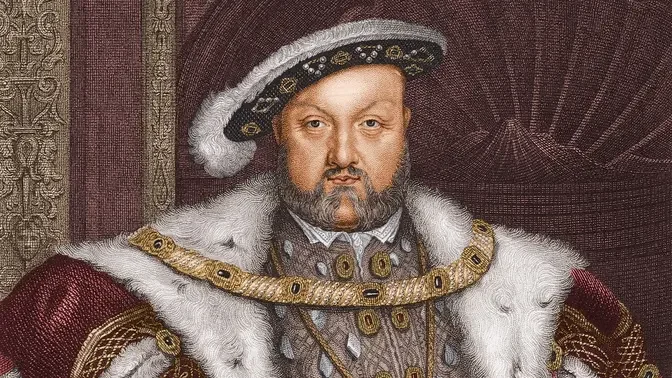
When presenting history in a public setting, there's a delicate line between putting famous
figures on blast for the irresponsible, immoral, or just downright memeable,
and falling into the trap of rewarding bad behavior with attention.
In this regard, researching a notorious king becomes much like watching over a toddler.
No hitting! Hands to yourself, please! Do not put that in your mouth!
Negotiating for basic manners with a baby is hopeless,
and so is expecting any better from a monarch,
because they're both playing by a completely different rule set,
and you can see it in their eyes that they know it too.
And this is why I spend so few videos recounting the lives of
big boy kings in their tonka truck wars. It's just exhausting,
and I always feel like I'm rewarding that bad behavior.
But today, in the spirit of the Valentine's season, I'm going to talk about love.
Or rather, whatever the hell Henry VIII was doing.
There is some overlap, but boy, is it slight.
So, to learn the story of England's most notorious lady killer as an object lesson
in what never to do, let's do some history.
We begin in England in the 15 aughts as young Prince Hal was an extremely captivating figure.
Admired in his day for his athleticism, charm, and good looks,
sure, he's at once better and worse than we're liable to give him credit for.
A multilingual and multi-talented king, he was an artistic patron and participant
in the Renaissance tradition. He was also full of a royally
insatiable appetite for food and women alike.
Those traits were only matched by his impulsiveness, arrogance, and self-obsession.
He got bored easily and was as distrustful as he was covetous.
Henry's paranoia led to the death of queens, officials,
religious dissenters, and nearly every advisor who ever served him.
Yet, for the first two decades of his reign, he was popular in his court and among the subjects,
in large part because he played the royal jock while his father's advisors
and one notoriously corrupt Cardinal Woolsey ran the kingdom.
But even early on, he couldn't leave well enough alone.
Bored of being merely a celebrity, Henry wanted to get the blood rushing by winning glory.
So, as ever, the clearest option was in France.
Yet, as ever, it did not work, costing the entire treasury in one go and only proving
that poor tiny England absolutely could not compete with the great powers of Europe.
So, with great frustration, he turned his focus back to England.
And this would prove especially bad news for his wife, Catherine of Aragon,
as it's here where Henry's reign surpasses the generically inept and
descends into the true hallmark of his career, religion-shattering horniness.
Now, before we progress, it is my historian's responsibility to remind you that people are
complicated and memes are not, so we're on the receiving end of a 500-year gossip circle that
we ourselves perpetuate every time we laugh at Old King Six Wives instead of thinking through
what the history meant for the actual human people who lived it.
Henry certainly belongs in horny jail, but we can't pat ourselves on the back
if we reduce an extremely consequential chapter of English history to the joke answer.
So, let's consider.
What did Henry want?
In a word, a son.
Henry grew up in the wake of the War of the Roses and was acutely aware of how catastrophic
the line of succession would get without a clear male heir.
His Tudor dynasty was new and it was not guaranteed to stay in power.
Henry was married to the stately Queen Catherine of Aragon, but after two decades of marriage,
no son.
Lots of infant mortality and one daughter, Mary, who survived to adulthood,
but Henry figured that wouldn't cut it in a fiercely patriarchal society like medieval Europe.
Catherine had been a good queen and a good wife, but once she was past childbearing years,
Henry had no use for her.
He had plenty of mistresses, but illegitimate sons would do him no good either.
What he needed was a brand new wife.
And people had done this before.
Divorce, per se, was not recognized by the church, but you could get an annulment where
the Pope says, oh, that marriage?
Yeah, that never happened.
You've actually been single the whole time.
In fact, Catherine was first married to Henry's brother, but after he died,
the marriage was annulled so she could marry Henry.
But this time, the Pope was unmovable.
Diplomacy, bargaining, saying pretty please, Rome would not budge.
In Europe, Henry was powerless.
But in England, he was the one in charge.
In 1532, a decade and a half after Martin Luther woke up and chose mayhem,
Henry broke with Rome and declared that the church in England was answerable only to the king.
Some of Henry's advisors objected, so naturally Henry had them killed.
And some Catholics in the North rebelled, so naturally Henry had them crushed as well.
Everyone else carried on with their day for fear of the harsh new anti-treason laws.
And with that, Henry had his church, his annulment, and his new wife, Anne Boleyn.
She had been a court lady to Catherine, and when Henry started making kissy faces at her,
she refused to be a mistress and insisted he marry her properly before any slamming was to begin.
Honestly, well played.
A few very short months after their marriage, Anne gave birth to the future queen Elizabeth,
but that was it.
Uh-oh.
In the midst of all that, Henry was struggling to reconfigure his monarchy
now that he was the head of the Church of England.
He became responsible for giving alms to the poor and happily confiscated all of the old church lands.
However, he had neither the time nor patience for another sonless wife.
Blissfully unaware of how chromosomal genetics actually works,
he concluded that this marriage was also cursed and had her annulled.
And executed for adultery and treason.
Zoinks.
This kind of frivolous cruelty also undermines the entire hoist of doing Protestantism in the first place,
which, frankly, is typical Henry.
Henry's subsequent betrothal to Jane Seymour the next day would finally net him the son he always wanted.
Never mind what Edward VI was like as king,
because he'd be succeeded seven years later by Mary and Elizabeth anyway,
so this whole exhausting ordeal is the result of one man's paranoia, lust, and enthusiasm for beheadings.
But with the mission finally complete, do you know what happens to Jane Seymour?
She died of an infection two weeks later.
I don't know whether to be sad for her awful luck
or relieved that she didn't live to see what it's like when Henry got a whiff of someone else's perfume.
But with his beloved bloodline preserved,
Henry turned back to foreign policy and failed just as badly as he did when he was a teenager.
He wanted a German Protestant wife as a check against Emperor Charles V
and chose Anne of Cleves in 1540, a mail-order bride he picked from a portrait gallery.
But Henry McSleaf's surround suddenly got all choosy and annulled the marriage the same year
because Anne didn't look enough like her portrait.
Rude.
That said, this ended a lot better than it very easily could have, so let's take the win and move on.
He next married Catherine Howard.
There was a religious strategy to this.
I don't care.
And he eventually had her executed for adultery as well.
Restraint?
In this kingdom?
Speaking of, he started some wars again.
Didn't super work.
Plus the treasury was back to empty.
Ah well, let's meet the last wife.
Catherine Parr was a Protestant widow who served as regent while Henry was at war in France
and made a point to formalize Mary and Elizabeth's places in the royal succession,
thus making Catherine Parr the actual MVP of the Tudor dynasty.
In any case, it was good timing because four years later,
Henry died, leaving our last Catherine to live her best life.
Oh, what a mess.
A king with his priorities so twisted and knots,
he wasn't sure whom he wanted to f**k, marry, or kill,
so he did everything to everyone and called it a day.
Henry's 38 years on the throne were some of England's most consequential
due to his sweeping reforms of church and state,
but all that sprang from the remarkable women whom he called queen.
These six stick in our minds because of Henry's distinct notoriety,
but any prominence he has in English history
is owed quite thoroughly to the captivating effect they had on him,
and in turn, on us.
And so we've come full circle to our starting comparison.
Like monarch, like toddler, they want their mommy.
Thank you for watching.
Before I go wash my mouth out with soap for that mommy joke,
god,
I'll give my adaptation seal of approval to Six the Musical,
because what it lacks in analysis of the geopolitical and theological factors
that contributed to the English Reformation,
it more than makes up for in raw, queenly vibes,
and is well worth the watch for the characters and music alone.
It won't teach you all the history,
but it makes the past really come alive,
and that is a rare treat.