
The Six Wives of Henry VIII – Part 2
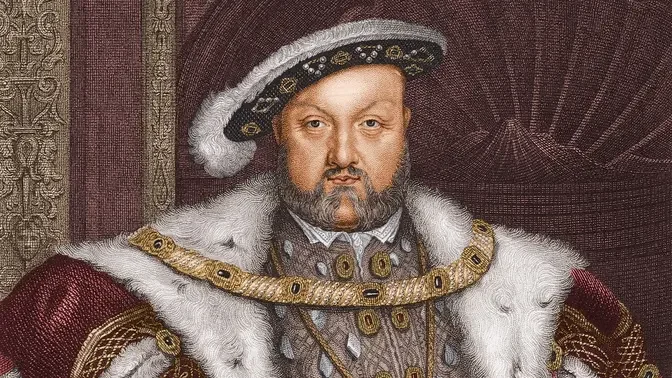
The Six Wives of Henry VIII
Part 2
By the age of 48, King Henry VIII had been through three wives, one he divorced,
one he beheaded, and one died giving him the son he so desperately wanted.
The once handsome and athletic lover was now a tyrannical, overweight monarch with an
He mourned for Jane Seymour for two years but eventually realized that he needed to marry
again. One son in the nursery was not enough. Having himself been a younger brother to an
heir who had died young, Henry knew the importance of a spare. His ministers encouraged him to make
an advantageous political marriage. By breaking with Rome to marry Anne Boleyn, Henry had made
enemies of most of Catholic Europe, and England needed new allies. But unsurprisingly,
foreign princesses were not lining up to marry the wife-murdering monarch.
Christina of Milan said,
If I had two heads, one would be at the King of England's disposal.
Anne of Cleves
Anne was born in Dusseldorf to Duke and Duchess John III and Maria of Cleves and Berg. Anne
received no formal education and had little in the way of cultural sophistication. She could read
and write only a little and only in German. She was skilled at needlework. After her father's
death, Anne's brother William became Duke. Cleves was a Protestant German state and opposed the
Holy Roman Empire, so an alliance with England made sense. Artist Hans Holbein was dispatched
to paint portraits of both Anne and her younger sister Amelia so that Henry could look the girls
over before making any matrimonial decisions. Holbein painted this portrait of Anne,
thought to be a rather close likeness based on contemporary accounts, and Henry became infatuated
with the demure, blonde, slim, and tall young woman. He sent his chief minister, Thomas Cromwell,
to negotiate the match. On New Year's Day 1540, the 25-year-old Anne arrived in England. Henry
decided to surprise her by disguising himself as a peasant. In this courtly game of love,
he was sure that his lady would fall in love with him on sight. But when Anne was shocked rather
than enamored with the old, overweight stranger who burst in on her, Henry was humiliated. He
complained that it was Anne who was ugly and that Cromwell had lied to him about her beauty.
He even called her the Flanders mare. He urged Cromwell to get him out of the marriage, but
doing so would endanger the German alliance. On their wedding night, Henry kissed his wife good
night and went to sleep. He railed at Cromwell the next morning that his wife's body was so
disordered that he was unable to consummate the marriage. But the sheltered Anne had no idea that
the couple hadn't fulfilled their marital duties. Understanding little English, she was also spared
the malicious court gossip repeating the king's insults against her. She was proud of having risen
from the backwater of Cleves to become queen of one of the most important countries in Europe.
To prove he was not impotent, Henry soon found his way to the bed of Anne's lady-in-waiting,
Catherine Howard. And he found legal grounds on which to divorce Anne without breaking the
contract with Cleves. At 11, she had been betrothed to a French nobleman, but the engagement was later
cancelled. Henry's lawyers argued that this meant she was not free to marry. After only seven months
as queen, Anne was offered a divorce, along with a generous allowance, houses of her own, and a
prominent position as the queen's sister if she would accept quietly. This would spare her having
to return to Cleves as a failure, and was far better than losing her head. So Anne wisely accepted
and sent Henry a letter, along with her wedding ring, which she asked him to break into pieces
as it was a thing of no value. For his part in the failed marriage, Thomas Cromwell was beheaded.
Anne retired to her country estates, but was a frequent guest at court and became friends with
her royal ex-husband. She was also close with his daughters, Mary and Elizabeth, and was a part of
Mary's coronation procession years later. She learned English and made herself at home in her
new country. She was described as a lady of right commendable regards, courteous, gentle, a good
housekeeper, and very bountiful to her servants. In 1557, at the age of 42, Anne died from cancer,
outliving Henry and all his other wives.
Catherine was one of 11 children of Lord Edmund Howard and Joyce Culpepper. Her father's sister,
Elizabeth Howard, was the mother of Anne Boleyn, making her a first cousin to the disgraced and
beheaded queen. Though the family had a noble pedigree, her father had been one of 21 children
and had inherited very little money. He was often reduced to begging from his more affluent
relatives to support his large family. When Catherine was five, her mother died, and she
and some of her siblings were sent to live with her father's stepmother, Agnes Howard, Dowager
Duchess of Norfolk. The duchess's household included many children of poor relations,
sent to her for care and education. But the duchess was often away at court and gave very
little supervision to the upbringing of her wards. Some of the girls in the household allowed
men into the dormitory at night. The girls were rewarded with wine and gifts. At 13, Catherine
was repeatedly molested by her music teacher, 36-year-old Henry Mannix. At 15, Catherine was
pursued by the duchess's secretary, Francis Dearum. Jealous Mannix sent a letter to the duchess,
telling her to visit Catherine's bedroom half an hour after bedtime. When she caught the pair
in the act, she sent Dearum to Ireland on business. He promised Catherine that he would marry her
when he returned. In the meantime, Catherine's uncle, the Duke of Norfolk, saw an opportunity to
increase his power by filling the king's bed. So he found the pretty 17-year-old Catherine a
and put her in Henry's view. Catherine was vivacious and good-humored. She loved dancing
and had a great tenderness for animals, especially dogs. The 49-year-old king became infatuated with
her. During the last months of his marriage to Anne of Cleves, Henry was seen repeatedly going
to Catherine's chambers. Less than three weeks after his divorce, Catherine and Henry were married
and enjoyed a 10-day honeymoon. The king called his new bride the very jewel of womanhood and
his rose without a thorn. He lavished her with clothes, jewelry, and estates and longed to
fulfill her every desire. He also promoted her uncle, the Duke of Norfolk, and many other Howard
men. Henry was hopeful for a pregnancy and was ready to crown Catherine queen upon that condition.
While Henry was besotted, Catherine was carrying out a secret love affair with her husband's
favorite courtier, Thomas Culpepper. The queen was also being blackmailed by former confidants who
knew of her premarital sexual history. Eventually, evidence of the same reached the Archbishop of
Canterbury, Thomas Cranmer, an enemy of the Duke of Norfolk. Cranmer placed a letter on the king's
chair in his private chapel, revealing the evidence against the queen. At first, Henry
didn't want to believe it. He wanted Catherine to be innocent, but Cranmer pushed the issue,
even torturing information out of Catherine's old love, Frances Dearham. Parliament passed a new law
making it treason for a queen consort to fail to disclose her sexual history to the king
within 20 days of their marriage, retroactively sealing Catherine's fate. When Cranmer went to
arrest her, she dissolved into such a state of shock and frantic anguish that he ordered the
guards to remove anything from her room that she might use to commit suicide. Her current and
former lovers, Culpepper and Dearham, were both executed. Culpepper, who knowingly committed
adultery with the queen, was a nobleman and got the axe, while Dearham, a commoner, whose only
crime was a premarital affair with a minor noblewoman, suffered the agony of being hanged,
drawn, and quartered. The barge that carried Catherine to the tower passed under London Bridge,
where the two men's severed heads were mounted. On the eve of her death, Catherine requested the
executioner's block be brought to her room, and she spent many hours practicing how to lay her
head upon it. The next morning, Catherine was pale and terrified, but composed. She needed help to
climb the scaffold and made a speech asking for mercy for her family and prayers for her soul.
The axeman took off her head in one clean stroke, and the 19-year-old queen was buried in the Tower
of London's chapel near her cousin, Anne Boleyn. Catherine Parr
Catherine was the eldest daughter of Sir Thomas Parr, a member of a prominent northern family,
and of Maude Green, a close friend and lady-in-waiting to Henry's first wife, Catherine
of Aragon. Young Catherine was born while her mother was at court and was named after the Spanish
queen, who was her godmother. Catherine's father died when she was young, and she was very close
to her mother. Queen Catherine of Aragon encouraged women's education, and Catherine Parr
had a passion for learning. She spoke several languages fluently and enjoyed reading and writing,
but was said to have hated needlework. At 17, Catherine married Sir Edward Berg, who was in
his twenties but was a sickly man. He died four years into their marriage. 22-year-old Catherine
then wed John Neville, Baron Latimer. He was twice her age, but the pair got on well and
shared genuine affection. When King Henry broke with Rome to divorce Catherine of Aragon,
Catholics in the north of England rebelled against the king. Rebels came to the Latimer home and
threatened violence if John did not join their efforts. Catherine watched in horror as her
husband was dragged away and the house was ransacked of food and supplies. She and her
young stepchildren spent the winter held hostage by the rebels and threatened with death. This
experience contributed to Catherine's loathing of Catholicism. Eventually, the rebels were defeated
and John returned home. The family put their nightmare behind them by moving to London.
Catherine loved the glittering atmosphere at court and the many new ideas there. After eight
years of marriage, John's health was fading. Catherine, ever kind and caring, nursed her
husband until his death. He left her a wealthy woman, but without him she had no place at court
and dreaded returning north. So she sought out a friendship with the daughter of her mother's
mistress, Princess Mary, and was given a place in her entourage. She fell in love with Sir Thomas
Seymour, brother of the late Queen Jane, and the pair planned to wed. But around this time,
she caught the eye of Henry. The King liked the bright, mature, and compassionate Catherine,
so different from his latest disappointment, the dizzy teenage Catherine Howard. And there was no
question as to Catherine's virginity as she had already twice been widowed. When Henry proposed
marriage, Catherine was heartbroken. She wanted a quiet marriage to Thomas Seymour and had no
ambitions to be Queen, but she had little choice but to accept and marry the King. She gave her
stepchildren positions at court and was close with all three of Henry's children, reconciling
the daughters to their father's affection. She was gentle with Henry, the prickly old bear,
and cared for his ulcerated leg wound. The aging King thrived in the light of her affection,
even going on campaign in France. During this time, he entrusted Catherine with the regency.
She was an excellent ruler and enormously influenced her stepdaughter Elizabeth,
the future Queen. But Catherine's one misstep as Henry's wife was nearly disastrous. She was a
devout Protestant and tried to convince the King to finish what he had started when he broke from
Rome and fully reform the English Church. Henry was furious that his wife would dare to
instruct him. He drew up an arrest warrant for his wife and rumor had it that he already had his
eye on a seventh wife, Catherine Brandon, Duchess of Suffolk. But unlike her predecessors, Catherine
received warning before she was arrested. She pled with the King that she had never dared to lecture
him, but instead brought up religion so that she could learn from the King's guidance. This lie
saved her life and she and Henry were friends once more. In 1547, after four years of marriage
to Catherine and 38 years on the throne, Henry, bloated and riddled with disease, died. He was 55.
The King was laid to rest in St. George's Chapel at Windsor Castle next to his third wife,
Jane Seymour, the only wife who didn't live long enough to piss him off. He left his final
wife Catherine a fabulously wealthy woman, but her heart's desire was Thomas Seymour. The couple
knew the Regency Council would not allow her to marry so soon after the King's death, so they wed
in a secret ceremony. When the news of the marriage became public, it caused a scandal and infuriated
her royal stepchildren. Catherine wrote two books, Prayers or Meditations and The Lamentation of a
At 35, she became pregnant, a complete surprise as she had never conceived during her three
previous marriages. During her pregnancy, her husband did not remain true to her. He carried
out strong flirtations with the Princess Elizabeth, who was living in her stepmother's house. Catherine
even caught her husband and Elizabeth in an embrace and sent the Princess away. The Dowager
Queen also cared for and provided education to Lady Jane Grey. In August 1548, Catherine gave
birth to a daughter, Mary, but six days later the Dowager Queen died from childbed fever caused by
poor hygiene during the delivery. She only outlived King Henry by 18 months. Hers was the first
Protestant funeral held in England. Thomas Seymour proposed marriage to Princess Elizabeth shortly
after but was turned down. He was beheaded for treason a year later. Henry VIII was one of the
most significant and influential monarchs of the nation and his life and reign were shaped by the
six women he married. His desperately longed-for heir, Jane Seymour's son Edward VI, was king for
just six years and died tragically young at 15. Catherine of Aragon's daughter, Mary, embittered
by her mother's maltreatment, ruled for a bloody five years. But Anne Boleyn had the final triumph.
Her daughter, Elizabeth I, reigned for a glorious 44 years and surpassed her father as arguably the
greatest monarch in English history. If you enjoyed this video, please consider
supporting me on Patreon and help me make more fascinating videos. Patrons get cool perks like
exclusive content, mentions in videos, and can even request video topics.
A link to my Patreon is in the description. Thank you for watching!