
Henry VIII and The English Reformation
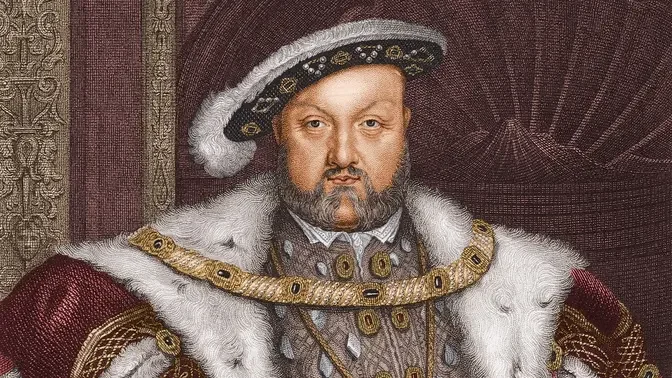
On February the 18th 1516, at the Palace of Palencia in Greenwich, London, a baby girl is born.
She will be called Mary and she has been born to King Henry VIII and his Spanish wife,
Queen Catherine of Aragon. Now ordinarily you may think this would be an occasion of great
celebration, but these are not ordinary times. These are the times of the fragile Tudor dynasty
and the Queen of England must supply heirs. Catherine had been pregnant four times since
their marriage in 1509 and had delivered one girl and three boys, but none had survived longer than
a couple of months. Henry was not only desperate for healthy children, but he was especially
desperate for healthy boys. You see in the early 16th century it was far more desirable to have
a king than a queen, so this new girl Mary, although welcome, gave Henry further disappointment.
But not to worry, Catherine is still youngish and they can try again. So two years later she becomes
pregnant again, another girl, who again dies after only a few hours. To say Henry was becoming
impatient would be putting it mildly. And that was the last time Catherine would become pregnant
and so Henry needs to come up with a plan. In 1525 he spots a new girl amongst Catherine's
ladies-in-waiting. She is called Anne Boleyn. He quite likes Anne and so he starts an amorous
relationship with her and by 1527 he has decided he'd like to get shot at Catherine and marry Anne.
Perhaps Anne is the one who can give him his male heirs. There's just one little problem with this
plan. This is 16th century Europe and if there's one thing you can say about 16th century Europe
is that it is very, very Catholic. And nothing happens in Catholic Europe without the big man,
Pope Clement VII, giving his papal approval. So Henry gets his top man, Cardinal Thomas Wolsey,
to have a word with the Pope and get a divorce sorted out. Now you might think, well job done,
except divorce at this time was very much frowned upon and you're going to need a pretty good excuse.
Henry's brilliant excuse is that because Catherine had been married before to a guy named Arthur,
that Henry's marriage was therefore invalid. Have I not mentioned Arthur? I should perhaps say that
Arthur is Prince Arthur, Henry's older brother who died in 1502. Okay, time for a look at the
Catherine's parents are Ferdinand II of Aragon and Isabella I of Castile. They were very powerful
in Europe at this time and of course very Catholic. Henry's dad, Henry VII, really wanted to be best
pals with the Spanish and so it was agreed for Prince Arthur to marry Princess Catherine,
which they did in 1501. England would have a Spanish Queen of England sitting next to King
Except Prince Arthur only went and fell ill and died in 1502. So to keep Ferdinand and Isabella
happy, Henry VII thought, I know, Catherine can marry young Henry, problem solved. So they did
in 1509. But now Henry wants to end this with a divorce because he believes it's against God's
will to marry your brother's widow. The Pope's bound to agree, so he'd best start his wedding
preparations for Anne. Now this is where things get a tad messy. The most powerful man in Europe
at this time is Charles V, the Holy Roman Emperor and he doesn't exactly get on well with the Pope
and he does have a liking for the odd war here and there. Well what's that got to do with Henry's
divorce? Well, it turns out that Charles V is the nephew of Catherine and because Catherine
really likes being Queen of England, he takes her side and threatens the Pope not to grant the
divorce. So the Pope says no divorce and this does not please Henry. However, it has not gone unnoticed
by the King that across Europe there has been a growing displeasure with the practices of the
Catholic Church and protest movements by the likes of Martin Luther were gathering pace. The demands
for a Protestant Reformation would seem to come at an ideal time for Henry as he now comes up with
another brilliant plan. If the Catholic Church won't grant him a divorce, he'll simply set up his
own church, make himself a supreme head, grant his own divorce, marry Anne Boleyn and all will be well
in the land. So this he did. The series of Acts of Parliament began in 1532 and he married Anne in 1533
and the whole break from Rome was completed in 1534 with the Act of Supremacy where Henry granted
himself the rather spectacular title of Supreme Head on Earth of the Church of England. So you'd
think Henry was happy now, right? He's enjoying his new role as head of a new church but he needs to
make sure it sticks. So he sets about removing all signs of Catholicism from the land. All of the
Catholic monasteries in England were dissolved and their riches plundered to swell the royal coffers
and the entire population was ordered to convert from Catholicism to the new Protestant Church of
England. Most did but those who refused to recognize Henry as the new head of a new church,
well, they lost their heads. So Henry gets his divorce, he created his new church, he marries his new
queen, he got rid of Catholics, now all he needs for the full set is a son and all will be well in the
land. Except Queen Anne finds it difficult to provide him with a son and only gives birth to
Henry loses patience with Anne and through some shifty skullduggery, enough for a whole another
video, she somehow manages to fall foul of the law and is beheaded for treason. There's no problems
with divorce then for Henry so he's free to marry again, and he does. He falls for Jane Seymour and
he marries her in 1536. Surely this time the son will follow. Success! Queen Jane delivers a healthy
boy in 1537 who will go on to become King Edward VI. Edward will continue his father's Protestant
reformation but remember when I said that these were not ordinary times? Well, Edward dies in 1553,
aged just 15. Now what? Well, he doesn't have any children but he does have an older sister,
Mary. Remember her? The one with the very Spanish, very Catholic mother? Well, guess what? She now
becomes Queen Mary and immediately sets about undoing all that Protestant carry-on and tells
England that although they'd all just made the switch from Catholicism to Anglicanism,
would they mind awfully switching back or be executed? To strengthen her Catholic mission,
she even goes as far as to marry Philip II of Spain who just happens to be the son of Charles V,
Holy Roman Emperor. Remember him? However, Mary dies in 1558, having never given birth to an heir.
It would seem that along with the end of her reign was also the ending of the new-found
English Catholicism because Mary's successor was her younger half-sister, Elizabeth. Remember,
Elizabeth was the daughter of Anne Boleyn who was the whole reason for the switch to Protestantism
in the first place. So guess what? It's time to again switch the English faith, this time back to
the Church of England. Queen Elizabeth reinstates the act of supremacy, after her sister Mary had
done away with it, and gives herself the title of Supreme Governor and now, once again, all will be
well in the land. Except... After Elizabeth died in 1603, having no heirs, the English throne was
taken over by the Stuarts of Scotland. The following century would see skirmishes such as
the Gunpowder Plot looking to restore Catholicism and it could be argued that the English Reformation
lasted until 1688 when the English Civil War saw the deposing of the last Catholic monarch of
England, James II. James was replaced by William III and Mary II who ruled in conjunction
and every British monarch since has been a Protestant. Furthermore, as a result of Henry VIII's
creation of the Church of England, every British monarch to this day has been head of the Church of
England. If you enjoy these videos, please take a moment to subscribe and not forget and hit the
bell icon so you receive notifications for every future episode. Thanks very much for watching.