
When Henry VIII Fell In Love With Anne Boleyn | The Lovers Who Changed History | Timeline
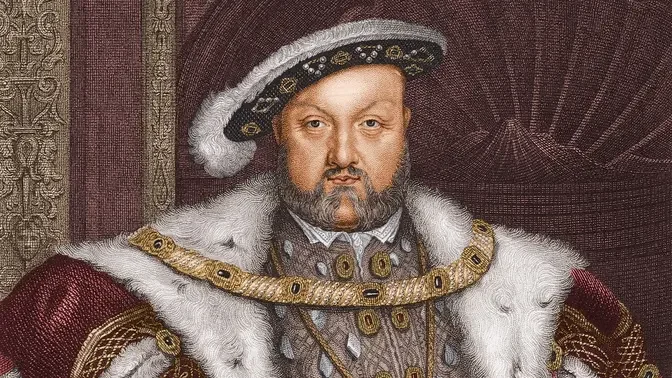
Anne Boleyn, the wife of Henry VIII, awoke in the royal apartments at the Tower of London.
Her ladies-in-waiting made their final preparations.
Anne left her chambers at a little before eight o'clock to face her destiny.
Awaiting her at the end of this short journey was an expert executioner, famed for his skills
with a razor-sharp blade.
He'd just arrived from France, summoned by the king as a last-minute act of mercy for
a wife for whom he'd risked everything, but whom he ultimately believed had betrayed him.
The lives of Henry VIII and Anne Boleyn have been cloaked in historical myth, romantic
legend, clichés and half-truths.
Henceforth, my heart shall be dedicated to you alone.
Their turbulent relationship continues to spark fierce debate.
I'm entirely innocent of all these accusations.
I'll be retracing the footsteps of this extraordinary couple, piecing together the fragments of
evidence that have survived to discover what brought Henry and Anne together and what ultimately
tore them apart.
We all know how this tragedy plays out, but how well do we know its leading characters?
This is the story of Henry and Anne.
My journey begins in the Kent countryside, in search of Anne Boleyn.
Her symbol was a falcon, used to extol her purity, her chastity and her grace.
There's a popular myth that Anne was from lowly origins, that she was a bit of an upstart,
but that's far from the truth.
This is Hever Castle, the seat of the Boleyns.
It's Anne Boleyn's childhood home, where she spent many formative years.
Near her parents, Thomas and Elizabeth brought up the three children who made it to adulthood.
The eldest was Mary, who fleetingly later would be a mistress to Henry VIII.
Probably the youngest was George, who was a great companion to Anne, a bright young
girl who would one day be queen.
Her father, Thomas Boleyn, was a member of the king's council and Henry VIII's ambassador to France.
Anne was well-educated and from a wealthy, privileged family.
The story goes that she was a free spirit, someone who was sparky, intelligent and fun-loving.
But this is based as much on rumour and speculation as any hard evidence.
It's so hard to get a sense of the real Anne Boleyn.
We have a few letters, but we don't have any diaries.
We don't really have any of the sort of things that we need to get a grasp on what she was
really like.
And yet when you come to a place like this, where she actually lived, one has this incredible
sense that the veil between past and present has grown thin and only time and not space
separates us from Anne.
Fortunately, a few telling pieces of evidence have survived, which give us a rare glimpse
into her character.
This is one of the few surviving possessions of Anne at Hever.
It's a book of hours.
It's a beautifully illustrated and illuminated manuscript book of prayers and devotions and
these things were immensely popular in Europe at the time.
And what's really exciting about it is that Anne held it.
There's something of a real thrill to be touching it.
It was probably one of her most treasured possessions.
What this reminds us is an importance of faith at this time.
It literally determined people's hours.
Religion marked out their days.
We often have an idea of Anne in our heads that's of her being ambitious and worldly
and perhaps something of a vixen.
And yet this is one of her few belongings that we know and can identify.
It reminds us that Anne is pious and religious.
But what's even more thrilling about it is that Anne herself wrote in it.
It's an inscription in French and it says,
Le temps viendra, je Anne Boleyn.
The time will come, I Anne Boleyn.
Now we don't know when she wrote this.
We don't know exactly what she meant by it,
but it seems immensely prophetic and powerful.
It's on a page where there's a picture of Christ being raised above the earth
and then there are these little heads at the bottom
that look like people coming up out of the grave.
So perhaps this refers to the day of judgment.
Many people in the 16th century thought that they were living in the end times,
the last days before the second coming of Christ.
But perhaps there's a more earthly explanation.
I wonder if Anne thought that she was destined for greatness.
All our doings being ordered by thy God.
Even if she was ambitious,
Anne could never have imagined that her destiny
would lie with the most powerful man in the land,
a married man, the king.
We all think we know Henry VIII,
but actually what we conjure up is Henry in the last decade of his life
when he's obese and savage and ruthless and cruel.
But he wasn't always like that.
In fact, when he first came to the throne
and for the first 20 or so years of his reign,
he was noted, first of all, for being really good looking.
He had auburn hair.
He was very tall.
He was six foot two when the average height was five foot seven and a half.
And he was so good at sport that everyone commented on it.
He surpassed all the archers of his God.
He was a fine jouster, a capital horseman.
To see him play tennis, one Venetian ambassador commented,
was the prettiest thing in the world.
That Venetian ambassador also said, perhaps he had a crush,
that he had a round face so very beautiful
that it would become a pretty woman.
But the thing that was most surprising to me,
coming across this young Henry,
was that he was also well loved.
He was considered to be kind.
The ambassador said that he was affable and gracious,
a man who harmed no one.
Erasmus said that he was a man of gentle friendship
and gentle in debate.
He acts more like a companion than a king.
Henry was evidently very charismatic.
When he spoke to you, it was like the sun was shining.
As a king and a man, he seemed to have few flaws.
But Henry would become tormented by his failure
to perform the most basic, yet most important task of any monarch.
It would put him on a collision course with Anne,
and together they would change England forever.
Henry VIII wasn't born to be king.
He'd come to the throne after the death of his father, Henry VII,
and only because his older brother, Arthur,
had died suddenly, at the age of just 15.
Within months of becoming king,
Henry married his brother's widow, Catherine of Aragon.
They were crowned together.
But with marriage came a huge pressure.
Now he needed to produce an heir
to secure the dynasty for the next generation.
And not just one, he needed an heir and a spare,
as his brother's death had indicated.
Henry would be married to Catherine for over 20 years,
and for much of that time they were happy together.
But they were beset by a devastating series of miscarriages and stillbirths.
When a son, Henry, was born, he died 52 days later.
Mary would be the only child to survive.
Most people at the time saw little value in a female heir,
as she would likely end up marrying a European king
or she would likely end up marrying a European prince,
allowing England to be dominated by a foreign power.
And France and Spain were a constant threat throughout Henry's reign.
So siring a legitimate heir became Henry's overriding obsession.
It was an obsession that would manifest itself
in Henry's relationship with God,
by whom he believed he had been anointed king.
This lack of a surviving legitimate male heir suggested to Henry VIII
that he was being punished by God.
And he suspected the reason was that he had married his brother's widow.
And scriptures backed him up in this.
In Leviticus, it says, in chapter 18, verse 16,
you shall not uncover the nakedness of your brother's wife,
it is your brother's nakedness.
Chapter 20, verse 21 says,
if a man takes his brother's wife, it is impurity.
He has uncovered his brother's nakedness.
They shall be childless.
Henry's theological experts assured him that childless,
in this instance, actually meant no sons.
While England waited for an heir to the throne,
the teenage Anne had crossed the channel
and was embracing all that Europe had to offer.
After some time in the Netherlands,
her father found her a role in the French court,
which would become a defining influence in her life.
Little is known of Anne's nine years on the continent,
and yet much is always made of it.
It certainly was a formative period of her life.
It was the period when she was educated.
And people in the 16th century, and today,
speculated in a kind of prurient, nudge-nudge, wink-wink kind of way,
that at the French court particularly, she learned the art of love.
I want to see for myself how Anne's time in France shaped her character.
I'm travelling to the Chateau de Blois,
one of the palaces where the French king, Francis I, held his court.
I can only imagine what the young Anne must have felt
when she first arrived here.
I've never been here before, and it's really exciting.
Anne would be a lady-in-waiting
to the cultured and pious French queen, Claude.
They didn't do things by halves, did they?
Look at this place. My word.
It was the most fashionable court in Europe,
reflected in its spectacular architecture.
This is an extraordinary sort of Renaissance style.
You've got the little classical statues up the top here
in these columns, and this amazing spiral staircase.
It's so incredibly beautiful, this staircase.
It would have been such an extraordinary time for Anne when she was here
because she was here with Claude of France,
who herself was a real patron of the arts.
Francis I, her husband, was so much a fan of the Renaissance
that he invited Leonardo da Vinci to France,
and he was installed just down the road.
There was every chance that Anne might have met him.
Anne would have been surrounded by this world of intellectual endeavour
and artistic endeavour.
It must have been such an exciting place to be.
I'm out of breath now.
Anne came of age in France.
One observer later wrote that no-one would ever have taken her
to be English by her manners but a native-born French woman.
What might Anne have learnt at this court?
The first thing, of course, is French
because French was a very important language at that time.
It was something like the English today in the northern courts of Europe.
We just know that she must have been at some very important events
such as when the English ambassadors came to France in 1518
or at the Field of the Clothes of Gold
because she must there have played an important role
as an interpreter between the English and the French.
She received a European education
and she was really different from the young ladies who just stayed in England.
Anne also saw first-hand what was required to fulfil the essential role of a queen.
Her mistress Claude gave birth to seven children in eight years,
including three sons, something Henry and Catherine could only dream of.
Claude was also extremely pious,
so it's unlikely that her court was a hotbed of promiscuity.
Cedric, one of the things that's often said about Anne's time in France,
with probably little evidence from what you've said so far,
is that there's kind of this idea that somehow she's learnt all about sex
while she's been at the court.
Do you think this is at all plausible?
Yeah, my opinion would be that it's not true, but it may be true.
We don't know. We have no evidence.
I don't think there was a clear difference at that time
between the court of Francis I and the court of Henry VIII.
Our first surviving letter from Anne was written to her father
and shows her aspirations to be accepted in the English court.
Sir, I understand by your letter
that you wish that I shall be of all virtuous repute when I come to court,
and you inform me that the Queen will take the trouble to converse with me,
which rejoices me greatly.
To think of talking with a person so wise and virtuous.
Written at five o'clock by your very humble and obedient daughter,
Anna de Boulogne.
We tend to think about Anne Boleyn in black-and-white terms,
so she's either a sexual predator or she's sexually chaste.
She's either pious or she's worldly.
She's either innocent or sophisticated.
And yet, actually, what I've learnt here is that her French education,
her time at the French court,
was such that it prepared her to be a much more complex character than that.
Her nine years on the continent transformed her from a teenage girl
into an extremely desirable woman.
The Anne that emerges back in England
is one who's been shaped by many different influences,
who is both pious and worldly,
who's both sophisticated and something of an innocent.
She's one who can play musical instruments,
who can sing, who can dance, who can speak French,
who is sophisticated and witty,
who's been exposed to a world of cosmopolitan glamour.
And she's such an attractive prospect because,
precisely because, she is so complex.
The time will come.
I, Anne Boleyn.
In her early 20s, Anne arrived back in London.
Henry held court in palaces all over the capital,
and I've come to one of the few that has survived.
Hampton Court.
I love this place. I'm always amazed when I come here.
Imagine what it must have been like for Anne when she came to court.
She was joining Catherine of Aragon's court.
She was a lady-in-waiting.
And Catherine would have had a number of women serving her.
And, of course, this meant really being a companion to Catherine,
reading with her, sewing with her,
being by her side as well as looking after her needs.
There would have been perhaps 1,200 people at the court at its most,
about 200 of whom were women, Catherine of Aragon's women.
And, of course, Catherine's court was part of the wider court,
Henry's court, which was probably at most 1,000 men.
A Tudor court was a heady mix of politics and theatre.
A court ought to be formal, ought to be serious, ought to be religious,
but it also ought to be, as well as all that,
a place where people are having fun.
Parties are going on, where people are enjoying themselves.
You don't want a court which is too serious.
Henry's court is awash with desire and love and sex.
It's full of young people with lots of time on their hands
and not much to do.
In Henry's court, when people talk about love,
they're often actually talking about promotion.
They're often actually talking about politics.
Courtly love is a game.
Henry has lots of roles, but one of them is the leading courtly lover.
Now, in order for him to play that role,
he has to have the leading courtly woman as his object of desire,
as the person he performs to.
Competition for this role was intense,
and maybe Anne aspired to be one of the leading players.
Henry did have mistresses, not nearly as many as the French king,
but it was considered to be a normal part of court life,
especially when Catherine was pregnant,
because it was considered unlucky in Tudor times
to have sex during pregnancy.
So in 1519, for example,
one of the most beautiful women at the court, Elizabeth Blount,
had given birth to an illegitimate son, Henry Fitzroy.
His surname means son of the king.
And, of course, this indicated to Henry
that if Catherine wasn't bearing him sons, it wasn't his fault.
When Anne came to court in 1522, Henry had another mistress,
someone Anne knew rather well.
Henry went out to joust one day,
bearing the motto, Elle m'encoure à Navarra,
she has wounded my heart, which spoke of this mistress,
and the she in question was Mary, Anne's elder sister.
We don't know that much about Mary.
We know that she was beautiful, giddy, high-spirited.
She enjoyed the trappings of court life, as Anne would later do.
And we know even less about her relationship with Henry,
except that it was short-lived.
The risk of fleeting royal affection
surely served as a warning to Anne over the coming years.
It's one of the most famous love stories in history,
and yet we know very little about
how Henry VIII and Anne Boleyn's romance began.
It's likely that Henry first noticed Anne during courtly entertainments.
What is more certain is that their stories came together in early 1526,
four years after Anne's arrival at court.
We know this because Henry was soon writing love letters
and giving her romantic gifts.
One of these supposed presents
is housed in the Victoria and Albert Museum in London.
One of the first gifts that Henry is said to have given Anne
is this beautiful miniature gold whistle pendant.
It's covered with foliage and it's really rather tiny.
And as well as being a whistle,
it also has within it a scoop for one's earwax
and a pick for one's teeth,
so it's all about personal hygiene.
It is the sort of thing that Henry VIII might have worn on his clothing
in a sort of court mask or festivity
that would have then been given away as a present.
But above all, it tells us a message,
and the message is clear.
Henry is saying,
if you whistle, I will come.
It might have been just another gift
from a king to a courtly love mistress,
but it soon became clear from Henry's own hand
that this was something far deeper.
I and my heart put ourselves in your hands,
begging you to recommend us to your good grace
and not let absence lessen your affection.
When historians study Henry and Anne,
much is made of the dark political forces
manoeuvring behind the scenes to unite or to separate this couple.
And what is lost amongst these affairs of state
is the fact that this was a very real and very passionate love affair
between two individuals.
These are copies of Henry VIII's letters to Anne.
The originals, the manuscripts, are in the Vatican Library.
They probably ended up there as part of the evidence
against Henry's divorce from Catherine of Aragon.
These are quite extraordinary
because they show to us these intimate moments,
these private thoughts.
This letter, for example, starts,
My own sweetheart, this shall be to advertise you
of the great loneliness that I find since your departing,
for I assure you...
..the time longer since your departing now lasts
than I was wont to do a whole fortnight.
I think your kindness...
..your kindness and my fervency of love caused it,
for otherwise I would not have thought it possible
that for so little a while it should have affected him so much.
And he concludes,
Darling, wishing myself especially of an evening
in my sweetheart's arms,
whose pretty duckies I trust shortly to Kate.
Ducks is the Tudor slang for breasts.
And he says, written by the hand of he who was,
is and shall be yours by his will.
Henry Wrex.
And these sentiments are reiterated elsewhere.
So here it says, for example,
I would that you were in mine arms, or I in yours,
for I think it long since I kissed you.
And to cause you yet oftener to remember me,
I send you, by the bearer of this,
a buck killed late last night by my own hand,
hoping that when you eat of it, you will think of the hunter.
But perhaps the sweetest one of all
is this one, which is written in French,
and he promises Anne that in the future
his heart would belong to her alone,
would be dedicated to her alone,
and that he desired that his body could be also.
Anne signs off again in the sweetest possible way.
H and R, his initials.
Autre ne cherche, is not looking for any other.
And then draws a love heart and puts AB in the middle.
So he's like a schoolboy doodling on his exercise book.
Henry loves Anne.
Beg also, if at any time before this
I have in any way offended you,
that you would give me the same absolution that you ask,
assuring you that henceforth
my heart shall be dedicated to you alone.
I wish my person was so too.
God can do it if he pleases.
I pray every day to that end,
hoping that at length my prayers will be heard.
We don't know exactly when these letters were written,
and sadly we don't have Anne's responses.
But it's clear that Henry's love for her
was becoming ever stronger.
We know that Anne received many of these letters at Hever Castle.
She was there in the late 1520s
when she was suffering from sweating sickness
and separated from Henry.
We just don't know what she wrote back.
Although you are my mistress, it has not pleased you
to keep the promise you made when I was last with you,
that is to say, to hear good news of you
and to have an answer to my last letter.
Sweating sickness was a potentially lethal disease
which had spread through Tudor England,
forcing Anne to stay away from the king.
I think because we don't have her responses,
a lot has been written to fill in that gap,
and there's been an assumption
that somehow she was playing hard to get and manipulating him,
that he loved her and she was just playing a game.
But in practice, I think ultimately
both of them wanted to do what was right,
and above all, Henry, of course,
wanted to have that legitimate heir.
He could only do that if Anne became his wife.
There was no point to her becoming pregnant beforehand.
In fact, it would have been detrimental to his cause.
I think both of them decided to hold out and to wait.
I don't think we should read into the absence of letters from Anne
some sense that she was the one holding all the cards
and Henry was just desperate to have her.
I think the two of them were passionately in love
but wanted to do this correctly, wanted to be right.
But the stakes were high.
Thomas More said politics be king's games
and for the most part played on scaffolds,
and love at the Tudor court was a political affair.
Anne was risking everything.
And it was tough for Henry too.
He now had to think the unthinkable,
to divorce Catherine and marry Anne.
The time will come. I, Anne Boleyn.
No king had ever divorced a queen.
The issue would become known as the king's great matter.
A play later performed at court, no doubt with Henry's approval,
made his feelings about Catherine and Anne clear.
Yet a piece of work that needs must be done.
Even now is he making of a new moon.
He saith your old moon...
It was called The Play Of The Weather
and was packed with political rhetoric,
talking of Jupiter needing a new, tighter moon
to replace his old, leaky moon.
But for this new moon I durst lay my gown
except a few drops at her going down.
Mocking and embarrassing Catherine,
it was a cruel statement of Henry's intent
to discard a loyal wife
whose only crime had been her failure to provide a male heir.
Though they fell on a sponge, they would give no sound.
This new moon shall make a thing spring
more in this while than a old moon shall
while a mile go a mile.
But Henry would dramatically underestimate
how difficult it would be to end this 20-year marriage legally.
England was a Roman Catholic country
and on religious matters,
even the king came under the authority of the pope
and he wasn't going to play ball.
I've come to see a document that testifies to the lengths
that Henry would go to get Rome's permission.
This document dates from 1529
and it was produced at a court
that had been convened in order to examine
Henry VIII's marriage to Catherine of Aragon
and the possibility of an annulment.
This document has lots to tell us.
First of all, saying that Henry's king of France and Ireland
and all the other things that he claims to be.
And what's really interesting about it
is that Henry has gathered all the officials of the church.
So it mentions Cardinal Thomas Wolsey,
we've got the Archbishop of Canterbury,
the Archbishops of Ely and London and Bath and Exeter.
It says that Henry feels
that this matter of his marriage to Catherine
has caused him a real rupture
in his tranquillity of his mind and his body.
In other words, being married to his brother's widow
in this sham marriage, as he's claiming it to be,
has caused such a burden on his soul
that his conscience is severely troubled.
So this is the first time we really have this recognition
that something has to change.
And this document also demonstrates to us
the lengths to which he will go to get what he wants.
Among these beautiful seals, on the third from the left,
we have one that has the signature up here
of John Fisher, Bishop of Rochester.
But not everything is quite as it seems.
Rochester was a really important figure in Henry VIII's life
and yet his signature here is not genuine.
He later claimed that it was a forgery,
that he'd never signed this document
and that he was entirely opposed to this matter of the divorce.
In the end, Fisher would pay the ultimate price
for his hostility to Henry and Anne
and for the lengths to which Henry would go in order to be with her.
Fisher ended up, as so many others in Henry VIII's reign,
on the scaffold.
Now, Henry and Anne's future together
seemed to rest on the judgment of the Pope.
Henry VIII was used to getting his own way.
Blocked by the Pope from ending his marriage to Catherine
so that he could marry Anne, he needed to find another solution.
And help came from a source close to the king, Anne herself.
I want to show you another book.
This is William Tyndale's The Obedience of a Christian Man from 1528.
In fact, it's a rather battered edition,
but what it has to say is really important.
Tyndale was a Protestant and he argues in this book
that the supreme authority is Scripture,
over and above the false authority of the Pope.
He also adds that it's shameful for princes
to be under the authority of the Pope.
Tyndale argues that kings are the highest authority in the land.
It says, the king is judge over all, and over him there is no judge.
What's really interesting is that Anne almost certainly
gave a copy of this book to Henry,
and Henry, on reading it, said,
this is the book for me and all kings to read.
He evidently rather liked it.
And it gave Henry a solution to his dilemma.
If he were the supreme religious authority,
there was no need to get permission from the Pope for his divorce.
And this idea that actually he was first under God
played to his egotism.
It was something he'd secretly suspected all along.
And this is another example of the way in which this love affair
was having a profound impact.
This love affair was so important
that it would end up changing the very faith of England.
Henry broke ties with Rome,
removing the Catholic Church's influence over the country,
and he set about creating a new Church of England
over which he would be the supreme head.
It was an incredibly brave move that risked taking England to war
with its Roman Catholic neighbours in Europe.
So Henry desperately needed a powerful ally.
In December 1532, he crossed the Channel with Anne
to seek approval for their marriage from the French king.
And they got it.
They had waited for each other for seven long and difficult years.
Now they had cleared a pathway to marriage.
And all the evidence suggests that by the time they left Calais
and returned to Dover, Henry and Anne were lovers.
I've always believed that Henry and Anne were passionately in love.
And if anyone should doubt their feelings for each other,
there's a remarkable 500-year-old book.
I don't suppose it was ever meant to be seen by anyone
except Henry and Anne.
I'm really excited about this.
In all my years of studying this couple,
this is the first time I've had a chance to see the real thing.
Will you go ahead?
So it's a stunning, exquisite... It's beautiful, isn't it?
..turn of the 15th century, 16th century,
probably Flemish illuminated book of hours,
but really evocative and very special
because it provides us with a really intimate glimpse
into Henry and Anne's relationship.
It contains two remarkable written entries
in the hand of Henry VIII and Anne Boleyn.
That's amazing.
And this is Henry's here, written in his own hand,
beneath, very importantly, an illumination of the flayed Christ,
sometimes referred to as Man of Sorrows or Eke Homo.
I think Henry is trying to portray himself by association
as the lovesick king suffering, you know, in his heart.
If you remember me in your prayers as strongly as I adore you,
I shall hardly be forgotten, for I am yours forever.
If you remember my love in your prayers as strongly as I adore you,
then I shall scarcely be forgotten.
Your Henry, Rex, forever.
Well... Would you like to see what Anne wrote?
Gosh, yes, yes.
I think she chose the page very carefully.
We can see here an image of the Annunciation,
so Virgin Mary has been told by the angel that she's going to have a son,
and I think that this is what Anne is telling Henry.
Yes.
That she is the woman to provide him with the son and heir
that he so desperately wanted.
And then at the foot of the page, we can see she writes to Henry a couplet.
By daily proof you shall me find
to be to you both loving and kind.
By daily proof you shall me find
to be unto you both loving and kind.
Wow.
These words that Henry and Anne wrote to each other
remind me of wedding vows.
Henry declaring that he would be hers forever
and Anne promising to give the king the son and heir he desperately wanted.
Now they set about making their union official.
Henry brought Anne to one of his favourite palaces,
the Palace at Whitehall.
At the time, it was the largest palace in Europe,
bigger even than the Vatican.
And this map from 1680 shows something of its large extent.
It shows that it had a tilt yard, tennis courts, gardens,
a great hall and many, many apartments.
It would have been a glorious place for Henry and Anne
to celebrate being together.
Whitehall Palace was burnt to the ground in 1689.
Virtually all Henry's Tudor buildings were destroyed
and what little is still left
is now only seen by politicians and civil servants
working in the Cabinet Office.
And this is it, almost all that remains of that once mighty palace.
It's a crying shame because so much of this story
would have been played out here at Whitehall,
including the pinnacle of Henry and Anne's romance,
their marriage.
Somewhere near here, in January 1533,
Henry and Anne were officially married.
It was a pretty private affair, there weren't many people there,
and so we have few witness accounts of exactly what took place.
But what we do know is that the couple would have been overjoyed
because Anne was pregnant
and surely this time it would be a boy.
They had defied a pope and redefined a kingdom.
It seemed that love had conquered all.