
The PAINFUL Death Of King Henry VIII Of England
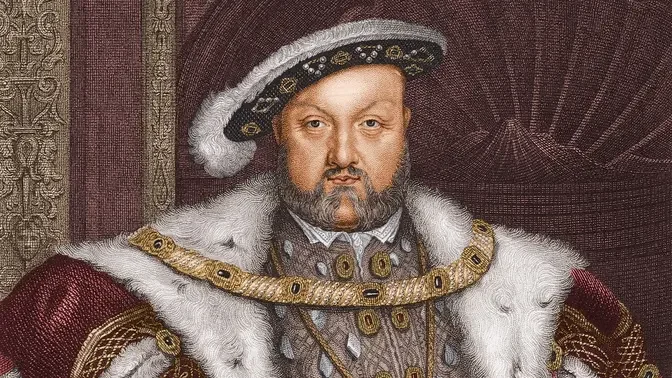
We associate Henry VIII today with being a notorious king, who was also rather brutal.
During his reign, over 70,000 people were executed, many in public and terrifying events,
being beheaded, hanged drawn and quartered and worse.
However when the king came onto the throne, he was a sign of virtue, and a sign of true
strength and power.
He was described at the start of his reign as a tall, handsome and athletic man who was
known for being very sporty.
As his final moments approached in January 1547, he was a departure from his former self.
He was a large and grotesque figure, with a waist measuring 52 inches, and a chest around
53 inches.
Henry VIII declined heavily in his final days, and his physical health it's believed is
linked to his temper and temperament.
Today we look at the final moments and death of Henry VIII, England's most famous king.
Henry VIII is mostly associated today for having 6 wives, but during his life he did
face a number of serious bouts of illness and disease.
When he was 23, he contracted smallpox, a deadly disease which was incredibly serious.
However he managed to recover over time, and then at the age of 30 he contracted malaria
which also made him sick for a while.
It was 3 years later that one of the most worrying parts of Henry VIII's life came,
when he was involved in a famous and hard hitting jousting accident that caused him
great discomfort and pain throughout the rest of his life.
It's believed by some historians that this accident changed the king completely, and
that his former self was a positive and happy king, transformed into a depressed, short
tempered and bitter one.
During a jousting match with the Duke of Suffolk, Henry was hit hard above his right eye by
a lance, forcing him off his horse and onto the floor.
After this he suffered badly with migraines, and at the age of 45 he was involved in yet
another serious jousting accident.
He fell from his horse, and after this was trapped by the animal, and was squashed by
the horse and also the weight of his armour.
This particular incident left him unconscious for at least 2 hours, and many were very worried.
When he finally came around, it was said later that the king had changed even further.
It's believed that this caused his mood swings, and that he possibly on the tilt yard suffered
from a severe traumatic brain injury.
Today he would have been diagnosed with this, but following this the king's health declined
further.
In his final years, Henry began to shun exercise, and he also began to overeat to a huge extent
that caused his infamous weight gain.
It's considered that he may also have had diabetes and high blood pressure.
The king also possibly had varicose ulcers, and the ulcers in his legs would force him
to give up sport and exercise, and in his final days servants had to carry him around
on a chair as he suffered with movement so much.
Obesity also quickened his death, with his overeating a major cause of him dying at the
age of 55.
Henry VIII passed away on the 20th January 1547 at the Palace of Whitehall.
On the day before his passing, he saw his confessor and priest, and was given holy communion.
Those people who attended on the king and visited him knew that death would soon be
on the horizon for the monarch, and the royal doctors knowing his feared reputation refused
to tell this to Henry.
Telling the king he was about to die was treason, and predicting that he would die also was
treason, meaning that in one last act of brutality from his deathbed, the king could
possibly have sentenced even one of his doctors to their deaths.
They knew about his reputation, and refused to be honest with the king of England.
It was a gentleman of the privy chamber, and a well liked attendant of the king, Sir Anthony
Denny, who was left to tell the king of his impending fate.
On the 27th January, a day before his death he told the king that, in man's judgement,
you are not light to live, and that the king should remember his sins as every good Christian
man should do.
Henry seemingly accepted his fate, and said, The mercy of Christ is able to pardon me of
all my sins, yes sir they be greater than they be.
Whilst on his deathbed it's thought that Henry had the realisation that he had committed
a number of great sins during his lifetime.
He was a man who had ordered the executions of some of his closest friends, and even two
of his own wives.
Anne Boleyn for example today, is seen as a victim of the barbaric king, and his close
advisor and friend Thomas Cromwell.
Because of Henry's frustration at Anne's inability to give him a son that he greatly
wanted, his attention switched to another woman, Jane Seymour.
But Henry needed a way out of his marriage, and he ordered Cromwell to find him one, and
Cromwell orchestrated an intricate web of lies that placed the queen accused of treason,
incest and adultery.
And with this scheming, the king and Cromwell had in a sense an innocent woman's head
struck from her body, having Anne Boleyn executed.
The execution of Anne Boleyn was just one of many sins the brutal king had committed,
and there was a long line of them.
The huge scores of those executed within his kingdom, placed around 3% of the total population,
executed during Henry's reign, which is a colossal amount, showing the true scale
of his bloody reign.
He had ordered his last high profile execution just a week earlier, having Henry Howard the
Earl of Surrey killed for treason.
On his deathbed, Archbishop Thomas Cromwell was summoned to hear the king's last wishes
and to pray for him.
His close friend Anthony Denny was ordered to get Cromwell to be with him, and Henry
then went into a deep sleep.
Cromwell was sent, and it took him hours to be by the king's side due to the treacherous
and icy conditions, and he arrived around midnight on the 28th of January.
He then went to the king's bedside, but Henry was in his final hours of life, and
wasn't talking and was struggling to stay conscious.
The final moments of Henry VIII's life had been stated as, at the end there was no master
and servant, no prince and churchman, just a priest preparing his parting soul for eternity.
Cranmer begged Henry to give him a sign that he trusted Christ for salvation, and in response
he felt a grip of his hand tighten slightly.
It was an evangelical departure, no anointing, no reading of Latin prayers, just a simple
acknowledgement of the all sufficient atoning work of Christ.
Cranmer would be glad of that.
Around 2am the king passed away.
His exact cause of death isn't completely clear, and it's believed that it could have
been a pulmonary embolism, or renal and liver failure that killed him.
The history books have been written stating that the king did die from natural causes.
For two days after his death, his body lay in a chamber undisturbed, and his death was
kept a secret even to his household staff who were still preparing meals to be brought
to his chamber for two days.
On the morning of the 31st January 1547, the Lord Chancellor announced the king's death
to parliament in tears, and Henry's son Edward was proclaimed King Edward VI, and
was taken to the Tower of London to await his coronation.
Over the next few days, Henry's body was embalmed and encased in lead, and was surrounded
by burning tapers as it lay in state inside the presence chamber at Whitehall.
It was then moved to the chapel, and across the country the bells of churches tolled in
memory for their dead king.
On the 14th February 1547, Henry VIII's body was taken from Whitehall to Windsor Castle.
The coffin was rather large, and it was covered in blue velvet and cloth of gold, and was
laid down on a chariot.
This was drawn by black horses who took it along the roads that had been prepared for
the procession of the king's final journey.
On the coffin was a wax effigy of the king, and on top was a crown and a nightcap of black
satin filled with precious stones.
The procession stopped every night at Cyan Abbey, before the next day heading to Windsor.
It was said here that the remains of the king exploded, but then the journey to Windsor
continued the next day.
It took 16 strong yeomen of the guard to carry Henry's coffin into the church, and to lower
it into the vault of the choir of St George's Chapel, with the king laid to rest next to
Jane Seymour, his third wife and mother to Edward VI.
Following the funeral ceremony, the chief officers of the household broke their white
staves of office and threw them into the vault after the coffin, showing that their role
serving their master had come to an end.
It was planned for Henry to be buried in a huge renaissance coffin that he had taken
from Cardinal Wolsey following his death in Leicester, but the work was not completed.
His sarcophagus does survive, but today it's the base of Lord Nelson's tomb in the crypt
of St Paul's Cathedral.
Henry VIII flies today under a simple and low-key 19th century black marble floor slab
that reads.
In a vault beneath this marble slab are deposited the remains of Jane Seymour, Queen of King
Henry VIII 1537 and King Henry VIII 1547.
He is interred in the same vault as Charles I's remains, the king who was beheaded following
the English Civil War, and also one of Queen Anne's children who died in infancy.
King Henry VIII is considered to have been one of the most notorious monarchs in history,
with his bloodthirsty temper and brutal outbursts of anger that resulted in bloody acts.
But his death was met with relative peace and quiet, tended to by only a few close people
and the Archbishop of Canterbury.
His death did not echo the turbulent nature of his reign, for example the political changes,
marriages and religious reforms he brought to the country.
He was a king whose life was compelling, and today he has become a legendary figure of
English history.
Once again thanks for watching.
To support our channel, please make sure to subscribe.
Once again thanks for watching.