
Pâte à Choux
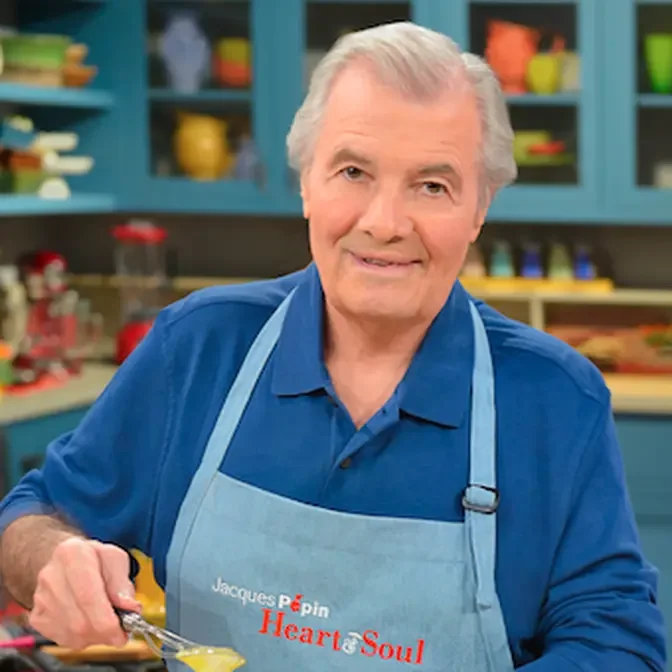
17 Video Views·Aug 15, 2023
Hi, I'm Jacques Pépin and today we're probably making the most versatile all kind of dough
which is called the pâte à choux, the cream puff dough. Nothing to do with the puff-based dough
which is a layer of... So the cream puff dough, I can count at least 20 different types of dessert
you do with it. Not only dessert but you also do savory dish with it which we'll do a couple.
I have a cup and a half of milk here and six tablespoons of butter and you have basically
the same amount of milk than flour that we're going to add to it and eventually the eggs.
Often you will see that in the oven, sometimes we do the pâte à choux the size of a pea,
you know, in the oven. That's like a garnish for a consommé. Then you do it the size of an olive
when it grows up, what they call a profit roll, you know, stuff it usually with an ice cream or
chocolate sauce and so forth. Then you do it bigger and it's a choux, you know, a choux à la
crème usually done with the whipped cream in it. If you do it the long way, it's called an éclair,
you know, like lightning the long way. If you do a little ring of it too, it's called a puits d'amour,
a love nest. If you do a big ring with it, you know, all around like this, it's called the Paris
Bresse in reference to a bicycle race from Paris to Bresse so it has that shape. If you do the
Saint-Honoré, the classic cake, it's done on a piece of dough and the choux are placed right on
top of it and filled up and the center is done with a pastry cream and so forth. This is only
a few of the desserts you do with a pâte à choux and then you take the same pâte à choux and you
poach it because the pâte à choux itself, you put a dash of salt in it so there is no seasoning.
If you do as we're going to do with cheese in it, in the oven, maybe a bit of paprika,
it's called gougère, a kind of very famous kind of a first course now or bistro type of dish.
If however, I take those and I poach it in boiling water, take it out, that will be a gnocchi,
the gnocchi Parisien, the Parisian gnocchi done with a cream sauce usually in the oven.
If I fry it in there and season with sugar, vanilla and so forth, then that's going to be
a fried pancake we call a pédanon in French. And finally, if I mix half of the pâte à choux
and half mashed potato and you drop them in boiling oil as well, I mean hot oil,
and you would have the pomme dauphine and so forth. And I'm sure that I forget
many of those. So it is a very important dough to do. So you bring your milk,
butter to a boil, maybe a dash of salt, a dash of salt. Okay. And as soon as it boils,
you add the flour. The flour is not sifted. As you can see, it's boiling here. I'll remove it
from the boil and drop the whole thing in one shot. Don't try to go slowly. It doesn't work.
And mix it together. I could have a pâte slightly bigger than that one,
but this thing will cohere together. I put it back on top of the stove here to cook it
for a couple of minutes to crust the bottom. So you can see it comes out of the pan very easily,
that type of texture, but you cook it for maybe one minute or two until the bottom of your pan,
which now is really nice and black, until it starts getting crusty and it's a bit whitish.
Just to drain that out. And then of course we have to add the eggs to it. Okay. So this is
the first part of the pâte à choux. Okay. So you have to let it cool a little bit.
That first part of the dough, which is called a panade, P-A-N-A-D-E. In addition,
a great specialty of Lyon that we call quenelle of Lyon is made the same thing with a panade and
eggs and then the flesh of the fish. So many variation on that. Okay. So the dough has to be
not cold, but not too hot because of the eggs.
So breaking the eggs inside. By hand, you would put one egg at a time. With the machine, I can
put two. Remember the first time my wife did that, that's over 50 years ago. We were skiing and she
came and did eggs and she tell me, look in the oven. I look in the oven, that mess
going on. I said, what's going on? She said, that's your recipe. So what she had done it,
she did a panade like that, put the eggs in it and mix it. Of course it cooked the egg.
You know, when you have something very gooey like this, actually one of the best way to clean
up that knife is you empty the mixture, most of it, and you put your knife back into the machine
and just turn it for like two or three seconds and it clean up your knife. Okay. I am going to
take a little bit here to do some, to do maybe some gougere with that. As I say, you could mix
some of it with mashed potato to do something else. I'm going to take some more here to do
maybe the dessert. Okay. And then the rest of it, I'll use it in a pastry bag. Okay.
I have a pastry bag here. When you use pastry bag, make sure that the thing fits at the end.
If you think that it's going to be runny, which we could push some of that in there,
don't decide not to get it dirty. Put that in something like this. Makes it a bit easier to
fill it up. Okay.
So here I have my plain pâte à choux. So this would be for the gougere.
And what I'm putting it in there is, you can put different type of cheese. I have gruyere here.
That would be very good. Remember that I didn't really have any seasoning. So here I'm going to
put pepper, a dash of salt, maybe a little dash of paprika. Okay. Mix that together.
And conventionally, if you do a lot of it, of course, you put it in a pastry bag,
but for me, I'm going to put it directly in this. And you can do, of course, any size you wish.
My mother, you know, I remember also, when we were kids, she made choux,
and she never used a pastry bag in her life. The choux or the profiteroles were placed like this
which is perfectly fine. Okay. Well, I need more space here, so I'll stop there.
For the, for this, I would put probably a bit of a parmesan cheese on top
or another type of cheese. That's it. Good. So that would be one part of it.
If I do them about the same size, the other one that I cook it together. So here I have my bag.
You bring one. You want to extend this. Hold it like an accordion. Bring it here and then you
twist. You twist and you press. You only press with that part of the hand, not with this. If
you open here, press, it goes back up. So the little profiteroles would be about that side.
You stop and you bring it back up. That would be about the side of profiteroles. Okay. When you do
so-called choux, it would be about that size. Stop and push up. You can do the puit d'amour,
as I was saying, which is going to be about that size. You can do éclairs, even with another
dough like this, that type of thing, even round one like this. And you can do some swan,
where you press it like that and pull out to do a long tail like this. And then after you put a
neck, that would be swan. Okay. So the variation is almost, oh yeah, I need that.
And then with that, I can show you also to do some gnocchi. I want to put that in the oven first.
So here, for example, you can use a brush to take the tail out of this. Not only you take the tail
out of this, but you brush it with eggs. You can do it with your finger as well, like this,
or with this. So if you do a large one like that, that would be a centenary cake. Okay. Brush out
of those. I have known, I was working with a chef who always put, brush an egg, brown the egg,
and then left it outside like 15, 20 minutes. So that egg dry out and put it another layer of that
to make it really, very shiny. So that's about, we can start with those to put in the oven.
Okay. So we've done a lot with your pate a choux. Again, I have the same one to do what I'm going
to do next, but where I probably would mix the pate a choux with some cheese. But in that case
here, you do the gnocchi. So you grab this boiling water, put that on the edge of your pan
and you press and you cut. That's how you do the little gnocchi, Parisienne gnocchi.
And you serve that usually with cheese, olive oil, a bit of a basil with it. I'll go inside
here. And of course I could have a larger one to make them slightly bigger. I could have
a fluted one to get another look. You see, they're going to come to the tub and poach now.
They poach about four, probably four or five minutes. That would be enough. And that's a
four or five minutes. You'd lift them up, cool them with cold water, ice. As soon as they are
cold, you take them out. And that's it. So you can have that couple of days ahead. If you have
a little gratin, you put a dozen of those in a little gratin dish, some sauce, some cheese
up in the oven. So that's a nice way of doing it. Here I have my temperature here is about right,
about 3, 375. So we can do the other part. I have more pate a choux here. And in that case,
I'm going to put a bit of sugar to it, a little bit of vanilla. What was classic in that recipe,
we used to do it with the orange water blossom. You know, it was always flavored with that.
And as I said, without the sugar, of course, and the vanilla, if I do half of this with potato
and half of this too, we have the classic pomme dauphine. But otherwise this one,
you would do it. So as you can see here, I push with my hand, don't go far from it,
push it and let it hang, push it down. Here is a small one here. That's it. You can see that those
are basically ready. So as you probably know, the gnocchi, the standard gnocchi, Italian gnocchi,
is done with potato. That's why it's called the gnocchi Parisienne. That's a Parisienne gnocchi
done with the pate a choux. But you can basically have the same type of sauce. And if you do the
quenelle I was mentioning before, which is the mixture of this with the flesh of fish and all
that. And again, it's done with lobster sauce and so forth. You can see the center of this
would be like a little quenelle. That's cooked enough. Cooked enough, considering that it has
to go back into the oven with whatever sauce you're going to do with it. So I can remove it.
And as I said, in a restaurant, if you want to do that ahead or if you do it ahead at home,
you cool them off first under cold water and drain them and then keep that in the refrigerator.
Okay. I can leave that here. So here I have the fritter. As you can see,
they tend to burst a little bit and open. And conventionally on top of that, you put powder
sugar, a lot of powder sugar. It's about six, seven different types of things that I showed
you with pate a choux. And there is many more. So it's really worthwhile to know how to do it.
I did it with milk, one cup of milk, one cup of flour, five eggs, four eggs, depending on the
size of the egg. And often I do it with water. Sometimes it's done with milk, sometimes with
water. Okay. Now the choux are ready. The profiteroles are ready. Even the gnocchi I have
in the oven here. The little gnocchi, as you see, can blow up in the oven. I put a little bit of
cheese on top of it and a dash of cream in the bottom. Conventionally, really done with more
tomato sauce or stuff like this. But this is a very delicate type of gnocchi to eat that you
serve right away because of course it's going to deflate. But this is beautiful. I'm gonna have a
piece here and burn my mouth. Salt. That's it. So this is your gnocchi, which I'm going to put here.
Now I have the fried, the fritter here. And as you know, when they get out of the hot oil,
often people put that on a paper with a, on a plate lined up with paper and so forth.
I've learned from the Korean who do a lot of fried food, the best way is to put it on a wire rack.
You see the oil dropped on the bottom, but it stay dry on the bottom. If you put it on that
towel, then it get moist underneath, it develop moisture. So this is it.
And what you want to do in this, a lot of, well that's your, your fritter. Good. Like this.
Then we have, we have the gougere here. Remember the gougere are the one with the cheese inside.
You know, the cheese, you see they are very airy inside. Paprika, cheese on top.
The gougere. This one is halfway eaten, so I put it underneath. This is the little profiterole.
So those profiteroles usually are cut open and stuffed with ice cream. As you can see,
they are very hollow. Stuffed with ice cream and served with a chocolate sauce.
This is the classic way of serving profiterole. And again, the same dough, bigger here, as you
can see. This is the choux. Very light. The choux conventionally, what you would do is to make a
hole in the bottom like this. You fill a pastry bag with whipped cream. Don't enter when they
are cold, of course. So this is your choux. This is the puits d'amour, I was saying. This is the
eclair. Again, which are usually stuffed this way, either with ice cream and glazed on top.
And this is the swan. I didn't do a neck, usually I do a neck. But what you do, you cut the front.
I mean, now they are still hot, so it's not really the right way of doing it. But you cut this.
You fill that up with pastry cream. You glue that to it, to the pastry cream, that the wing.
And then we have a little nail, a little neck that we do here with the dough as well.
So those are all variations on my pâte à choux, which I hope you're going to do at home.
Thank you for watching.