
Henry VIII (1509 - 1547) - 10 Minute History
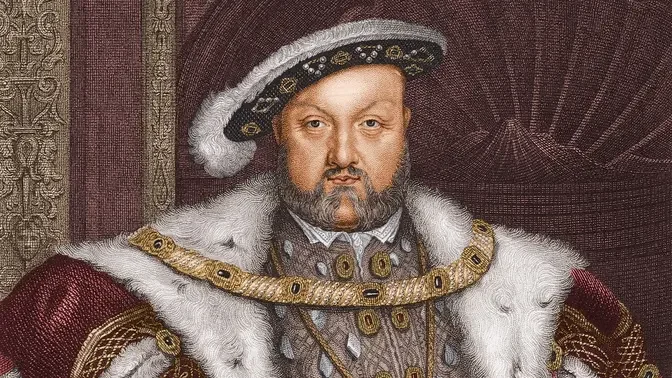
Henry VIII's reign in 10 minutes.
Inheritance and early reign.
So, Henry VIII's father was also called Henry, of course he was Henry VII,
and he was a very cautious king.
He had a lot of people trying to get him off the throne, the Yorkists of course,
and so he hoarded, or was seen to hoard, a lot of money through various schemes
like his council, council learned in law, bonds and recognizances, and other schemes like that.
However, his son Henry VIII was going to prove to be a very different kind of king,
and from an early age he enjoyed going off and hunting with the sons of the nobility
in important positions in his father's councils, for example,
these younger nobles being known as the Minions.
And these Minions, like young men did, very much wanted to go off to war,
which was very much in alignment with what Henry VIII himself wanted to do.
He wanted from a young age to be remembered as a warrior king,
and this very much leads into his early foreign policy.
Now as well, two months after his father's death in 1509, he married Catherine of Aragon,
and this very much set the precedent of what he would do throughout his reign,
which was act on his emotions and desires,
rather than necessarily looking at what was best for the nation, as his father might have done.
So let's have a look at some government policy.
There were essentially two styles of ruling during Henry VIII's reign,
and these were conciliar and ministerial,
after the very brief, I think only two months or so, of a regency council,
but he was waiting to turn 18.
Now from 1509 to 1514, there was conciliar, so he ruled at the head of a council.
Then from 1514 to 1529, Cardinal Wolsey came along,
and he was the chief minister in control of the government.
Then you had three years of conciliar government again,
followed by eight years of ministerial rule, this time under Thomas Cromwell,
and finally seven years of conciliar government once again.
Now Wolsey rose to prominence because he managed to organize Henry's war and finance it in 1512.
And of course, Henry wanted to go to war, so this put Wolsey in Henry's good books.
He introduced the Court of Star Chamber.
He was a commoner from a common background,
and the Court of Star Chamber helped commoners to essentially bring up their common grievances,
which otherwise they wouldn't be able to do.
Although this worked so well, that there were so many requests to use this court,
that it became clogged up and stopped working after a while.
And he actually fell from grace, Wolsey fell from grace,
due to his inability to solve the King's Great Matter,
which was his desire to get a divorce from Catherine of Aragon to marry Anne Boleyn.
However, the following up would be Cromwell,
who was able to resolve this Great Matter by breaking away from the Church in Rome
and starting a new Anglican Church.
And he greatly reformed the English Church during his time being responsible
for the dissolution of the monasteries,
turning the English Church into a Protestant one for the first time,
and sparking the English Reformation.
Although he himself would fall from grace due to the failure of the marriage to Anne of Cleves,
who was the daughter of an important German prince,
who was also a Protestant.
He wanted to align Henry to that, but the marriage didn't work out.
And thanks to the efforts of the Duke of Norfolk,
he fell from grace and was executed in 1540.
So the foreign policy is very much linked to this.
Now, there was a first failed invasion of France in 1512.
This was down to the fact that Henry had been promised by his father-in-law,
who was the King of Spain at the time,
that he would also invade from the south if Henry landed a force in Gascony.
But they essentially used him,
and there was no supporting troops in the English were forced to pull back.
However, the following year, the English saw two stunning successes on the battlefield.
The first being the Battle of the Spurs in northern France,
Henry himself leading the charge.
It was really rather an insignificant battle,
but Henry got that taste of glory that he so much wanted,
as well as the Battle of Flodden.
While he was away, the Scots tried to invade,
although they were cut down by the Earl of Surrey in the north,
on Flodden Field on Brankston Moor in Northumberland,
both happening in 1513.
Now in 1539, after of course the break with Rome,
politics shifted an awful lot,
and there were calls for a crusade,
mostly thanks to Reginald Pole,
who was an Englishman in Italy at the time.
And the peace between the Holy Roman Empire and Spain and France
all meant that they could possibly invade England,
so there was really dangerous there.
And in 1543, again, there was problems with Scotland being known as the Rough Wooing,
because Henry wanted to marry his son Edward,
who became Edward VI,
to the daughter of the Scottish kings,
although they were not really in favor of this.
And there was a French invasion of the Isle of Wight in 1545,
that could have become an invasion of the rest of England,
if there hadn't been a great naval effort from the English
to try and repulse them in the Battle of the Solent,
which was also the time in which the Mary Rose sank in 1545.
Let's have a look at religious policies,
which were of course incredibly important for Henry VIII's reign.
So in 1521, actually, Henry was a strong and devout Catholic,
and arguably he was still a strong and devout Catholic upon his deathbed.
And after Martin Luther wrote the 98 Theses,
he actually wrote a counter-response to this,
which was called In the Defense of the Seven Sacraments.
And the Pope enjoyed reading this so much
that he bestowed the title of Fidei Defensor,
or Defender of the Faith, upon Henry,
and he really was a strong Catholic.
However, when he needed to get an annulment,
which is essentially a divorce from his wife Catherine of Aragon,
when he'd had enough of her in 1527,
he refused to give this,
mostly because in the same year,
the troops of the Holy Roman Emperor Charles V
had sacked Rome and taken him prisoner,
and Charles V was indeed the nephew of Catherine of Aragon.
So he had a vested interest in keeping her as the Queen in England.
So he had to get another solution.
Now there was a trial of Catherine of Aragon
and the break with Rome all in 1529,
Henry having used the clause in the Bible,
the Leviticus clause,
which said that if you sleep with your dead brother's wife,
because of course Catherine of Aragon had been married to his brother Arthur,
who had died the same year.
So then this didn't work because the Pope rejected it.
There was a Cardinal Campagio who came over
and they tried to get it sorted in England,
but they ruled in favor of Catherine of Aragon.
So then in 1534,
he really properly breaks from the Church in Rome
with the Act of Supremacy and the Act of Succession.
The Act of Supremacy making Henry the Supreme Head of the Church on Earth,
the English Church,
essentially replacing the Pope from that title
and barring Mary, his daughter who had been born in 1516
with Catherine of Aragon,
he barred her from the succession,
essentially marking the break with Rome.
So of course, from the break with Rome,
at this time,
England became essentially a Protestant nation,
at least the administration,
and Thomas Cromwell and Thomas Cranmer,
Thomas Cranmer becoming the Archbishop of Canterbury,
they both pushed Protestant reforms in the government and in legislature.
So for example, from 1536,
the lesser monasteries started to be dissolved
to the horror, of course, of the strongly Catholic population,
which was especially strong in the North,
so Northumberland, Yorkshire, Cumbria, that kind of area,
and the Southwest, so Cornwall, Devon,
although essentially the entire country was largely Catholic.
Now this gave rise to the Pilgrimage of Grace
and the Lincolnshire Risings,
again, the strongly Protestant northern areas,
who found mass support with tens of thousands of people
marching to the banner and marching around,
although they were ultimately defeated
through cunning and canny on Henry VIII's part,
although this showed the popular support
of the Catholic faith in the country,
and even on the higher echelon,
so one of Henry's friends and counsellors, Thomas Moore,
refused to recognise Henry as Supreme Head of the Church,
and because of this,
and because of things like the Treason Act,
he was then beheaded,
showing just how serious Henry VIII was.
Now securing the succession,
so very much linked to the break with Rome,
is that one of the reasons he married Anne Boleyn
was because Catherine of Aragon had been pregnant many times
and had actually given him two sons,
but they had both died.
They of course had a daughter,
who would later become Mary Tudor, Mary I,
although another reason he wanted to marry Anne Boleyn
was to produce a male heir to continue the succession,
because this was very important.
He had three surviving children,
so Mary, who was born in 1516,
Elizabeth, who was born in 1533 to Anne Boleyn,
and Edward, who was born in 1537 to Jane Seymour,
who died in childbirth, giving birth to him.
Now there was an active succession in 1534,
which made Elizabeth first in line and then barred Mary,
although in 1536, when Edward was born
and when Anne Boleyn's head was cut off,
so her mother,
he changed the succession again,
which made Elizabeth completely illegitimate
and barred her as well as her sister Mary
or half-sister Mary from the succession.
Now if I have to put the reign of Henry VIII
into a five-point timeline,
these are the dates I would go for.
So first of all,
1509 is the start of Henry's reign
after the death of Henry VII,
and he really comes into his own right
as a ruler after the end of the regency period of rule
with the regency council.
So in 1513,
there are several things going on.
So first of all,
the invasion of Northern France.
This saw the Battle of the Spurs
with Henry playing a leading role in that himself,
as well as the Battle of Flodden
when the Scottish under,
I believe James IV,
came with a large army into Northumberland
and they were completely defeated upon Brankston Moor,
two twin victories
that really strengthened Henry's position
and really upped his prestige
on the international scale.
So 1534,
of course,
very important year.
Break with Rome is embodied
after the act of supremacy,
making him the head of the church on earth
and ousting the Pope
and the act of succession,
which then sorted out the succession
of who was going to come after him,
meaning that the offspring with Anne Boleyn
would also be,
or would become the next rulers of the country.
1536 is the year in which Anne Boleyn,
her head is cut off
and he marries Jane Seymour.
Also the year in which Edward is born.
So a lot of things going on.
As well as religiously,
the start of the dissolution of the monasteries,
the Lincolnshire rising
and the pilgrimage of grace in response to this
because the people were still obviously
incredibly strongly Catholic
and didn't want this.
So a lot of things going on in 1536
and finally 1547,
of course,
because this is the death of Henry VIII
upon which Edward VI,
his only surviving son,
came to the throne.
All right, everyone.
So thank you very much for watching.
This has been Henry VIII in 10 minutes
and I'm going to try and get it exactly
on the 10 minute mark.
Thanks again to the Patreons
for supporting me and making this possible.
And don't forget to like,
comment and subscribble.