
Mother Teresa Full Video from "Who Cares About The Saints?" with Fr. James Martin, S.J.
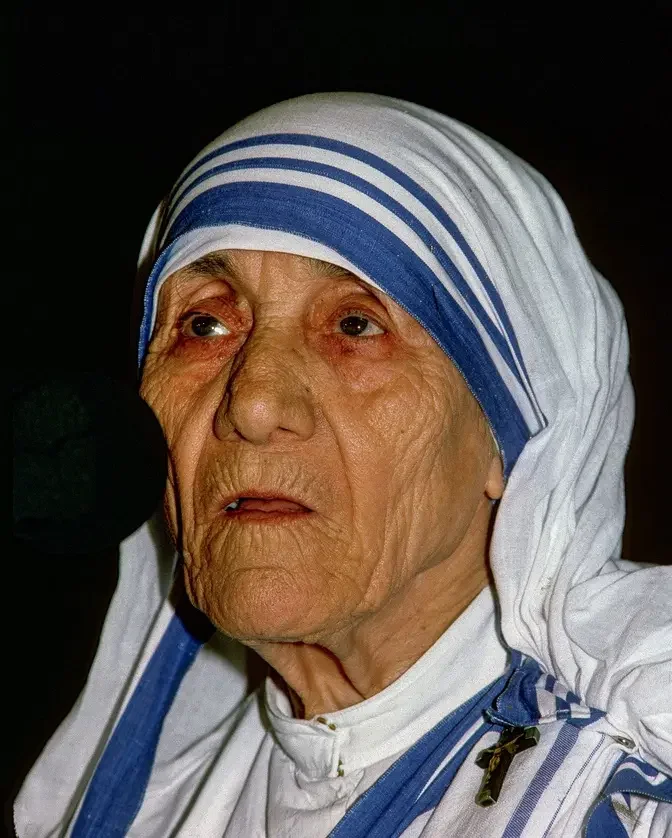
6 Video Views·Feb 14, 2023
When I was in my second year as a Jesuit, I was sent to Kingston, Jamaica to work with
the Missionaries of Charity, about whom I knew very little other than they were the
religious order founded by Mother Teresa.
And so I was asked to work with the Missionaries of Charity, who like in a lot of their other
places care for the sick and the dying.
They bring them right up the streets, they fed them, they bathed them, they gave them
a place to sleep, and it was very beautiful.
Now, the Missionaries of Charity were always very joyful, which I thought, well, initially
that must be some sort of dodge or that seems fake.
But ultimately, I realized that they really were joyful about what they were doing.
And that got me interested in reading about their founders, because they would always
talk about how Mother says this, Mother says that.
Mother Teresa was born Agnes Bochachu in 1910.
She entered the Loretto Sisters in Ireland and was sent to India to work with the poor.
And she worked in a fairly poor neighborhood teaching young girls.
At one point she was very tired, she was sort of suffering from exhaustion, and she took
a trip to Darjeeling on a train ride, so she's in India.
And after her papers were opened at the end of her life, it was discovered that she had
enjoyed what spiritual writers call elocution, she actually heard Jesus' words, inviting
her to work with the poorest of the poor.
Surely before that, Mother Teresa had said in prayer that she would never refuse Christ
anything he asked her, which I always say shows you be careful what you pray for because
you might get it.
So Mother Teresa gets this sense in prayer that she's being called to work with the
poorest of the poor, which involves not only leaving her school, but leaving the Loretto
Order, because they were sort of set up to teach the girls there in Calcutta, and she
leaves.
And she said it was one of the hardest things she's ever had to do.
So she gives up her work in the school, and she basically starts working with street people,
bringing them in, caring for them, and basically finding great difficulty in starting out and
getting approval for these kinds of things.
But she's filled with this great sense of consolation, this great sense of God's presence
that enables her to do this kind of work.
Eventually the Indian government and the state sees what she's doing and gives her permission.
There's a beautiful story where early on, she sets up a place in Calcutta next to a
Hindu temple.
And of course, people were not happy to have this Catholic woman, this unknown Catholic
woman coming in and just sort of setting up shop.
So there's a mob that gathers out in front of her place, and she comes out and she invites
the leader of the mob in to see what they're doing.
And of course, they're taking care of all these poor people.
The leader of the mob goes out and says, we will close her place if all of your mothers
and sisters agree to do what she's doing for our people.
She kind of cements her love by the people, and she becomes adopted by Calcutta and by
all of India.
So Mother Teresa, I think, is probably the best known contemporary saint.
People called her a living saint, even when she was alive.
But I think there's a very unusual part of Mother Teresa's life that is not very well
known.
And that is, after the train ride, after this train ride to Jarjeeling, when she felt very
close to God, she had this great spiritual darkness that lasted, some say, for the rest
of her life.
To her spiritual director, she wrote,
In my soul, I feel that terrible pain of loss, of God not wanting me, of God not being God,
of God not existing.
With time, she started to understand, with the help of her spiritual director, that these
feelings of abandonment were one way of identifying with the figure of Christ on the cross and
the abandoned poor.
And so she transformed that darkness into a way of serving others.
And isn't that the way it is in our lives a lot?
We have this very intense experience of God, this very intense spiritual experience that
sometimes leaves us.
And it's the part of faith that we really have to live out.
It's not as if we're always feeling close to God, and Mother Teresa wasn't feeling close
to God either every day.
And I think her life is a lot more like our lives than we think that it was.
That work that the missionaries of charity do, and that I was helping to do, which was
my work was bathing old men and clipping their toenails, can be very physically difficult
to do.
And I found it difficult to do.
But it was wonderful for me to see the way that they approached each person, not as just
another sick person, but as someone who was beautiful, someone who deserved the dignity
that God gives us all.
And Mother Teresa has this wonderful expression where she says, it's important to meet Christ
in his most distressing disguise.
So not just Christ in a beautiful cathedral when the priest holds up the Eucharist and
the organ is playing and everybody's singing.
It's easy to find Christ in there.
Or when you're holding a newborn baby or when you're looking at a sunset.
When you're looking at a poor, dirty, smelly street person who's dying of throat cancer,
that's one man I took care of.
And to be able to see Christ in that person, I think is very beautiful.
And I think in that way, Mother Teresa gives us all a gift because she reminds us that
it's not just finding God in the beautiful, but it's also finding God in his distressing
disguise.
I don't want to paint Mother Teresa as a sort of super pious, unreal person.
Mother Teresa was a very tough person.
She had to, first of all, found a religious order.
She had to run a religious order.
And eventually she had to raise a lot of money.
There's a great story about people giving Mother Teresa money, and I think this would
warm the hearts of fundraisers everywhere, that her primary response when people would
give her money is, not enough.
So here's a woman who sort of knew how to use power.
When she would go to different cities, she would go right to the mayor or the governor
of a state and say, I would like to have a place for the homeless in your town.
And she knew that no one could resist Mother Teresa.
There's also a great story in her journal.
She writes to a group of her sisters saying, who are basically complaining about the long
hours, saying, hey, look, you take these long hours and live in the name of the poor, and
I do a lot more work than you do, so stop complaining.
So this is not a sort of kind of pasteboard saint.
This is a really strong woman who knew what she wanted, but at the same time was able
to marry that with this great devotion to the poor, because she knew who she was doing it for.
Mother Teresa, when people would come to see her in Calcutta to sort of become like her,
she would have a lot of them stay and work with the poor.
But she'd also say to people, find your own Calcutta.
Where are you called to find Christ in distressing disguise?
It might be in your family.
It might be in your workplace.
It might be in your neighborhood.
So it's not as if all of us have to become Mother Teresa, because I think when we think
that we have to become another person, we're ignoring the beauty of the person that God
has already created and the unique vocation that we all have.
So I think it's really important to see that Mother Teresa's life is a real shining beacon
to a lot of people who might find it difficult to persist in the light of a lot of spiritual
darkness or confusion, but also a real inspiration that all of us are called to be saints in
our own way.
Mother Teresa says to us, it's okay to doubt.
It's okay to feel separated from God.
But she also shows us that the part of faith is continuing on with the Christian call and
continuing on with our work, no matter how difficult or how separated from God that we
might feel.
It's a hard message, but I think it's ultimately a very inspiring one for Mother Teresa.