
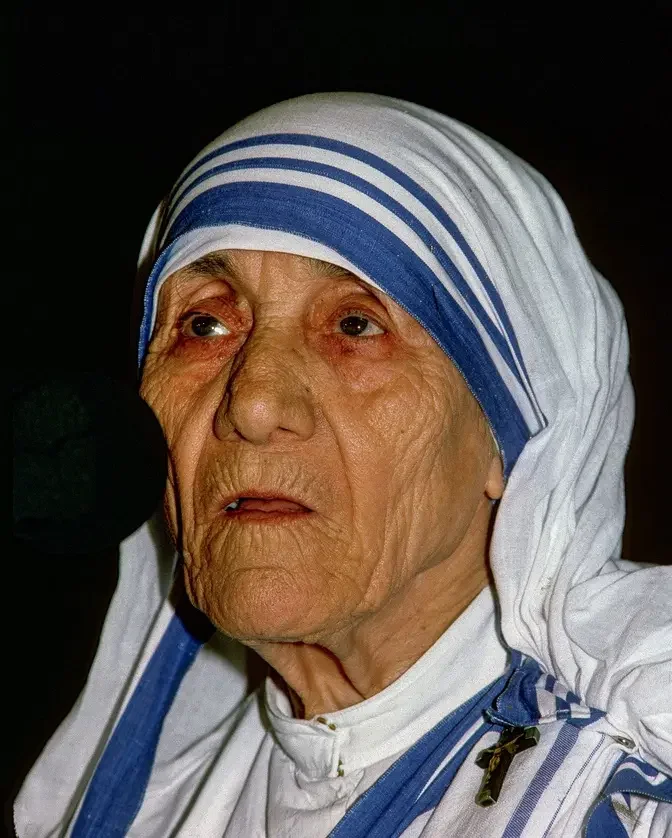
15 Things You Didn't Know About Mother Teresa
23 Video Views·Dec 19, 2022
Welcome to ALUX.com, the place where future billionaires come to get inspired.
Hello Aluxers and welcome back to our channel. You know how we like to keep it varied,
so we thought an infusion of spirituality and goodness might be just what you needed.
Today we're looking at the life of a very special role model,
Mother Teresa, in order to get our inspiration from her life work.
Born on August 26, 1910 in Skopje of the former Ottoman Empire,
now the capital of the Republic of Macedonia, and named Agnes Gonya Boyaci.
She was born into a rather good family. Her father, Nikol, was a businessman involved
in Albanian community politics at the time. Agnes was baptized in the Catholic Church
the day after her birth, this being the day she considers to be her real birthday.
She joined the religious congregation of Sisters of Loreto when she was 18 years old
and dedicated her life to charity, getting involved in helping people with HIV-AIDS,
leprosy or tuberculosis, in managing orphanages, dispensaries and mobile clinics,
as well as setting up family counseling programs, and so on.
Mother Teresa was recognized by the church as a saint, or canonized,
on September 4, 2016, and her feast day is September 5, the day of her death.
If you are new here, welcome! Be sure to subscribe and follow us on Instagram at alux.
We thought it would be both interesting and enriching to get a closer look at the life of
someone whose last achievement was to become a saint, to shed light on the controversial aspects
of her life, and to get inspired from all the good she brought into the world.
Here are 15 things you didn't know about Mother Teresa.
Number 1. She realized her vocation when she was a child
Growing up in a place where Catholics were a minority, young Agnes and her siblings started
their education in Catholic school. Born in a wealthy family that lost its status after the
death of Agnes' father, her mother kept the children close to the church in order to strengthen
their faith through the dark times that made them become poor. Thus, Agnes learned how to
promote hospitality and charity, and became fascinated by stories of the lives of missionaries
and their service in Bengal. At the age of 12,
she decided that she would commit herself to religious life, and so she did six years later.
Number 2. She never saw her family again after joining the religious congregation
Leaving home in 1928, aged 18, she went to Ireland to join the Sisters of Loretto at
Loretto Abbey in Rathfarnham. After a few months of training in Dublin, she was sent to India,
where on May 24, 1931, she took her initial vows as a nun. She was never to return to
see her family, whose opinions regarding Teresa's decision were as follows.
While her mother gave her permission with an open heart, her brother did not agree.
Even though she explained that, in this way, she would serve the king of the whole world.
However, Teresa took care of her family's graves and even visited them in her declining years.
Number 3. She kept a Pope waiting
In the 1960s, her work had already gained the attention of church leaders,
who started calling on her, willing to support her projects. However, Mother Teresa sticked
to her vows, and put her mission work above everything else. There was this one time in 1965,
when Pope Paul VI came to India to visit her, but she informed him that she was too busy doing her
Instead of offending the Pope, this only made him admire her more for her dedication.
He decided to support her cause, by offering her the Lincoln he'd been driving around in
for his trip, which Mother Teresa accepted, and then auctioned it off to raise funds for her projects.
Number 4. She founded the diocesan congregation, Missionaries of Charity
It was her call within the call that made Mother Teresa decide to get
involved precisely in helping the sick and the poor.
In 1950, she received permission from the Vatican to start her own order,
the Missionaries of Charity, that would, according to her,
care for the hungry, the naked, the homeless, the crippled, the blind, the lepers,
all those people who feel unwanted, unloved, uncared for throughout society.
People that have become a burden to the society and are shunned by everyone.
The congregation had grown to more than 4,000 sisters by 1997, and even today,
it carries on the healing work that Mother Teresa did not only dream about, but lived for.
Number 5. Mother Teresa received the Nobel Peace Prize
The most famous honor that Mother Teresa was awarded with is the 1979 Nobel Peace Prize.
Hearing that she had been selected by the Nobel Committee, she said that she was
unworthy. The U.S. President Carter, who is one of the nominees himself,
sent Mother Teresa a message congratulating her for the award that was richly deserved.
Mother Teresa did not forget her life purpose. Even while standing in the Hall of Fame,
she reminded the audience that what she was most aware of was the condition of the poor,
and she refused the traditional Nobel banquet that is hosted for most recipients as a celebration.
She insisted that the equivalent of $190,000 be used to help the poor she was working among.
Now, what would you do with the $190,000?
Number 6. She faced personal doubt in her beliefs
It's all fun and games until you have to keep faith of steel while seeing the world's downside.
Even though you wouldn't dare to imagine someone as modest and devoted to God as Mother Teresa was
to have doubts, apparently she was only human. Correspondences over her lifetime revealed that
she faced many doubts about God and couldn't always feel his presence in her life as strongly
as she felt she should. However, she put the blame on herself for the misery this caused her.
What is truly admirable, though, is the remarkable way in which she turned those
doubts into fuel to keep her doing what she believed was best for humanity.
Number 7. In spite of being so liberally involved with social work,
Mother Teresa had a strong pro-life position. She believed that unborn babies were the weakest of
the weak and insisted on how important it was for expecting mothers to be helped and cared for.
Furthermore, in 1994, at the National Prayer Breakfast, she even stood in front of U.S.
President Bill Clinton, a Democrat, saying that she felt that,
The greatest destroyer of peace today is abortion, because it's a war on the child,
a direct killing of an innocent child, murder by the mother herself.
Number 8. Mother Teresa's Caligat home for the dying raised controversy.
Established by Mother Teresa in 1952 in the building of an abandoned Hindu temple,
it was a free hospice for the poor. People who were brought to the home received medical
attention from the missionaries of charity, and the idea was for them to be given the opportunity
to die with dignity. However, in 1991, after visiting the home, Robin Fox, editor of the
British medical journal The Lancet, wrote that the medical care patients were given was haphazard.
He explained the personnel had little to no medical knowledge, and that serious medical
errors related to decision-making, pain management, or even diagnosing curable and
incurable diseases were systematically made. These aspects were confirmed by other reports
as well documenting the situation. Number 9. Baptism of the dying was another
controversial aspect of Mother Teresa's work. The ultimate supposed remedy the dying were to
receive in the hospices run by Mother Teresa and the missionaries of charity was the baptism.
The members of her order were encouraged to baptize dying patients without regard to the
individual's religion, as Mother Teresa considered it to be beautiful for no one to die without
receiving the quote, special ticket for St. Peter. Um, this was happening in a country where
the large majority of the population was Hindu, right? Strong criticism was brought to this
practice, as critics argued the patients were not in a position where they could consent
clearly and unequivocally, both because of their health condition and because they were usually
not provided with sufficient information regarding the theological significance of a Christian
baptism. Number 10. Mother Teresa received a state funeral. Mother Teresa passed away in 1997
at the age of 87 and the Indian government decided to give her a state funeral in order to honor her
lifetime work with the sick, the needy, and the poor. What is interesting is that in India, state
funerals are normally reserved for the president and the ministers. The criteria is based on their
service to the country and the entire country is asked to mourn. However, Mother Teresa was once
again the exception to the rule, as she received a state funeral as an expression of gratitude to
the Indian people. She was buried in Calcutta after a six-hour ceremony. Want to know some
more interesting facts about India, dear Aluxers? Oh, we have just what you need. Check out our 15
Things You Didn't Know About India video in order to get richer in knowledge and be tempted to
choose a new holiday destination. Number 11. Mother Teresa lived a strict life of discipline.
Having given up the comfort of her own life when she was a child and her family lost its status
after the loss of her father, Mother Teresa understood the depth of the sacred vows she took
when she became a nun. Thus, she got used to living in the same poverty as those she was trying to help.
However, some of the nuns who met her claimed that she was very stubborn and insistent about how to
care for the poor as well as to distribute the supplies. And she was very strict regarding the
way she treated fellow nuns, to the point that she was denying them many creature comforts,
including heating, mattresses, and proper seating. Number 12. She also got involved in international
charities. Mother Teresa made several trips outside of India for humanitarian reasons.
For example, in 1982, she rescued 37 children trapped in a frontline hospital at the height
of the siege of Beirut. This was made possible with the help of the Red Cross, whose workers
accompanied her through the war zone to the hospital so that she could evacuate the children.
She also tried to expand her work to communist countries, which unfortunately rejected the
missionaries of charity. Furthermore, she visited Armenia in 1988 after the 6.8 magnitude Spitak
earthquake, helped the Hungary and Ethiopia, as well as the radiation victims of Chernobyl.
In total, she operated 517 missions in over 100 countries.
Number 13. As her health started to decline, it was thought she was, quote,
under attack by the devil. Mother Teresa's health started to decline in 1983,
when she had a heart attack in Rome while visiting Pope John Paul II. Subsequently,
when she was hospitalized with heart problems, Archbishop of Calcutta, Henry Sebastian de Souza,
ordered a priest to perform an exorcism, with her permission, because he feared her
problems were due to spiritual matters. Mother Teresa had a second heart attack in 1989,
after which she received an artificial pacemaker. Due to all these problems,
she offered to resign as the head of the missionaries of charity, but the sisters
of the congregation voted for her to stay, and she obeyed their will.
Number 14. She received worldwide recognition through hundreds of honors.
What is truly fascinating is how much recognition one can get when they're not chasing it. Mother
Teresa received a total of 124 awards and honors, including the Nobel Peace Prize,
the Padma Shri Award from the President of India in August 1962, the Pope John XXIII Peace Prize
in January 1971, the Order of Merit, awarded by Queen Elizabeth in November 1983, as well as the
She has been commemorated by many museums, and named the patroness of a number of churches,
and there is even a Mother Teresa Women's University in India.
Number 15. She is Saint Mother Teresa today. After her death, the Holy See began the process
of beatification and canonization, for which a total of 35,000 pages were used as documentation.
What was also needed is the documentation of a miracle, resulting from the intercession of the
prospective saint. And so, in 2002, the Vatican recognized the occurrence of a locket containing
Mother Teresa's picture, healing the tumor of an Indian woman as a miracle. Thus, Mother Teresa
was canonized on September 4, 2016, by Pope Francis in St. Peter's Square in Vatican City.
Tens of thousands of people witnessed the ceremony.
And that's it for today Aluxers. Now that you've learned some more about Mother Teresa,
we'd like to know, do you think there was anything truly controversial in her life?
Let us know what you think down in the comments.
Still here? As usual, here's a bonus fact just for you.
Number 16. There are various suspicions regarding the way Mother Teresa managed donations. Being
accused to have built an empire of charity, Mother Teresa's suspicious fund management
was criticized on several occasions. In 2013, a research group from the University of Montreal
brought to light several controversial aspects regarding her questionable political contacts,
as well as her suspicious management of the enormous sums of money she received.
In 2017, investigative journalist Gianluigi Nuzzi published accounting documents from the
which is the Vatican Bank, revealing figures of the funds held by Mother Teresa on behalf
of her charities, and how she was the bank's biggest client, amounting to billions.
Thank you for spending some time with us Aluxers. Make sure to like and subscribe
so you never miss another video. We also handpicked these videos which we recommend
you watch next. Thank you for being an Aluxer and we'll see you back tomorrow.