
The Magical Legend Of King Arthur | The Legend
35 Video Views·Jan 2, 2023
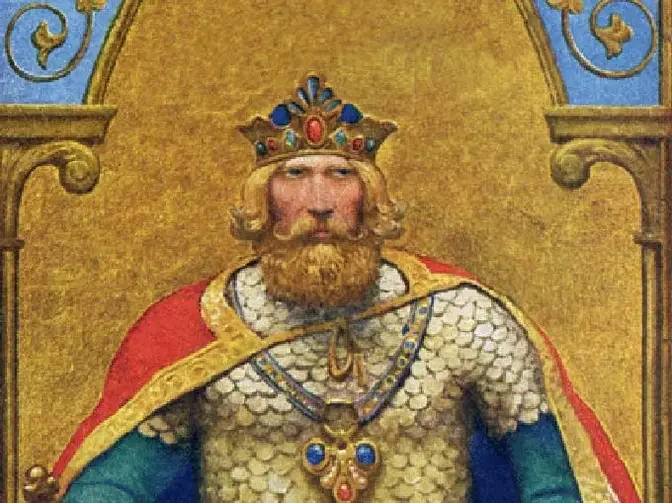
Of all the ancient tales of the island of Britain, one set of stories takes pride of place.
The stories of King Arthur. Arthur, the perfect king. A warrior hero whose exploits have thrilled
generation after generation, for century after century. Fearless and flawless, he's the king
of a fabulous court, with a queen of enchanting beauty. Arthur, champion of honor and self-sacrifice.
His knights of the round table, paragons of chivalry and romance.
Their daring quests burnish the glory of their king, and they fight for justice on his behalf.
Arthur's genesis may be lost in the mists of time, but his values still speak to us today.
His ideals have inspired presidents and protesters, democrats and dictators,
all around the modern world. Even the manner of his passing seems to comfort the defeated
and downtrodden. One day, if the myth can be believed, all that they hope for may come again.
But what are the facts about this mystical king? Archaeologists have scoured Britain to try to
pinpoint the location of his fabled court, Camelot. Historians have searched every surviving
ancient manuscript for scraps of evidence about the real Arthur. Romantics have sought to follow
his quest for the holy grail. But have they all been looking in the wrong direction?
This is the true story of King Arthur, the legend. Britain, at the end of the Middle Ages,
an island torn apart by civil war, desperately hoping for a hero. Off the coast of Wales,
a young nobleman is sailing back from exile in France to the land of his father's. His mission?
To capture the crown of England. On the way, his sailors have hoisted a homemade flag,
the fire-breathing red dragon of Wales, set against green and white, the family colours
of a dynasty, the Tudors. Henry Tudor is coming home to do battle with King Richard at Bosworth.
It's the culmination of a bloody struggle for the English crown between two power-hungry clans,
York against Lancaster, the Wars of the Roses. And Henry comes proclaiming his Welsh blood
and asking his fellow countrymen to take up arms with him. He claims the mantle of the Son of
Destiny, the long prophesied redeemer who comes to restore the fortunes of the Welsh.
Henry's progress is full of symbolism. Symbolism that was echoed again and again in a book
published in that very same year, 1485. The book also had a young hero who would emerge from civil
war to claim his destiny as king. It was one of the first volumes ever to be printed and sold
widely in Britain. It came from the printing press of William Caxton, the first English printer.
Le Morte d'Arthur, The Death of Arthur, by Sir Thomas Mallory, tells the whole story of the king
and his knights of the round table. It's the legend that we remember to this day.
Like Henry Tudor, Arthur becomes king of all England. Like Henry Tudor, significant chapters
of his story are written in France. But like Henry Tudor, Arthur's roots are in fact Welsh.
In the earliest Welsh stories, he isn't a king, or at least he isn't a historical figure.
He's a legendary one. Often he's a giant, a giant and a giant slayer. Frequently he's a trickster.
He behaves in ways that Mallory would never have allowed him to behave. What we have is a typical
legendary hero figure. By 1485, this shape-shifting legend is ready to emerge from the Celtic twilight
to dazzle Tudor England. Mallory is writing at the height of the Wars of the Roses,
and in the story he reflects this. You get rival kings fighting for the position vacated by
Uther Pendragon, who was the chief king. And Mallory actually says, words to the effect,
would that the kings of today had the nobles of yesteryear. He's looking back at this wonderful
British world, which he sees as the best place to have been. In Mallory's story, each pretender to
the throne is given the chance to draw the true king's sword from an anvil in which it's embedded.
Only the boy Arthur succeeds. No one, not even the boy himself, knows that Arthur is Uther
Pendragon's true son and heir. Uther Pendragon falls in love with someone else's wife, and he
makes a pact with Merlin, the wizard Merlin. And Merlin changes his appearance, so he makes love
to this woman, and she doesn't realize what has happened. And this child, who is a child of deceit
and adultery, is Arthur. And this child is given to Merlin, and he's schooled by Merlin. And now
this unlooked-for son passes the magical test, reclaims the royal sword, and succeeds his dead
father. From now on, through all history, he will be known as King Arthur. His court, Camelot,
becomes famous far and wide. There, the greatest knights in Christendom gather in a circle of
fellowship. They commit themselves to fight for honor, free the oppressed, defend the powerless,
always defying evil and braving peril. They pursue a mystic search for the Holy Grail,
the communion cup of the Last Supper, said to have received Christ's blood at his crucifixion.
No knight is more courageous than Lancelot. His sword serves the king, but his heart belongs
to Arthur's queen, Guinevere. Guinevere is involved in this adulterous relationship.
She's never condemned as such. I mean, I think there's this sense that, you know,
this is what women are like, which is perhaps not so much to modern taste. And it's interesting
that contemporary novels are going to be able to depict her very, very different. She's a lot more
verbal apart from anything else. But she is very interesting because she comes straight out of
Welsh tradition, so far as we can tell, the earliest elements of Welsh tradition. She
develops first just as a queen and consort, then as this figure of conflict. And then finally,
she finds her voice in the 20th and 21st century, as people begin to say, well, you know,
what did women do in the Arthurian legend? Guinevere and Lancelot are drawn ever more
intimately together. Their slow burning love ignites. It will destroy this perfect kingdom.
When the lovers yield to their passion, the king's embittered rival, the evil Mordred,
uncovers their adultery. Arthur's court is rocked to its foundations. The king must condemn his
queen to death. The fellowship of the round table is shattered and Lancelot is exiled from Camelot.
When he returns to rescue Guinevere, chaos ensues. Mordred raises an army and seeks to batter the
king into submission. In a terrible battle, the knights of the round table perish. Mortally
wounded, Arthur is carried from the battlefield and transported to the mystic Isle of Avalon.
There he will sleep through time, neither living nor dead, until it is said he will awaken again
as the son of destiny at the hour of his kingdom's greatest need. In the real world of 1485,
many Welsh people believed that the ancient prophecy had finally come to life. In defeating
King Richard on the field of Bosworth, Henry Tudor claimed the crown of England. To the Welsh,
his very flag was a portent straight from the tales of King Arthur.
The Welsh banner, the dragon banner, this is the famous red and white dragons,
which Merlin prophesies about. That there's a battle between two dragons, it looks as if the
white one is going to win, and just at the last minute the red one comes in, duffs up the white
one, and you know, he's victorious. The red one is Wales. Now while it's controversial just exactly
how much of this stuff Henry actually used, his firstborn son, whom he sends to Leamster,
which is in the Welsh marshes, to rule as Prince of Wales, and he gives him a very special name,
Arthur. Clearly, at the dawn of the Tudor dynasty, the stories of Arthur were stories to be reckoned
with. But where did their power come from? What was their origin? And what historical truth lay
in them? In trying to answer these questions, antiquarians and historians have looked back
from Henry Tudor's day, a whole millennium, to the time when a British king like Arthur
might have lived and breathed. In the centuries after the Roman Empire collapsed, the native
peoples of southern Britain found themselves ringed about by hostile forces. Raids from British
tribes from the north, war bands from the west sailing across the Irish sea, and from the east
came powerful invaders from mainland Europe, the Saxons. Native warlords were forced to defend
their lands and their peoples. Out of this period emerges a number of battle leaders, petty kings
perhaps. This is the period where people try to say that this king or that king must have been
Arthur. And it just doesn't quite work. But what does happen is this image of the battle leader,
generous, fierce, a leader of his people. And it's the stories about these figures that eventually
historicize the figure of Arthur, so that you get a king, a specific king, a mythical king,
who is the savior of his people. So who was this hero figure who turned back the Saxon tide?
What were his values, his culture, and what might his people have seen in him as a hero?
In order to understand any of this, we need to go further back in time again.
Much further back, 4,000 years ago, a new people started to appear on the shores of Britain.
Smiths and sages possessed of a rare magic. They brought with them the secrets of metalworking
and a culture we call Celtic. We know them as the Beaker people from the fine pottery vessels they
use in their everyday life and their rituals. Their beliefs are now lost in the mists of time.
We can guess at them only in tales of the old gods and myths of the birth of a wonder child.
But from generation to generation, their customs and beliefs must have been passed on.
By the late Iron Age, 2,000 years ago, their myths and legends had become part of the fabric
of life in Britain. We have some tantalizing glimpses of who these people's heroes might
have been. Written down centuries later, the earliest Celtic tales recall strange combinations
of gods and humans using all kinds of magic and trickery. Champions engaged in quests and
adventures, forerunners of our King Arthur. Stories of these ancient heroes must have been
familiar to every Iron Age child. Suddenly, this settled pattern of life was pulled apart.
In 43 AD, the Romans invaded Britain, seeking mineral wealth and farmland and slaves and glory.
Across lowland Britain, they built massive army camps like the one at Caerleon in South Wales.
Caerleon is a place that will become enormously significant for the way the story of Arthur is
told. It is the original model for his court and capital. And what a vibrant place it must have
been, this imperial city, as recent excavations have revealed. What we can see here is a new
reconstruction that we've had done. It's still in the development stage, but it shows what this part
of Caerleon might have been like at the end of the first century AD, as we imagine it, around about
100. You can see a river ship coming up the usk from the Severn estuary, bringing men and materials
into Caerleon. Here we have the quayside, which we've been excavating here, where all the materials
and the men would have been offloaded. And then we have a fly-through of the Roman buildings that
we've been uncovering. And it really gives a tremendous sense of how big some of these buildings
were, and how imposing and important they must have looked at the time. So Roman Caerleon was far
more than a military barracks. Its trading links with the continent would change the lives and
beliefs of Britons forever. It's the first and only time that we in Britain became part of a
Mediterranean world. Caerleon was a major access route, so the wine that Romans liked to drink,
or the olive oil that they liked to put on their food, for example, came in amphorae in large
storage vessels. And it's not just the material things, but also the new gods that Romans brought
with them, the new languages, the new ways of dressing and thinking about the world. These
would also have been brought into Western Britain, presumably at places like this.
The Romans ruled Britannia for four centuries. They bring warm baths, and writing, and Christianity.
It's a legacy which will shape the story of Arthur. But when their empire crumbles,
the Romans march out of British history, leaving a power vacuum in southern Britain.
This is the territory on which native British kings were hurried into rearguard action against
the new invaders. It is the world of King Arthur. It's also the age of the saints.
Religious leaders like Wales's patron saint, David the Waterman, stand for the Christianity
that the Romans brought to Britain. They are on a mission to keep the stream of this new faith pure
from the invading Saxon infidels. But this is a realm where water itself has always been sacred.
The old Celtic gods remain close to the surface of people's lives. It's this ebb and flow of
Christian and pagan, Roman and ancient British, that we must get into focus if we to grasp the
richness of the Arthurian world. But in the fog of war, as the battles with the Saxons intensify,
Arthur's own identity is still veiled in mystery. At the beginning of the sixth century,
you have a monk, Gildas, who writes about the loss of Britain. And he sort of says, you know,
this king and that king weren't up to the task. He's describing a world which is fragmenting
almost as he's looking at it. He's actually writing within a generation of Mount Baden.
And he mentions the battle. And this is one of the really important battles in the Arthurian legend.
But he doesn't mention Arthur. He's one of the great mysteries, one of the great hurdles you
have to get over when you're dealing particularly with the historical background of Arthur,
is what is going on? Here is this monk who sort of says, well, you know, you lost Britain because
you weren't living up to your ideal. Yet, if you extrapolate what Gildas is talking about,
what you have is the battle leader who is Arthur. Whoever it is that leads the native British at
the Battle of Mount Baden, victory there halts the Saxon advance for a generation.
In this breathing space, the legend of King Arthur will bloom. Today, this wooded hillside
on the outskirts of the Welsh capital, Cardiff, hides its secrets well. Few would now guess that
it was once one of the power bases of the ancient British, or that it has a very special place
in the story of Arthurian archaeology. This little hill fort dates probably to the period around about
500. It's defended by three major banks and ditches, which are really quite massive scale.
The finds indicate that this was occupied by people with power and status. They have
imported ceramics, pottery from the Mediterranean, probably with wine and olive oil,
possibly from Constantinople, from the Aegean, some coming from North Africa,
from the Carthage area, objects of status and power. Sparkling riches from an early date.
Evidence perhaps that an opulent court like Camelot might have been a reality.
The site was investigated by Leslie Alcock, who was the lead archaeologist in Cardiff University
in the 1950s. He dug it originally because he thought it was an Iron Age site,
and I think much to his amazement hit these very rich deposits of late 5th, 6th, 7th century date.
The wealth discovered here at Dinas Powys led Alcock to investigate a site of similar age in
the west of England. So Cadbury Hill became associated in the popular mind as the site
of Arthur's court. In the 1950s and 60s historians were trying to work out whether there was a
historical Arthur. Camelot and the traditions of courtly love are clearly a much later medieval
construction. So we were trying to understand the collapse of the Roman Empire, the emergence of
Anglo-Saxon kingdoms, the taking over of Eastern Britain by people speaking essentially a Germanic
language. And that was the kind of context that Alcock thought Cadbury and an Arthur figure could
fit into. It may not have led to Camelot, but archaeology on sites like this gives us a much
clearer picture of the historical world from which Arthur emerged. There is no archaeological
evidence for Arthur, but when you see a little strongly built hill fort like this, this does
give you a sense of the kind of people who would have lived here. Round about it there's good soils
and we think they would be exploiting the resources of the local farms. They would be paying what we
call food renders, the equivalent of rents, to the petty king who lived here. This is the kind of figure
that Gildas denounces within historical sources. The kings of Western Britain who he sees as bad
Christians feeding their warriors and giving treasure to their poets. Petty kings or local
heroes. The native British leaders halt the Saxon advance at the borders of the land we now call
Wales. And now Arthur finally enters the historical record. The Historia Brittonum is one of the
really interesting texts in the Arthurian legend. Difficult to date. About ninth century is the
consensus at the moment. But what it does is it actually presents us with a historical or seemingly
historical Arthur. And it puts him in the vanguard of battles. It lists all his battles. It says what
a great leader he was. It calls him Dux Bellorum. It's using the sort of vocabulary of the Roman
Empire as well. This is the basis on which Arthur seems to be historical. And it's very convincing.
It still sort of attracts people to say no, no, no, no, there must be something historical there.
Those controversies aside, what you get from this is a figure who is beginning to change from being
a folk tale figure, someone who kind of duffs up the monsters, to someone who leads men, who can
save his country, who is noble and fierce, but fights human battles rather than sort of supernatural
ones. The Saxons and the Welsh have fought to a standstill. Between them, no man's land. On the
English side of the border, the Mercian king Offa constructs one of the largest defensive earthworks
anywhere in Dark Age Europe, Offa's Dyke. Over in Wales, Arthur is being remembered more and more
clearly as a hero who defended Christian Britain against the infidels from the east.
The National Library of Wales in Aberystwyth houses the wonderful manuscripts of the earliest
Arthurian tales, the Black Book of Carmarthen and the White Book of Rhydderch. These stories
track Arthur's legendary progress around Wales, and they record how he left his name on the
landscape itself. This rocky tour in Pembrokeshire, Cairn Beaker, overlooks an ancient ring of stones.
Tests prove it's very ancient, dating back to Neolithic times. But in Welsh, it's remembered as
Beidd Arthur, Arthur's grave, one of several places recorded by antiquity as his resting place.
Nearby stands another feature associated with the king. This is Cairn Arthur, or Arthur's Stone,
one of a legion of places right across Wales which have some sort of reference to the life of this
king. He must have ridden his horse very hard perhaps, because there are not one but two places
named after the place where his horse's hoof pressed into the earth. And it seems as if this
legendary, maybe historical, king has left his imprint right on the map of Wales. You could say
this is just a lump of rock, but give it a name and this lump of rock is baptised.
And I imagine people actually traversing what is often a very wild terrain, trying to explain why
this stone was placed here, and maybe coming up with an explanation, long before geologists could
ever begin to explain how the ice melts and moves stones like this about. And with their sense of
description, coupled with imagination, they call this place Cairn Arthur. And whether or not Arthur
ever came here doesn't really matter, because someone did think this place mattered enough
to give it a name, and through that give it some sort of permanence. For all that his spirit seems
to belong here, and for all the prophecies that he will return one day, Arthur, like the Welsh, seems
to be retreating into the mountains, a doomed hero figure destined to be remembered only by his own
people. But then, our tale takes a strange twist. In 1066, the Normans cross the English Channel from
France. William the Conqueror takes the crown of England. The Normans' grip is consolidated by the
construction of hundreds of castles. Just a quarter of a century later, they have built the
great keep of Chepstow Castle, the gateway to South Wales. Now they can sweep westwards across the
coastal strip, building yet more castles. It's from this new territory that the Normans now control,
Marchau Walia, or the Welsh Marches, that a new telling of the legend of Arthur emerges in the
1930s. This will be the Arthur who conquers the world. The author takes these stories, which are
essentially British stories, and he forges them into this beautiful coherent tale. Now the author
himself was part Norman, and either part Welsh or part Breton, we're not quite sure, but he's
certainly a mixed figure. So he kind of strides, he strides these two worlds, and so he's in a perfect
position to kind of forge this new view of Arthur as the king, the leader, the most noble of all men.
And this is Geoffrey of Monmouth. Geoffrey of Monmouth grew up close to Roman Carillon.
Walking its ramparts, much more substantial in his day, he saw it as a great imperial city.
He describes Arthur's coronation in the city of the Legion, attended by rulers from all over
Europe. And thanks to Geoffrey, Carillon is still welcoming visitors who are in search of King Arthur.
This town now is half of what it would have been when the Romans were here, and then Arthur would
have come directly after the Romans, and he would have made use of this walled place with an
amphitheatre that holds 5,000 people. So for me, Arthur is a Welshman linked to Rome, and he would
have said, come here and meet me at my fortress. We have people all over the world that come in,
particularly from the US actually, who feel far more at home with owning Arthur than we do.
They've come and they search out Carillon as a place where he would have been. So for me,
completely, Carillon embodies King Arthur's magic. Carillon is Camelot.
Whatever Carillon was for Geoffrey of Monmouth, some say he was writing propaganda, using the
ancient British tales to legitimise the Norman conquest. Noble and warlike, the Normans are the
true heirs of Britain's imperial past. Geoffrey as Arthur is a great, fierce battle eater. He's not
the kind of kindly king at the round table. He is really very, very aggressive. So you can see how
Geoffrey is creating for the Normans this idea that they had a right to the land. The land never
belonged to the Anglo-Saxons. It never belonged to the conquering people. It belongs to these
Britons, who come ultimately from Troy, so he brings in the classical world as well,
give their name to the land of Britain. And in a sense, their ownership is enshrined in this figure
of Arthur. Geoffrey's book becomes a medieval bestseller, a big hit across continental Europe.
Soon, writers in France are adding new strands to the legend, reflecting the courtly culture
of the royal castles of the Loire, which would define la vie française for centuries to come.
The most famous stories are clearly the stories in the romances, and these were originally written
in the 12th century by a man named Chrétien de Troyes. He certainly wrote the Lancelot story
for Marie de Champagne, who was the daughter of Eleanor of Aquitaine, who became the wife of Henry
II. So you still have this arc between the Normans on the continent and the Normans in Britain.
But he chooses these British stories, these wonderful, wonderful stories, and he fits them
actually into a hole that Geoffrey leaves. Geoffrey does say at one point that in this period
of peace, the Pax Arthuriana, the best men in the world came to Arthur's court. And that's the
period in which these wonderful romances are written. Chrétien opens up Arthur's world to
embrace the rules of chivalry, what a king should be, what a knight should be, what courtly love
should be. The stage is set for Lancelot's fatal romance. He's Arthur's right-hand man,
his best friend, the best knight of the realm, the bravest knight, the fiercest knight. But of course,
Lancelot falls in love with Guinevere, with Arthur's queen. And you get the kind of eternal
triangle, because in chivalry, a knight was supposed to love a lady who was married and
out of his reach. But what is a practical problem if the queen falls in love with the knight?
You know there's going to be conflict.
Conflict, too, back in Britain. Arthur's role in legitimizing the Norman conquest is not complete.
The Normans have yet to secure their grasp on the whole island of Britain.
Scotland and upland Wales remain outside their direct control.
A new and vigorous king makes it his mission to change all that. Edward I, Edward Longshanks,
becomes known as the Hammer of the Scots, and he embarks on the biggest program of castle building
anywhere in medieval Europe to crush the troublesome Welsh. It's said that Edward
proclaimed his own son as Prince of Wales in Caernarfon Castle in 1284,
claiming for the conquerors the mantle of the Son of Destiny. But even the Hammer of the Scots
needed the help of King Arthur. The famous round table now displayed in Winchester's Great Hall
dates from the days of Edward Longshanks. It shows how he sought to legitimize his claims on Britain
by associating his court with the court of King Arthur. Longshanks' grandson, who was Edward III,
was also interested in the cult of Arthur, and of course he takes this notion of the
Fellowship of the Round Table, and eventually it becomes the Order of the Garter, these
specially selected knights, the best of the best, and of course he invests his son, the Black Prince,
as the leader of this. So these Arthurian themes are being anglicized and they're being politicized.
But Wales remained restless. Soon, in its rebel leader, Owain Glyndwr, it seemed to have found
its own Son of Destiny. Under Glyndwr, in the first decade of the 1400s, the Welsh took hold
of a string of Norman castles. Owain was crowned Prince of Wales at Harlech, and in his court here,
a new Welsh Camelot, he laid plans for an independent country. Glyndwr's Camelot lasted
a decade, but in the end his rebellion was crushed before he disappeared into the Welsh mists,
leaving little but prophecies that he too, like Arthur, would one day return to redeem his people.
But for the whole of the coming century, Britain remained riven by the Wars of the Roses.
It was a struggle focused on the legitimate right to succeed to the throne.
That's why the story of Arthur became such a fruitful subject for Sir Thomas Mallory.
One of the dominant themes in this legend is rulership and who should be king, because in
the medieval world it was extremely important to have a clear, clean line. And of course Arthur
doesn't actually have a legitimate son. And in the Arthurian legend, part of the conflict, part of
the interest comes from the fact that it's not there. In the real world of 1485, Henry Tudor
ended the Wars of the Roses by force of arms, but he still needed to legitimize his dynasty's claim
to the crown. When Henry names his son Arthur, Henry VII calls his eldest son Arthur, and this
isn't a boy who survives. We end up with Henry VIII. But it's very interesting how he is using
this Arthurian legend. It's very controversial as to what exactly Henry is doing. But what we can
see, and we're going to see that we've seen it already, and we're going to see it again,
is that whenever you use Arthur, he's kind of a way out of a sticky situation.
Arthur always takes you to a glorious past.
Claiming a link to this glorious past was important for Henry's fellow countrymen too.
The Welsh nobility kept ornate scrolls which traced their ancestry back to the native princes
of Wales, and further back again to King Arthur himself. But as the generations passed, Arthur
and his importance seemed to recede further and further from mind, until another great change in
British life brought him back to center stage. It wasn't a change that you'd have expected to
breathe new life into an old legend. The Industrial Revolution. It heralded the birth
of the modern world. Wales was one of its cradles. In the new mechanical age, notions of romance and
chivalry seemed outdated. But for some, the squalor of the present was the very inspiration
to reclaim the glories of the past. In Merthyr Tydfil, at the heart of the booming iron industry,
one privileged income was drawn back to the old Welsh tales.
Charlotte Guest was an aristocratic lady who was brought up in the southeast of England.
She married at the age of 21, married John Guest, who was the owner of Dowlais Ironworks.
But she fell in love with the tales of the Mabinogion and set about translating them
into English. She says in her introduction that we should claim Wales as the cradle of Arthurian
romance, that Wales really is responsible for having introduced these tales to the wider world.
In England too, there was an impulse to escape from the dark satanic mills, back to the purer,
more honorable world represented by Camelot. England's poet laureate, Alfred Lord Tennyson,
woke Arthur from his long sleep with a little help from Charlotte Guest.
She knew Tennyson. She tells us in her diary of how she took tea in Little Holland House
with Tennyson and how her translation influenced his Idols of the King.
Charlotte Guest's translation did appeal to the period. And this is what's so interesting,
I think, about Arthur and about the Arthurian tradition. Arthur is in a way a shapeshifter,
and the fact that we know so little about him as a historical character,
that it's been easy to push him into these various roles and for authors to use him.
I'd argue very strongly that behind the Arthur of Mallory and Tennyson, Geoffrey of Monmouth,
there is a very Welsh Arthur, and that is the original Arthur.
Now, this Welsh original goes global. He appeals to all sides in the great
ideological conflicts of the 20th century. In Nazi mythology, the SS were the Third
Reich's Teutonic Knights, Arthur's true heirs. Hitler's lieutenant, Heinrich Himmler,
was obsessed with Arthur. He designed a Camelot for his senior Gruppenführers
in the castle of Wewelsberg in Westphalia. The focal point was a huge round table.
J.R.R. Tolkien took a different view. In The Lord of the Rings, Arthurian figures wage war
against fascism. There's a quest, a fellowship, the guiding hand of a wise wizard, and the return
of the king, all to protect Middle-earth against an evil dictator. But it was in the 1960s that
the world's most charismatic leader became associated with King Arthur. Camelot was a
byword for the White House and a President John Fitzgerald Kennedy, a modern-day court of honor
and idealism with a visionary leader ready to guide his people through the dark days of the Cold War.
Never have the nations of the world had so much to lose or so much to gain.
Together we shall save our planet, or together we shall perish in its flames.
It was his widow Jackie who latched on to this image of the White House as Camelot
and promoted it in the grief-filled aftermath of Kennedy's assassination.
Americans are very attracted to Arthur because he's the good Middle Ages. Americans are slightly
suspicious of what is happening in Europe, wars and kings and all kinds of things. But this
glorious past, this fictional past, they can deal with because here is might for right.
We ought to have good leaders and we ought to have people who support the good leaders.
And of course the Kennedy era ends in a curious parallel to Mallory in that Kennedy was just so
full of promise. Whether he would have fulfilled it or not, we don't know. And that's the point
because he dies young and we kind of think what could have been.
A noble leader departing this life too soon, leaving a grieving widow and a sense of destiny
unfulfilled. But the prophecy remains, one day he may come again. If Arthur's greatest battles
in ancient times were with the Saxons, one of his greatest legacies for us today
may be the remarkable survival of Welsh identity and culture in the modern world.
On match days in Cardiff, the capital of Wales, the Red Dragon is flown proudly.
It still has the power to overcome the old enemy. And at least one of Wales' former rugby heroes
takes inspiration from his own given name.
I sometimes react flippantly and say of course I was named after the late king
and wait for the reaction. My first cap, my first appearance for Wales was against England.
There was a Celtic Arthurian mist that encircled the city and the stadium. The English
came as overwhelming favourites with their legions and happily on that day we won.
That whole history, that whole tradition, the occasion, the atmosphere, I felt 10 feet tall.
I felt like a king going into battle. We've been next door to a much larger and more powerful
nation for our entire history. We need leaders and the name Arthur invokes somewhere deep inside us
a sense that we can produce great leaders, powerful leaders that can inspire a nation,
achieve great things. Arthur as I would call him in Welsh, Arthur in English, Arturo in Italian,
and there are endless it seems variations around the world. But to me he was, is and always will be
a great Welsh warrior king and no one, no historian or anybody else will ever convince me otherwise.
King Arthur may be Wales' greatest export, he has become a hero for the whole world
and in a way that transcends the facts of history, a legend for all time. He is a mythical figure
placed in history over and over again because of the power his story wields to shape that history.
He remains King Arthur, the legend. Who was he? Well he wasn't a historical figure, he's a
legendary figure who becomes historicized and he's perfect, he's the legendary hero, he's the fighter,
he's the trickster, he's the giant slayer. It's so easy to historicize that character and what makes
Arthur so powerful is that you can historicize him in different periods. He can be a sixth century
king fighting the Saxons, he can be a medieval king, he can be a Victorian king, he can be a
20th century king. He's going to go into the 21st and 22nd century. He's absolutely the perfect figure
to project onto him all our ideas of nobility, order, good governance, beauty and romance.
It is absolutely the perfect myth.