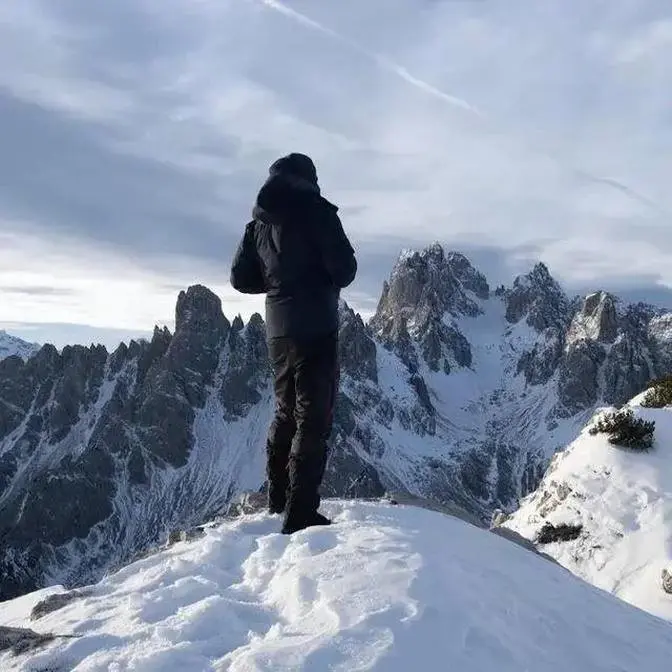
At this time of year I spend a lot of time travelling and leading workshops, and in the past I've not filmed videos during the workshops, but this year I thought it would be interesting to shoot some video during the workshops and then to analyse some of the images that I shot while in the field. I wanted to shoot as spontaneously and discretely as possible, so most of the footage was shot with an iPhone 11 and a DJI Osmo Mobile 3.
If you’d like to join me for a landscape photography workshop in Italy or Iceland next I’ll be co-leading groups there in 2021. Check my website for more information https://www.andymumford.com/workshops/
If you're interested in purchasing any of the gear I use in this video, and you enjoy my videos, please support my work by clicking on the affiliate links below. Thanks so much.
Good morning from the Dolomites. I'm here in winter. We're leading a winter workshop now and
I don't normally film videos when I'm leading workshops. I thought it might be fun this year
to give it a try, see how it works. So what I'm going to try and do while I'm here over the next
week is to film what we're doing, film some of the workshop, film some of the locations that
we're shooting, talk a lot about photography, talk about the shots that we're doing and try
and do it with an iPhone, just with an iPhone and see how that turns out. Because when I'm out in
the field I really do like to be focused purely on photography and on the mood and the feel of
the place. It informs a lot of my images and the way that I shoot and I do find it very hard to
kind of divide my head between producing videos and focusing on still photography and this is
doubly true on workshops when I really like to be focused on the group and I'm getting the most out
of a scene with the group. But I found that with the iPhone that I've been shooting more and more
short video clips and the quality is so good I've been really impressed by the kind of quality
that it can produce. So I really felt that on this trip that if I could shoot videos quickly
and discreetly enough that it would allow me to still maintain my focus on still photography then
that might be an interesting way of actually recording this trip and talking about the
photos that we're shooting here. So we made it up in the snowmobile to Trecem, here we are as you can see
it's pretty much a white out here we can't see a lot but we're gonna stay around see if we can
get a shot of the peaks framed by the clouds because it's really quite peaceful and quite
atmospheric and it's nice to create something unusual so we're gonna have a look at that
before we go back down before it gets too dark because the walk over to where we are now it's
quite tricky it's deep snow it's slippy and we don't want to be going down too much in the dark
and making that risky. And then to get back down to the car we're gonna go back down on sleds
which is gonna be a lot of fun it's gonna be an adventure I hope so yeah. Now as it turned out the
clouds are so thick we literally couldn't get a shot of the Trecem peaks while we were there
and this is the reality of landscape photography quite often you make an effort to get to a location
and you don't get a single shot but as we were walking back to the sledges I caught a glimpse
of one of the distant peaks and it was being sort of revealed and concealed by these clouds swirling
around the top of it. Now it's certainly not a great shot but it is an image and it was certainly
worth getting the camera out to shoot it because for me it's always better to come back with
something than with nothing at all. Now in places like this where the clouds are moving really fast
I had to shoot the scene really quickly and I didn't get the time to set up the tripod because
by the time I'd set up the tripod the clouds would have probably swirled around it and the image
would have been gone so I chose to capture it handheld which meant boosting the ISO higher
than I normally would because the light levels were quite low. Now when it comes to technique
for hand-holding the general rule is that double the focal length for the shutter time so here I
was shooting at 70 millimeters so I should have been looking at a shutter time of around 1.140
1.150 but I had the iOS the image stabilizer the lens stabilization turned on which generally gives
me about two stops so that takes me back down to around 1.30 which pretty much put this within an
acceptable level of handheld shooting. Now it would have been better with the tripod it would
have given me a better shot but I might have missed it in those few moments if I'd taken the
time to stop and set the tripod up. Now as I said it's not a great image it's not a portfolio shot
but sometimes you just get what you can. Now fortunately we had much better luck with the
conditions at the other locations where we shot so here at Passo Giau this is a fantastic place
to shoot both in the summer and the winter at sunrise which is when we were shooting here and
also at sunset. We've got views in just about every direction and lots of possibilities with a wide
angle lens with a telephoto lens but here this was shot with a drone and just having a drone gives
you another perspective entirely. With drone photography you have quite a lot of freedom to
move the camera around up and down left and right so I put the drone in such a place that it really
emphasized the line of the curve on the hill on which we were standing giving me these converging
lines and then got the drone low enough so that the brow of the hill we were standing on was
actually below the line of the peaks behind us which put the group directly in front of the
rising sun. Now strong light is always a powerful compositional tool because it's naturally going to
pull the eye towards it and here I used the backlighting of the figures to create the main
focal point with the line of the hill working as an element pulling the line in and being framed
between these two peaks on the left and right. Now from an exposure point of view when you're
shooting directly at the light like this you the dynamic range is always going to be extremely wide
so I actually bracketed five shots it's something I tend to do with the drone as a dynamic range
on the sensor isn't as wide as a dynamic range on my camera on my X-T3 but I very rarely need
all five shots and here I just I just basically needed two to blend together but at the end of
the day this was probably one of my favorite images from the trip certainly my favorite
image from the morning because it's always nice to get something original from a location.
So this is an image taken on the same morning but with a much more conventional wide angle
composition now the peak makes an obvious focal point and with this hill in front of us there was
a natural leading line towards it supported by the other various lines and the compositions of the
hills but I felt this composition felt a little bit flat it was really lacking in any depth and
that's why shooting with a really wide angle lens when you can find a strong foreground element can
really work but finding foregrounds isn't always that easy particularly in snow there are a lot of
footprints around the scene but having a look around I found on the southern side of this hill
of these these kind of shapes now it wasn't perfect I would have liked some some nice clean
lines but I really liked the way that the the curve of the slope here supported the line that
led towards my main focal point which is also really nicely positioned between the peak of
on the left and the cellar towers on the right now the fact that it's closer and the lack of
haze around this peak giving it more brightness also helps to separate it from those two peaks
behind it and make it really pull the eye towards it. I shot this at f7.1 which with the particular
wide angle zoom lens that I'm using it tends to perform really well there. In terms of focus
I'm shooting with an APS-C sensor with a crop sensor and you get a huge amount of depth field
at this aperture it starts at something like 40 something centimeters in front of the camera and
then goes on to infinity. Now 40 centimeters is really close it's rare that I'll have the tripod
below that so unless there's something projecting from the ground to the lens like a flower or
something like that I find I very rarely need to focus stack. Now with a full frame sensor and
again with a medium format this is different you've got less depth of field and you probably
would need to focus stack on a composition like this certainly with the GFX I'd need to focus
stack here but for this particular image I didn't I could do the whole thing I could get focus front
to back in in one shot. I'm always going to be troubled by this patch of bare mountain here
where the snow hadn't settled and slid off the side of the mountain but I think you know I've
said in videos before that failure it's an essential part of landscape photography.
Every session doesn't end with an image that's going to stay in our portfolio but putting that
aside there's actually just a pleasure in the simple art of composition of looking at the
elements of taking in what you see around you and just creating some image even though that
image may be less than perfect. So this is an attempt to capture the same scene in a different
way to the wide-angle image that you've just seen it's a it's telephoto panorama with a
with a selection of images shot in portrait format arranged into a panorama. Now it's actually taken
on a different morning when we had a little bit more interest in the sky. Now here I really
ignored the foreground and aimed just to capture the vista across the horizon the view of the peaks
and our panos they work just like any composition just panning across the scene doesn't work there
needs to be a focal point and there need to be other elements in the image to support that and
I felt that this this same peak worked well as a focal point as in the previous image and you've
got these different lines and triangles within the scene working to support it and to pull the
eye through the image towards the peak. Then you've got these repeated shapes things like this which
always give strength to a composition. Now in terms of shooting this it's important with panos
to shoot with all the exposure settings in manual because otherwise as you move through the image
of the scene you're going to find that the ultra exposure is going to change the exposure settings
and you'll get a different exposure on the different frames which means for example the
sky is going to be darker or brighter in one frame than another and it's going to be very obvious
when you blend it together. Now you can't really adjust that later exposure in camera and exposure
in software never really work in the same way the balance of tones between shadows and mid-tones and
highlights is never the same so it's just better to to set a manual exposure that will work to
capture the whole scene if you can't do it with one exposure then you can bracket it and then
sweep across with the with the camera with the exposure set in manual. Now for me personally I
think it's a good idea to have the white balance set manually as well because as you move through
the scene the values might change giving you a slightly cooler or warmer frames. Now again you
can adjust this in post but I shoot a lot of video and adjusting white balance mid-clip in a video
getting it to match really is complex so I've just basically got this ingrained habit of always
shooting with my white balance set to daylight that way I know it's always going to be consistent
across each frame that I shoot. And the final thing with panoramas is to ensure that when you're
shooting that you've got a significant overlap between each frame. Now I always recommend
something between 30% and 50% because that way you'll ensure that light room's got lots of
overlap and can and can stitch the frames together successfully and a leveling base if you can get
one is also really handy to make sure that you keep the scene level as you pan the camera through
each frame. Now one of the most successful shoots that we had came early in the workshop at Passo
which is a high pass overlooked by the peaks of Lagosoi and Tofana which really catch the first
light when the sun comes up and paints them in the morning. Now in this location I really wanted
to shoot wide to include these two leaning trees which work as an arrow pulling your eye towards
Tofana, the peak of Tofana, but on their own they really weren't enough. I felt that the image
lacked depth, it needed some foreground element to give some balance to the two elements here.
Three elements is always a strong compositional structure, it creates a triangle that the eye can
move around, it makes the image feel much more dynamic as the eye moves through that triangle.
This meant shooting ultra wide angle which does diminish the peaks, it's always going to make the
peaks smaller but I felt that it was worth it for the strength of these leading lines and how it
balances with the other elements in the image. Without these leading lines the image just felt
a lot weaker and had a lot less depth so I found these lines which are caused by winds and the snow
and then got really low to emphasizing them. When it comes to processing this image there was
already quite a lot of haze around the peak and rather than remove it I actually added to it using
the dehaze tool and a radial filter to actually add haze and brightness. Now this is a process
that I use a lot in my image editing to shape the light. If you've seen my Lightroom video or my
Capture One video I explain how I use radial filters to selectively brighten parts of the
image using the dehaze tool because I find that this enhances the way that the light's falling
and this again serves as a way to move the eye through the image bringing attention to parts
of the image that we want to focus on. So okay that's it for this video I'll be putting together
part two of this trip in a few weeks or so and uploading that and then over the next month I'm
going to be off to Lofoten and then off to Iceland and I'll be shooting more videos in the snow there
so I hope this has been interesting and I hope it's been useful. Thanks for watching and good
luck with your own photography see you soon and as always take care.