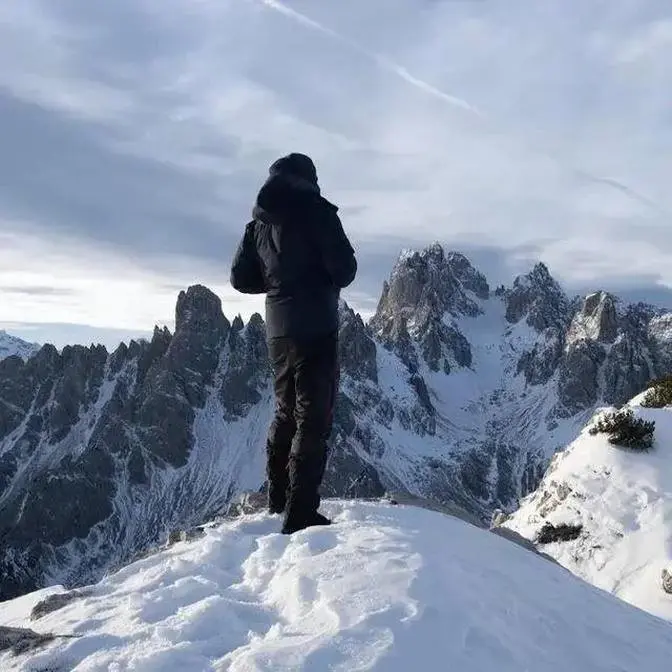
In this video I wanted to take a look at the different elements of the creative process - how we go from being in the landscape and experiencing to capturing that experience in an image
If you’d like to join me for a landscape photography workshop, there are still some places left on my 2025 workshops and I'm now opening waiting lists for 2026 and 2027. Check my website for more information https://www.andymumford.com/workshops/
If you're interested in purchasing any of the gear I use in this video, and you enjoy my videos, please consider supporting my work by clicking on the affiliate links below.
All right. So, the creative process.
Now, creativity is a weird thing in
landscape photography. We're not really
creating something from nothing. We're
taking something exists, something that
exists as we see it in front of us, and
then finding a way to interpret that.
And it's in that interpretation that our
creative process exists. Everything from
where we choose to stand to what lens we
use to how we frame the scene and then
how we expose it is all part of the
creative process. So, I thought a lot
about this video and how to define it
because for me, it's not really a
stepbystep process. The scene as well as
my state of mind determine how I
approach it. But in every scene, there
are factors, things that I take into
account that are pretty much always the
same. So, in this video, I want to try
to break down my creative process when
I'm out in the field shooting. From the
seed of seeing something that inspires
me and through the different stages of
turning that into an image.
For me, every image starts with being
inspired to visit a particular place and
photograph there. And in this video, I
want to look at how it works. when you
go to a place that you're interested in
for one reason or another, but you don't
have a specific image in mind that you
want to shoot. Now, what we find
interesting is different in everyone.
Personally, I'm fascinated and inspired
by large epic scenes, epic landscapes,
places that feel almost elemental, as
though they've been there forever.
Deserts, for example, are places that
I'm always drawn to photographing. And
for years, I wanted to head to the
deserts of the southwest of the US to
shoot there. Now, on that trip, there
were some places that we visited that
I'd already seen images from. And in
these places, making the image was
really all about finding the the
different elements for the composition.
The subject itself was was pretty much
one that I'd already identified before
going there. And in those cases, the
elements that go into making the images
are things I've kind of already
discussed before in composition videos
that I've made. So, that's not really
what I want to talk about in terms of
the creative process. But while we were
there and driving around, we kept seeing
these blue shell slopes at the foot of
the mezz. And that's kind of where it
starts. You don't necessarily straight
away see an image, but you see the
elements that you think you can make an
image from. And in this case, it was a
triangles, which are strong
compositional shape and lots of very
regular diagonal slopes with leading
lines along the spines of these small
hills. And this triggers that thing in
your head where you think, uh, okay, I
think maybe there's an image here. Now,
these slopes were everywhere in the area
where we were staying. So, the next step
was to look at Google Maps and see if we
could find an area which we could access
and which had a lot of photographic
potential. And by photographic
potential, I mean that it was clean of
other elements that might ruin
compositions. Things like roads,
buildings, power lines, landscape
elements that didn't necessarily
contribute to the scene. and where there
is harmony in the arrangement of the
landscapes. Now, Google Maps is a
fantastic tool for identifying
interesting landscapes and finding
places to set up. I use it a lot. In
this case, we found an area that looked
like it would have lots of potential for
aerial images with interesting values
that were all in converging lines. And
then it was just a case of going there
and moving on to the steps that I'll
talk about next. Things like finding the
composition, finding the mood. But the
primary stage here was heading to an
area that I find inspiring, the deserts
of the southwest. And then as we were
driving around, it's just really about
keeping my eyes open, keeping my mind
open, then just noticing things,
noticing something that had elements
that work for an image. And that's a
huge seed of all inspiration. noticing
the landscape, seeing the landscape, not
necessarily looking for pretty things or
whatever, but being aware of the
elements of a landscape that will work
in an image. And the more you do that,
then the easier it gets. Okay. So, once
you've found a place or something that
inspires you to photograph it, the next
step is how you are going to compose it.
Now, I've talked a lot about composition
in quite a few videos that I've made as
for me, it's the most important aspect
of photography and perhaps the hardest
to master and to understand, but I don't
want to go over the same things that
I've talked about in previous videos
here. What I want to do is look at this
from the point of view of the creative
process and the decisions that you have
to make. So, the first thing is
understanding the fundamental structure
of the image. What is it that inspires
you and how can you best show that? Is
it the whole wide vista? And if it is,
is there one element in there that you
can build the image around? Something
like a mountain peak or a tree? Or is it
just the general scene, the way the
landscape flows? Or is it something
smaller that's caught your eye, a
repeating pattern or a shape in the
landscape or the way that two elements
complement each other or balance each
other? To do this, to see this, you have
to open yourself to the landscape, to
really look at it, to see if there's
something that can anchor the image, a
main subject, something which sometimes
can be really big and obvious, or
sometimes it can be a tiny small element
that works because it contrasts and so
it pulls your eye towards it. Sometimes
there's not really a singular subject.
Sometimes it's a whole landscape. And on
these occasions, I'll look for shapes or
lines, things that flow together and
elements that work together. In both
these occasions, what you leave out is
just as important as what you include in
the composition. And it's here that lens
choice and focal length come into play.
With a wide-angle lens, you're going to
include everything in the landscape
that's in front of you. So, this focal
length works usually if you've got three
really strong elements. a strong main
subject that doesn't get lost in the
image, a foreground that supports a
subject, and finally a good sky, as the
sky will almost always be the background
of any wide-angle image. And then you
need to get the foreground to connect
with the subject, which is usually much
further back in the image. And this will
usually going to require walking around
looking for foregrounds, getting higher,
getting lower to find a way to connect
these two elements together. So the eye
moves from one to the other. And that's
part of the creative process,
identifying that anchor, that main
subject, and then walking around trying
to find a foreground that supports it.
Now, one thing that I find that helps me
with this particular process is using
the wide-angle lens on my phone, as this
allows me to move around really freely
and try different heights and different
ways of framing the elements. But
wide-angle images like that are just one
template. And many many scenes don't
have foregrounds or they don't have
great skies or subjects that need
support. They don't necessarily work as
a wide angle. And it's important that
you don't become fixated on one
particular element or one particular way
of doing things or framing things. Just
because you have a good sky, it doesn't
mean that you have to include it if it
doesn't work with the other elements.
Only include it if it works with the
subject that you're shooting. only
include a foreground. If you can find a
decent one or one that works to support
the main subject. If not, then exclude
it. If you include something that
doesn't support the image, then for sure
it's actually going to detract from it.
Not every landscape needs a foreground
or a sky. Lots of scenes are actually
stronger without them. A huge part of
the creative process for me is is asking
myself, what am I trying to show here?
What am I actually shooting? and then
honestly evaluating if including other
elements actually make it better or
weaker. Don't get hung up on a
particular template or way of shooting.
Every scene works differently. So look
at the scene and try to reduce it to its
essential elements. Very often the best
way to show a scene is to just show a
small part of it that represents the
whole to remove elements and make a
simple more minimal composition that
distills a scene to what is basically
its essence to what's essential about
that landscape. For scenes like this,
then a telephoto lens works best. Just
trying to include one or maybe two
elements in the frame. But sometimes to
get to this stage, we have to start
wider. We have to start with the big
scene and then just keep subtracting,
refining the composition, reducing the
scene and using the viewfinder to
analyze whether the image works or not.
And if we need to keep subtracting more
or including more in the frame.
[Music]
All right. So talking about planning
about composition these are tangible
aspects of making images but a huge part
of the creative process is your state of
mind. And this is relevant at every
level. from making yourself get up at a
ridiculous time in the morning, pushing
yourself along a trail to the level of
expectation that you carry with you when
you go out shooting and just the general
feelings that you have in your head when
you're out doing photography. All of it
has a huge effect on the way that you're
going to to make images. I think the
first thing to do when you're out
shooting is to try to clear your mind of
expectation. Now, it may be that you're
visiting a place that you've been really
inspired to shoot and wanted to go there
for a long time, but the chances of it
being exactly as you've imagined when
you get there, or like the photos that
you've seen are are pretty much
impossible. It's not going to be like
that. Disappointment is a byproduct of
what happens when something fails to
meet your expectations. So, the first
thing to do when you arrive anywhere is
to arrive there with an open mind. But
it's not just potential disappointment.
being really excited about being in a
place or being in a scene that really
inspires you that everything is so good
that you get really anxious about
messing it up and not capturing it or
even the leftover adrenaline or
tightness from a really long hike. All
of this crowds into your mind and makes
it harder to focus and makes it much
harder to get your mind into a creative
space. So, you need to slow down to
breathe. Don't immediately reach for a
camera and try to start shooting. Just
spend some time looking at the place and
absorbing it immediately. Getting your
camera out of your bag. It can anchor
you to a spot. And that's doubly true if
you set your tripod up. This can cause
this kind of tunnel vision where you
don't really see the scene, only the
tiny part of it that you expected to see
or the bit that caught your eye when you
first arrive and you miss so much like
that. You need to slow down and take a
breath. Clear your mind. Look around and
try not to get fixated on one particular
scene, on one particular thing. And the
best way to do this is to give yourself
time by getting there early. Landscape
photography requires patience and not
just in waiting for the light, but in
dealing with things like expectation,
things like disappointment, frustration
at the weather or whatever. All of this
plays into the experience of being in a
place. And it's very easy for negative
feelings or being anxious at missing a
shot to feed into every aspect of what
you're doing. things like maybe your
camera does something expected and you
can't work out what it's doing can stop
you in your tracks and you can become so
fixated on that that you actually forget
why you're there. So for me the key is
just trying to keep a calm mind because
without this it's pretty much impossible
to have the mental bandwidth to be
creative to see the scene to find the
elements that work to create harmony in
the composition to notice things that
maybe aren't working in your composition
things like the exposure need to you
need to have a clarity of mind and the
key to that is just taking your time and
slowing down. It almost never happens
that the first time you frame a scene
that you absolutely nail the
composition. It almost always needs to
be refined. And to do this, you need to
be aware with all of your senses
connected to what you're doing, to the
light, to the way the different elements
of the landscape are flying, to the
weather, or any potential in issues,
things that are maybe like creeping into
the edge of your frame. So, your state
of mind really is important. And of
course, it's really easy to say, try not
to be anxious. Try to keep a calm and
open mind and be calm. It's really easy
to say that. But of course, it's much
harder to do that in reality when you're
excited, when you're out of breath, or
when you're frustrated. So, the first
practical thing to do is to get to a
location early, then sit down, drink
some water, eat a cereal bar, whatever.
Look around and leave your camera in the
bag. Having the time just to do that is
the first step to calming your mind down
and putting it in a place where you can
start to think about framing a scene and
start to think and start being creative.
Now, I know that when when I make a
video like this, it's very easy to in
order to try to explain something to
break it down and divide it up into
easily digestible chunks. When in
reality, all the aspects that I've
mentioned, things like composition,
things like state of mind and
inspiration, they aren't linear steps or
separate things to pass through. They
all overlap each other. They're all
happening at the same time. And this is
definitely true of the mood of an image
because it's it's this mood and the
emotion that you have, that feeling that
will inform every aspect of creating the
image. Now, I've always believed that
when we're at a place, we're not really
taking the photograph of the place, but
we're more attempting to capture the way
that that place makes us feel. And so,
we can go to the same place on different
occasions and come away with very
different images each time. The way a
place makes you feel will affect the way
that you expose an image, whether you
lean darker or lighter in your exposure.
It affects the composition as well. For
example, in a place like Dead in
Namibia. Now, for me, this place is all
about the intimacy of that location of
these trees that have stood there in
this place for hundreds of years. So, I
compose it with a telephoto lens,
cutting out the sky, cutting out most of
the foreground, and keeping the trees
prominent in the composition. In
Hokkaido, there's a simpleness in the
winter landscapes there. There's just
this pure whiteness of the snow that
really influences my mood, and that
makes me lean into bright exposures
without shadows, clean, simple
compositions. On the other hand, heavy
clouds in Iceland make me lean the other
way towards darker, more moody images.
And so I'll expose accordingly. I'll
expose darker and try to find darker
elements of the landscape that I can
frame the image with. Up on the mees of
the southwest and in the deserts, the
scale of the landscape there is massive.
There's just this sense of awe, the
vastness of the space. And so I'll lean
towards using a wide angle to try to
convert that epic scale with lots of sky
and a distance that just goes on and on
and on. But then in the abandoned mining
town of Commons Scop in Namibia, I
wanted to capture the isolation, the
passing of time. So finding rooms
without footprints flying through them
was my biggest concern there. So
whenever I'm on location, I try to tune
into what the feel of that place is.
Whether it's filling me with awe,
whether it's claustrophobic or intimate,
what's the best way of capturing that?
And again, this is inextricably
connected with your state of mind, with
your inspiration. And like those things,
it requires a bit of space and time to
tune into. And once I have that, then
the other aspects of the process become
much clearer, which lens to use, how to
think about framing as well as decisions
about exposure and stuff like that. And
when it comes to exposure, this is
really something you need to get right
at the time, even if you shoot in RAW.
I'm not talking about simply brightening
or darkening darkening the file uh in
post-processing. What I mean here is the
mood that you choose to show will
reflect the way that you shoot a scene.
A dark image will probably embrace
shadows and it's very hard to change
that in post to give it a brighter feel.
A brighter image probably won't include
many shadows. It will lean towards the
highlights and the brighter mid tones.
Once you've done that, it's very
difficult then to introduce darkness
into that to make it a moodier image.
So, you need to be aware when you're on
the scene. Post-processing is a really
important part of the creative process,
but you should never think that you can
change an image from what it is, from
how it is, when you feel it. For me,
post-processing should be used to
enhance the mood that you captured in
camera and to bring that out. So, it's
important that when I'm in the field,
I'm aware of what that mood is and how I
can capture that in camera, but then
also to think ahead what the edited
image can look like. The best images
have an intentionality that flow through
every aspect of how you make them.
Whereas, just pointing my camera to
something pretty and then hoping I can
make something of it later. For me, that
just never works. So, that's it for this
video. I hope it's been useful, at the
very least interesting. It's one of
those videos where everything can feel a
bit abstract and intangible and to be
honest trying to define the different
processes that are happening in my head
when I'm out shooting. It's been a bit
of a challenge when I was writing the
script for this video. But if you've got
any comments or any questions, just drop
them down below and I'll get back to
you. And if you have enjoyed it, please
like, please subscribe because it really
does help the channel. And if you like
my photography and you enjoy my
approach, why not join me on a workshop?
I've been leading workshops all over the
world for over 10 years now and we're
constantly refining the way that we put
our tours together and heading to some
really really stunning places. We're
just launching some of our 2026 and 2027
workshops now. We've got tours coming up
to Utah, to Alaska, Madera, Namibia,
Botswana, and Japan. And you can find
full information on all my tours on my
website. So drop me a line if you're
interested in joining us. And as ever,
take care and good luck with all your
photography. I'll see you next time. See
you.