A medical student in North Carolina reportedly bragged on social media that she intentionally stuck a needle twice into a patient during a blood draw after he mocked her “pronoun pin.” This is the story of what happened. I, as always, give my thoughts on the situation at the end! Timestamps below...
00:35 - What Happened? 03:27 - What Did the Med student do? 05:30 - How the med school responded 06:05 - Thoughts of the twitterverse 07:37 - The med student’s apology 08:06 - My thoughts on the situation
*None of this is meant to be construed as investment advice, it's for entertainment purposes only. Links above include affiliate commission or referrals. I'm part of an affiliate network and I receive compensation from partnering websites. The video is accurate as of the posting date but may not be accurate in the future.
Before posting anything, you should always ask yourself,
should I be posting this?
It was only after the med student tweeted about it
that she got in trouble.
Welcome back to the channel, everybody.
For those of you who are new around here,
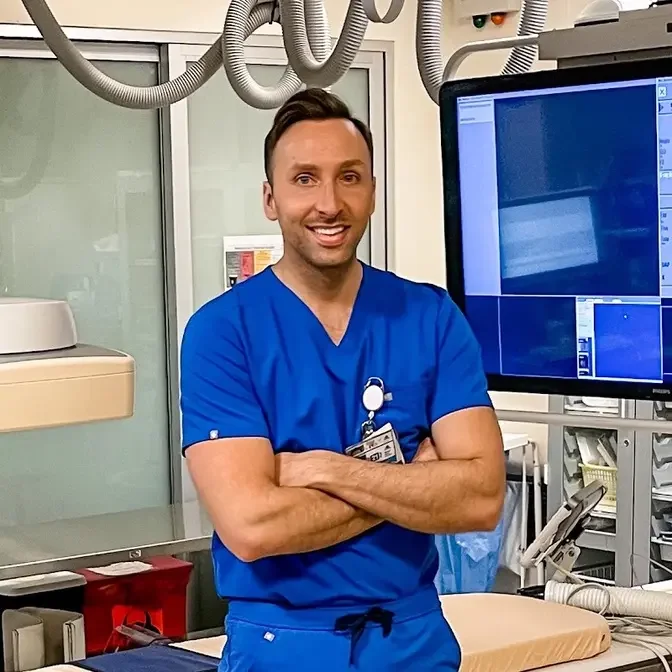
my name is Michael, AKA Dr. Chalini,
and I am a board-certified diagnostic
and interventional radiologist in New Jersey.
On today's video, I wanted to talk about something
that I heard recently involving a med student
in a harmful interaction with a patient.
And even though I mentioned it on a prior podcast episode,
I wanted to do a video entirely devoted to this topic
and go into a little more depth on it.
So enough babbling, let's go ahead and get into the video.
Let's go.
All right, so we are just going to jump in
on what exactly happened with this particular situation.
So a fourth-year med student
out of my former state of North Carolina,
and more specifically, Wake Forest University,
was doing blood draws on a patient.
And if you don't know anything on how hospitals work,
blood draws are usually done by the phlebotomist or nurse.
However, a lot of times,
med students will do their own IVs and blood draws
on patients because it helps them learn.
And after all, this is a teaching hospital
and they are there for a learning experience.
And also, depending on what hospital you are at
during your residency, you may do them there as well.
So any sort of practice up to that point will help you.
During my first year of residency or my internship,
I did a ton of blood draws and IVs.
So again, any practice you get in med school
will be advantageous.
So back to the story.
She was performing a blood draw on a patient
and the patient noticed a pin on her white coat saying,
see my pronoun.
The patient laughed loudly and said, quote, she, her.
Well, of course it is.
What other pronoun is there?
It?
So let's stop there.
Again, those are not my words.
Those are the words of the patients.
I'm quoting this for the purpose of the video.
So this kind of interaction happens
with patients all the time.
As you can imagine,
not all interactions with patients are good ones.
It's just part of the profession.
We deal with difficult patients sometimes
and even the occasional patient that tries to assault you.
It's just part of the job.
And I'm not saying it's a good part of the job
or even remotely one of my favorite parts of the job,
but it is still a part of the job nonetheless.
And part of med school and residency
is learning how to deal with these kinds of situations.
Because like I mentioned,
not all patient interactions are amazing.
And I'm kind of putting a pen in the story
because I want to make a point here.
And the point I'm trying to make is
that not all of the patients acting this way
are doing it intentionally.
And we can't lose sight of that.
Every patient comes from a different walk of life
and may have different views or ideologies.
Some of which may be extreme
and some patients are more outspoken than others,
but ultimately you should treat the patient the same
regardless of the aforementioned.
And the reason we should do this,
well, there are many reasons,
but one of them is because the patient
may not be in control of their actions.
They may be demented.
They may have mental illness.
They may be intoxicated or they may be heavily medicated.
As healthcare professionals,
we must treat all patients the same
and in a professional manner.
I think every single healthcare professional
watching this video right now can comment with an example
of when a patient made fun of them
or said something extreme to them,
or even tried to hit them.
And please comment below if you've experienced
any of these things and you are a healthcare worker.
And what happens when these sort of things happen?
Well, you just keep going about your day.
And I do want to make myself clear here.
I am not by any means saying that this behavior
should be part of our job,
but unfortunately it kind of is.
And we don't have any control of patient's actions.
So why am I bringing all of this up?
Well, for one, this medical student
didn't handle the situation in the best manner,
in my opinion.
It's what she did after the interaction
that prompted an investigation in the first place.
So what did she do?
She took to social media,
specifically the cesspool that is Twitter.
And she tweeted the following,
I had a patient I was doing a blood draw on,
see my pronoun pin and laugh loudly to the staff.
She, her?
Well, of course it is.
What other pronouns even are there?
It?
And then she went on to say the most important part
of this tweet, which was,
I missed his vein so he had to get stuck twice.
Crying emoji.
So let's analyze this tweet a little bit.
She's responding to a tweet about transphobia
with her own example.
The problem is she's talking about an interaction
with one of her patients.
Now this isn't exactly HIPAA
because she doesn't include any specific patient information
or have any way to identify that specific patient,
but she is quoting a private conversation
she had with a patient and putting it on social media.
So while that doesn't fall in the realm of HIPAA,
that's kind of that ethical gray area.
And like I said, the second line of this tweet
is what sent off all the red flags.
I missed the vein so he had to get stuck twice.
Okay, so this is the problem with social media.
This tweet could be interpreted a million different ways.
And if we know anything about Twitter,
we know that anything that you say
that could have different interpretations
or interesting undertones will be blown up
in every possible polarizing manner.
This tweet was no different.
So did she intentionally miss the vein
in order to hurt the patient,
to get back to the patient for making fun of her pin?
Or did she feel bad for missing the vein twice?
Is that a sad emoji or a sarcastic one?
You see what I mean here?
It's the second line of this tweet
that can have many, many meanings.
And as you can imagine, Twitter took it and ran with it.
Just for an example, the libs of TikTok account
with over 600,000 followers on Twitter
said tagged WaitForce School of Medicine
and said, fourth year med student says
she abused a patient because he laughed at her pronoun pin.
She has since deleted her account.
So this is what happens as we know on Twitter,
somebody tweets something out, someone identifies it,
and then a big account tweets it out
and they usually will tag the school
or the person's occupation or whatnot.
So what did WaitForce have to say about this tweet?
This was the original response once the school found out.
WaitForce School of Medicine said in a statement,
the actions described in this student's social media post
do not in any way reflect the quality of care and compassion
that WaitForce University School of Medicine
strives to provide to our patients each and every day.
We stand behind our values that include trust,
excellence, and space where all belong
and we can actively reinforce those values
with learners and providers, the school said.
While federal law does not permit us
to share specific information,
we are taking the proper measures to address the matter
with the student school leadership is involved.
So now that we had that generic response from the school,
what was everybody else on Twitter saying?
Well, in case you're wondering,
here's some of the quotes or retweets that I found.
Let's read the first one.
The student needs to be expelled
and the police need to be notified.
If the school does not handle this appropriately,
I hope the patient sues the student and the school.
Next, this individual simply cannot be trusted
with a patient.
They need to be removed from the program, nothing else.
And how about one more?
I'm not ever going to let a doctor from this school
become involved in any aspect of my medical care.
This one student seriously degraded the reputation
of the entire university with a single tweet.
See how powerful these tweets are?
WaitForce now has a reputation
of their graduates assaulting patients.
And what about the other people
who saw it a little differently?
Well, one commenter said,
doctors miss my veins all the time.
It's not malpractice to be human.
Another said, is there any indication this was deliberate?
And another user asked,
it's dumb and unethical to post about it,
but it seems like it could also
just be an amusing coincidence.
I'm sure y'all know how much it sucks
when people interpret ambiguous comments
as proof of your malicious character.
Later on down the road,
when they were investigating this a little further,
the school actually mentioned
that she did not recall the incident accurately
in her tweet.
They stated the following.
Our documentation verifies that after the student physician
was unsuccessful in obtaining the blood draw,
the student appropriately deferred a second attempt
to one of our certified professionals.
The student did not attempt a blood draw again,
the school reportedly wrote.
So what exactly happened to the student?
Well, the student was ultimately placed
on a leave of absence as a result of inappropriate
and a misleading post.
This is all according to a statement
that the university put out.
The student involved actually put out a long apology
in the university campus paper
in which she basically blamed being inexperienced
in saying she never intended harm to the patient.
Here is her full apology.
For the event mentioned in the tweet,
I was performing a blood draw on a patient
and during our conversation,
they had shown dismay at my pronoun pen,
Del Rosio wrote in her statement.
I calmly shared my thoughts about the pronouns
and did not escalate the situation further.
When I was doing the blood draw,
I missed the first time due to my inexperience as a student
and per our policy,
my supervisor performed the successful blood draw
the second time.
During this encounter,
I never intended to harm the patient.
Okay, so now that we've heard both sides
of the argument,
what exactly do I think about this whole situation?
Well, I'm going to give her the benefit of the doubt here
because I doubt that she was maliciously
poking the patient multiple times on purpose.
What probably happened is just like the article stated.
She was clearly upset with what the patient said to her
and she wanted to tell the Twitter world what happened,
which again, probably not the best idea
to share a conversation that you had with a patient
on social media, regardless of how good or bad it was.
She then likely tried to get Venus access,
which she couldn't,
which isn't uncommon for someone who is learning.
However, if she didn't just feel the need
to post this on social media in the first place,
she would have never been in this situation.
So therein lies the problem.
Why even post to social media in the first place?
And while we're on this topic,
let's talk about med school
and how they don't prepare any med student
for using social media.
And they most certainly should,
especially with how popular social media is today
and how common it is to see a healthcare worker
on social media.
It's a blessing to be able to reach
a large portion of the public.
You can educate them and even market yourself or practice,
but it's also a curse because even one small mess up
can have career altering effects, especially in medicine.
I personally think it's very important for physicians
to get involved in social media.
And I also think it's just as important
to train the next generation to use social media
and train them to use it safely and efficiently.
The medical education system is very antiquated
in the fact that they only teach medicine.
But these days doctors need to know
so much more than just medicine.
They need to know marketing.
They need to know finance.
And yes, they need to know social media.
If you've been watching my channel for some time now,
you know that I have strong feelings
about the lack of personal finance education
in medical school, but social media is right there with it.
The reason I think social media should be a part
of the medical curriculum,
because it's so important for them to know
how to use social media effectively
without risking their careers that they worked so hard for.
Social media is a great tool to express creativity,
provide mentorship for the next generation of doctors,
educate the public, market yourself or business,
or even be used as a tool to inspire others
to go into medicine.
It is an excellent tool for medical professionals,
but its impact should not be taken lightly.
This is just one example how a med student experienced
the negative consequences of using social media.
But it also should be taken
as a learning experience for others.
Before posting anything, you should always ask yourself,
should I be posting this?
Or could this be misinterpreted in a different way?
Or even better, run it by somebody else before posting it.
So that officially concludes this video.
Please hit the subscribe button
and like this video.
Comment below if you have any questions or comments
on this particular topic.
As always, make sure you follow me on Instagram and TikTok
if you don't already,
and I'll see you all on the next video.
Bye.