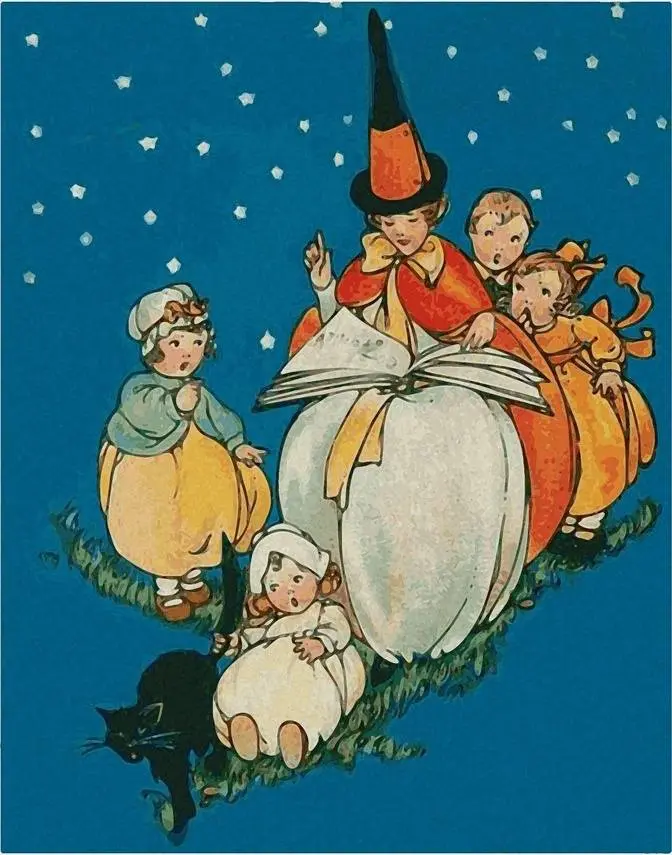
"Hansel and Gretel" which is also known as “Little Step Brother” and “Little Step Sister”, is a German fairy tale collected by the German Brothers Grimm and published in 1812 in Grimm's Fairy Tales.
“Hansel and Gretel” has been adapted to various forms of entertainment, most notably the opera “Hänsel und Gretel (1893) by Engelbert Humperdinck”.
Hansel and Gretel are the names of a son and a daughter of a poor woodcutter. They live with their father and stepmother in a village near a forest. When a famine spreads over their land, they are abandoned in the forest by their father under the urge’s of the stepmother. Because she does not want to be starved to death. At first, their father rejects the wife’s idea but she claims that the two children may be taken by strangers who can feed them. Because the food is running out of stock, the father is forced to abandon his children. However, their plan is discovered by Hansel and Gretel. The children use a trail of white pebbles to come back home after they are left in the forest. However, they fail to do it for the second time when they cannot get the pebbles. Hansel and Gretel have to use slices of bread to make the trail but bread slices are eaten all by the animals.
Hansel and Gretel get lost in the forest, and fall into the hands of a witch who lives in a house made of gingerbread, cookies, cakes, and candy, with window panes of clear sugar. They are caught by the witch when they are eating her house due to hunger and tiredness. The old witch lures the children to come inside the house promising to provide them with a soft bed and good food.
Hansel and Gretel enter the house without realizing that the witch is bloodthirsty and intending to eat them. However, Hansel and Gretel trick the witch intelligently. They not only cheat the witch to avoid being eaten but also kill the witch. They survive and come back to their family with a vase full of treasure which they take from the witch’s house.
The stepmother has died from an unknown cause. Their father has been spending all his days lamenting the loss of his children, and is happy to see them come back safe and sound. With the witch's wealth, they all live happily ever after.
The moral of this fairy tale is : Children do not trust or speak to strangers, no matter how kind they may appear to be.
Comments are disabled for this video.
Hi, welcome to Read Aloud with Mr. Paul. I'm so glad you could be here.
Today we're reading a story I've loved since I was little, Hansel and Gretel,
illustrated by Paul O. Zielinski and retold by Rika Lesser. Look at this beautiful painting on
the inside cover. It shows us where the story takes place. We can see that it happens in the
countryside. Looking closer, we notice there are no cars, no airplanes, no power lines.
This story is set in the land of long ago and not the world of today.
Here's our title page, Hansel and Gretel, illustrated by Paul O. Zielinski,
retold by Rika Lesser. What does it mean to retell a story? That's right, it means to tell
it again. So Paul and Rika are retelling the story in their own way. It may be a little
different from another version you've heard before. At the edge of a great forest, there
once lived a poor woodcutter. He could scarcely manage to feed his wife and two children,
Hansel and Gretel, and this made him miserable. The day came when there was nothing left to eat
in their house but one loaf of bread, and he grew terribly anxious. His wife said to him that
evening as they lay in bed, Listen, husband, there is something you must do if we are not
all to starve. Early in the morning, take the two children, give them what little bread we have,
and lead them into the forest. Build a fire for them, and while it is burning, go away and leave
them there alone. For a long time the man could not reconcile himself to his wife's plan, but she
would give him no peace until he finally agreed. The children had heard everything their mother
had said, and Gretel began to cry. Hush, Hansel whispered. It will be all right. I have an idea.
Then he got up as quietly as he could, put on his jacket, and went outside.
White pebbles on the ground glistened in the moonlight. Hansel carefully gathered them up
and stuffed the pocket of his jacket with as many as would go in. Then he went back inside,
lay down beside his little sister, and fell asleep. Early in the morning, before the sun had risen,
the parents came and awakened the children. To each one they gave a little piece of bread.
Gretel took both pieces and put them under her apron because her brother's pocket was
filled with pebbles. Then they all set out on the path into the forest. While they were walking
along, Hansel often stood still and peered back at their house. His father said,
Why are you always stopping and looking back? Oh, Hansel replied, I am looking at my white kitten,
who is sitting on the roof and wants to say goodbye to me. Secretly, however,
each time he gazed back, Hansel dropped one of the small white pebbles on the path. The boy's
mother said, Just keep going. That's not your kitten. It's the morning sun shining on the
chimney. But Hansel kept gazing back, and each time he did, he let another stone fall.
And so they went on walking a long time, until they were in the midst of the great forest.
There they stopped and gathered firewood. Their father lit a huge fire, and when it was burning
brightly, their mother said, Rest a while now, children. Your father and I are going off to cut
wood. Wait here by the fire until we come back. The children sat by the fire and ate their bread.
They waited until nightfall, but their parents did not return. When it grew very dark, Gretel
began to cry. But Hansel said to her, Wait just a little longer until the moon is up.
And when the moon was up, the white pebbles gleamed in the moonlight and showed them the way.
Hansel took Gretel's hand, and together they walked all through the night. In the morning
they reached home. Their father rejoiced to see them, for he had not been happy about what he had
done. But their mother was angry. Not long after, again, there was almost nothing to eat in the
house. And again, after going to bed, the children heard their mother tell their father that he must
take them into the forest, deeper than they had gone before. And again, Gretel began to cry.
And again, Hansel got up very quietly to go out and gather pebbles. But when he got to the door,
he found that his mother had locked it. Hansel, too, grew sad and could not comfort his little
sister. Early in the morning, before daybreak, they all got up, and each of the children was
given a small piece of bread. As they walked along, Hansel often paused and gazed back.
His father asked,
My boy, why are you always stopping and peering back at the house?
Oh, answered Hansel, I'm looking at my little pigeon, who is perched on the roof and wants to
say goodbye to me. Secretly, however, he crumbled up his bit of bread, and each time he turned around,
he would drop a crumb on the path. His mother said,
Just keep going. That's not your little pigeon. It's the morning sun striking the chimney.
But Hansel kept glancing back, and each time he did, he dropped another crumb. And when they'd
come even deeper into the forest, to where it was thickest, they stopped. Their father built a huge
fire. Their mother told them to rest and wait while they went off to chop wood. As they sat
by the fire, Gretel gave half her bread to Hansel, for her brother had strewn all of his along the
path. They waited until evening, but no one came to fetch them. When it grew very dark and the moon
rose, Hansel looked for the breadcrumbs, but they were gone. The thousands of woodland birds had
pecked them up and eaten them. Hansel still meant to find the way home, and he pulled Gretel along
after him. They walked all through the night and all the next day, but they were lost in the great
forest. On the third day, chilled and hungry, they came upon a little house that was built out of
bread. Its roof was made of pancakes, and its windows of sugar candy. The children were so happy
to see it that they ran up to it, Hansel to the spongy roof, and Gretel to the sparkling panes of
the window, and they ate greedily. Hansel was devouring a huge chunk of the roof, and Gretel
was pushing out yet another window pane, when they heard a thin voice call out from inside,
Who gnaws my house to rubble? The children were so frightened that they let fall what
they had in their hands. Just then, a gnarled old woman came gliding out the door. When she caught
sight of the hungry children, she wagged her head and said, Oh, you poor little things,
come along with me to eat inside the house. I'll take good care of you. And she took them both by
the hand, led them inside her house, and served them a fine dinner. Then she made up their bed,
and the tired children lay down and fell fast asleep. The next morning, before Hansel and Gretel
were awake, the old woman crept up to their bedside. As she watched the two of them sleeping
so sweetly, she thought to herself, Now there's a tasty morsel for you. And she lifted Hansel up,
and carried him outside, and locked him up in a little stall as if he were a piglet.
Then she went back inside and shook Gretel awake, yelling, Get up, you lazy girl.
Go out to the well and draw water, and then get to work and make something good to eat.
Your brother is in that stall over there. First we're gonna fatten him up, and when he is fat,
I will eat him. Gretel was terrified of the old woman and had to do as she was told. Every day,
she brought Hansel water and lots of good food to eat. She herself got nothing but crayfish shells.
And each day, the old woman went to Hansel's stall and told him to stick out one of his fingers
so she could feel if he were growing plump. And each day, Hansel held out a bone instead of a
finger. One evening, after four weeks had gone by and it still seemed that Hansel was growing no
fatter, the old woman said to Gretel, Now be quick about it. Go out and fetch water to fill the
cauldron. Tomorrow morning, whether or not your little brother is fat, I am going to slaughter
and boil him. While you are getting the water, I will be kneading dough. We'll bake bread while
he's cooking. Early in the morning, when Gretel got up to light a fire under the cauldron full
of water, the bread was already in the oven, and the old woman called out to Gretel, Come over
here right now. It smells as if the bread will soon be done. My eyes are weak. I want you to
look and see if the bread is turning a golden brown. If you can't see in far enough, then get
on this board and I'll push you in. There's plenty of room in the oven. Once you're inside,
you can take a good look. Now the old woman really meant to leave Gretel in the oven to roast,
but Gretel could tell what the woman had in mind and said to her, I'm not quite sure how to go
about it. Could you show me? If you get on the board, I'll push you in. And the little old woman
sat on the board, and Gretel pushed her into the oven as far as she could. Then she slammed the
Inside the oven, the old witch screamed and howled, and while Gretel was running away,
the old witch burned to ashes. Gretel ran directly to Hansel's stall and let him out.
She told him what she had done, and the happy children hugged and kissed one another.
One last time, they went back inside the witch's house. Everywhere they looked were precious gems
and sparkling jewels. They took all they could carry with them and set off for home. They walked
and walked, and at last the woods began to look familiar. When they arrived home,
their father wept with joy to see them. Their mother had died, he told them. Every day that
they were gone had been filled with sadness. Now they emptied their pockets of the glittering jewels,
and the woodcutter and his children lived happily and prospered to the end of their days.
Thank you so much for joining me for Read Aloud with Mr. Paul. Until next time,
discover the wonder in a book. Pick one up, take a look.
If you enjoyed this Read Aloud with Mr. Paul, please like,
subscribe, and ring the bell to be notified of future episodes. Thanks again.