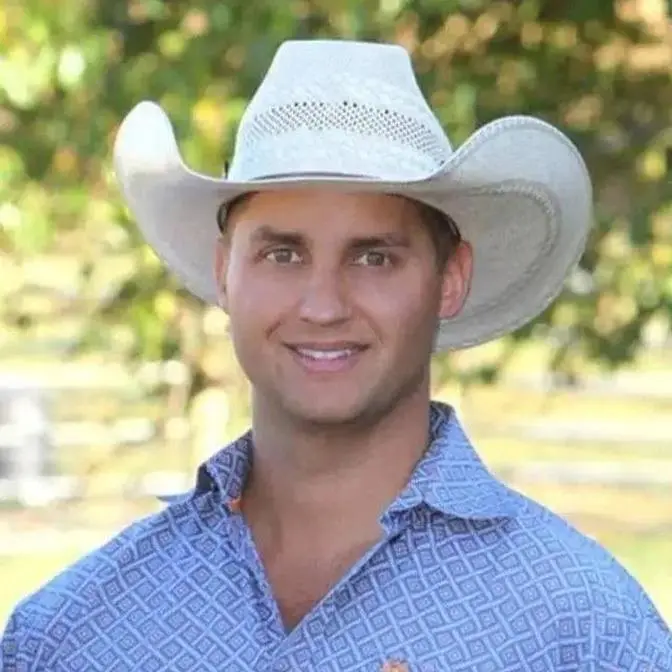
Why does this horse keep chasing the owner's dogs? Ryan Rose uncovers the real reason behind the behavior and explains how understanding horse psychology can solve the problem. Plus, Ryan shares a simple dog training tip at the end using the "out" command to improve boundaries and communication.
💼 Build a better horse business. Join our Skool community to learn marketing, business systems, and proven strategies to help you grow in the horse industry. 👉 https://www.skool.com/horsemanshomepage/about
🤠 Take your horsemanship to the next level by joining our Patreon! Get exclusive training content, behind-the-scenes videos, members-only Q&As with Ryan, special training opportunities, and access to exclusive merch. 👉 https://www.patreon.com/ryanrosehorsemanship/
A trainer guides Diana in managing a yearling horse that is defensive toward her dogs. The session focuses on establishing strict personal space boundaries for the horse and improving dog obedience. By using physical corrections and specific cues, the trainer emphasizes that safety depends on the owner's consistency and confidence in managing both animals.
It's almost like a game for her at this point.
There was just enough pressure going on that she finally decided to do something about it.
Him or her safety is on you when you're out here.
You have to be willing to correct the horse.
But you've got to be willing to touch him.
This has been extremely helpful.
My name's Diana. I contacted Ryan Rose because I was out one day fixing my hay net
and had the dogs with me.
And Coon here, he is a little bit older.
And Nellie is a little bit younger.
And our yearling decided that she wanted to chase the horse, or chase the dog.
And I was in the way.
Luckily, she was smart enough not to come at me.
I think she's a little bit cow-y, and she sees these guys as fun things to chase.
My kids are out there with the horses.
And him being a heeler, he's at our heels at all times.
So I don't want it to become something that could cause somebody to get hurt.
And does your dog listen really well if you were to, say, lay down before it got there
or to get out if it's in a bad spot?
She may or may not listen.
Normally I just let her out. I just have her out.
So the dog just does whatever it wants.
Well, kind of, yeah.
It's really important to have a down cue, like lay down or down.
And they just lay down instantly.
Especially dogs that have high instincts.
And you have two dogs that have high instincts.
Because you see where they're going for something, but something else is coming,
and they don't see it.
And if you could have a down, that could keep everybody out of trouble right away.
Another one is out.
And the reason they teach a lot of herding dogs out,
sometimes the dog will go after cattle when you don't want them to.
Or they are maybe trying to cut through the herd instead of going out and around them.
So they teach them out to just move out of that area.
And I believe you could teach it to your dog very easily.
I think it would be helpful to do both, not just the horse.
From what I observed, you have a yearling here.
She looked like when you were coming up here, she was nipping at you and in your space as well.
And so the first thing I want to do is address that
and just build her tolerance of respect for your personal space as well.
Because right now she's a yearling.
She's not very committed to it.
She's experimenting with it.
But if you let it go, it will turn into a bigger problem.
Because that same attitude she has towards the dog will turn to you if we let that go.
So that's what I want to start with.
And for now, we'll just keep the dog out of the pasture.
And we'll just work with her a little bit.
I'm just going to pet her with this a little bit, make sure she's not afraid of it.
Because again, I don't think she's very committed to this at all.
I don't think she wants to be a dominant horse.
It's natural for every horse, regardless of what their personality is,
to figure out the herd pecking order and to experiment with leadership.
And so you could have the same herd, and over years, the pecking order changes.
But it's very common for horses to test the pecking order.
Sometimes I'll tell people they vote for their leader every day.
Because of this natural instinct for them, we have to communicate to them that we're in charge.
And so I'm going to do that in a minute here, but she's a little bit afraid of my stick.
And so I'm just going to build her confidence with this.
Boy, she's got some really cool markings on her front legs there.
That's a beautiful horse.
Essentially, I think more than her trying to play with the dog, she's actually being defensive.
Because the dog is kind of oblivious to horse traits and is just running around having a good time.
You would have a much bigger problem if she was being aggressive to the dog.
It looks aggressive, but you've got to understand horses have a flight or fight response to pressure.
If she starts to feel enough pressure by the dog, and when we were hanging out over here,
there was just enough pressure going on that she finally decided to do something about it.
And that was be defensive and go towards the dog to drive it away.
That's a fight response versus a flight response.
The approach is less about correcting her when she's going after the dog
and actually more about building her confidence with the dog being around her.
I'm going to work on driving her out of my space, so I'm just going to wave the stick
and just put a little pressure on her and just ask her to be, just to kind of back up
and yield out of my personal space.
So there's a little lick and chew.
So she got released by stepping off that pressure.
Maybe for a few days, just bring in a stick with you when you come into the pen.
And if she gets too close, all you're going to do is stop and you're going to wave the stick.
And you're just going to ask her to be out of your personal space bubble
and just get that little step off.
So again, I'm not saying she's a pushy horse with bad ground manners or anything like that.
I'm just saying she's a horse that doesn't know that yet,
and you have a really good opportunity to go ahead and set some boundaries.
Like see, she's already stopping out there and not wanting to barge in.
And so she strikes me as a horse that wants to be really sweet,
but she needs to get a little bit more education because we don't want that to turn into more of a habit.
Essentially, I'm teaching her to respect my back.
And I think all horses should learn this at some point.
If I stop, they should think about stopping,
and I'll just kind of wave my arms and make some commotion and ask her to back up.
Because most people only train their horse when they're facing them like this.
But a lot of times, we're in the pasture, we're feeding, you're going to get the other horse,
or you're catching the dog, whatever you're doing.
You're not facing her, you're facing away.
And so I just want her to realize that from this position, she could also yield backwards.
So even though this horse is not at all trying to be dominant or pushy or anything like that,
she just needs to have the basic understanding that she can yield to a person's back.
And so you'll see occasionally, she has to run into the stick to know that that's there
and there's a meaning there to it, that I'm not just bluffing.
Like this is a bluff.
And so she's yielding to this now, but if she didn't yield to it, I would follow through.
And she would eventually, I say run into the stick because I'm moving backwards.
If she stopped moving backwards, the stick would touch her.
But I'm always giving her the opportunity to step away from it.
And then the last thing we're going to do is we're going to ask her to step her front end over.
And the way I do it with a horse that's kind of green is I'll be in front of them,
and I'll just present a boundary with the stick alongside their neck,
and I'm just asking for that front end to step over.
Again, I ask for that same yield off the halter, but now I'm asking for it off the stick
and just being able to start to get a little bit of control over the hind end and the front end.
And it's just getting that step over. That's all I need.
And again, she's being really good, trying to figure out what I'm asking for.
Nice little yearling.
Let's bring the dog in now.
I want her to learn to tolerate the dog being around her.
I don't want you to put the dog in the kick zone or anything,
but I want her to have some tolerances around the dog being by her.
As you get closer and when you get closer, I want you to do it more by her front end than her hind end
because I can't get there quick enough.
If she decided to kick, she would beat me to it, and we'd have a hurt dog, and it'd be a bad deal.
So we want to protect the dog's safety as we're doing this.
But we're going to do it by the front end.
But what I'm looking for is a really good training opportunity.
If she's just standing there like that and the dog was by her and I correct her,
that doesn't really solve anything.
She has no idea why she got corrected.
But if she'll pin her ears or go to nip the dog or take a step towards the dog,
that's what I'm looking for to correct her.
Basically, I'm just going to back her up quickly.
I'm abruptly going to just wave the stick in front of her and just say,
No, we're not doing that.
There's pressure there if you decide to go after the dog.
And so she's kind of minding me right now, so that's good.
But we're also getting her used to the dog just being around her more and more.
Ellie's being a good girl.
She's being a trooper.
She is a bit oblivious, though.
She is.
She has no idea what kind of danger she's in when she's that close to their feet.
No.
But that's why it's good that you've got a good...
Now see there, she just pinned her ears, and that was the only thing she did.
So that was the only thing she gave us as any sort of negative thought towards the dog.
And so I just did a little correction.
She didn't even hardly move her feet, but we got a little lick and chew,
which means it was just enough that it was effective.
The reason she had a lick and chew is when I corrected her, she switched nervous systems.
When she relaxed, which was right away,
she came back to the parasympathetic nervous system and got more comfortable.
If I did a little less, it wouldn't have bothered her enough to cause that to be a change at all.
And if I would have done too much, I would have scared her about the situation
and pulled her mind completely off it and got her afraid of me or the stick or the dog or something else.
Sure.
I think if it's okay with you, I'm going to take her offline now.
And we're going to do the same thing,
because I do want you to just do those exercises with her real quick.
Okay.
I think if I got maybe some feed, that would also...
Yeah, let's do that.
No, because we've got to keep...
Hey, attention, pay attention.
Hey, hey.
Fix it.
Tap her.
Oh, you've got to tap her with it.
Oh, I missed out.
Dang it.
Let me see if I can try to do that again.
So that was a missed training opportunity.
You'll get another one when you get the feed out.
Okay.
So I just wanted to share with you guys something that I'm really passionate about doing
that I've recently decided to take on.
And that is a train the trainers program.
I want to help other equine professionals grow their businesses and be more profitable
and run just an overall more successful equine business.
So if you're thinking about becoming a trainer or you already are a trainer
or you want to teach lessons, that sort of thing,
I want to show you how to run a successful business in the equine industry.
There's a big need for it out there.
There's a lot of horses that need to be trained and a lot of people that need coaching.
And so if you're interested in getting started, I'm going to be launching a program on school
where I show you all my playbook on how to run a successful equine business.
And so if you're interested to get started, there'll be a link in the description below
and in the comments, and I'll look forward to seeing you on there.
Oh, the bay horse doesn't get any?
Sorry.
Better luck next time.
You just be ready with your stick and string there.
Got to have eyes in the back of your head.
Yup.
Good job.
Now, she went away more from you going, ah, more than the stick.
I want you to reach out and tap her with the stick if it's a training moment.
So again, the point of this is to set up deliberate situations where you're ready to do something about it
rather than just have, oh, heads up.
Seems like when there's food around.
Can you call your dog back?
Nellie, come here.
Nellie, here.
Nellie!
Hey!
Get over here.
Come here.
It's a two-part issue.
We got to get a little more handle on the dog where the dog minds when you need him to.
And then you have to be willing to touch the horse when she goes after it.
Like unless you just never want to bring your dog out here.
No, I want to.
And so it's like you got to be willing to, like you had the stick.
You got the power.
You know what I mean?
You got to step out there and touch her and tag her with it.
Okay.
And that's what I was trying to say when you went, ah.
You got the, you deflected the horse, but you didn't fix it.
Okay.
You talked her out of it.
And that's probably where my problem is.
You talked her out of it in that scenario, but it wasn't enough to be effective where
she's not going to do it again.
Uh-huh.
You know?
But yeah, she was completely oblivious to the danger of being that close too.
Right.
I mean, she has to be put away when the farrier comes because she would climb right underneath
all of them.
Yeah.
But so in my opinion, part of this is dog training too.
Oh yeah, for sure.
Him or her safety is on you when you're out here.
Right?
You have to be willing to correct the horse and touch him.
And it doesn't take very much, but you got to be willing to touch him.
Okay.
So what I would do here is I would play a game of, no, you can't come into my, when
you're here with the dog, there's just, we're going to put our bubble way out there.
Okay.
Big bubble.
Yeah.
Hey.
Yeah.
There you go.
Good.
You know, really this is a good lesson for any young horse to learn that the human can
drive them off of feed regardless of that.
Mm-hmm.
And this time, instead of chasing her off the feed, I want you to walk around near the
vicinity.
Don't get really close, but I want you to just kind of walk around.
You just got to be ready.
Nellie here.
Be ready to use your stick and string.
So don't get, kind of ignore the horse, but just be near.
Nellie here.
Hey, come here.
That wasn't exactly what we were going for, but, but she did the right thing and ignored
the dog and went away.
But I think you can all, I think you can also appreciate the dog training aspect of this
too.
If you're going to have the two together, there's both variables.
Let's do this again.
So walk away here.
I'll come to that feed again.
Because this is ultimately what we want, is her to just ignore the dog.
Mm-hmm.
And this will actually be a lot easier to fix too once you're riding her, because then
you can like pick her head up, you can yield her hindquarters, you can have the dog running
all around you and stuff.
It's a lot, kind of a harder to set up this scenario.
Yeah, you're doing really good.
You just ignore the horse, walk by.
Also, do you see how the dog is giving the horse space now?
Yes, I do.
And again, don't try to make the dog be by you.
I want the dog to respect their space and move out around, just like I want the horse
to be able to defend themselves against coyotes that come into the pasture.
Okay.
So we're looking for kind of a balanced equation here, but do you guys see what we got going
on now?
We got a dog respecting the horse and we got the horse ignoring the dog.
Go ahead and go all the way around now.
Be ready here.
Oh, that was good.
That was really good.
And you see, again, I like that response of her just going like, well, because you got
so close to her, she was like, oh, maybe I should just not be here.
And that's a better response than her defending the feed.
Yeah.
Really good.
All right, I'd head away.
I think that was a really good little training session.
So this is what I'd set up again tomorrow.
Okay.
Do it a few days in a row.
Okay.
You can really make a change with something when you set it up multiple times.
There's two choices.
The horse can leave the feed and just give you space, or it can tolerate you coming by
and everybody's getting along and fine.
The dog can learn to stay out.
I mean, you can even practice shushing the dog away and get the dog to stay away from
the horse and the combination of the two.
Except for the older dog, I wouldn't.
Right.
No.
I think this is about all he needs to handle.
He doesn't have much choice.
Yeah.
But I wouldn't do anything casually out here.
I would only do training sessions until you're really convinced the horse is going to ignore
the dog.
It's not as defensive around the dog, and it's all good.
Okay.
So, yeah.
You just got to be aware of it, and it's your job to protect the dog and defend the dog,
and you're not going to hurt the horse with touching him with the stick.
And the string, look how far away you can get.
Sure.
You got ten foot of reach.
You have a four-foot stick and a six-foot string.
Do you have one of these?
I don't have the one with the string.
I just have...
You do now.
Oh, thank you.
All right.
Shout out to Weaver.
Oh, yeah.
Thank you.
Thanks for hooking us up.
So, as I was working with this situation, I realized that having some training on the
dog is also going to be helpful, because there's times where the dog just needs to get into
a safer position.
And I am not a dog trainer, but I do have a little bit of experience with dogs around
livestock.
And so, I decided to try to help her with at least one cue to help the dog move out
and get to a safer position.
Out.
So, I just make some commotion until she goes somewhere else.
It doesn't have to be to you.
It could be wherever.
But she's drawn to you, so it's working just fine.
Let me just do it a couple more times, and then I'll have you do it.
Okay.
Good puppy.
Out.
That was pretty good, huh?
For a non-dog trainer.
Let me just do that one more time to make sure it wasn't a coincidence.
Good puppy.
Out.
Not bad, huh?
All right.
Come on.
For somebody who's not a dog trainer, it's pretty good.
I think you made it obvious that she can learn.
Okay.
Now it's your turn.
Shush the dog.
Oh, horse.
Get the horse.
Go, go, go, go, go.
Yes.
Good job.
That was just enough that it was a bit of a correction.
You were at the bottom end of it qualifying as a correction, but it was enough that she
didn't like it.
So, she got out of there.
Okay.
More than you going, eh, you know, making a noise towards her.
So, that was really good.
Nellie, out.
Out.
Super.
Well, now we're teaching the dog to go to safety as well.
Let's try that one more time.
Okay.
Stay right there.
Give her the cue.
Out.
Look at that.
Good girl.
Yeah.
Awesome.
So, now we got a little more safety on the dog, a little more safety with some control
with the horse.
Well done.
All right.
Sweet.
Doesn't that feel better?
Yeah.
That does feel better.
It feels better to have like some options now, you know?
For sure.
And again, teach her to lay down, teach her to calm, but I thought that would be a really
easy one to show you.
Yeah, that's a girl, Nellie.
Good girl.
Ryan Rose Dog Training.
Dogmanship.
All right.