
Secret Training Routine That Made Alizhan Unbeatable!
1 Video View·May 31, 2026
Welcome to the ultimate arm-wrestling talk! Get frequent updates, expert match breakdowns, and bold analysis no fluff, just pure armwrestling action. Stay tuned, stay strong, and dive into the world of intense battles and strategies!🔥
AI GeneratedMay contain errors
Video Summary
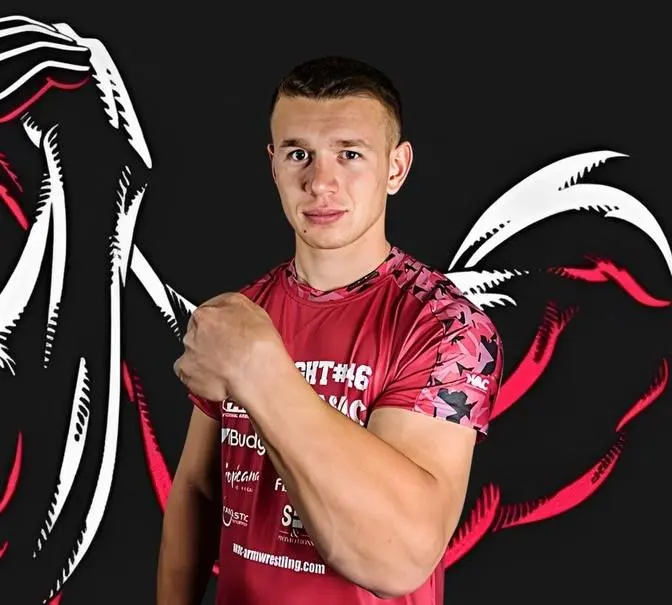
AI GeneratedThis video provides a comprehensive breakdown of the training regimen and background of Alijan Muratov, a world-class professional left-handed arm wrestler from Kazakhstan. It explores his transition from right-handed pulling due to injury, his explosive hook style, and a detailed day-by-day analysis of his strength and conditioning routine.
Have you ever wondered why Alijan Muratov doesn't feel any pressure from his opponents?
He probably holds one of the strongest wrist flexions in the history of the sport.
Do you want to know Alijan's one-week workout schedule?
Hey guys, welcome back to TableTorque.
Alijan Muratov is a professional left-handed arm wrestler from Kazakhstan,
widely considered one of the strongest left-arm pullers in the world.
He became famous for his explosive hook style, insane side pressure,
and his ability to dominate much heavier opponents.
He mainly competes on the left arm because of a serious right elbow injury earlier in his career.
This 28-year-old athlete stands 180 centimeters tall
and competes at a consistent body weight of around 100 to 105 kilograms.
Alijan mentioned in an interview that he started arm wrestling when he was in 5th grade.
Most people don't know that Alijan was originally a right-handed puller.
In an interview, he was asked whether he was stronger on the left or the right.
His answer surprised me.
He got injured during a local competition in 2010 when he competed without warming up properly.
He dislocated his elbow and the ligaments were torn off.
After that injury, his main focus shifted completely to the left hand.
Even 5 years ago, Alijan already had his eyes on Vitaly Laletin.
At that time, Vitaly was performing extremely well on the left hand
and Alijan had already shown interest in facing him in the future.
And now Alijan has reached a level where he can genuinely challenge Vitaly.
In fact, he already has challenged him.
He was also supposed to face Oleg Zhok,
but the match got cancelled because of the tragic accident
where the arm wrestling community lost one of its greatest gems.
Alijan has an exceptional ability to force people into a hook.
So let's go through his one-week training schedule
and see how it helps him become so dominant.
And just to be clear, I didn't make any of this up.
All this information came from interviews Alijan gave to the Iron Rating YouTube channel.
I'll put all the video links I referred to in the description below, so check if you want to.
Alijan's weekly schedule starts on Monday, where he trains biceps.
Biceps are extremely important in arm wrestling.
For a hook puller, training biceps is unavoidable
because supination heavily activates the bicep.
When you arm wrestle, you may end up in positions
where you need strong biceps to hold your opponents both offensively and defensively.
So don't skip training bicep.
Almost every type of bicep curl used in arm wrestling
mainly helps in defensive palm-up positions.
Alijan trains with an EZ barbell in both seated and standing variations.
He also trains with heavy dumbbells and performs one-arm curls.
On Tuesday, he does general body conditioning exercises.
He didn't specifically mention what exercises he does,
but I think it includes workouts other than arm wrestling movements.
Maybe shoulders, push-ups, or other full-body exercises.
On Wednesday, he focuses entirely on wrist training,
and he lifts extremely heavy weights for his wrist.
Honestly, I have never seen anyone crack his left wrist.
It's literally unbreakable.
He trains with the wrist wrench, and trust me,
no other handle will make your wrist stronger like the wrist wrench.
It is one of the best tools for wrist strength,
and even the multi-spinner is derived from the wrist wrench.
One way he uses the wrist wrench is by placing his arm on a table
in a palm-up position and curling the weight upward.
Interestingly, this is something I personally used to do
even before I saw it anywhere on the internet.
Back in my early training days,
I had a wrist wrench which I made for myself,
but I couldn't afford a pulley setup,
so I trained this exact same way.
Yeah, good old days.
So here's a tip for you guys.
If you have a wrist wrench but no pulley setup,
try training this way.
He also does curls with dumbbells.
And when you are curling with dumbbells,
the way Alijan does it is not wrong,
but the way Levan does it is much more applicable to arm wrestling.
Because in Alijan's version,
the whole hand gets attacked equally.
The weight is simply pulling the entire hand downward.
There isn't much pressure directly on the fingers.
But in Levan's form,
he curls at an incline angle.
Because of gravity,
the dumbbell creates downward curling momentum,
and you resist that force and curl it upward
using your fingers and wrist.
As you know,
in arm wrestling,
your wrist gets attacked through your fingers.
Your opponents use back pressure to open your wrist
by applying pressure to your fingers.
So it's essential to curl the weight
while actively engaging your fingers.
But if you want to train only the wrist itself,
you can place your hand at the edge of a table
and keep the wrist straight.
Then apply enough flexion force
to maintain that straight wrist
and try to hold it as long as possible.
He also curls a barbell loaded with weights,
the same style Akimbo often does.
For Thursday, he trains either legs or back.
In one video, Alijan Muratov mentioned
that he always starts by warming up his back and legs.
When you train with very heavy weights,
your legs and back help stabilize your body
and maintain posture.
So properly warming them up becomes very important.
He also does a lot of bodyweight pulling movements
like pull-ups, muscle-ups, and chin-ups.
If you are pulling yourself upward
using your hands and arms,
your back muscles are naturally involved
because the lats, traps, rhomboids, and rear delts
help generate pulling force
and stabilize the shoulders.
And on Friday, he trains brachioradialis.
By that, he mainly means back pressure.
As you know, back pressure is not useful
only for top rolling.
Back pressure and pronation
are the foundation of arm wrestling.
No matter what style you pull with,
you always need them, especially pronation,
both offensively and defensively.
He does a lot of back pressure exercises
using the gravity method.
And he attaches the straps
either through the thumb or through the knuckles
to engage his hand vectors as well.
When you watch the Petrenko versus Alijan match,
you can clearly understand how important pronation is
even for hook pulling.
It decides who goes palm down
and who gets forced palm up.
Petrenko was able to slow down Alijan
by containing Alijan's pronator during his surge.
At the same time, Petrenko activated his own pronation
and forced Alijan into a palm-up position.
That's where he gave Alijan trouble.
So training pronation is extremely important.
On Saturday, he spends time
working on cable pulleys and sparring,
so he is probably doing
most of his side pressure drills on this day.
He combines side pressure with wrist training
and trains from many different angles,
starting with thick rolling handles.
You can see him training with rolling handles
where the pulley angle is placed very high.
This creates a steep angle that pulls you downward.
And the deeper you go,
the more resistance you get upward,
mainly on your hand.
If you want stronger finishing power,
this type of setup is amazing
because it trains down pressure.
The notable thing here is not only the rolling handle,
but also the thickness of the handle itself.
When the handle is thick,
your palm stays closer to flat,
so the pressure gets distributed more into the fingers.
This improves finger strength and wrist strength.
For Alijan, the hand is not completely flat here,
but it still doesn't fully close.
This setup doesn't put maximum stress on the wrist.
It mainly focuses on flat finger strength
and, of course, side pressure.
He focuses a lot on form
because he wants the movement to mimic
exactly how he pulls on the table.
The next angle they train from is more perpendicular,
creating more lateral side pressure.
This helps fighting in the center of the table.
More center control and inside power.
It helps you take the center right from the go.
This angle directs more force sideways
instead of downward.
It places less stress on the fingers and wrist
and more stress on the elbow.
Here you can see him doing internal rotation
using the wrist wrench.
You can even attach the straps to the wrist wrench
to keep your hand connected to the roller
because once the weight becomes heavy,
gripping it alone becomes extremely difficult.
And in arm wrestling, straps are there,
so you don't want to waste all your energy
squeezing the handle.
But still, trying to hold heavy weights without straps
is not useless.
It can greatly improve your performance
outside the straps.
And whenever you curl the weight,
the load constantly tries to open and extend your wrist.
So the entire movement is controlled by wrist flexion.
Here your pecs engage a lot
because pulling your elbow inward
helps connect your arm tighter to your body.
If you check Elysian's Instagram,
you can also see many videos of him
training with the multi-spinner.
He does a lot of pronated back pressure drills on cables
and also tries to engage his riser.
From all this,
we can understand that he trains his wrist
multiple times throughout the week.
In an older video,
he was asked what his top three exercises were.
According to him,
the most important exercise starts with bicep curls.
And honestly,
he transfers that power to the table extremely well.
Elysian has incredibly strong biceps.
Even Georgy Zhuranov once mentioned
that Elysian nearly tore his bicep during a hook battle.
The second important thing for him
is table training using pulleys
because it closely imitates
hand-on-arm wrestling movements.
And the third one he emphasized was rope climbing.
Rope climbing can take your arm wrestling strength
to another level.
You can climb with your pinky higher
or with a normal grip.
And both variations build incredible elbow connection
for both top roll and hook styles.
Elysian also trains his pecs twice a week,
although he never clearly mentioned
where he fits it into the schedule.
Even if you never directly train pecs,
inside pulling naturally develops them.
So it's not exactly side pressure itself
building the pecs.
The idea is that stronger pecs
make your hook more connected to your body.
Now remember,
this workout schedule came from an interview
around four years ago.
I think he has made some changes since then
because nowadays he incorporates
a lot more bodyweight pulling exercises
like weighted pull-ups and weighted chin-ups.
And honestly,
it has made him unbelievably strong.
Rope climbing was always one of his favorite exercises,
but he also mentioned that
as his bodyweight increases,
climbing becomes much harder.
I think now you got an overall idea
of what Alijan Muratov is doing,
and you also understood
that there is nothing magical about it.
He is simply extremely dedicated,
and he has been doing this since childhood.
He also had an amazing peer group,
geographical and genetic advantages,
proper nutrition and recovery.
Everything contributed to what he is today.
And one more additional secret
behind Kazakh strength.
Alijan's coach and he himself once said
that everyone there drinks goat milk,
which they call koumiss.
Here you can see he is literally
holding an entire bottle of it.
As you know,
goat milk is good for bone strength
because it is rich in calcium,
protein and other bone-supporting nutrients.
That's all for today, guys.
See you in the next video.
And consider subscribing to the channel.
See you later.