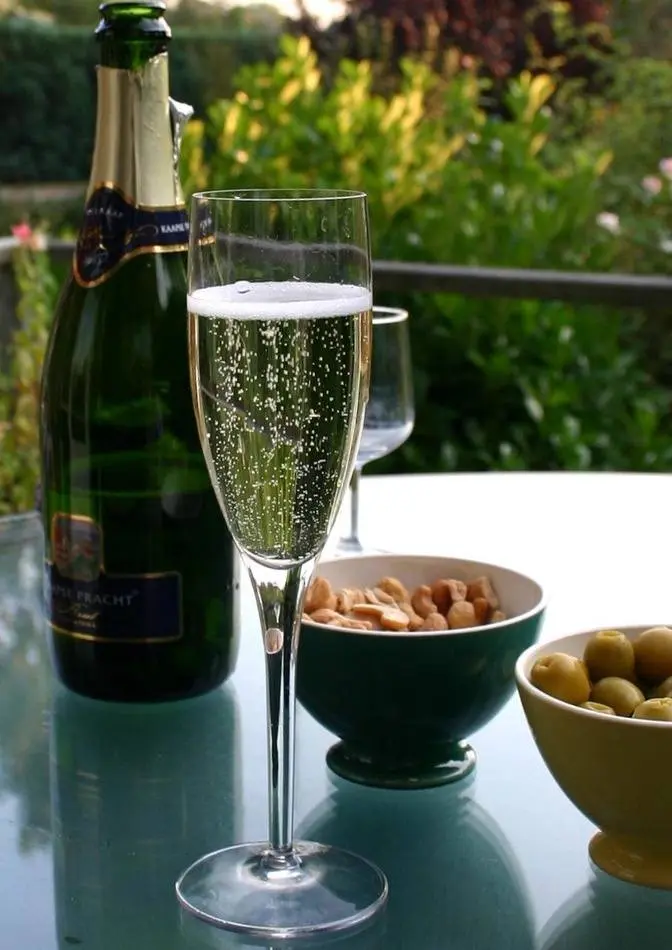
Tired of paying $80 for Champagne just because the label says you should?
There are sparkling wines aged longer than Champagne, made by stricter rules than Champagne, and that beat Champagne in blind tastings — for a fraction of the price. This video is for anyone who feels that doubt at the wine shelf before a date, a celebration, or a Friday that earned it.
I'm Anya Gariboldi — sommelier, wine judge, and WSET Diploma graduate. I teach you how to stop overpaying for the label.
0:00 — A $47 sparkling wine beat a $300 Champagne (blind tasting story) 0:30 — Why the Champagne shelf gives you anxiety 0:57 — #1 Alta Langa: Italy's Champagne killer (Piedmont) 1:20 — Why Champagne aging rules are a scam 2:02 — Alta Langa tasting: $47 that drinks like $120 2:48 — #2 Satèn (Franciacorta): the only "silk" sparkling wine in the world 3:07 — Why Champagne feels too sharp 4:02 — Satèn tasting: the texture $300 prestige bottles try to copy 4:31 — How to read ANY wine label (Wine Sense Method) 4:47 — #3 Corpinnat: Spain's rebellion against cheap Cava 5:50 — The Corpinnat rules that make France uncomfortable 6:47 — #4 Méthode Cap Classique: South Africa's billion-year-old secret 7:35 — Why South Africa is drinking 19th-century Champagne DNA 8:23 — The "French heritage tax" you've been paying for 300 years 8:38 — Free vintage chart (so you never get burned by a bad year) 8:56 — Drink for the glass, not the ego
Professional sommelier Ana Garibaldi reveals how to find high-quality sparkling wines that rival expensive Champagnes without the \"heritage tax.\" She identifies four \"glitches\"—undervalued regions and styles from Italy, Spain, and South Africa—that offer superior aging, organic standards, and complex flavor profiles at a fraction of the cost of French luxury labels.
I judge wine for a living. One day a $47 walked into a blind tasting and absolutely destroyed
a $300 champagne. No labels, just a glass and an umbra. I gave wine a gold medal and wrote in my
notes the definition of the French luxury. Well, it wasn't champagne. It was $47. Look,
I'm not going to sit and lie here. I do taste wine. Most people never get near. But when it
comes to my own money, I'm exactly like you. I want quality, not the label. Imagine you're
standing in the wine aisle staring at a wall of glass. You've got a date, a promotion,
or perhaps maybe just a Tuesday that felt like a little marathon. You want that pop,
but the champagne shelf is looking at you with the absolute audacity to ask for $80. And suddenly,
you're hit with that, should I or should I not? Pause, take a deep breath, put the bottle down.
Hi, I'm Ana Garibaldi. I'm a professional sommelier, wine judge, and WSAT diploma graduate.
And today, I'm here to fix your wine aisle anxiety. Glitch number one, Alta Langa. This
is Alta Langa, Piedmont, Italy. And here is why the French don't want you to know it exists.
If you're dining with a wine snob, this is your move. We're talking about the insider's bottle
that makes $300 labels look like they're trying too hard. In champagne, the standard entry bottle
only has to be aged 15 months, and it's usually a blend of different years to keep the taste
consistent. Consistent, that's a polite word for predictable. Alta Langa does not do that.
By law, every single bottle must be a vintage, no blending, no shortcuts, and the minimum aging,
30 months, double the time. In champagne, 15 months gets you the cheapest bottle on the shelf,
the one that already costs you a fortune. Alta Langa entry level, 30 months, every single bottle.
And here's what kills me. This is Alta Langa's cheapest bottle. In champagne,
that aging would cost you triple. All right, let's taste. So first, on the nose.
You get that rich, toasted hazelnut that Piedmont is famous for. Maybe a hint of warm sordor straight
from the oven. Honestly, to me, it smells like money. All right, let's try this on the palate.
Here you get the concentrated punch of dried apricot and the tart snap of red apple skin,
but the structure that lures you. There's incredible savory, salty minerality on the
finish that just won't quit. So this is the $47 deadbeat market legend in blind tasting.
In France, this level of complexity would cost you $120. Here in Italy, 47 euros. Glitch number one,
screenshot the name, Italy's Alta Langa. All right, glitch number two, satin. Have you ever
had a glass of champagne and thought, hey, this is way too aggressive, too sharp, too acidic,
and you quietly assumed you just didn't like it? Well, you weren't wrong, but you were not the
problem. The pressure was. Most champagne is like a carbonation attack, but what if I told you that
there is a secret weapon for the guests who swear they don't like bubbles? I tell them to look for
the only one wine on earth that is legally required to be silk. This is satin, Franciacorta,
Italy, and this word is a registered trademark. Nobody else in the bubble world is legally
allowed to use it. Here is why. While the rest of the world pumps up the pressure, satin is capped
at five atmospheres, one bar less, but that one bar changes the entire physics of wine.
Instead of bubbles that sting, you get creamy mousse that melts. Floral, elegant, soft, the French spent
millions convincing you that sharp equals luxury. Franciacorta looked at that and said,
soft is the ultimate flex. All right, let's look at the wine. The bubbles are so fine, they're almost
microscopic. All right, let's try this wine on the palate. Instead of sharp acidity, you get that
kind of pillowy whipped cream texture. It's incredibly soft with finish of lemon curd and a
hint of honeycomb. That texture, that's what $300 prestige bottles are trying to achieve. Glitch
number two. The word is satin. Screenshot it. Two down, two to go. If these names are starting to feel
like a lot, don't worry. This is exactly why I created the WineSense method. It's a system that
teaches you how to read any label, so you can find these hidden gems yourself on any shelves in the
world. I'll put the link below if you are ready to stop guessing. Okay, let's move to glitch number
three. Corpinat. Before we get into this, I have to be honest with you. If you think you like Cava,
the Cava you think you know, it's a lie. This is what Cava was actually supposed to be. I know,
I know. When my last video about Spanish wine went up, the comments were flooded. The Spanish
orders were literally like begging me, I need to stop. Don't tell the world our secret. The prices
will skyrocket. Well, I'm sorry, I can't stay quiet. For decades, the name Cava was dragged down
by industrial mass-produced bottles sold for what? Eight dollars. It became the cheap party
wine of Europe. The thing you buy when you can't afford champagne and don't want to admit it. A
group of elite Spanish producers got so insulted by this association and so tired of their world-class
wine sitting next to Breguet and Bean bottles that they did something unthinkable. They quit.
They walked away from Cava name entirely and they formed Corpinat. It's not a region,
it's a rebellion. And the rules they set for themselves, this is where France starts being
very uncomfortable. Hand-harvested only, no machines, unlike most big brands in Champagne,
100% organic, no exceptions. And the aging, in Champagne the minimum is 15 months. In Corpinat,
entry level is 18 months, but most bottles are aged for 30, 60, even 120 months. 120 months,
ladies and gentlemen. That's 10 years in a bottle before it reaches you. You are getting hand-picked
organic decade-age sparkling wine for 50 to 70 dollars. If the French did this, they would put
it in a crystal bottle and charge you a mortgage payment. In Spain, it's just a standard of honor.
And hey, to all of my Spanish followers, I'm sorry, the secret is out. The word is Corpinat,
not Cava. Screenshot this. Now, finally, glitch number four. Method cup classic, South Africa.
If you want to know which bottle keeps the CEOs of the big Champagne houses awake at night,
well, it's not Italian and it's not even Spanish. It's from the oldest soils on the planet. This is
exactly the moment when you want everyone at the table to drink high-end and there are a lot of
people at that table. It's the ultimate hospitality hack, world-class quality at the price that lets
you buy two cases instead of two bottles. How? Because while Champagne sits on chalk from 70
million years ago, South Africa has soils nearly 4 billion years old. That's prehistoric and it
gives the wine a saline mineral punch that makes even a $200 French bottle taste flat by comparison.
But here's the secret nobody in the industry talks about. In the 1900s, the French actually shipped
their elite clones of Chardonnay and Pinot Noir to the Western Cape, which means when you drink
South Africa cup classic, you aren't just drinking South African sparkling. You are drinking the DNA
of the 19th century Champagne grown in billion-year-old mountains. I've sat on palace where
a $25 bottle of Greyhound back completely dismantled a $150 vintage Champagne in a blind
tasting. Same traditional methods, same grapes, but a nervous energy and a sunky stripeness that
France simply cannot replicate without adding significant amounts of sugar to compensate.
It's the most honest luxury bottle on the market. The words are method cup classic or just MCC.
Screenshot it. You see, here's the real secret. The French did not just invent wine. They invented
the world's most successful psychological anchor. 300 years of convincing you that luxury is a French
word. You can keep paying the heritage tax, subsidizing a marketing budget, and a gold foil
label. Or you can drink like someone who actually knows what they're holding. And to help you even
more, I've linked my free vintage chart list below. It's a cheat sheet so you never accidentally buy
a world-class name from a total disaster over here. Tell me in the comments, are you brave enough
to leave the French label behind or are you still drinking for the statues? Drink for the glass,
not the ego, and subscribe for more wine secrets. I'm Ani Gariboldi and I'm just getting started. Cheers!