
Scientists Just Found a Mysterious Tiny World With Atmosphere Beyond Pluto That Breaks Our Theories
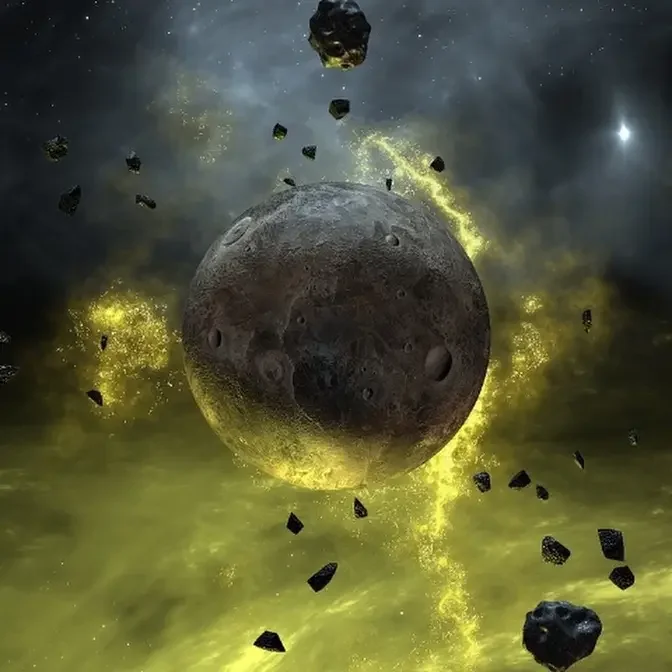
Far beyond the orbit of Neptune, in the frozen darkness of our Solar System, scientists have just discovered something that shouldn’t exist… a tiny icy world with an atmosphere. This object, known as 2002 XV93, is only about 500 kilometers wide—far smaller than planets like Pluto—and yet, somehow, it’s holding onto a layer of gas around it. And that’s where the mystery begins, because according to everything astronomers believed, objects this small simply don’t have enough gravity to keep an atmosphere.
Source - https://www.nature.com/articles/s41550-026-02846-1
#space #solarsystem #jwst #astronomy #science #astrophysics
Far beyond the familiar planets of our solar system, beyond Jupiter, Saturn, Uranus, and even Neptune,
there exists a region so cold, so dark, and so distant that sunlight itself feels weak and lifeless.
Out there, the sun is no longer a blazing presence in the sky, but just a dim star,
barely strong enough to illuminate the frozen worlds drifting in its reach.
This is the realm of the Kuiper Belt, a vast, mysterious region filled with icy remnants
left over from the birth of our solar system more than 4.5 billion years ago.
It is often described as a frozen graveyard, an archive of ancient objects
that have remained largely unchanged since the earliest days of planetary formation.
For decades, scientists believed they understood this region fairly well.
These distant objects, called trans-Neptunian objects, were thought to be simple, small, frozen, dead,
with no internal heat, no geological activity, and no atmosphere.
Just silent relics drifting endlessly in space, preserving a snapshot of the solar system's past.
In many ways, they were considered the most boring objects in planetary science.
But now, something extraordinary has been discovered,
something that challenges everything we thought we knew about these distant worlds.
The object at the center of this discovery is known as 2002 XV93.
It's not a planet, not even a dwarf planet like Pluto.
It's much smaller, only about 500 kilometers wide, which is tiny on cosmic scales.
To give you a sense of how small that is, if Earth were shrunk down to the size of a football,
this object would be closer to the size of a small pebble.
And this size difference is extremely important, because in planetary science, size matters a lot.
A larger object has stronger gravity,
and gravity is what allows a world to hold onto gases and form an atmosphere.
Without enough gravity, any gas simply escapes into space.
That's why small objects were always assumed to be completely airless.
Yet for the first time ever, scientists have detected an atmosphere around a small world like 2002 XV93,
something that, according to existing theories, simply shouldn't be possible.
Their gravity is too weak, and any gas would drift away into space almost instantly,
especially over billions of years.
That's what makes this discovery so puzzling.
It's not just unexpected.
It directly contradicts what scientists thought was a well-understood rule of planetary physics.
Now here's the fascinating part.
This object is so far away that we can't directly see its atmosphere like we do with planets.
There are no detailed images, no clear visual confirmation.
So how did scientists detect it?
They used a clever and highly precise method called a stellar occultation.
Imagine this.
A distant star is shining steadily in the sky, its light traveling across vast distances to reach Earth.
Suddenly, a small object passes in front of it, briefly blocking that light.
To us, the star appears to blink for just a moment.
But that tiny flicker of light can reveal an enormous amount of information.
By carefully studying how the starlight dims and reappears,
scientists can determine the size, shape, and even the presence of an atmosphere around the object.
If there is no atmosphere, the starlight disappears suddenly and returns just as sharply.
But if an atmosphere is present, the light fades gradually as it passes through layers of gas,
and then gradually brightens again.
In this case, telescopes in Japan observed 2002 XV93 passing in front of a distant star.
And what they saw was surprising.
Instead of the starlight disappearing instantly, it faded slowly and then returned slowly.
That subtle but crucial difference revealed something incredible.
There was a thin layer of gas surrounding the object, an atmosphere.
Now, don't imagine something like Earth's atmosphere, filled with clouds, oxygen, and weather systems.
This one is extremely thin, almost ghost-like.
Scientists estimate it is about 5 to 10 million times thinner than Earth's atmosphere.
Even compared to Pluto, which already has a very weak and fragile atmosphere,
this one is 50 to 100 times thinner.
So yes, technically it's an atmosphere, but barely.
It's more like a faint haze of gas, clinging weakly to the surface.
Still, even that is enough to shock scientists.
Because according to existing theories, there should be nothing there at all.
Not even a trace.
Scientists aren't completely sure yet,
but they have some strong clues that the atmosphere is likely composed of very light, volatile gases,
substances that can easily evaporate or sublimate, even in extremely cold conditions.
These include methane, nitrogen, and carbon monoxide.
These gases are common in the outer solar system.
For example, Pluto's atmosphere is mostly nitrogen,
with small amounts of methane and carbon monoxide mixed in.
These substances can freeze into ice on the surface,
and then turn directly into gas when exposed to even weak sunlight,
a process known as sublimation.
But the real mystery is not what the atmosphere is made of,
it's how it exists at all.
Right now, scientists are considering two major explanations,
and both are fascinating in their own way.
The first possibility is that this tiny world is not as dead as we once believed.
Instead, it might still be geologically active,
slowly releasing gas from its interior through a process called cryovolcanism.
Cryovolcanism is similar to volcanic activity on Earth,
but instead of molten rock, it involves the eruption of cold materials like water, ammonia, or methane.
These icy volcanoes can release gases from beneath the surface,
creating a thin atmosphere around the object.
If this is what's happening, then 2002 XV93 is not just a frozen rock.
It's an active world, quietly venting gas into space,
even in the extreme cold of the outer solar system.
That would completely change our understanding of small objects in this region,
The second possibility is more dramatic and perhaps more temporary.
It's possible that this atmosphere was created by a recent collision.
In the distant reaches of the solar system, objects occasionally collide with each other,
sometimes releasing gas and debris into space.
If another object struck 2002 XV93,
it could have knocked loose frozen gases from its surface, creating a thin atmosphere.
But if this is the case, then the atmosphere may not last.
Over time, perhaps years or decades, the gas would slowly escape into space,
leaving the object airless once again.
If that's true, then what we're seeing is a rare and fleeting moment,
a temporary atmosphere that exists only because of a recent cosmic event.
And that means something incredible.
If we observe this object again in the future, the atmosphere might be gone.
At first glance, this might seem like just another distant object in a remote part of the solar system.
But this discovery is much bigger than it appears,
because it challenges one of the core assumptions in planetary science,
that small, icy bodies are inactive and lifeless.
Now we know that might not be true.
This tiny object suggests that the outer solar system is far more dynamic than we ever imagined.
Instead of being a static, frozen graveyard,
it may be a place of hidden activity, slow transformations, and unexpected behavior.
And if one small object can have an atmosphere, how many others are out there waiting to surprise us?
There's another reason this discovery is so exciting.
Objects like 2002 XV93 are incredibly ancient.
They formed billions of years ago, during the earliest stages of the solar system,
and have remained mostly unchanged ever since.
That makes them like time capsules, preserving valuable information
about the conditions and materials that existed when the planets were first forming.
By studying them, scientists can begin to answer some of the biggest questions in science.
How did planets form? What materials were present in the early solar system?
And how did the outer regions evolve over billions of years?
And now, with the discovery of an atmosphere on such a small object,
we have a completely new layer of complexity to explore.
Because once again, the universe has reminded us of something important.
Just when we think we understand how things work, it shows us that we don't.
And somewhere, in the cold darkness beyond Neptune,
a tiny world is quietly holding on to a thin, impossible atmosphere,
challenging everything we thought we knew.
We've done our best to break down this complex idea in a simple and engaging way,
and we truly hope you enjoyed it.
If you'd like to support the channel, you can do so through Super Thanks,
or by grabbing one of our James Webb Telescope Image Printed T-shirts from our store.
And finally, a heartfelt thank you to all our channel members.
Both old and new, your support means everything to us.