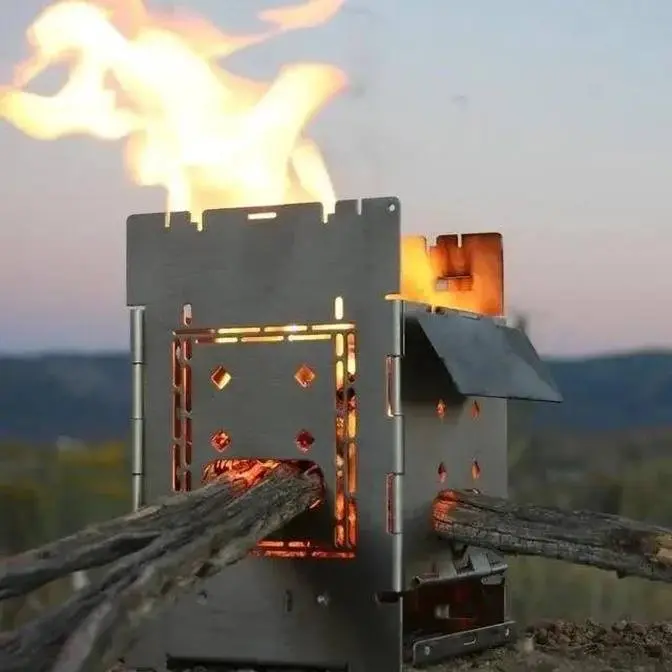
The New Firebox SUMO Stove Expansion Kit for the classic 5"G2 Original Folding Campfire Stove is a game changer! The SUMO widens the stance so side work stations can be configured to accomplish most any cooking task. Set up a GRILL, OVEN or POT-STAND above one of our NEW Side Car Coal Trays then load it up with hot coals harvested from the main burn chamber. Now that you have a heat source you can bake, barbecue, or us as a stovetop. Set up either side for custom cooking while also utilizing the heat coming from the center. Our New Hang-Over Sticks can be set at three different heights which make the set up possibilities almost endless. As if that's not enough cooking versatility you can also broil underneath the main burn chamber at two different heights. Install the ash pan upside down and you have a toaster! Remove the ash pan altogether and you have enough space to broil a thick cut steak or a few drum sticks. These simple to use accessories make the Best Bushcraft Stove into a camp kitchen power house. Gone are the days of cooking one thing after the other, trying to keep everything warm. Now you can be boiling your potatoes, while also baking bread and broiling your cowboy cut steak. All at the same time!
Good girl. Good morning. Hey, I'm here a little bit earlier than everyone else. I'm gonna do some
testing in the break room, but our morning routine is to play with Ursa for a little while,
so we're gonna have to do that first. All right, come on, let's go. For those of you who didn't
see my last video, I'm gonna do a quick review of what the Sumo system is to give the rest of
this video context. The Sumo system for the five-inch firebox is a system that revolutionizes
how you use your five-inch stove. So this is the classic five-inch firebox that's been around for
more than 15 years. A lot of people consider this stove to be the king of wood-burning stoves.
So in the bottom of this case, you can see we've got these are the actual Sumo stands,
and then this acts as a griddle. I'll show you how that works as well. But these
Sumo stands go on to the bottom of your five-inch firebox, and they just provide a whole lot more
stability. This is your ash pan that goes down below. Now the top portion of your hard case
doubles as a heat shield to protect the surface that your stove is sitting on.
The top portion of your hard case becomes a griddle, so you can cook your breakfast in that.
But this is actually the subject of this video. We're going to be testing three different materials
for this griddle to see which works best. This is an oven and side workstation accessory kit.
So inside we have a grill. This is an airbake pan for the oven, and inside it we have some
hangover sticks. And then we also have what we're calling sidecar coal trays. Now these actually fit
down here at the bottom of the stove, and they give you a place where you can put hot coals
to fuel your side workstations. So let's set this side up as an oven. I have my hangover sticks that
go right here. I'll lower my wind damper, and then we can place our airbake pan right here.
You would put hot coals here, then you would wrap the whole thing with a windscreen.
To finish the oven, you use its storage box as an oven lid. This is the high oven position,
so this is where you would cook cinnamon rolls or biscuits. These are our high-low hangover sticks,
and you can see that this would create a lower position for your airbake pan. Then you wrap the
same windscreen, and this gives you a much deeper oven for baking a loaf of bread. You can also set
this up as a grill or simply use it as a pot stand. You can also set up these high-low fire sticks
in their high position, which creates a work surface that matches the top of your five-inch
firebox. So if you have something here, you could slide it directly over here,
and it's still supported at that same height. So that's the beauty of the Sumo system,
and there are other features and options, but I can't go into every detail about it
in this video. This video is focused on which material we should use for the actual griddle.
Here we have our griddle contenders. I have carbon steel in 16-gauge coming in at 15.1 ounces,
stainless steel in 18-gauge coming in at 12.3 ounces, and titanium in 18-gauge coming in at
7.3 ounces. Here we have our heat shield samples. This is our 22-gauge stainless steel. It comes in
at 7.2 ounces, and this is 22-gauge titanium that comes in at 4.4 ounces. These three samples have
all gone through the same seasoning process. I used grapeseed oil, which I highly recommend.
Grapeseed oil has very high polyunsaturated fats. The only other oil that has as high of
polyunsaturated fats is flaxseed oil, but flaxseed oil is a very low smoke point oil,
and grapeseed oil is a very high smoke point oil. This gives you the most polyunsaturated fats,
but I think it also gives you the most durability. You can see quite a bit of difference between how
the material has accepted the seasoning. The carbon steel came out much darker. The stainless
steel is a little bit mottled, like the oil wanted to separate and push apart, so it didn't
accept the seasoning very evenly. And then the titanium is very light. I ran it at 450
for two hours for two coats. Let's try to get these as even as possible. I'm on a fairly
high temperature, so I am going to quench these pans as a stress test. I'm going to put the pans
on empty, and then I'm going to pour water into them. I would normally never quench my pans like
this, but I want to do it as a stress test, both for the material and for the seasoning. If I'm
going to have any issues with pans warping, I want to know about it now. Let's go ahead and add this
water. So the heat got through that one pretty good. I don't know if I'm going to be able to put
all this water in there or not. All right, that fills it up a little fuller than I thought.
The stainless was definitely the hottest. Oh, the titanium is getting hot. I can see the
seasoning is burning on it. If you do end up overheating your pans accidentally for whatever
reason, you never want to cool them down quickly. You always want to let them slowly cool down.
Okay, the 18-gauge stainless steel seems to be closest to boiling. The 16-gauge carbon steel
is right on its heels, and then the titanium seems to be quite a ways back. You'll be able
to see the boil pattern of where the bubbles are coming up, which will show us how evenly
the different samples are heating. Okay, the stainless steel is starting to boil
just right here. Okay, so far we definitely have a boil started on the stainless steel version.
The carbon steel is just starting to boil in that same spot, and the titanium is just right
on their heels. It's not very far behind, but it is starting to boil now. Look at these one by one.
That carbon steel is taking a little bit longer to even out the boil. It's really kind of at a
similar position as the titanium, but the stainless steel, it's boiling away. It's
got a pretty rapid boil there, and you can see the titanium is not boiling as rapidly.
Another test I wanted to try was just to move the pan off the heat to see how quickly
the boil slows down. So it did slow down fairly quickly. Now the stainless steel,
yeah, it cools down fairly quickly as far as how fast that boil goes away.
Yeah, pretty much right away. I want to give the seasoning a little bit of a workout, so I'm going
to let this boil for a minute longer. These have been on the heat for a full 10 minutes, actually
a little longer than that. Let's go ahead and take them off, and I'm going to leave the burners going.
It looks like this stainless flame might be a little higher than the other two.
I'm just going to try to adjust it down a little bit, and let's get some butter
on each pan. Now butter, as far as what kind of fat, you know, is the best at keeping your eggs
from sticking, I think butter is probably at the bottom of the list. I don't think that it prevents
sticking all that well. So let's just do a little more on this pan, and I think that's fairly even.
Let's try that. Let's go ahead and get all these back up on their heat.
Feels like the stainless might be the hottest. Okay, I've got three large eggs. I want to get
them into the pan before the butter overheats too much. The titanium is getting pretty hot too.
The titanium definitely burns the butter the most. Now obviously this is way too hot of a temperature
to cook your eggs, but it will show us kind of an evenness of cooking, and which one
sticks the most. So you can see this closest edge to us is not as well cooked on any of them,
but it seems to be worse on this carbon steel sample. Yeah, these eggs are not going to be pretty
and make a mess. Let's just see if we try to move them around. This carbon steel, the egg seems
fairly disconnected from the pan. It's sticking just a little bit right in the middle.
You can see the stainless. The stainless, yeah, it's not too bad either. Let's see what happens with the
titanium. The titanium seems to be burning the most, and it did stick maybe a little more than
the other two samples. Let's turn them all. All right. I'm going to turn the heat off on all of them.
This carbon steel sample, the yolk is still quite soft. A little less soft on the stainless,
and I think the titanium is about the same as the stainless.
Let's see how they stuck or what happened there. This carbon steel is not stuck at all.
It came right off. Let's check the stainless. The stainless, I could feel a little bit of,
you know, something happening there that may have been sticking just a little bit,
but really not. Let's try the titanium. The titanium is about the same as the stainless
as far as how much it stuck. Let's just turn these over for the fun of it. See what we have.
From this small little test, you know, I think you would need more experience with each of these
pans to have a really good idea the differences between them, but just this little test,
I would say that this thick carbon steel sample probably has the best cooking performance.
The stainless sample seems to be pretty similar to the titanium sample,
but it might have a little better cooking performance than the titanium. The titanium
did seem to get hotter. It seemed to develop more of a hot spot, so my thinking or feeling
that the titanium tempered the heat a little bit, I'm not so sure now. You know, I don't know. Like
I say, I think I would need just more experience with each of them before I could really say I
like this one better for these reasons. You know, I think that with this small of an amount
of experience, I just can't give, you know, real solid answers. Let's go ahead and clean these
pans up, and then let's just look at them to see if we have any warpage on any of them. I have one
of the sumo stands here. I'm just going to kind of use that as a as a flat edge, and there's a
little bit of rocker here. Now, we didn't look at these prior to using them, and there's not any
rocker here. I'm not rocking at all this direction. Let's look at the titanium's rocker,
and it definitely has a little more rocker than the stainless steel, and it does have rocker in
both directions. Let's look at the carbon steel sample, 16 gauge. This one has the least amount
of rocker, and this one has a little bit of rocker both directions. I think that it got quenched
harder in those initial tests, that quenching that I did. I think this titanium sample got
much hotter before that cold water hit the surface. Now, this is still totally acceptable. I don't
think that this amount of bulging is really a problem. I have put a third coat of seasoning
on all of the pans, so now I'm going to use the pans like I would. You know, rather than doing
them a certain way because I'm doing testing, I'm going to use them like I would if I were just using
them. So, I'm going to make myself some breakfast this morning. This is how that third coat of
seasoning turned out, and you can see the carbon steel really accepts the seasoning nicely. The
stainless steel still seems to be beating up. It's still not becoming even, and the titanium is
starting to get darker, and it accepts the seasoning, you know, pretty decently. Let's go ahead and cook
on them and see what happens. Bacon and egg breakfast coming up. I put these burners a little
bit lower, or I set these burners a little lower in the stoves because I want the heat to have more
time to spread out before it hits the pan. Let's put our pans on, let them warm up. Titanium, stainless
steel, carbon steel. Let's hit these with a little bit of spray. Three pieces of bacon on each pan.
Yeah, the carbon steel hasn't quite warmed up yet. Maybe I'll turn that one up just a little bit.
The carbon steel's heat has caught up now, and they seem to be cooking at a pretty even temperature
all the way across the board. All the pans are progressing quite nicely. This bacon has reached
the stage where you kind of want to turn it down a little further. Bacon likes quite a bit of heat
in the beginning, and then it's really good to just get your temperature really low to finish it off.
Okay, this bacon is almost done. I think my bacon is pretty much done, and I've got these burners
turned down. I like to cook my eggs low and slow. Maybe I got them just a little too low.
Bring the temperature up just a bit. Let's get some salt and pepper on these.
You can see that the carbon steel sample is the furthest along. In fact, I think I could go ahead
and turn that one just a little bit. It's sticking, but not stuck. This one looks like it's ready now,
and it was sticking a little bit, probably more than the carbon steel.
It's really hard to follow bacon. You know, something about cooking bacon seems to make
stuff stick a little bit worse. Yeah, the stainless was sticking about the same amount
as the titanium. If not, maybe just a little bit more, but I didn't break any yolks. I'm very proud
of myself in that regard. Turn the titanium down just a little bit more. In fact, I'm going to
turn them all down just a little bit more. Just let those eggs finish up nice and slow, and then we'll
be ready to plate up my breakfast. Okay, I'm just going to use my plate to hold my pan from sliding.
But I think all of these eggs have turned out very nicely. Let's see, we'll keep them in order.
That's my carbon steel. Here we have the stainless steel, and here we have our titanium.
All right, let's cut into these eggs. This one would be the carbon steel, and I'd probably let
them cook just a little bit longer than I normally would, but I don't like them to run all over your
plate. I just like them to be tender, so that's about perfect for me. This is the stainless steel.
It's a little bit softer. You know, that's about a perfect over medium in my opinion. Here we have
our titanium. Yeah, that's a beautiful egg as well. That's about the same. Anyway, so what I learned
from this is the carbon steel, it does carry its heat a little better, and it does have a little
better cooking performance as far as sticking. It seems like the stainless steel and the titanium,
there's just a little bit more sticking. But at the end of the day, I don't think the differences
are so great that you can't get what you want. If you want a lightweight pan, get the titanium.
If you don't want to have to worry about corrosion, if you live in a wet area or a really
humid area, then stainless steel probably makes the most sense for you. If you really love your
carbon steel and you want the thicker material, then the carbon steel is going to be your choice.
I feel like they all work just fine, and you should probably choose based on your needs as far
as if you need lightweight, go with titanium. If you need corrosion resistance, go with stainless
steel. And if you want the ultimate cooking performance and the best seasoning, then go
with carbon steel. But they all work great, so I think you're going to be happy with
whatever you choose. But for now, I'm going to go ahead and eat my breakfast. Come here, Ursa.
You want a piece of bacon? Good girl. See? Good girl. Good girl. I should do this every morning.
I need lots of experience, right?
Yep. At the end of the day, this bacon and these eggs, they're all cooked perfectly. They're all
very delicious. So whatever you choose, you're going to be able to cook yourself up a delicious
breakfast like this. Thanks, everybody. Bye-bye. Hey, Adam, you want to try a piece of bacon?
Oh, yeah. Smells good. Oh, it is good.
You want some? Oh, spoiled.
Want to try a piece of bacon? Heck yeah.
Just testing in the break room. I have a quick update for you in the interest of full disclosure.
I was cleaning up after myself in here, and I scraped the bacon grease out of these griddles.
And as I finished washing them up, I noticed that the titanium pan had lost some of the seasoning
off the center of the pan. The seasoning should hold up better than that. So I don't know if the
titanium pan is going to hold on to its seasoning very well. It's a little too early to know for
sure, but that's kind of the direction it's headed. Thanks, everyone. Bye-bye.