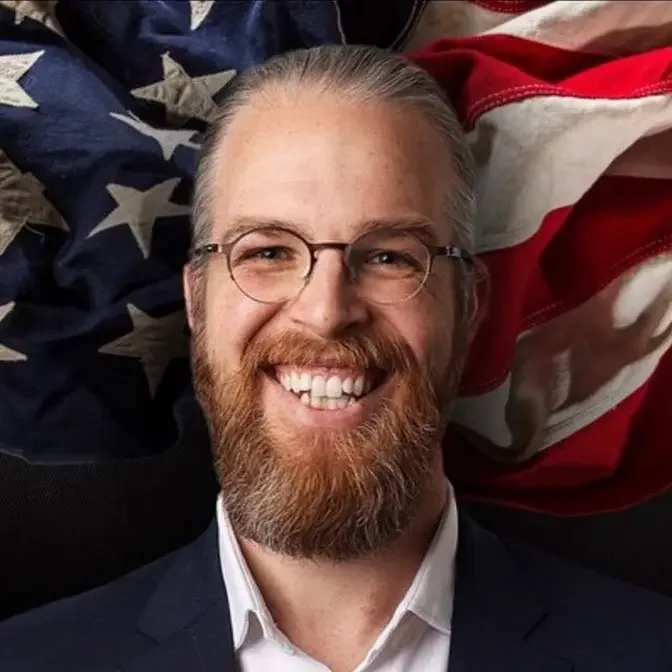
Thirty years ago, Bill Still made The Money Masters and changed how millions of people understand who really controls money. Now in his 80s, he rarely gives interviews. He joined me to share something most people never hear: there is a simple, constitutional fix to America's debt crisis. Abraham Lincoln used it to fund the Civil War without borrowing from a single bank. It was confirmed by the Supreme Court in 1884. It has been buried ever since. We also cover why your savings are not as safe as you think, why the gold standard is a trap, and where the digital dollar is really heading. Bill Still explains how this ends and what can still be done.
Kimchi One from Brightcore – Improve your health, improve your life. 25% Off with code: MANINAMERICA at https://mybrightcore.com/maninamerica Or dial (888) 575-6488 for up to 50% OFF and Free Shipping – ONLY when you call!
To learn more about Red Light Therapy, visit http://myredlight.com and use promo code SETH to save.
Welcome to Man in America, a voice of reason in a world gone mad.
I'm your host, Seth Wholehouse.
If you look around at the world today and you say to yourself, something seems kind
of screwed up, and you go down the journey of rabbit hole after rabbit hole in trying
to understand what on earth happened and how did we get here, a lot of those rabbit holes
will lead you to one thing, which is the central banking system.
And you start to understand that a lot of the current problems and issues and everything
that's going on with our country and our world, these things are tied directly into
the banking system, which is really, if you look at even biblically, what's the one
example that we got of when Christ was angry is when he flipped over the table of the
money changers in the temple.
And so I think there's a lesson there.
It wasn't just about, hey, do not conduct commerce in this sacred area, but I think
to me, it was actually much bigger.
It was about the system of usury that has opened up a loophole for the people that own
the money and control the money supply to enslave those that they lend that money to.
And if you look at how to understand this, there's one documentary that I would say is
the best that I've found that doesn't just talk about the Federal Reserve or some of
the more current issues, but really traces things back to ancient Rome, back to the
origins of this system and how it kind of wound its way through history to build what
is now this massive behemoth of this global central banking empire.
And that documentary is called The Money Masters.
And just so happens that this year is the 30 year anniversary from 96 when this
documentary was first put out.
I have the documentary uploaded to my channel, which I'll make sure is linked in the
description for the show so you can go watch it.
It's a long documentary.
It's three and a half hours long.
But if you want to understand the banking system, what's happening, it's honestly
probably the best single place I could point you.
Now, the man behind this documentary is a guy named Bill Still.
Now, Bill Still, I remember I first came across like, who is this guy?
This is this is brilliant.
What an amazing man to put this out 30 years ago.
And he's not someone who does interviews very often.
He hasn't done an interview in quite some time, but his team actually reached out to
me.
I'm not sure how they found me or what gave them that initiative to do that, but they
did.
And so Bill is actually going to be my guest today.
And so I feel similar to when I've interviewed people like G.
Edward Griffin, the person behind Creature from Jekyll Island or some of these just
amazing people that you get an opportunity to sit down with.
Today, I get that opportunity to sit down with Bill Still.
Now, he's older.
I think he's around 80 years old, right?
So I'm 40 this year and he says he's twice my age in some of our discussion.
And so I will just give you a little bit of kind of warning heading in that his mind
isn't as strong as it used to be.
And so there's a handful of times in this discussion where I ask a question, especially
getting into more of these historical details that fascinate me, where he's not able to
really kind of paint the complete picture of that.
And he openly admits it and says, look, I'm sorry.
He's kind of lost his train of thought.
So just keep in mind that that's part of this discussion, but that's also part of the reality
of what happens in the process of transferring this knowledge and wisdom from the elders
to the next generations.
And so thankfully, he's put so much of his life's work into this documentary, which you
can watch for free in the Money Masters.
But I'm trying to do my duty to help transfer some of this wisdom and knowledge into the
next generations.
And so maybe I can help to carry a small part of the torch that he's carried for most of
his life.
And so I think it's still a phenomenal interview.
And it's something of sitting down with this person that has just this depth of understanding
and this history behind him and the wisdom that comes from seeing 80 years of these systems
playing out.
So I hope that you enjoy this interview.
Again, I'll put the link to his documentary, The Money Masters, in the description to the
show.
And let's just go ahead and dive in.
So this is the interview with the legend Bill Still.
Mr. Bill Still, it is such an honor to have you on the show.
Thank you so much for being here with us today.
You must be very easily honored.
Well, it's not often I get to interview people that were doing the kind of work that I'm
trying to do now.
Arguably, almost before I was born, I was born in 86.
And I think you've been at this for quite some time.
So I look at you as a legend in this arena of trying to get, in a lot of ways, a lot
of very controversial truths out there.
So I certainly am honored.
Yeah, well, a legend in this case means that you're broke.
Because there's one key phrase that is the truth on monetary reform.
And that is, there's no money in monetary reform.
There you go.
It is probably the most difficult subject to not be attacked by talking about.
It's a dangerous one.
There's lots of money in it.
It's all about money.
It is.
And so I first came across you through your documentary called Money Masters, which I'll
pull up briefly.
And actually, it's even uploaded to my own channel because I had to share it with people.
I was so impressed with it.
So this is your documentary.
Actually, this is the 30-year anniversary since your documentary came out.
And it was a very, very profound documentary for me to see because it didn't just trace
things back to the Federal Reserve.
It looked at really the history of money, debt, usury, going back even to ancient Rome.
And it was really helpful in understanding the world that we see around us.
And so I guess I'll let you start wherever you want to in this in trying to help us
understand the modern kind of global banking system that is really ruling a lot of our
world now.
Where did this start?
Where are the origins of this?
How far back did this system go?
Well, either back in ancient Rome or to the time of King Henry I, about 1100 AD.
Let's start there.
Okay.
King Henry was a very interesting guy.
He did not follow the traditional pattern of monarchs of that era or any era subsequently.
And thus, he was really interested in improving the lot of the common man.
And so this all goes back to gold money.
The problem with that is that gold is easily hypothecated.
In other words, since you really can't walk around with a bunch of gold coins in your
pocket to buy things, you have to have it hypothecated into something else, into some
kind of paper.
And inevitably, that hypothecation leads to cheating.
And so no matter how honest the goldsmith was, it was just too tempting.
He could print up little receipts for his gold money and print up more receipts than he had.
And it's just as simple as that.
That's the same pattern that goes on and on and on, over and over and over, just with a different
name.
And now it's called the Federal Reserve System.
And they're just hypothecating money.
And so actually, that's why I've always been opposed to gold as the basis of monetary policy,
because it's the same thing back through all of history.
Whenever gold becomes money, then it's hypothecated, and it's easy to cheat on.
So what King Henry did, not wanting to actually use a paper solution, was he came up with the
concept of the tally stick, which was a stick of hazelwood, and it could go from about this size
to—I held the biggest one in the collection of the British Museum in my Money Masters film.
It was about, I don't know, four feet long.
Red represented 25,000 pounds.
Yes.
Now here, yeah, more typically hazel.
But in other—yeah, those are nice tall—and those are fairly big tally sticks, too,
because they were even tallies—were even used for common transactions, going to the store,
wherever the store was back in those days, you know, you could spend tally sticks for it.
And the king encouraged that, because it had notches in the stick,
and then the stick was split down the lengthwise, so it had come out in two pieces,
but the notches would be identical, and so those would go into the king's treasury,
and if anybody was ever caught counterfeiting or suspected of counterfeiting, they could compare
tally sticks, and if it was an illicit one, then there would be no absolute comparison,
so he would be guilty.
So anyway, tally sticks, 1100 AD, and those were—even though it sounds like a really weird
way to have a money system, and complicated, carving notches into sticks and stuff,
it was the most enduring money system in the history of Great Britain, and maybe the world.
It lasted for 780 years in England, and was only eliminated in the 1850s or something like that,
so non-gold-based money, tally sticks.
Here's the hard truth. Every six years, your dollar loses half its buying power.
That means a $100,000 savings account today could feel like $50,000 by 2031.
And you see it every time you fill up your tank, buy groceries, or pay the bills.
Prices are up. Your dollar's down.
But there's a simple way to protect the value of your savings with something real.
Something proven. Gold.
An asset that holds its value over time.
And that's why I trust noble gold investments.
They make it simple to protect your savings with physical gold or silver.
No high-pressure sales, no call centers, just honest guidance.
One-on-one support and transparent pricing.
And right now, when you open a qualified account,
noble gold will send you a free 10-ounce silver American flag bar as a thank you.
So head over to goldwithseth.com or call 626-654-1906 today to learn more.
Again, that's goldwithseth.com or 626-654-1906.
Don't just protect your wealth, preserve its power.
And so this is an interesting concept.
I think if you look at what is money, right?
Like a lot of things, when you're born into it, you just accept it as it is.
You accept, okay, that's gravity.
Gravity glues you to the ground.
This is what plays this role.
But when you look at these tally sticks and really what is money,
obviously in earlier civilizations, they would have barter systems, right?
If you were a farmer, you could trade X commodity for Y commodity.
But obviously, if you need Y commodity, but you have Z commodity,
and that person doesn't need that commodity,
having some sort of monetary instrument becomes helpful and useful
because it creates an easier system of exchange of value.
And so with these tally sticks, how were they used?
I mean, you can see in the picture, you can see that there are,
obviously there's writing on them.
Then you can see there's these little notches in them.
But what was the function of, how did those serve as a kind of a
in-between exchange of value?
You know, that's a really excellent question.
And I must admit, I do not know the answer to that.
I would have to refer to the Bank of England, and I just don't know.
I don't know exactly.
I know that they made them small enough so they could be carried in the pocket
of the average person and used in trade.
That's the end of it.
I see.
So it was actually, so basically the stick itself,
you could kind of give a stick in exchange for something.
It just became, instead of, say, having a dollar bill with a piece of
a number written on it, these tally sticks were in and of themselves.
Yeah, the number was the notches.
I see.
Okay, that represented value.
Just to go off on a little sidekick, if I could.
Please do.
I love sidekicks.
That's where the treasure is found.
Well, when we were filming it, we really didn't know what to expect.
There were two guys and myself, and we devised this plan so that we would,
we were filming on little SD cards, and so we would film for a few minutes,
and then we'd take that SD card out, and one of us would hide it on his person,
stick a new SD card in, because it was the back of England,
the literal mothership of this whole thing.
So anyway, we tried to make all these fancy-schmancy ways of
being able to use the film that we got.
At the end, the gentleman's name was John, and I think it was Wadsworth was his name.
He was the curator of the Bank of England.
He was the one that spoke to us, and brought tally sticks out to us,
and explained the whole deal.
And in the end, I asked him, John, why did you even let us in here?
I've talked to you twice on the phone.
You knew exactly where I was coming from.
It's in direct opposition to the gold money system that we thought you represented.
And he went, well, no one's ever asked before.
So in other words, just because we were bold enough to give the guy a call,
and set up an appointment, and come see him, that was all it took.
He was charming, and he was very open, and willing to tell us everything
about whatever we needed to know.
So just a word to the wise, you know, try things.
Try things, even though they might be scary.
Very, very good point.
And so, going back even to looking at Rome, and understanding usury.
So you can see how the tally sticks, which are a good example,
almost like it's an independent system.
The sticks are created, they have their value, and they just become this kind of,
I guess, this currency, this monetary instrument of trading value.
Yeah, to jump in, now my aging brain has retrieved some bit of knowledge on Rome.
And, you know, Rome started out with, what was before it, silver coins.
But anyway, then they went to silver coinage, then they went to,
gradually went to gold coinage.
And as soon as they went to gold coinage, they were, essentially, they were done.
Because what happened then was a gradual debasement over a period of 300 or 400 years,
where it ended up, these gold coins ended up being 5% gold.
You know, and that's typical.
That's the problem with this whole system.
Other people are making money off of the ability of a nation to have its own money.
That makes sense.
And that gets into just the whole idea of usury, right?
Which is, from my kind of very elementary understanding, it's basically saying,
I've created this money, and you can use this money.
But if I give you a dollar to fund your monetary system, you owe me a dollar and one cent back.
But I only gave you a dollar, so you'll never be able to actually pay back the interest
on that dollar.
And so, when did usury start kind of coming into the system?
And I know that even at one point, the Catholic Church was in strong opposition to usury.
But at some time along history, they changed their tune.
And now it's as normal as seeing the sun in the sky.
Yeah, rather than change their tune, it's just they put up the,
we're ignoring that problem wall.
And to answer that question, I'm sorry, but I really can't give you a coherent answer on that.
That's okay.
Whatever you want to respond to with, or wherever you want to take it, is absolutely fine.
Let's just move up to the United States.
Lots of people like to start with Lincoln.
And that's because Abraham Lincoln was the best example of a righteous use of the money system.
He wanted to fund the American Civil War.
And so he went to New York to borrow, you know,
large sums of money from the New York bankers.
That's where you went.
And they wanted to charge him 36% interest to fund the war.
And he came back and he had one of his advisors said,
you know, there's this other way of doing it.
Okay.
So Lincoln needed to fund the war and wasn't going to be, you know,
wasn't going to sell his soul to the New York bankers in essence.
And so what did he create?
What did he do to fund it?
Well, he actually knew, this started out during the American Revolutionary War,
when continental currency came in.
And continental currency has always had a really bad rap amongst the gold mining people,
primarily because, oh, you know, they just overblew the amount of currency and blah, blah, blah.
Well, they didn't, the founding fathers didn't do that.
They actually created the right amount.
What happened and what you never see in history books
is that the inflation of that currency was Great Britain's use of monetary policy
by bringing over loads of counterfeit American currency.
And they spread that throughout the colonies.
And in fact, Old Road One, which runs up and down the Eastern seaboard,
was improved primarily by the counterfeiters to help their distribution of their counterfeit money.
And so when George Washington at the end said, you know, you can't buy a load of
provisions without a load, an equal load of this paper money,
that was the situation towards the end.
But it wasn't because of an inherent flaw in the system that the American founding fathers
implemented, because they didn't have any choice.
They didn't have gold money.
They didn't have silver money.
They were new to this continent.
And so they had to make up.
They were forced into the correct solution, which was just creating their own paper money
without charging interest to the people who used the money.
And so that was a good thing.
And in any case, Abraham Hamlin was advised of this by someone in his group.
And he once again, he didn't really have an alternative.
So that's what he went with.
And so he devised the greenback dollar.
And it's circulated very well and without inflation.
And there wasn't anybody in the South who was smart enough to do the same thing Great
Britain did, namely counterfeit it.
And so it worked, served the nation very well and did for a number of years.
And in fact, it served the nation until 1972, actually, when, you know, it was gradually
and it wasn't really phased out.
It's still good for trade right now.
Tax Network USA.
So this is actually really important.
So look, if you owe back taxes, if you have unfiled tax returns, or if you just filed
every year, but you still keep owing, or if you retire and you get hit with a big tax
bill, you can expect if you're a business, you've got messy books that you get to kind
of sort through.
Tax Network can really help with that.
Even if you're pulling your money out of your 401k or IRA and now you owe IRS for that.
Doesn't matter how your tax issue started.
The outcome's the same.
Your balance is not going down.
Penalties grow, interest compounds, and many of you are about to owe again for this tax
year.
So if you don't have a plan, stop what you're doing and call Tax Network USA.
The IRS is not waiting.
They're enforcing collections through wage garnishments, bank levies, and property seizures.
They can even file for you without your consent.
So that's where Tax Network USA comes in with their 15 years in business.
There hasn't been a tax case that they haven't seen or resolved.
They specialize in tax controversies.
They help taxpayers nationwide get back on track by resolving back taxes and unfilled
returns once and for all.
So whether you owe tens of thousands of dollars or $10 million, their team has resolved over
a billion dollars in tax debt.
They can do the same for you, but you have to call them now.
So they're offering a free investigation call with the IRS.
So after that investigation, they put a clear case plan in place to resolve your problem
and get you back on track.
It's about using your legal rights to take control before the government sets the terms
for you.
So don't wait for another IRS letter or a frozen bank account.
Call 866-686-1359.
Again, that's 866-686-1359 or visit TNUSA.com slash MIA.
The phone number and the link are also in the description.
This is a United States note.
Its main reason you can tell it is a United States note instead of a Federal Reserve note
is because U.S. notes have the red seal.
Federal Reserve notes have the green seal.
The money in your pocket is the green seal Federal Reserve note.
That's a note produced as an interest bearing debt.
And that's exactly why at this time we are trillions of dollars in debt.
And the solution is so incredibly simple.
And that is that we just merely need to bring the red sealed money back and start pumping
it into the system at the same time that the green seal money is removed from the system
and burned.
The Federal Reserve notes, every one of them should be destroyed and replaced on a one
for one basis only with the red seal United States note.
So to look at this, I always like using analogies and metaphors to understand these things.
We homeschool our children.
Every Friday is our homeschool day.
So we've got kids running everywhere.
It's usually my girls are two and five.
So homeschool is me dressing up like a monster and chasing them around or we're building forts
in the woods or these kinds of things.
I homeschooled four children myself.
There you go.
So let's just imagine that I had 10 kids and say that those 10 kids represented a country
and they wanted to have their own little currency for trading among themselves.
So the greenback would be the equivalent of me, say, I print out a paper with 100 little
squares on it.
Each one has a little number one on it.
And so these are your money tokens.
And I make them and I give them each these little tokens and they can use those among
themselves to trade in value.
So that's kind of the greenback, whereas the current system is that I have this little
country of these 10 children, the homeschool country, and a banker comes in and says,
Seth, I'm going to lend you some currency to use in your country, but you're going to
owe me for it.
And so I'm like, okay, well, they understand currency.
So they give me their own notes, but their notes are their seals and their notes are
owned by them.
And there's interest paid on those notes.
Whereas my little papers I make, you can imagine that they could circulate and they have their
own little healthy economy that could be used.
Whereas the other one, as soon as I, as the owner of the country, accept the banker's
printed currency that they control, I'm in essence, I become a debt slave to that banker
and I don't even own my own country anymore.
And then all of my homeschool constituents are now enslaved to the banker through me
as well.
Is that a simple analogy?
Right, if for no other reason than they're kids and they don't understand that people
can cheat and stuff like that.
So they just accept, you know, whatever you give them and go with that.
And that's exactly the state the American population is right now.
They think that someone coming on like me who's saying, you know, your current money
is really the counterfeit money.
And they're raking off a huge, a trillion dollars a year off of you in their interest.
And it's not necessary.
And we could wipe it out in a single year.
President Trump could wipe out the national debt in a single year merely by issuing United
States notes instead of Federal Reserve notes, wiping the Fed out.
Now, from a political standpoint, I don't recommend that you actually say we're gonna
wipe the Fed out.
No, we're gonna say, well, we're just going to take away some of the Fed's power.
And the Federal Reserve does a great job of clearing checks.
So we're gonna make that their only power.
They don't have any power to determine the quantity of money in the system.
That's all you have to do.
And then just issue Lincoln's greenbacks back into the system, destroy every Federal Reserve
note on a one for one basis.
The quantity of money in the system remains the same.
And that's what the Constitution calls for.
The U.S. Constitution demands this.
And we're ignoring it.
People are deliberately trying to misinterpret when this was, let's see, this was a Supreme
Court decision back in 1884 that said, yes, the United States, no interest-free United
States notes are what we should be using.
But it's not been followed.
It seems like the problem is that whether it's certain U.S. presidents or certain leaders
around the world, when they start taking those actions, they end up with a bullet in their
head, right?
I mean, it seems like that's the sacred cow you can't touch because it would then, again,
it would then separate us from the control that the central banking system has on us.
And so looking into that mechanism, where would you say, when you think about central
banking and the centralized banking system, would it be accurate to say that the seat
of that throne is the city of London?
Is that where the kind of head of the octopus is?
It may be.
I don't know exactly.
And I have searched this out a little bit.
When we were filming the Money Masters, we were trying to get a shot of the Bank of England.
And it's very difficult because it's in a very crowded area, and you just can't find
a good place.
But we found one place, but I had to climb up the escape ladders on the side of a building
to get a good shot of it.
So up I went, and it was just me.
I knew how to run the cameras, of course, and everything.
So it was just me, and I carried a camera.
I set it up, and got stood in front of the camera and started reading my script.
And a couple of barbies come up below, and they go, excuse me, sir, do you know where
you're standing?
No, I don't.
That's the Lord Mayor of London's office.
He would like you to come down.
Interesting story, that's all.
Of course.
And so when we get into the banking system, very commonly, everyone's pointing the fingers
towards the Rothschild family, and you cover this pretty extensively in your documentary
and through my own research, you can see that, yeah, they've done a good job at really kind
of seizing control of that system.
But I guess walk us into, and whatever kind of comes to mind, whatever you can pull out
your mental filing cabinet that's accessible for you, how do you trace back this current
banking system, this Rothschild or the London-based Bank of England, where does that trace into,
and how did that power become so centralized out of there, such a strong control on the
global monetary system?
Well, it happened during a, you know, my memory just is, you're asking me a series of questions
that I've written on and I do not really remember.
It happened to do with a particular crash in the English stock market where Lord Rothschild
was able to buy up a huge percentage of it for pennies on the dollar.
And so the Rothschilds essentially took control.
But thereafter, it's much more difficult to trace the historical tentacles over to the
United States and their system.
We can assume that it was Rothschilds, but I can't prove it.
So I'm sorry to not be fully…
Oh, that's okay.
I mean, and I know even these things are difficult to kind of ascertain, but you look at people
talking about, they say, oh, Elon Musk is the wealthiest person and he's worth this
much.
And I think it's like, okay, well, if your family's controlled large swaths of the global
banking industry over time, do you have, and this is probably not easy as well, but if
you had to take a guess, what would you say that the accumulated wealth is of the Rothschild
banking empire?
No idea.
I would never even make the attempt because right now the US is $39 trillion in debt.
31 trillion of that is held by the public.
We're responsible for it.
And I lost my train of thought again.
I'm sorry.
Oh, that's okay.
That's okay.
In any case, those are the only numbers that I really have.
But the whole point is that that really doesn't matter.
What matters is curing this problem because it's about to kill this country.
The debt is not going to be erased.
It's not going to be reduced.
It's going to continue unabated until some cataclysmic explosion happens financially
and who knows what's going to happen from there, unless you just provide the simple
cure that the Constitution calls for.
That's all we have to do.
Let me elucidate as long as my memory is permitting me.
You've got to eliminate the ability of banks to create money out of nothing.
Right now, this is called fractional reserve lending.
And most sources that you'll read say that, well, the banks are supposed to only lend
out nine or ten times the amount of money they actually have.
Well, why should they lend out any money that they don't actually have, number one?
But they don't even follow that.
We found out during the congressional investigations after the 1998 crash that the biggest banks,
JPMorgan, etc., were leveraged 300 to 1, not just nine or ten to one, 300 to one.
They were just printing up money, throwing it into the system by buying things, buying
things that we could be buying for a lower price.
So that was really the only deep inside look we've had at how much money they're making.
And so, I mean, you mentioned some sort of just kind of cataclysmic crash of the system,
and it's almost, I look at it as you have a balloon that you just keep blowing up,
and you keep blowing up, and you keep inflating, inflating, inflating.
And what we've seen is that it doesn't matter whether it's Republican or Democrat,
the debt goes up all the same.
There's no change in that.
It's not like you have someone that gets in, and there is completely, it's reversing course.
It's continued.
And naturally, it seems like the law of these types of situations that it continues and
until it gets to a point where it can't go any further, but it doesn't just slowly just
retract down, it just blows up.
And one of my concerns is that they want that to happen, that they know it will happen,
and that maybe that they're waiting until that happens, because then they're going to
come out and say, okay, well, obviously this fiat system has run its course, so now we're
going to move over to some sort of AI-driven digital currency, some sort of centralized
currency.
We're going to tokenize everything.
Eventually, all assets will be tokenized.
And to me, that's the, as much control as they have right now through this debt-based
financial system, the level of control they'll have with a digital version of this is a million
times worse.
Well, I suspect that Trump knows what the solution is, because he's mentioned at different
times in his career that he could end the national debt problem in eight years.
And when I first started talking about this several years ago, it seemed to me that he
could easily end it within four years, one term of his.
But actually, if you do the calculations, it could be done in three years.
But he could also merely offer the bondholders a substantial increase if they would turn
their debt money in early, so that this could actually be done.
Theoretically, I'm just guessing it's true, in a year or so, and then we would be out
of the system.
Milton Friedman was the one who really added this fractional reserve lending piece to how
I interpreted our problem.
And that is, he took a look, he asked me for a copy, a pre-publication copy of the Money
Masters.
And as you know, it's lengthy.
Milton Friedman.
Yes, Milton Friedman.
He was a professor at a university in San Francisco.
Oh, maybe Stanford.
Maybe it was Stanford.
And so I said, OK.
So we sent it out to him overnight so that he could have it on a weekend.
And then he called me on the telephone on Tuesday and said, well,
this is very notable.
This is a very good start.
But if you try to correct the system without ending fractional reserve lending, boy, you've
done nothing.
And of course, boy, so what was I then?
I was maybe in my mid-30s or something like that.
But I didn't mind being called a boy by Milton Friedman.
So but I mean, he was the one that corrected me because at the time I went, oh, really,
is that that big a problem?
Yeah, it's a big problem.
That's how they steal.
That's how they adjust the amount of money they steal.
So fractional reserve lending has got to end.
And what does that mean from a practical standpoint?
Banks can only lend money they actually have.
What a novel concept.
That's what we all think goes on.
That's what we all think, that if you violated, you would go to jail.
But no, they can just steal that much money.
And it's not really stealing, but they make an interest off of that.
So, yeah, they're making a lot more money off of the practice of lending out money to
our economy in general, to the nation, where they shouldn't.
They shouldn't be.
That's not their purpose.
Their purpose is to lend their money, take a chance on their money to the general public
and not to the nation, where they can then control the politics of the nation.
Well, they also I think one of the other biggest scams is the whole FDIC insured.
You go to your bank and FDIC insured up to a quarter million dollars and whatnot.
But if you look at the numbers and you look at the coffers of the FDIC and you look at
the total deposits, it's a fraction of that.
And so for anyone that grew up watching It's a Wonderful Life and you see the old black
and white footage of everyone going in and saying, here's my bank slip, where's my money,
where's my money?
And they say, ah, sorry.
It's like, so maybe the first people in line, they get their money out.
But that's what most people, the same way a lot of people just trust whatever doctor
is wearing a white coat, they trust whatever official voice there is.
They just think that the banking industry is just out to offer banking services to people
and the government's making sure it's safe.
But the whole thing is a Ponzi scheme.
And unfortunately, I think a lot of people are slated to lose their entire life savings
if the whole system goes under.
Yep, and so fractional reserve lending is the basic problem.
And Trump could fix it.
I think Trump has been aware of the problem, but he also probably understands, and I'm
just guessing here, that if you think he's got a problem right now by wanting to kill
off Iran's ability to take over the world, which is a serious possibility at this point,
that ain't nothing compared to if he tries to kill the Fed.
Oh, it is.
And so I guess that looking in terms of solutions, I'd probably say if we were halfway through
Trump's first term, I'd think, hey, you know what?
Maybe he's going to do this.
As of right now, not whether it's Trump or someone else, I almost have just my own personal
rule that I don't put any faith in what the federal government's going to do to make my
life better.
I kind of zero, right?
It's great because it's like, okay, if they help something, it's a bonus.
But if they don't, I'm not let down by it.
And so for people that are aware of just the sober reality of this system and how corrupted
and how much has been used to control, aside from waiting for a change happening at the
federal level, what can we do?
What can people do when they are trying to just affect changes that they actually have
control over in their lives?
That's a very good question.
And I've been trying to popularize the correct solution, which is the simple solution.
And there are plenty of people that have made plenty of money by offering another solution
that's much more complex.
We're going to create this new institution that's somewhere between Treasury and the
All that does is just leave wide open the ability for them to maintain their control.
And it's in the Constitution.
The nation is supposed to issue its own money.
And we're not doing that right now.
We've given this over to the Federal Reserve System and the banks.
And it's killing the economy.
And I don't know what you're going to do to convince a sufficient number of people to
take this seriously and mount an effective resistance to it.
All I can do at this point is just try to renumerate the problem to the best of my limited
abilities, and hopefully somebody else will pass it on.
I can pass it on to somebody else.
But there's been this alternative.
I don't want to talk bad about them.
There are other people with other solutions that won't work.
Let's put it that way.
And I don't want to name any names.
But the only solution that will work is just to eliminate the ability of banks to lend
money they don't have, which is a pretty common sense thing.
And you can say it in one sentence.
And once people start to believe it, maybe that will have an impact.
What about just trying to keep our assets out of the banking system?
And that's why I think a lot of people turn towards, now it seems more silver than gold.
I always have just a few pieces of an old silver dollar in 1923, or an old half dollar,
or even just the classic little 10-ounce bullion.
To me, aside from owning land or boxes of ammo or whatever, which I think are very valuable,
especially as a barter tool, I don't trust crypto.
This is just kind of me.
I think that crypto, I think the NSA or these agencies probably have backdoor access that
we don't know about.
And so I don't trust those digital things.
But I agree.
Aside from, this is kind of my solution, is if I have any extra money, I'm not keeping it sitting
in a savings account, earning 4% interest on it.
I try my best just to kind of, the same way I have chickens.
I try to rely on the grocery store for my food.
I'm trying not to rely on the banking system for managing my money.
And so for just the day-to-day, what are your thoughts on how to handle that?
I think you're doing the best a human being can do.
Sorry to be so short with my answer, but you're doing great.
And I don't have a better solution.
All I can do is talk about the historicity of how we got here in an attempt to prove
to people that the existing system is terrible and easily fixed, easily fixed.
Of course, there's a couple of steps in that easily part that could also put your life at
severe risk.
Yeah, well, I guess that's also what I do too.
That's part of why I have this show and why I think you created your documentary,
is I think that part of it is that if the average American even knew the simple fact that
the Federal Reserve was about as federal as Federal Express,
if people could even just understand these things,
because I do think that if enough people know this information,
then that can create a catalyst for change,
which is why you've been very heavily censored.
I've been heavily censored as well,
is because this is, again, this is touching the sacred cow.
And that's why I think education is one of the most important things that we can do proactively
and hope that it can get enough people to understand this information.
Absolutely.
I mean, there's nothing really worthwhile other than this,
nothing more worthwhile in my life than the pursuit of this.
That's why I keep going, even though, remember, there's no money in monetary reform.
Exactly.
You can't do it to make money.
And so if Trump finishes up his second term,
and you see that there's really been no substantial change at all to this monetary system,
which I think is highly likely that there won't be any big change,
and I hope so, but let's just say there's not,
what gives you hope?
What allows you to look to the future and see something that's worth fighting for?
Well, he has put in positions of power young, primarily men who
know what they're doing and who, from all appearances right now,
any one of three of them would do a pretty good job of carrying the torch.
And you can't blame Trump.
He's done a tremendous amount, more than many presidents put together before him.
But will it be enough?
Can he possibly find room in his solution cart to add monetary reform in there?
Even some small percentage of it?
I don't know, but that's what I would like to push for.
That's what I hope for, that we can convince him.
Because the oncoming people might do well, they might not.
But we already know what Trump is.
And if Trump got behind it, he would be behind it.
And any major powerful figure who got behind it, the simplicity of it is mind-boggling.
And if he got behind it, you could sway a lot of people that, yeah,
this is the best thing to do.
The bankers are not going to take it lying down.
They're going to try to crash the economy.
And this is the thing, the very thing Trump does not need, to be people going into their
pockets and saying, hey, we were all right before Trump.
So I don't know.
But I don't have any alternative but to keep trying to do what I'm doing right now,
as you have seen evidence of, in a way that is diminishing quickly.
And so I'm hoping somebody else comes along.
The whole—there's this other group of people who have their own program that involves
adding new layers of the bureaucracy, and that's going to fix it.
And it's not.
You just have to go back to the simple core.
This worked for the founding fathers.
It worked for them great.
They created money literally out of nothing in a country that had nothing.
How did they do that?
And the example of Abraham Lincoln, where he took on the South and was able to do it
without borrowing money.
How did he do that?
Do you see any indication of this happening at a state level?
Because looking at this and thinking about looking at the federal level, I mean, I had
hoped that Trump would come in and we'd see reforms with big pharma, right, or big tech.
And you see that the same people that were censoring us or poisoning us are now sitting
at the dinner table, right?
And so I just don't have a lot of hope there.
But, say, at a state level, I mean, would that be a possibility where, say, someone
at the state level, could a state issue its own state currency?
Obviously—
Well, Ben, you're applying directly in the face of the Constitution.
The Constitution didn't want that at all.
They wanted the money power to be as close to the electoral body, as close to the people
as possible.
That's why the money power invested in Congress is invested in the lower house of Congress.
Those are the people, the elected representatives that are the closest to the people.
That's the way the Constitution was designed.
They want it to express our will as citizens of the United States to the best possibility.
And so it specifically inhibits the states from having much to do with the money power.
I see.
That makes sense.
Okay.
And I could do some research, but I know there's more explanation behind that as far as what
possibly could happen with every state printing its own state money again.
But it's not constitutional for a reason.
Yeah, you could say in a lot of ways it's the double-edged sword of the Constitution,
right, in limiting certain things to the federal level.
But then when that federal level is hijacked and not acting in the interest of the people,
it also handcuffs things at the state level.
I think if our founding fathers, if they had a crystal ball and they could look into what
was happening in America right now, maybe they would have just said, let's just go fishing
instead.
I think they'd break out the rifles.
And there you go, yeah, or go hunting.
So I don't know, that's pretty much it.
It just boils down to those simple things.
We've got to end the ability of banks to steal money by providing loans for money they
don't actually have.
And that's the core of it.
Yeah, it's simple, simple.
Well, Bill, as we're wrapping up, I want to just pull up one more time your documentary,
The Money Masters.
I've got this on my own channel, so I'll put a link in the description for people to watch
this.
Honestly, I'd say that this is one of the most effective things that we can do to be proactive,
is just share this documentary with as many people as possible.
Because educating the masses, in my view, is the one thing that we have more control
over that we can do, is to help get more people educated.
And if we get to a place where the average person in America understands even a fraction
of what this documentary goes into, that would give me a lot more hope.
Also, I will pull up your website, which is thestillreport.com.
So I encourage people to also check that out.
You can even, for those of you that are watching and listening, you can support there through
the Patreon.
And so, yeah, I guess, Bill, do you have any closing thoughts as we wrap up this discussion?
No, I'm sorry.
I'm getting to the point where I'm not nearly as articulate.
I mean, there are dozens of examples of speeches that I've given over the years where I really
had my facts together, and I just don't anymore.
And, you know, we need somebody else to step up and devote a substantial portion of their
life to learning this stuff, repeating it, and being able to hammer the essential facts,
which are really pretty simple, home time and time again.
That's what we need.
And so, thank you for helping.
Of course, I'm trying to carry the torch in whatever way that I can.
And a lot of people are.
So, well, Bill, thank you for, obviously, thank you for giving us the time today.
But thank you for devoting your life to this cause and putting this information out there
and fighting, I think, in one of the most important arenas that can be fought.
You've helped shape my worldview on this.
I've learned a lot from you.
And I think that the work that you've done will continue to echo into future generations as
people start discovering this information.
The key thing is just follow the Constitution.
It's very simple.
And they put it in there for an important reason.
And they knew the consequences of not doing it firsthand.
They were the first victims of this on this side of the Atlantic, at least.
Yes, exactly.
Exactly.
Well, Bill, thank you again for your time.
It was such an honor to speak with you.
Thank you for the opportunity.
Absolutely.