
Painting a Portrait in Oil | ‘Aureoline’ ☀️ (painting tips)
2 Video Views·Mar 24, 2026
AI GeneratedMay contain errors
Hello everybody! Today I'm bringing you along for a laid-back portrait painting session. I'll be
sharing some of my favorite tips and things I personally pay attention to when painting.
We'll also talk about colors. Color is such an important element in any painting unless it's
monochrome, though arguably you'll still use a few colors for that. So hopefully you'll find
these insights helpful or inspiring or maybe you'll just enjoy the chill painting atmosphere.
By the way, if you're new here, my name is Daria. I'm a painter specializing in oil with a focus on
figurative and realistic styles. I've been teaching oil painting for over seven years
and I love painting portraiture. So let's get right into it.
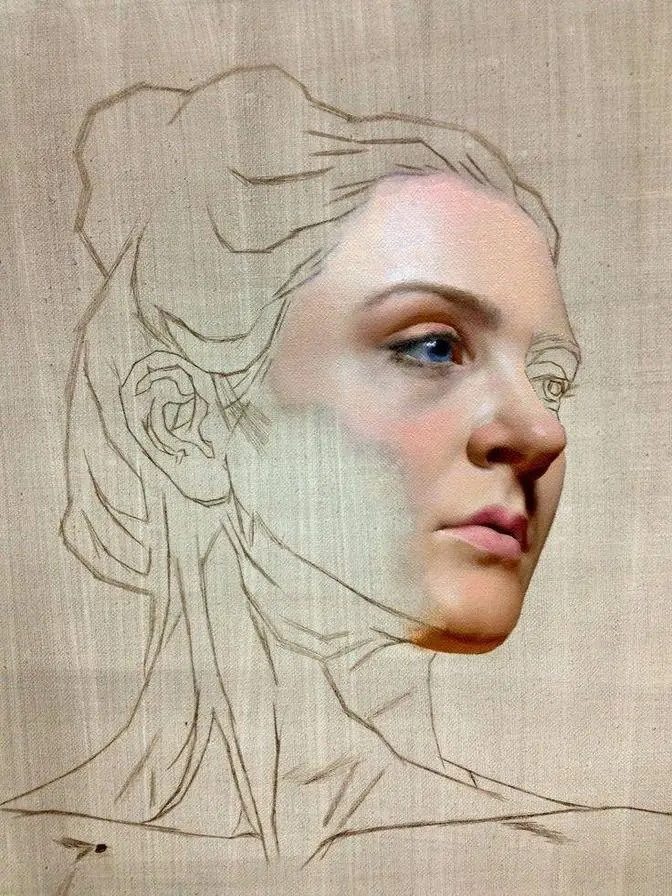
So in the beginning I did a little toning, a sheer wash, just to start off. There is a faint
pencil sketch that I did prior. Now I'm establishing where the darks go.
It's hardly an underpainting, but it helps to see the main forms. I like to place some
darker tones first. The lighting is going to be interesting on this one. Like a low morning
sunlight coming from the right, so most of the left side of the subject's face is going to be
in shadow. I like dramatic or interesting lighting, so this one is very exciting.
I was really careful though building up the darks. I wanted to make sure everything is
proportionally correct and in place. That's when I realized that a slightly darker wash
would have been more helpful here. But I also kept it light on purpose to have a light yellow tint
of the canvas, well paper in this case, peeking through as a part of the background later on.
There's always some experimentation and observation involved. It's part of the
painting process to make decisions and see what works and what doesn't.
The thing I've been thinking a lot lately is I've been painting and drawing for many years
and let me tell you practicing regularly really makes a difference if you want to improve. I
actually don't believe in natural talent or that you have to be gifted to learn how to paint. I
think pretty much anyone can improve their painting skills. But here's the thing, not everyone will
love it enough to persevere and put in the time and effort it takes to get really good at it.
On that note though, there is so much content out there now which is amazing. Resources and videos
that can give you guidance and tips. It's better than ever in my opinion to learn a skill,
especially in creative disciplines like painting, sculpting, music production, baking and it's
really a good time also. Speaking of that, if you struggle with a particular issue when painting,
which for many people is proportions, symmetry, the things along those lines, I advise you to
draw or sketch more because it's difficult to improve in that area otherwise. But if it's
anything less technical, less unambiguous and more on the creative side, like how you want to blend
colors and apply paint, if you want to figure out how to soften features or introduce a variety of
hues when painting faces, since our skin is more red in some places and more blue or green or yellow
in others, so I suggest learning directly from the artist you like, from old masters whose technique
or artistic style speaks to you. Don't spread yourself too soon going into too many genre styles,
subject matters, at least go about it one at a time if you do intend to. Study the artists whose
work you admire and use their paintings as a reference point, as an example. It helps to keep
the works you look up to in one place, one folder, so you can review them and remind yourself of what
you're aiming for, that's what I do, and how to correct the areas you've been struggling with.
Now, you don't need to copy anyone's style, I feel like that goes without saying, but I just
want to clarify, it's about learning the craft itself, learning by example and getting inspired.
Let me share a pro tip about oil painting that helped me a lot, which I learned a few years ago
and it has stuck with me, and it's really simple. Spend a lot of time and focus on the palette. Most
of your time during the painting process should be spent on the palette, mixing and choosing the
right tones and then placing them on the canvas, in a way similar to the idea of measure twice,
cut once, emphasizing preparation before you commit to doing something. It seems like we're
always focused on the painting, but so much work is done on the palette and sort of behind the
scenes. A simple example, we are painting a cheek, it's best not to try all kinds of colors and values
mixing them directly on the canvas until you're satisfied with the tone. Sure, some mixing and
blending is done on the canvas, but the more accurate with the tone you are from the start,
the better. Then you lay another color next to it, thinking about the shape, the lighting, values in
general, not over blending and avoiding the approach I mentioned in the first example, because
that's a quick way to create muddy colors. Also, it's almost always a good idea to return to the
palette to pick up more of or refresh the color, because your brush picks up paint from the
painting. Let's say you're working on a shadow, you place it nicely over or touching a slightly lighter
tone, and then if you continue with the same brush, the tone will be lighter, it's not going to be as
deep. So in this case, it's best to wipe the brush with a paper towel and pick up more of that proper
dark shade to go in again. Take your time, compare the painting with the reference or the model in
front of you. The more you progress and have on the canvas, the more you can judge the colors
relative to one another. With this painting you can see how important the shadows are and the
depth, because the lighting is more dramatic and direct in a way. And obviously here it's very
important to make them dark enough, the right value that is. But I want to remind you that
overall, even in less dramatic lighting scenarios, one of the most common mistakes people make when
they paint portraits is not making the dark values dark enough. So oftentimes when you feel like your
painting looks a little flat or lacks depth, that's because all of those darker areas, those darker
values aren't quite deep enough. So that's one of the most common and widespread issues out there.
This is a challenging shadow, I have to say. In the beginning it may seem too dark, but then when it all
comes together, you see it's actually the right value. Overall, the setting reminds me of early
morning light, that stillness. And on that note, while painting this, I once again reaffirmed that when
painting highlights, you should use more and thicker paint. Otherwise, it doesn't reach the
same level of brightness. It's also really easy to pollute it, so make sure to use clean brushes, since
just a bit of pigment left in the bristles after you wipe the brush with a paper towel can still
go a long way to tone down the highlight color. Also, I usually like to add more color to the
brightest light values. I think it always looks beautiful when highlights are a little bit tinted,
let's say a bit more magenta or maybe a yellow golden tone, but that can also bring it down a
notch, which usually is actually fine. Though here I mostly just used titanium white. Yes, I added a
touch of cadmium yellow and orange to it, but not much, to paint the light on the cheekbone, forehead,
reflections in the eyes, little dot on the tip of the nose, and so on. And using thicker, stiffer
paint that has more body to it creates a bit of texture that can reflect light, and to our eye it
looks brighter. We'll perceive it as a stronger highlight, so that's cool. I've heard this idea
that every action creates a counteraction, and I feel like this is so true in my experience.
For instance, when I'm thinking, oh, this part would be so hard to paint, and you know, for some people
it's challenging to paint hands or ears, things of that nature, or maybe it's creating a variety
of hues in your work and branching out into using more color. For some people that's kind of a
struggle. When I approach it with that mindset and I'm kind of pushing it into place, forcing it, it
really does feel more difficult, as if there is some pushback. But other times when I'm more relaxed and
I don't see it as something challenging, if you approach the same tasks with ease or even kind of
playfulness, I feel like they have a higher chance of just flowing naturally and you're letting them
fall into place. This concept can be applied to so many other things. Another example that's very
relevant for me today. I create most of my own schedule. I plan what time I'll start painting,
editing, exercising or doing other tasks. But on days when I don't get enough sleep, when I try to
push through the fatigue and force myself to complete even the simplest things, everything
seems much harder. It's like there is this invisible resistance or pushback that appears whenever I'm
trying too hard to power through in terms of my attitude to whatever the thing is. However,
when I'm saying to myself like, okay, there's no problem here, I can take a nap in the afternoon,
I can get a coffee, you know, I can take a walk later, like it's all good. I remind myself that
it's a choice and I feel okay with it because I'm not forcing anything. I'm choosing to do things.
It would be nice to do what I plan to do and it happens much more effortlessly. I feel like this
applies to so many things in life. Once I heard this idea, I wish I remembered the source because
I'm blanking on that right now. But I feel like it made so much sense with a lot of things in my
life, including painting, including work and everyday life. So yeah, it's very interesting
in my opinion. By the way, I love painting hands. Even though, yes, I do think many people find it
challenging and it can be, but I also find it kind of fascinating from an anatomical perspective.
There is something satisfying about capturing the different angles and bits of subtle reflected
light here and there. Here I took a break. I rarely can finish a painting in one day.
Then I continued from where I left off. Just a general tip about brushes and their maintenance.
Finishing off a painting session. If I know I'm going to take a long break or leave the
painting overnight, I usually wash my brushes. But sometimes I wipe them and dip them in a
little bit of oil, then leave them flat on my palette. They don't need to be fully soaked in oil,
just a normal amount. I do this to save time and prevent them from drying with paint in the
bristles. Brushes can be expensive, so it's good to take care of them and this is a great method.
I do clean larger brushes every time though. I find it's just easier to wash those. And I do
wash older brushes when I take more time off or if I'm not sure I'll be able to come back and
when I was planning to. I've been really enjoying the color scheme of this painting. I actually
think that this combination of yellow and purple is just my favorite one currently. And these are
complementary colors. I do plan to make a video that's more about color theory and complementary
colors, how to use them and a lot of other things related to it. But right now I just wanted to say
that I love these colors and how the purple tones can really elevate and highlight the yellows.
I actually started with the idea of painting a yellow iris flower to the left but then I
changed it because it didn't fit as well as I hoped. The color itself worked perfectly but
it was such a bright accent that it was stealing all the attention and I wanted it to feel more
subtle and more like a supporting element. So I had a choice, either add more yellow
flowers and change more things or pivot and repaint that part a little. Ultimately I decided
to adjust it and I think it's more fitting now. It supports that warm soft morning feel I was
aiming for in this painting. I hope you like it and if you're looking for more in-depth tutorials
and demos please check out my Patreon page. And I'm gonna close with enjoy painting. Don't make
it all about improvement. Sometimes it's just nice to let yourself create, be in the zone,
in the moment and to appreciate it for what it is. In all likelihood it will also help you get
greater results, though may not be apparent at first. Have a great day everyone and I'll see you later!