
How to get rid of the AIR in your sound
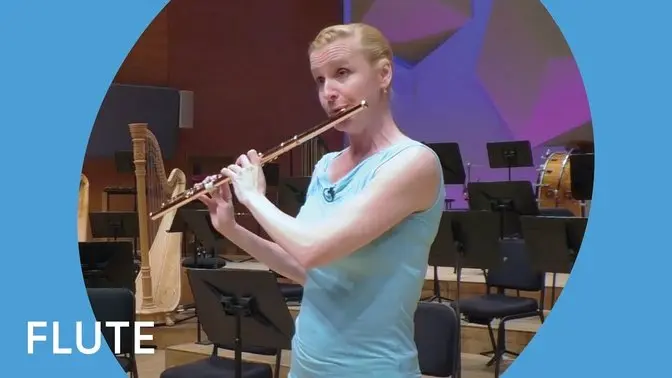
#Education #music # instruments # Flute # Orchestra # instrument demonstration
Comments are disabled for this video.
Hi, it's Amélie.
Today we're going to talk about
how to get rid of the air in our sound.
That's a question that comes a lot
because I think we all want a pure tone.
And the first thing you have to make sure
is that you have the right diagnosis
because sometimes we think we have air in our sound,
but sometimes it's good air.
It's the type that makes the sound go fill up rooms.
I see a lot of flutists that cover the embouchure hole a lot
and they get a little sound,
but it does sound pure,
but it doesn't project at all.
So I'll give you an example of that
just to make sure you don't go there
when you get rid of your air.
So that little...
There's no air, but there's nothing.
The sound is very thin.
So you don't want that.
So make sure you're not going in that direction
to get a tiny sound that doesn't project.
Now we're going to just have a checklist
of what we want to do during those exercises
that I'm going to give you.
So first, we're going to choose our favorite note,
the one that you think your sound is best on.
And then we're going to go to all the notes.
So we're going to go all the way down
and try to keep the same sound quality
and then take that same note again
and go all the way up.
But when you do that,
I want you to think about focusing the airstream
on the embouchure plate like a V,
not an open V, like a closed V.
Think about not covering the embouchure too much,
just one third to one quarter.
Very important, try to visualize all the notes under you.
Sometimes when we go in the high register,
we tend to visualize over us
and then we are not,
the sound becomes like this.
You know, it's not inside,
the air has to go inside the flute.
So everything is under you.
The low register is at your knees
and then middle is around your waist
and your chest will be around the high register.
So that's how it works.
And then open everything, open the throat,
open the mouth to make it resonate.
So I'll pick a note.
Let's say the A flat.
Okay, I like my A flat.
And then you don't have to go very slowly.
You can just listen to your sound and go down
and then breathe whenever you feel like it.
So I'll try to keep that in mind
and blow exactly the same
and keep the same sound quality.
And notice that I don't lower my head like that
when I play in the low register.
I still keep it opened.
Okay, because if you do that,
then you change the whole angle
and that's what exactly we don't want to do.
We want to keep the same angle.
Okay, so now I'm going to go up.
I take my time to find really the sound
that I'm looking for.
You see now I'm comparing
because I thought my C sharp
was not as good as my A flat.
Now I'm resisting changing everything.
I'm trying to keep the same way of blowing the air,
not change the angle too much.
Okay, so I think you get the idea behind it
to just have a reference note
and try to expand and keep that same quality of sound.
Once you did that,
you can also sing in your flute.
So there's a video that I've done
that's exactly about singing in your flute.
You can watch it
if you don't know how to sing in your flute.
Singing your flute will help you with your sound
because it will make you in resonance with your flute
because your body will resonate
on the same note as your flute.
And it's as if you were singing
when you play, you mock sing.
I'll give you an example of just long notes
while singing in my flute.
Of course, I give myself the note before I start
so I know which note to sing.
I'll go a bit faster
so you don't have to wait too long.
You see now I change octave
because my voice doesn't go that low.
Then I'll try again to play a bit
to see if it helped my sound.
I think it did.
But I still try to really do the same thing
with my throat as when I was singing.
And one of my favorite exercises
to help with my sound is harmonics.
So harmonics, you use a low note
and inside that low note are contained higher notes.
For example, on a low C
you have the next C and then the G,
the other C, the E and the G, the other G.
I'll show you.
So I always keep the fingering C
but by blowing differently
I get all those different notes.
So I'll show you.
So that's the natural sound, the low C.
Second C.
G.
The third C.
High E.
High G.
You can play it just like that.
Maybe at first you might have to play the real note
just to make sure you're doing the right one
because it's a bit difficult in the beginning maybe.
And then another good way to do it
you do the harmonic
and then you go back to the low note.
You can practice those harmonics
on the low C, low D flat, low D and low E flat.
And then higher than that it becomes pretty difficult.
Try to practice those three exercises I've given you today
and please leave in the comments
if it was helpful for you or not
and which ones were the most helpful for you
or you can also share your own exercises
to make your sound better.
And thanks so much for watching.
If you liked this video, please like it.
If you haven't subscribed yet, please subscribe
and see you next time.