
Graham Hancock Reveals How Ancient Egyptians Cut Granite — With Proof
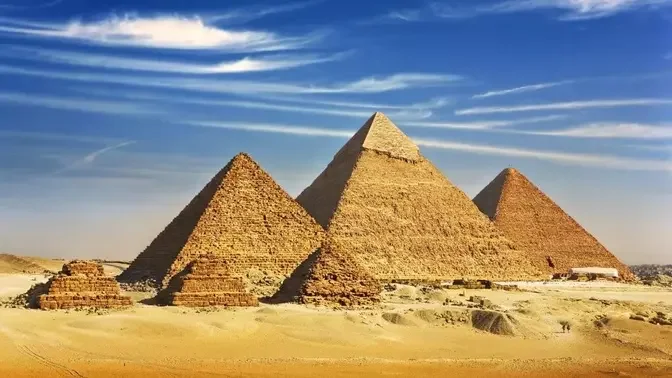
#Archaeology#archaeological artifacts
The granite in the Great Pyramid, if you look at the famous King's Chamber, its walls and
its roof, the ceiling of the King's Chamber, are all made with gigantic granite blocks.
For 4,000 years, the granite monuments of Egypt have guarded a secret.
How did ancient hands cut through one of the hardest stones on earth?
Cut out of solid granite.
These huge granite stele, they're very similar in many ways to ancient Egyptian obelisks.
Mainstream archaeology offers copper chisels and sand.
But one man refused to accept that answer.
Graham Hancock followed the evidence into quarries, tombs, and forbidden chambers.
What he discovered challenges everything.
How did they cut granite?
Deep beneath the sands of Saqqara, in a labyrinth of tunnels carved into solid bedrock,
sit 24 granite boxes.
Each one weighs between 70 and 100 tons.
Each one was cut from a single block of stone, quarried hundreds of miles away.
The corners are perfect 90-degree angles.
The interior surfaces are polished to a mirror finish.
When measuring instruments are placed against the walls, the deviation registers in thousandths
of an inch.
Yet according to mainstream archaeology, these boxes were created over 3,000 years ago, using
copper chisels and sand.
This is the mystery that first captured Graham Hancock's attention and that he refused to
ignore.
Copper is a soft metal.
On the Mohs hardness scale, copper scores around 3.
Granite falls between 6 and 7.
Diamond, the hardest natural substance, sits at 10.
The physics are simple.
Effective cutting requires a tool harder than the material being shaped.
Dragging a copper chisel across granite is like carving marble with a wooden spoon.
You might leave a mark eventually, but you will destroy your tool long before making
real progress.
Experimental archaeologists have tested these ancient methods, as an abrasive, and attempted
to drill into granite.
The results were painfully slow.
One experiment managed just 6 centimeters over 20 hours of continuous work.
The copper wore away.
The sand scattered.
The progress was, in the words of one researcher, comical.
Yet the official story insists these same techniques carved obelisks weighing hundreds
of tons and created thousands of stone vessels with walls thinner than eggshells.
Hancock looked at the official story.
He looked at the physical evidence.
And he saw a gap wide enough to drive a civilization through.
The evidence carved in stone.
In 1883, a British archaeologist named William Flinders Petrie arrived in Egypt carrying
something unusual.
While other explorers hunted for gold and mummies, Petrie brought measuring tapes, calipers,
and precision instruments.
He was interested in accuracy, and what he discovered would puzzle researchers for generations.
Among his most significant finds were granite drill cores, cylindrical pieces of stone left
behind as waste from ancient drilling operations.
To most observers, they looked like debris.
To Petrie, they revealed something extraordinary.
Carved into the surface were spiral grooves, clean and uniform, winding around the stone
like threads on a screw.
After careful measurement, Petrie calculated that whatever tool created these marks was
cutting into solid granite at one-tenth of an inch per revolution.
This feed rate was reportedly far faster, perhaps hundreds of times faster than modern
diamond-tipped drills can achieve.
Petrie estimated the downward pressure required would have exceeded two tons.
He was left wondering how ancient workers could generate such force, maintain such consistency,
and keep their tools intact under the strain.
The drill cores now sit in the Petrie Museum at University College London.
Few visitors notice them.
But for researchers like Graham Hancock, these small objects represent some of the most important
evidence in Egypt.
The spiral grooves tell a story that contradicts everything taught about ancient technology.
Hand drilling produces irregular marks because human pressure varies, arms tire, and grips
shift.
But these grooves are uniform from top to bottom, maintaining identical depth and spacing
throughout.
This is the signature of mechanical precision.
The drill cores are compelling, and they are just the beginning.
Scattered across museums worldwide exist over 40,000 stone vessels from ancient Egypt.
Many date back 5,000 years to the pre-Dynastic period, before the pyramids, before the pharaohs.
These vessels are carved from granite, diorite, basalt, and quartz.
The walls are sometimes just millimeters thick, yet perfectly uniform throughout.
The interiors are hollowed out through narrow openings that would prevent any known hand
tool from reaching inside.
The surfaces are polished to smoothness rivaling optical glass.
Recent three-dimensional scanning has measured their precision down to thousandths of an
inch.
The symmetry between opposite sides remains precise to within the width of a human hair.
One researcher spent two years attempting to replicate a small diorite vase using only
tools attributed to ancient Egyptians.
The result was rough, lopsided, and nowhere close to the originals.
She admitted that matching the quality of ancient examples was essentially impossible
using primitive methods.
The stones of Egypt hold records more enduring than any document.
Drill cores with extraordinary feed rates.
Vessels with remarkable precision.
Granite boxes with tolerances that defy explanation.
Each artifact whispers the same message.
Something happened here that official history has yet to understand.
The engineers who asked why.
Archaeologists study the past through pottery shards, burial sites, and ancient texts.
They are trained to interpret symbols, analyze bones, and piece together timelines from fragments
of civilizations long gone.
But when it comes to understanding how something was physically made, they often lack the expertise
to ask the right questions.
This is where engineers enter the story.
And when engineers began examining ancient Egypt, the official narrative started to crumble.
Christopher Dunn spent over 50 years working in aerospace manufacturing.
He began his career as an apprentice machinist in Manchester, England, learning to cut metal
with precision measured in thousandths of an inch.
He eventually moved to the United States, where he programmed industrial lasers, managed
tool production, and oversaw quality control for components used in jet engines.
Dunn understands materials.
He understands tolerances.
He understands what it takes to shape hard substances into precise forms.
And when he first encountered the stonework of ancient Egypt, he recognized something
that archaeologists had missed entirely.
Dunn traveled to Egypt nine times over three decades.
The precision of this building exceeds anything that we require of builders today.
He brought calibrated instruments, precision straight edges, and the trained eye of someone
who had spent a lifetime evaluating manufactured surfaces.
At the Serapium, he climbed inside the massive granite boxes and ran his tools along the
interior walls.
The surfaces were flat to within two thousandths of an inch, a tolerance that modern machine
shops struggle to achieve on granite.
The corners were perfectly square.
The opposing faces were parallel to degrees that suggested pure engineering rather than
simple craftsmanship.
Dunn later wrote that such precision demands a very good reason and tools capable of producing
absolute perfection.
These were objects designed and executed with intention far beyond what the official story
allows.
They were masterworks, shaped with purpose and care.
Dunn found himself among like-minded observers.
Other engineers and machinists who visited Egypt returned with similar questions.
They noticed saw marks on granite blocks that penetrated the stone in straight, consistent
lines, marks that suggested blades cutting through rock the way modern band saws cut
through wood.
They observed drill holes with smooth walls and uniform diameters, holes that displayed
the steadiness and regularity that only mechanical tools produce.
They measured the colossal statues at Luxor and found that the left and right sides of
the faces were precise mirror images of each other.
A symmetry achievable only through controlled mechanical processes or measurement systems
far beyond simple hand tools.
The stone vases presented perhaps the greatest puzzle of all.
Engineers examining these artifacts pointed out features that seemed designed to confound
replication.
Narrow necks opened into wide bodies beyond the reach of any rigid tool.
Handles protruded from sides that would block any lathe or grinding device, yet the interiors
were smooth and perfectly symmetrical, hollowed out with consistency that defied all explanation.
One analysis using structured light scanning found shape deviations of less than 15 microns
on vessels over 5,000 years old.
This level of precision exceeds modern industrial pottery by a factor of 10.
Whatever made these objects operated with accuracy that surpasses even our own technology.
Graham Hancock recognized the importance of these engineering perspectives.
Archaeologists could dismiss his questions as the musings of an outsider, a journalist
seeking attention beyond his field.
Yet Christopher Dunn demanded a different response, a man who had spent half a century
producing precision components for machines that fly through the sky.
The measurements, the tolerances, the physical evidence recorded by calibrated instruments
and trained professionals all demanded attention.
The engineers brought something to this mystery that archaeology lacked.
They brought the ability to look at an object and understand exactly what was required to
make it.
The conclusion these engineers reached was unanimous and unsettling.
The tools attributed to ancient Egypt, the copper chisels and dolerite pounders and sand
abrasives, fell far short of producing what we see in the archaeological record.
The precision is too high.
The consistency is too perfect.
The scale is too vast.
Something else was responsible.
Some technology existed in the ancient past that we have either forgotten or remain unaware
of entirely.
The Lost Technology
Graham Hancock remains humble about what he knows.
He admits uncertainty about exactly what technology the ancient Egyptians used.
He acknowledges the blueprints for machines that vanished thousands of years ago remain
beyond his reach, but he insists, with decades of evidence behind him, that something existed
which we have yet to understand.
The proof lies in plain sight, carved into the hardest stones on earth, visible to anyone
willing to look.
The question that haunts researchers is deceptively simple.
What kind of technology leaves these marks?
What kind of tools cut granite with spiral grooves at feed rates that exceed modern drills?
What kind of process hollows out stone vessels through openings barely wider than a finger,
leaving interiors polished to mirror smoothness?
What kind of machinery produces surfaces flat to thousandths of an inch on blocks weighing
a hundred tons?
The answer remains elusive.
Yet the mystery itself validates the question.
It means we must look harder, or perhaps shift our direction entirely.
Hancock believes we are dealing with a lost civilization, a culture that flourished before
recorded history and was wiped out by a cataclysm roughly 12,000 years ago.
He points to geological evidence suggesting massive flooding at the end of the last ice
age, floods that could have erased coastal cities and drowned millennia of human progress
beneath rising seas.
The survivors, he argues, carried fragments of their knowledge to places like Egypt, Turkey
and South America, seeding the great civilizations that would emerge thousands of years later.
The precision stonework we see in Egypt may not be the invention of dynastic Egyptians
at all.
It may be an inheritance, a gift from predecessors whose names have been lost to time.
This theory is controversial.
Mainstream archaeologists reject it outright, insisting that ancient Egyptians developed
their skills gradually through trial and error over centuries.
They point to tomb paintings showing workers dragging stones with ropes.
They reference the progression from simple mastabas to step pyramids to the smooth-sided
monuments at Giza.
They argue that human ingenuity, given enough time and motivation, can achieve remarkable
things without invoking lost technologies or forgotten civilizations.
But Hancock sees a flaw in this reasoning.
The progression does not actually progress.
The Great Pyramid of Giza, built during the Fourth Dynasty, remains the most precisely
constructed monument in Egypt.
The pyramids that came after were smaller, cruder, and more prone to collapse.
If the Egyptians were learning and improving their techniques, why did their greatest achievement
come so early?
Why does the quality decline rather than advance?
The pattern suggests not gradual development, but inherited knowledge, skills passed down
from an earlier source that the dynastic Egyptians could replicate, but never fully understood.
The technology itself remains mysterious, but researchers have offered possibilities.
Some propose advanced understanding of acoustics and resonance.
The ability to use sound vibrations to soften stone or reduce friction during cutting.
Ancient texts from multiple cultures describe priests chanting during the movement of massive
blocks, accounts that mainstream scholars dismiss as mythology, but that Hancock considers
worth investigating.
Others suggest chemical processes, the use of plant-based acids or mineral compounds
to dissolve granite at the molecular level.
One theory involves natron, a salt compound the Egyptians used for mummification, which
when heated to extreme temperatures can break down the quartz crystals that give granite
its hardness.
None of these explanations are proven, but all of them are more consistent with the physical
evidence than primitive hand tools and simple abrasives.
What troubles Hancock most is not the mystery itself, but the refusal to engage with it.
When engineers present measurements that contradict the official story, they are ignored or dismissed.
When researchers propose alternative theories, they are labeled pseudoscientists and excluded
from academic conferences.
The resistance is not scientific, it is institutional, and it raises an uncomfortable question.
If mainstream archaeology is so confident in its explanations, why does it fear alternative
inquiry?
Truth does not require protection from questions.
Only falsehoods do.
The lost technology of ancient Egypt may never be fully recovered.
The machines, if they existed, are gone.
The knowledge, if it was ever written down, has not survived.
But the evidence remains, etched permanently into granite and basalt and diorite, waiting
for a generation of researchers brave enough to take it seriously.
Why did exploration stop?
In 1993, a German engineer named Rudolf Gantenbrink sent a small robot into one of the narrow
shafts inside the Great Pyramid.
The robot, equipped with a camera, crawled upward through passages too small for any
human to enter.
What it found at the end of that shaft stunned the world.
A small stone door with copper handles, sealed and untouched for thousands of years.
Behind that door, something waited.
A chamber, a passage, an artifact no one knew.
The discovery made international headlines.
Researchers prepared for the next phase of exploration.
Then everything stopped.
Egyptian authorities, under the direction of antiquities officials, took control of
the project.
Gantenbrink was denied further access.
His robot was confiscated.
The door remained sealed.
For years, the world waited for answers that never came.
When a follow-up expedition finally drilled through the door nearly a decade later, the
footage was broadcast on live television to millions of viewers.
Behind the first door was another door.
And behind that, silence.
No explanation and further investigation.
The mystery was buried as quickly as it had been revealed.
This pattern repeats throughout Egyptian archaeology.
In 2017, scientists used muon tomography, a technique that detects cosmic particles
passing through solid structures, to scan the interior of the Great Pyramid.
They announced the discovery of a massive void above the Grand Gallery, a hidden space
large enough to contain a commercial airliner.
The finding was published in the journal Nature, one of the most respected scientific publications
in the world.
Researchers called for further exploration.
They proposed non-invasive methods to determine what lay inside.
Silence followed.
The void remained unexplored.
Excavation requests went unanswered.
The question of what this enormous hidden chamber might contain, or why it was built,
stayed shrouded in mystery.
The discovery faded from public attention, replaced by other news, other distractions,
other mysteries left deliberately unsolved.
Graham Hancock has witnessed this suppression firsthand.
He has stood at sites where obvious questions are met with hostility rather than curiosity.
He has watched researchers lose access to artifacts after publishing findings that contradicted
official narratives.
He has seen careers destroyed and reputations smeared simply for asking what should be asked.
The resistance is not scientific.
Science welcomes questions.
Science thrives on challenges to established theory.
When evidence contradicts a hypothesis, science demands revision.
But what Hancock encounters is not science.
It is gatekeeping.
It is the protection of academic territory, funding streams, and institutional authority.
The experts who control access to Egypt's monuments have built careers on a particular
version of history.
Admitting that version might be wrong would mean admitting they have been wrong for decades.
So the questions linger, waiting for answers.
How were the granite blocks of the king's chamber lifted into position?
The mystery endures.
How were the serapaeum boxes transported through tunnels barely wider than the boxes themselves?
The puzzle remains.
How were 40,000 stone vessels carved with precision that exceeds modern manufacturing?
The secret stays hidden.
The official response to each mystery is the same.
Ancient Egyptians were clever.
They had lots of workers.
They used ramps and ropes and patience.
And if you push further, if you demand specifics and details, if you ask for demonstrations
or experiments that actually replicate the results, the conversation ends.
You are labeled a conspiracy theorist.
Your questions are dismissed as ignorant or dangerous.
The questions remain, waiting patiently for answers.
They are carved into every drill hole with its puzzling spiral grooves.
They are polished into every vessel with its astonishing symmetry.
They are squared into every granite box with its unexplained tolerances.
The evidence remains, whether convenient or otherwise.
Graham Hancock has spent 30 years asking these questions.
He has been mocked, dismissed, and attacked by people who have never set foot in the sites
he has studied.
And yet he continues.
The truth matters more than approval.
History belongs to everyone, including those outside academic circles and institutional halls.
Somewhere in the ancient past, someone achieved something extraordinary.
And we deserve to know how.
The stones remember what was done to them.
The cuts and grooves and polished surfaces hold secrets that official history refuses
to acknowledge.
Graham Hancock believes those secrets will eventually be revealed, not by the gatekeepers
who guard them, but by ordinary people who refuse to stop asking questions.
The pyramids have stood for thousands of years.
They can wait a little longer for the truth.
The proof is carved in stone.
The only question left is whether we are brave enough to accept it.
Like, share, and subscribe.
The truth is just beginning.